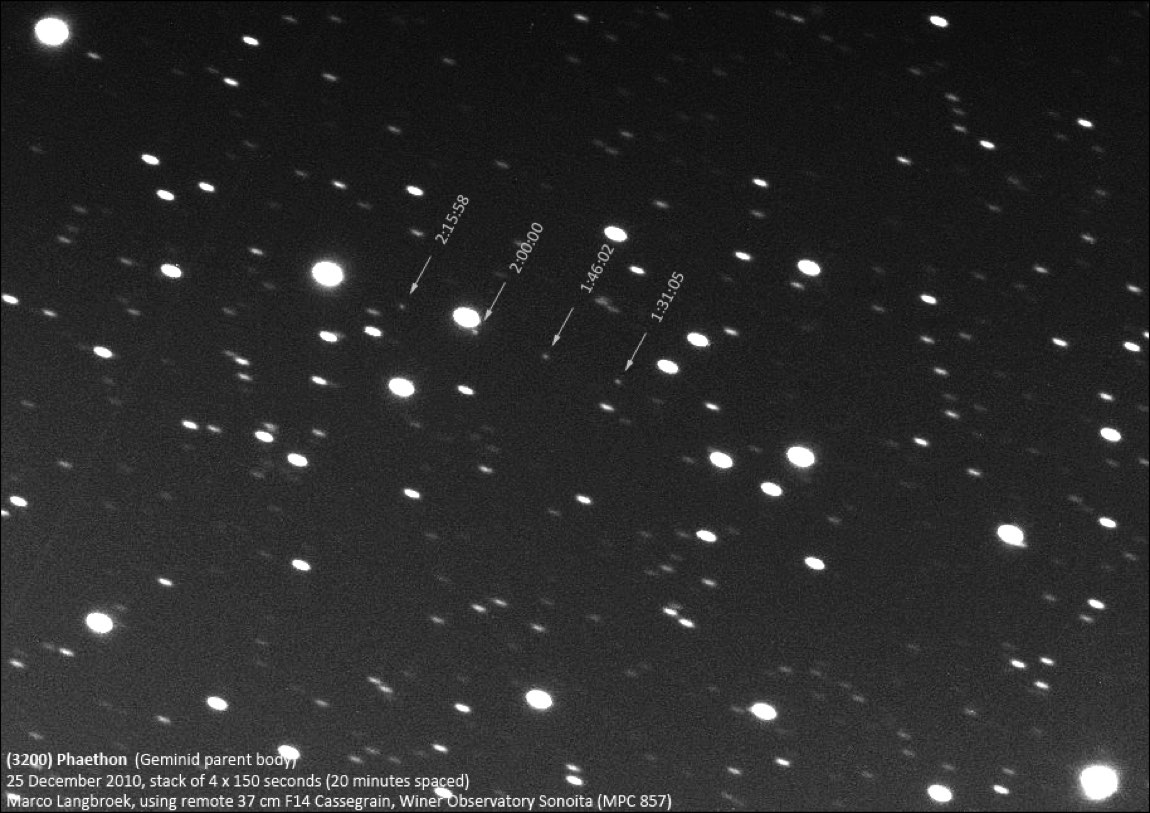
 Photograph · Marcoaliaslama · CC BY-SA 3.0
Asteroid · Deep guide
3200 Phaethon
Also called: 3200 Phaethon · (3200) Phaethon · 1983 TB · Phaeton
The rocky 'comet' that sheds the Geminid meteor shower every December.
What is it?
Phaethon is a near-Earth asteroid about 6 km across whose orbit dips closer to the Sun than any other named asteroid — about 0.14 AU, well inside Mercury's orbit. Its path matches the Geminid meteor stream, so it is considered the shower's parent body, even though it looks more like an asteroid than a comet. Intense solar heating may crack its surface and release dust. Japan's DESTINY+ mission plans to fly past it, with launch planned no earlier than 2028.
The deep dive
Researched for the Atlas from Wikipedia — 3200 Phaethon (7,481 characters read) · updated Nov 14, 2026
01 The Rock Comet That Defies Categories
Phaethon occupies a strange middle ground between asteroid and comet, earning it the informal label "rock comet." Most asteroids are inert, rocky bodies that simply reflect sunlight. Phaethon, however, brightened unexpectedly by roughly a factor of two when it reached perihelion in July 2009, as measured by NASA's STEREO-A spacecraft. A visible tail also appeared during STEREO observations in 2009 and 2012. The leading explanation for years was that the Sun's extreme heat — capable of raising surface temperatures to around 1,025 K (750 °C; 1,390 °F) at perihelion — fractures surface material the way mud cracks in a dry lake bed, sending fragments drifting away under solar radiation pressure. This discovery was significant enough that Phaethon helped define an entirely new class of objects called "active asteroids," which share both cometary and asteroidal traits. Other members of this new class include 133P/Elst–Pizarro, found after Phaethon's peculiarities prompted astronomers to look more carefully at the boundary between these two ancient families of small bodies.
02 A Perihelion Closer Than Mercury Gets
Phaethon's perihelion distance of just 0.14 AU (20.9 million km; 13.0 million mi) is its most striking orbital feature. For context, Mercury — the innermost planet — never gets closer than about 0.31 AU from the Sun, meaning Phaethon dives more than twice as deep into the solar furnace as Mercury ever does. This extraordinary closeness is a consequence of Phaethon's high orbital eccentricity, which also makes it a crosser of four planetary orbits: Mercury, Venus, Earth, and Mars. Its semi-major axis sits at 1.27 AU (190 million km), comfortably in the Apollo asteroid category, yet its elongated path swings it both far inside and modestly outside Earth's orbit. Because general relativity and the slight oblateness of the Sun both cause measurable shifts in a closely approaching orbit, Phaethon has been identified as a possible candidate for detecting these relativistic and solar-shape effects directly in its orbital motion — a rare opportunity offered by very few named objects.
03 How Phaethon Was First Spotted
Phaethon holds a unique place in discovery history: it was the first asteroid ever found using images from a spacecraft rather than a ground-based telescope. Astronomers Simon F. Green and John K. Davies were searching data from the Infrared Astronomical Satellite (IRAS) for moving objects when they identified it in images taken on October 11, 1983. The discovery was formally announced three days later on October 14 in International Astronomical Union Circular 3878. Optical confirmation came from Charles T. Kowal, who reported the object looked asteroidal in appearance. It carried the provisional designation 1983 TB before receiving the permanent numerical designation 3200 and the name Phaethon in 1985. The name comes from the Greek hero Phaëthon, son of the sun god Helios — a fitting choice for an asteroid that ventures closer to the Sun than any other named body. Its provisional spelling "Phæton" has since been recognized as erroneous.
04 Surface Chemistry: Blue, Dark, and Unusual Deeper
Phaethon's surface chemistry is a subject of active, evolving research. Observations in 2007 revealed that it is blue in color, corresponding to a B-type asteroid under the Bus taxonomy — an unusual hue among small bodies, most of which are reddish or grey. Some researchers classify it instead as an F-type asteroid based on its dark surface material. The 2009 spectral shape was shown to resemble aqueously altered CI/CM carbonaceous meteorites. Analysis of mid-infrared data from the Spitzer Space Telescope linked Phaethon specifically to the rare Yamato-type (CY) carbonaceous chondrites, ruling out other carbonaceous meteorite types. That same Spitzer spectrum confirmed the presence of magnesium-rich olivine, carbonates, and iron sulfides on the surface. A 2020 polarimetric study painted a picture of steep surface slopes covered by a mix of regolith and larger pebbles. Work published in 2022 proposed that Phaethon's distinctive blue color and its rock-comet-like emission activity could both be explained by intense solar heating at perihelion causing sublimation of darkish-red refractory organic material, nano-phase iron (nFe0), and pyroxene.
05 Sodium Gas, Not Dust: A 2023 Surprise Deeper
For decades, the leading model held that the Geminid meteor stream and Phaethon's faint tail were produced by dust and rocky debris ejected during the asteroid's repeated close solar passes, driven by thermal decomposition and outgassing of minerals such as the olivine, carbonates, and iron sulfides identified in its spectrum. That picture was upended by a 2023 NASA study using imaging from the SOHO spacecraft. Filtered images showed no detectable sign of dust at all. Instead, the material being emitted from Phaethon was identified as sodium gas. This finding cast serious doubt on the idea that the Geminid meteor stream is built from debris shed during periodic perihelion passages. If sodium gas rather than dust is what Phaethon currently releases, some other mechanism must account for the stream's origin. One emerging alternative is that the Geminids were created by a single ancient breakup event rather than gradual, ongoing mass loss — a hypothesis that reframes Phaethon's role from active ejector to ancient remnant of a far more violent episode in the solar system's past.
06 Phaethon, the Geminids, and Fred Whipple
The connection between Phaethon and the Geminid meteor shower — one of the year's most reliable and prolific displays, peaking each mid-December — was recognized almost immediately after the asteroid's discovery. Fred Whipple, the astronomer famous for describing comets as "dirty snowballs," noted shortly after the 1983 discovery that Phaethon's orbital elements matched those of the Geminid stream with striking precision, identifying it as the shower's long-sought parent body. This solved a longstanding puzzle, because every other well-studied major meteor shower had been traced to a comet, and astronomers had searched without success for the Geminids' source for years. Phaethon became the first asteroid known to be a meteor shower parent, further blurring the boundary between asteroids and comets. The 2023 SOHO result showing only sodium gas emission — with no detectable dust — has since reopened the question of exactly how Phaethon produced the debris that now forms the Geminid stream.
 ⤢
07 Orbital Cousins and a Possible Family Deeper
Phaethon does not travel through the inner solar system entirely alone. Two other Apollo asteroids, (155140) 2005 UD and (225416) 1999 YC, share orbits remarkably similar to Phaethon's, raising the possibility that all three originated in a common breakup event — perhaps the same ancient fragmentation that may have produced the Geminid stream. Beyond these two close orbital relatives, Phaethon is also suspected to be a member of the broader Pallas family of asteroids, linking it to 2 Pallas, one of the largest objects in the main asteroid belt. The Pallas family association is relevant to questions of composition and origin, as it would place Phaethon's ancestry in the outer regions of the main belt before some gravitational disturbance redirected it onto its current extreme orbit. The orbital mechanics that could have transported a Pallas-family fragment to such a Sun-grazing path remain an open area of investigation, touching on the long-term evolution of asteroid orbits under planetary and solar perturbations.
08 Radar Portraits: What We Know of Its Shape
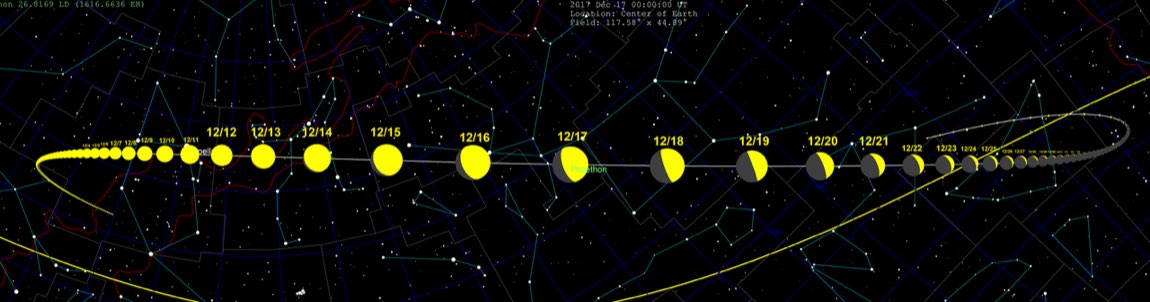
Although Phaethon has never been visited by a spacecraft, radar observations have begun to reveal its shape and dimensions. When Phaethon approached Earth to 0.120895 AU (18,085,600 km) on December 10, 2007, the Arecibo Observatory detected it by radar for the first time. The best observations came during the December 2017 close approach, when Phaethon passed 0.06893169 AU (10,312,034 km; 6,407,601 mi) from Earth — about 27 times the Moon's distance — in what was the closest flyby opportunity in the observational record to that point. Goldstone and Arecibo both trained their radar systems on the asteroid, achieving a resolution of 75 meters per pixel (246 feet per pixel). That approach distance was pinned down to a remarkable 3-sigma precision of ±700 m, a testament to how thoroughly Phaethon's orbit is understood after more than 35 years of observations. The asteroid peaked at magnitude 10.8 between December 13–15, 2017, bright enough to be seen through a small telescope, before dimming slightly to magnitude 11 at closest approach on December 16.
09 Four Centuries of Predictable Close Passes Deeper
One of the most reassuring facts about Phaethon is how well its future behavior is understood. Despite its classification as a potentially hazardous asteroid — a designation triggered automatically by its diameter and its Earth minimum orbit intersection distance (E-MOID) of 0.01945 AU (2,910,000 km; 1,808,000 mi) — astronomers are quick to note that this label reflects geometry and size thresholds, not an actual near-term impact threat. With an observation arc exceeding 30 years, the orbit is determined with very small uncertainties, and close approaches have been reliably constrained for the next 400 years. The next time Phaethon will approach Earth more closely than it did in December 2017 will be on December 14, 2093, when it will pass 0.01981 AU (2,964,000 km; 1,841,000 mi) from Earth — closer than 2017 but still far from dangerous. This level of long-range predictability is unusual among potentially hazardous asteroids and makes Phaethon one of the better-characterized objects in the near-Earth population.
10 DESTINY+: Japan's Mission to Phaethon
The unanswered questions surrounding Phaethon's composition, activity, and relationship to the Geminids have motivated a dedicated space mission. DESTINY+ — an acronym for Demonstration and Experiment of Space Technology for Interplanetary Voyage with Phaethon Flyby and Dust Science — is being developed by JAXA, the Japanese space agency. The spacecraft is designed to fly by Phaethon and study various minor bodies connected to it, while also demonstrating advanced technologies intended for future deep space exploration. The mission is planned for launch no earlier than 2028. A close flyby will allow instruments to examine Phaethon's surface composition, search for the sodium and any other emissions directly, and characterize the asteroid in far greater detail than is possible from Earth. The mission could resolve the central debate over whether Phaethon is shedding material continuously through solar heating or whether the Geminids are a relic of an ancient fragmentation, and it may clarify whether the CY carbonaceous chondrite link holds up under direct scrutiny.
11 Why General Relativity Shows Up Here Deeper
Most asteroid orbits are shaped overwhelmingly by Newtonian gravity from the Sun and planets, with relativistic corrections too small to measure. Phaethon is an exception worth highlighting. Because it repeatedly dives to within 0.14 AU of the Sun — far closer than any planet — it experiences an unusually strong gravitational field during each perihelion passage. General relativity predicts that this close approach should cause a measurable precession of the orbit's orientation over time, analogous to the famous advance of Mercury's perihelion that served as one of the early confirmations of Einstein's theory. The slight flattening of the Sun (solar oblateness) also perturbs close-approaching orbits in a detectable way. Because both effects accumulate with each perihelion pass and because Phaethon's orbit is now known with extraordinary precision, it has been identified as a candidate for directly measuring these two distinct contributions to orbital precession in a small-body system — a form of solar system physics rarely accessible with asteroids.
12 Open Questions Waiting for DESTINY+
Even after four decades of observation, Phaethon leaves researchers with a list of unresolved puzzles. The 2023 sodium-gas finding from SOHO undercut the dust-ejection model that had been the consensus explanation for the Geminid stream, but the ancient-breakup alternative remains speculative and poorly constrained. The exact meteorite type that best matches Phaethon's surface — whether CY carbonaceous chondrites, CI/CM material, or something else — is still debated as understanding of CY origins continues to evolve. The precise mechanism producing the blue color, the polarimetric evidence for steep slopes and mixed regolith, and the relationship to orbital cousins 2005 UD and 1999 YC all await clarification. Even the classification sits uncomfortably between F-type and B-type depending on which property is weighted. The DESTINY+ flyby, planned for no earlier than 2028, represents the best near-term opportunity to answer these questions with in-situ measurements rather than remote sensing — and may force yet another rethinking of what this remarkable object actually is.
 ⤢