Asteroid · Deep guide
624 Hektor
Also called: 624 Hektor · (624) Hektor · A907 CF · 1907 XM
The largest of Jupiter's Trojan asteroids — a stretched-out giant with a tiny moon.
What is it?
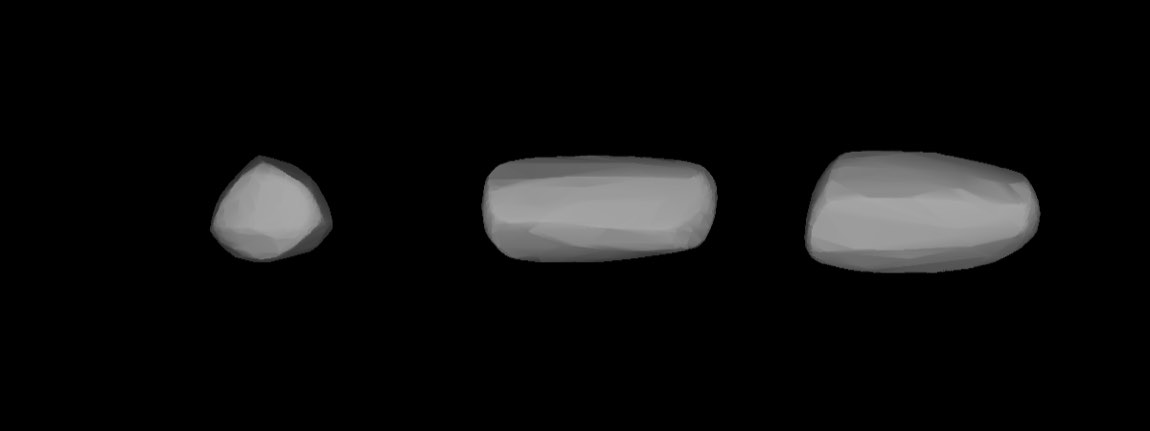
Hektor is the biggest of the Trojan asteroids that share Jupiter's orbit around the Sun. It is very elongated, about 416 km long, with a volume equal to a ball roughly 225–250 km wide. It was discovered in 1907 by August Kopff and named after the Trojan prince Hector. In 2006 astronomers found a small moon about 12 km across, now called Skamandrios.
The deep dive
Researched for the Atlas from Wikipedia — 624 Hektor (4,123 characters read) · updated Nov 14, 2026
01 The strangest shape among giant asteroids
Hektor holds a remarkable distinction: it is one of the most elongated bodies of its size anywhere in the Solar System. Measuring approximately 403 kilometers along its longest dimension while averaging only around 201 kilometers across its other dimensions, the asteroid is shaped something like a battered sausage — roughly twice as long as it is wide. To put that length in perspective, 403 kilometers is about the driving distance from Los Angeles to San Francisco. Yet all that stretched-out mass adds up to a volume equivalent to a sphere of only about 250 kilometers in diameter. Its estimated mass is 7.9×10¹⁸ kilograms, which works out to a surprisingly low bulk density of just 1.0 g/cm³ — barely denser than water ice. That low density is itself a clue to Hektor's internal structure, suggesting it may be a loosely packed, porous body rather than a solid rock, consistent with the idea that it formed from two separate objects gently merging long ago.
02 A contact binary hiding in plain sight Deeper
The leading explanation for Hektor's bizarre shape is that it is a contact binary — two originally separate asteroids that drifted together under mutual gravity and now touch, or nearly touch, at a narrow neck. The two proposed lobes have estimated mean diameters of 220 kilometers and 183 kilometers respectively, making them meaningfully unequal in size. This kind of double-lobed structure is also seen in 216 Kleopatra, another asteroid held up as a contact-binary example. Confirming the shape proved surprisingly difficult. Hubble Space Telescope observations made in 1993 could not resolve a clear bilobate form because Hektor was simply too small and too far away for Hubble's angular resolution at that time. It took until 17 July 2006, when the Keck 10-meter-II telescope deployed its laser guide star adaptive optics system, before a bilobate shape was indicated from Earth. Subsequent studies combined that imaging with a long archive of historical lightcurves to refine the picture, also pinning down a rotation period of 6.9205 hours.
03 Misplaced hero: a Trojan in the wrong camp
Jupiter's Trojan asteroids are divided into two groups that share Jupiter's orbit but sit at opposite points along it — the leading L4 group, nicknamed the Greek camp, and the trailing L5 group, known as the Trojan camp. Astronomers whimsically named the asteroids in each camp after warriors from the corresponding side of the legendary Trojan War. Hektor, named after the Trojan prince Hector, the great defender of Troy, lives in the Greek camp — making it a Trojan hero stranded behind enemy lines. It is one of only two such mythologically misplaced trojans; the other, 617 Patroclus, is a Greek warrior marooned in the Trojan camp. Both asteroids received their names before the Greek-camp and Trojan-camp convention was formalized, so the mythological mismatch was simply grandfathered in. Hektor was discovered on 10 February 1907 by astronomer August Kopff at Heidelberg Observatory in southwest Germany.
04 Skamandrios: a moon born from catastrophe
In 2006 the same Keck observations that hinted at Hektor's bilobate shape also turned up something else entirely: a small moon orbiting the giant asteroid. Named Skamandrios — after a figure from Trojan mythology — the satellite measures between 10 and 15 kilometers in diameter, tiny beside its enormous parent. It orbits at a semi-major axis of 623.5 kilometers with a period of 2.9651 days, or about 71 hours. Skamandrios was formally confirmed with additional Keck observations in November 2011 and officially named on 12 March 2017. Researchers speculate that the moon was born from violence: when two proto-Hektor bodies collided at low velocity and merged to form the bilobed primary, the newly joined object may have been spinning so fast that it was gravitationally unstable, flinging off a fragment that became Skamandrios. If both bodies share the same density, the moon's volume implies an approximate mass of 8.74×10¹⁴ kilograms.
05 An orbit that is anything but orderly Deeper
Skamandrios does not cruise around Hektor in a neat, predictable circle. Its orbit is described as both highly inclined and eccentric — meaning it is tilted significantly relative to Hektor's equatorial plane and traces an elongated ellipse rather than a circle. Even more striking, researchers believe Skamandrios likely undergoes chaotic rotation, tumbling irregularly rather than keeping one face locked toward Hektor the way Earth's Moon keeps one face toward Earth. The gravitational environment responsible for this chaos is genuinely complex: Hektor's own bilobate, non-spherical mass distribution tugs on Skamandrios unevenly, and Jupiter's powerful gravity looms in the background. Scientists have found that accurately modeling Skamandrios's motion requires the framework of the restricted four-body problem — accounting for the Sun, Jupiter, Hektor, and the moon simultaneously — rather than the simpler two-body approach used for tidier satellite systems.
06 First trojan ever found with a companion
Hektor's claim to historical fame extends beyond being the largest Jupiter trojan. It was also the first Jupiter trojan asteroid ever discovered to have a satellite companion, opening a new chapter in the study of these ancient Solar System objects. Since that discovery, three other binary trojans have been identified in the same L4 Greek camp: 16974 Iphthime, 3548 Eurybates, and 15094 Polymele. The L5 Trojan camp has its own binaries — 617 Patroclus, which is unusual because its two components are nearly equal in size, plus 17365 Thymbraeus and 29314 Eurydamas. Taken together, the growing census of binary trojans has become an important tool for understanding how these distant bodies formed and evolved. Because binary systems allow mass estimates that single asteroids do not, each new discovery adds crucial data points about the density and composition of this ancient population.
07 Dark, red, and chemically primitive
Hektor belongs to the D-type asteroid classification, a category defined by a dark surface and a distinctly reddish color. D-type asteroids are among the most primitive objects in the Solar System, thought to retain material left over from the earliest stages of planetary formation with relatively little subsequent alteration by heat or chemistry. The reddish hue is generally attributed to organic-rich material, possibly including complex carbon compounds, though the exact chemistry remains debated across the field. Hektor's low estimated density of 1.0 g/cm³ is consistent with a mixture of rock and ice rather than dense rocky or metallic material, further reinforcing its primitive character. The NEOWISE infrared survey estimated Hektor's albedo at approximately 0.107, while the AKARI survey came in far lower at approximately 0.034 — a dramatic disagreement that illustrates how difficult it is to pin down the surface properties of a distant, slowly tumbling, irregular body from Earth.
08 Why size estimates for Hektor disagree so sharply Deeper
Two major all-sky infrared surveys — NEOWISE and AKARI — both observed Hektor and arrived at strikingly different size estimates: 147.4 kilometers and 231.0 kilometers respectively. That is not a small discrepancy; it represents a difference of nearly 84 kilometers in diameter for what should be the same object. The root cause is not a disagreement about Hektor's absolute brightness in visible light — both surveys recorded relatively similar absolute magnitudes of 7.20 and 7.49 — but rather a large divergence in estimated albedo, the fraction of sunlight the surface reflects. NEOWISE estimated albedo at approximately 0.107 while AKARI came in at approximately 0.034, more than three times lower. Because astronomers derive an asteroid's size by combining its total brightness with its albedo, a lower assumed albedo forces the model to invoke a physically larger asteroid to explain the same observed brightness. The uncertainty is compounded by Hektor's dramatically varying shape, which causes its reflected light to swing widely as the asteroid rotates.
09 A puzzle for IRAS and a gap in the record Deeper
The IRAS satellite — the Infrared Astronomical Satellite, which conducted a pioneering all-sky infrared survey in 1983 — produced a widely used catalog of asteroid sizes and albedos that became a foundational reference for the field. It is therefore notable, almost paradoxical, that 624 Hektor does not appear in IRAS's published results. For an object as large and significant as the biggest Jupiter trojan, this is an unusual omission. The absence means Hektor is the largest Jupiter trojan to be entirely missing from that landmark dataset. The 2003 Hubble Fine Guidance Sensor study that examined Hektor placed it alongside other well-studied asteroids including 63 Ausonia, 15 Eunomia, 43 Ariadne, and 44 Nysa. Hektor has also served as a practical test target for the upgraded laser guide star adaptive optics system at Keck Observatory — the same technology that, as a demonstration of its power, enabled ground-based astronomers to image binary asteroids directly for the first time.
10 Naming Hektor and its moon across two millennia
The asteroid's name reaches back to the Iliad, Homer's epic account of the Trojan War. Hector was the foremost warrior defending the city of Troy — brave, honorable, and ultimately killed by the Greek hero Achilles. August Kopff, who discovered the asteroid in 1907 at Heidelberg Observatory, chose the name before astronomers had settled on a formal convention for assigning Greek or Trojan names to the two camps of Jupiter's trojans, which is why the Trojan hero ended up in the Greek camp. The moon Skamandrios carries on the mythological thread: in the Iliad, Skamandrios is an alternative name used for Astyanax, the infant son of Hector and Andromache, though the name is also associated with the river Scamander near Troy. The official naming of Skamandrios was confirmed on 12 March 2017, more than a decade after its discovery — a typical lag that reflects the lengthy process of observational confirmation and committee review required before a solar system body receives a permanent designation.
11 How Hektor fits among all Solar System bodies
Being the largest Jupiter trojan makes Hektor the undisputed heavyweight of a population that numbers in the hundreds of thousands of catalogued objects. Its volume-equivalent diameter of roughly 225 to 250 kilometers places it comfortably above the next-largest trojans, though it falls far below the scale of dwarf planets or the larger main-belt asteroids. What makes Hektor exceptional is not just size but the combination of size with extreme elongation: very few solar system bodies anywhere near this scale are as stretched in shape. The contact-binary model, if correct, means Hektor represents a surviving example of a type of gentle merger event that must have been relatively common in the early Solar System, when swarms of planetesimals were still colliding and sticking together. As such, studying Hektor's shape, density, and the dynamics of its satellite offers a window into collisional processes that shaped the outer Solar System billions of years ago.
 ⤢