 Photograph · KuriwaObs · CC BY-SA 4.0
Asteroid · Deep guide
617 Patroclus
Also called: 617 Patroclus · (617) Patroclus · 1906 VY · Patroclus–Menoetius
A pair of 100-km Trojan asteroids orbiting each other — the grand finale of NASA's Lucy mission.
What is it?
Patroclus was long thought to be one large Trojan asteroid, but in 2001 it was found to be two similar bodies: Patroclus, about 110–115 km across, and Menoetius, about 100–105 km. They circle each other every 4.3 days. Both are dark D-type objects, and their slow mutual orbit makes Patroclus a slow rotator. NASA's Lucy spacecraft is scheduled to fly past the pair in 2033.
The deep dive
Researched for the Atlas from Wikipedia — 617 Patroclus (6,138 characters read) · updated Nov 14, 2026
01 A Binary Hidden in Plain Sight
For nearly a century after its discovery in 1906, Patroclus was treated as a single body — a large, unremarkable dark asteroid tumbling through Jupiter's gravitational wake. That picture changed completely in 2001, when astronomers realized they were looking at two separate worlds orbiting each other. This was the first binary trojan asteroid ever identified, making the Patroclus–Menoetius system a landmark in planetary science. The two components are remarkably well-matched in size: refined measurements from the Keck Observatory placed the larger body, Patroclus, at roughly 122 km across and the smaller companion, Menoetius, at roughly 112 km. A later stellar occultation in 2013 refined those figures further, giving Patroclus a volume equivalent to a 113 ± 3 km sphere and Menoetius a volume equivalent to a 104 ± 3 km sphere. Finding two objects so similar in size orbiting each other hints strongly that they formed together rather than one capturing the other — a constraint that shapes every model of how the early solar system assembled itself.
02 Two Worlds Dancing 680 Kilometers Apart
Patroclus and Menoetius orbit their shared center of mass at a separation of 680 ± 20 km — roughly twice the distance between London and Edinburgh — completing one full revolution in 103.5 ± 0.3 hours, or about 4.3 days. This mutual orbit is nearly circular, which is consistent with the two bodies having settled into a tidally relaxed configuration over billions of years. Because the system rotates as a locked pair on that ~103-hour cycle, the rotation period of the whole system is dominated by the orbital motion rather than any spin of the individual bodies, making Patroclus what astronomers classify as a slow rotator. Lightcurve observations since 1989 have confirmed a rotation period between 102.8 and 103.5 hours, with a brightness variation of less than 0.1 magnitude — a small amplitude that indicates each body is nearly spheroidal in shape rather than elongated or irregular. Accurate measurements of the binary orbit were reported in 2006 using the Keck Laser guide star adaptive optics system, one of the most powerful ground-based imaging tools available at the time.
03 Lighter Than Water: What They're Made Of Deeper
Perhaps the most startling physical fact about Patroclus and Menoetius is their density: just 0.88 g/cm³, which is less than the density of liquid water (1.0 g/cm³) and about one third the density of typical rock. An object that light cannot be made of solid rock. This measurement pushed scientists toward the conclusion that the pair are icy bodies, far more similar in composition to comets than to the rocky asteroids of the inner solar system. The low albedo of 0.047 — meaning the surface reflects only about 4.7% of incoming sunlight, making it one of the darkest surface types known — fits that picture: cometary nuclei and icy outer-solar-system bodies are typically coated with dark, processed organic material. Under the Tholen classification, Patroclus is listed as a dark P-type, though earlier references also describe it as a D-type. The D-type designation is common among Jupiter trojans and outer solar system bodies. The combination of low density and dark, possibly organic-rich surface makes Patroclus a scientifically compelling target for understanding what primordial material looked like before it was processed into planets.
04 Captured Wanderers from the Outer Solar System Deeper
The icy composition of Patroclus and Menoetius fits neatly into a broader theory about where Jupiter's trojans actually came from. It is suspected that many Jupiter trojans are small planetesimals that were captured into the Lagrange points of the Jupiter–Sun system during the migration of the giant planets approximately 3.9 billion years ago. This scenario was formally proposed by A. Morbidelli and colleagues in a series of articles published in May 2005 in the journal Nature. If correct, trojan asteroids like Patroclus are not native to their current orbits at all — they are refugees from the outer solar system, dragged inward and trapped as the giant planets reshuffled their positions. That would make them pristine samples of whatever material existed beyond the frost line in the early solar system, preserved at low temperatures for nearly the entire history of the solar system. The low density of the Patroclus–Menoetius pair, suggesting an icy rather than rocky interior, is cited as evidence consistent with this capture scenario.
05 Sitting in Jupiter's Trailing Shadow
Patroclus occupies Jupiter's L5 Lagrangian point — the gravitationally stable zone that trails Jupiter in its orbit, roughly 60 degrees behind the planet as both travel around the Sun. This region is called the Trojan camp, mirroring the Greek camp at the leading L4 point. The asteroid orbits the Sun at a distance ranging from 4.5 to 5.9 AU — where 1 AU is the Earth–Sun distance — completing one full solar orbit every 11 years and 11 months, or 4,353 days. Its orbit is moderately elliptical, with an eccentricity of 0.14, and tilted 22 degrees with respect to the ecliptic plane. That inclination is relatively steep, meaning Patroclus wanders noticeably above and below the plane in which most of the planets orbit. This combination of eccentricity and inclination makes Patroclus's orbit somewhat more dynamic than a simple circular path hugging the solar plane, and it is part of why researchers find the trojan population scientifically interesting — their orbital histories carry imprints of the early solar system's turbulent rearrangement.
06 The 2013 Occultation: 41 Observers, One Star Deeper
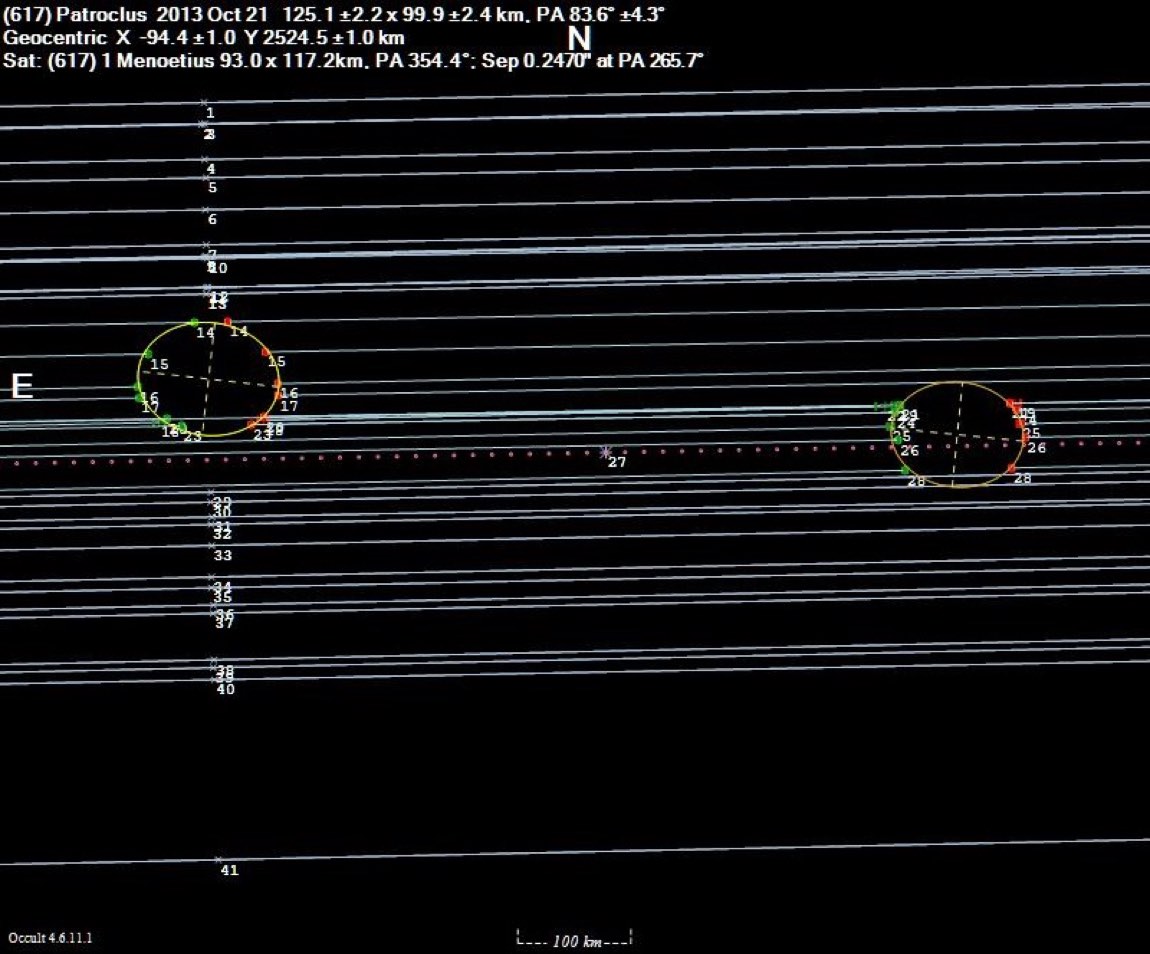
On 21 October 2013, Patroclus and Menoetius passed in front of a magnitude 8.8 star — an event called a stellar occultation — and both bodies blocked the star's light in sequence. A coordinated team of 41 observers stationed at different locations across the United States watched the event unfold. By timing exactly how long the star disappeared from each vantage point, the team could reconstruct the shapes and sizes of both bodies with precision that imaging alone cannot achieve. The result placed the orbital separation of the two components at 664.6 km at that moment in time, and gave Patroclus a volume equivalent to a 113 ± 3 km diameter sphere and Menoetius a volume equivalent to a 104 ± 3 km sphere. Occultation campaigns like this are among the most effective low-cost methods available for measuring outer solar system bodies — they require no spacecraft, only precise timing and a dense network of ground-based observers spread across the shadow path. The 2013 event stands as the most precise direct measurement of the Patroclus–Menoetius system made before the planned Lucy flyby.
07 August Kopff and the Second Trojan Found
Patroclus was discovered on 17 October 1906 by astronomer August Kopff at the Heidelberg Observatory in Germany. It was the second Jupiter trojan asteroid ever discovered — following 588 Achilles, found earlier that same year — and its identification helped establish that the theoretical Lagrangian stable zones actually hosted real populations of minor planets. The name was proposed by Austrian astronomer Johann Palisa, and the official naming citation appeared in The Names of the Minor Planets by Paul Herget in 1955. Because the convention of assigning Greek names to the L4 Greek camp and Trojan names to the L5 Trojan camp had not yet been established at the time of naming, Patroclus became the only resident of the Trojan camp named after a Greek figure from the Trojan War. The companion asteroid 624 Hektor presents the mirror-image anomaly: it is the only Trojan-named asteroid sitting in the Greek camp. Both exceptions are grandfathered in. The observation arc for Patroclus begins at Heidelberg in November 1906, about three weeks after the official discovery.
08 The Name and Its Unlikely Pronunciation
Patroclus was named after the legendary Greek hero who was the close friend of Achilles and was killed by Hector during the Trojan War — a figure whose death set in motion the final act of the Iliad. The companion body, Menoetius, carries the official designation (617) Patroclus I Menoetius and was named after the legendary father of Patroclus. Menoetius was previously known by the provisional designation S/2001 (617) 1 until its formal name was assigned. The pronunciation of Patroclus itself has an interesting history: in Greek and Latin, all vowels in the name are short, so the classically expected English stress would fall on the first syllable. However, the poet Alexander Pope, translating Homer into English verse, shifted the stress to the first 'o' — rendered here as pə-TROH-kləs — purely for metrical convenience, and that irregular stress has become the standard English pronunciation. The article notes this as an example of how literary tradition can override etymological expectation in the names of classical figures that passed into scientific use.
09 Lucy's 2033 Appointment with Patroclus
Patroclus and Menoetius are one of five Jupiter trojan systems targeted by NASA's Lucy spacecraft, a flyby mission designed to visit multiple asteroids across the trojan populations. The Patroclus–Menoetius encounter is scheduled for 2033. Because Lucy is a flyby mission rather than an orbiter or lander, it will pass through the system at high speed, capturing images, spectra, and other measurements during a compressed window of closest approach. The dual nature of the target — two similarly sized bodies orbiting each other — makes the encounter particularly scientifically valuable, since Lucy will be able to characterize both components of the binary and directly probe the properties, shapes, surface geology, and masses of a system whose density already hints at a cometary, icy composition. Patroclus–Menoetius is the only binary system among Lucy's trojan targets, adding another layer of uniqueness to the 2033 flyby. The mission represents the first spacecraft ever to visit the Jupiter trojan populations.
10 How Dark Is Dark? The Surface Albedo Deeper
The combined Patroclus system has a measured albedo of 0.047 — meaning its surface reflects just 4.7% of the sunlight that hits it. To put that in perspective, fresh asphalt reflects roughly 4–5% of visible light, so the surface of Patroclus is about as dark as a freshly paved road. This extremely low reflectivity is characteristic of D-type and P-type asteroids, the dark taxonomic classes that dominate the outer solar system. The combined effective diameter derived from infrared surveys — including data from the Infrared Astronomical Survey Satellite (IRAS) and NASA's Wide-field Infrared Survey Explorer (WISE) through its NEOWISE mission — falls between 140.36 and 140.92 km for the system as a whole. The Collaborative Asteroid Lightcurve Link adopts the IRAS values: an albedo of 0.0471 and a diameter of 140.92 km, based on an absolute magnitude of 8.19. These infrared-based sizes treat the binary as a single equivalent body, so they differ from the component sizes measured through occultations and adaptive optics, which resolve the two bodies individually.
11 Open Questions Before the Lucy Flyby Deeper
Despite decades of observation, fundamental questions about Patroclus and Menoetius remain unanswered. The exact internal structure of each body is unknown — are they solid icy-rock mixtures, or porous rubble piles loosely held together by gravity? The fact that the density of 0.88 g/cm³ is below that of water strongly suggests significant porosity or an unusually ice-rich composition, but the two possibilities are hard to distinguish from Earth. The origin of the binary configuration itself is debated: did the two bodies form together from a collapsing cloud of material in the outer solar system, or did a collision split an earlier single body? The nearly equal sizes of the pair and the circular mutual orbit favor a co-formation scenario, but that has not been confirmed. It is also unclear what the surface chemistry looks like in detail — whether the dark coating is processed carbon-rich organic material, silicates, or some mixture — a question the Lucy flyby's spectrometers are designed to answer. The 2033 encounter will be the first opportunity to test these competing ideas with direct spacecraft measurements.