Asteroid · Deep guide
588 Achilles
Also called: 588 Achilles · (588) Achilles · 1906 TG
The very first Jupiter Trojan ever discovered, in 1906.
What is it?
Achilles was the first asteroid found sharing Jupiter's orbit, discovered by Max Wolf at Heidelberg in 1906. Achilles is a dark D-type asteroid about 130 km across, one of the ten largest Jupiter Trojans. It turns once every 7.3 hours and may be roughly spherical. Wolf named it after the legendary Greek hero, and later Trojans have also been named after figures of the Trojan War.
The deep dive
Researched for the Atlas from Wikipedia — 588 Achilles (4,241 characters read) · updated Nov 14, 2026
01 The man who found the first Trojan
Max Wolf, a German astronomer working at the Heidelberg-Königstuhl State Observatory in southern Germany, discovered 588 Achilles on 22 February 1906. Wolf was a pioneer of astrophotography, using long-exposure photographic plates to detect faint moving objects that the naked eye could never catch. The name for the new asteroid was actually suggested not by Wolf himself but by his Austrian colleague Johann Palisa, who proposed honoring the legendary Greek hero Achilles from Homer's Iliad. Wolf's colleague August Kopff, also at Heidelberg, then discovered 617 Patroclus just eight months later, and by early 1907 had added 624 Hektor — the largest Jupiter trojan of all — to the growing family. It was an extraordinary run for a single observatory: within about a year, Heidelberg had identified the founding members of an entirely new class of solar system object.
02 A near-miss that almost stole the record Deeper
The story of who truly "discovered" the Jupiter trojans carries a footnote that complicates simple narratives. The body now catalogued as (12126) 1999 RM11 had actually been observed two years before Achilles, recorded under the provisional designation A904 RD. That earlier observation, however, was too brief to allow astronomers to calculate a proper orbit, so the object could not be confirmed as a trojan or even reliably linked to later sightings. Under the conventions of asteroid science, a discovery requires enough data to establish an orbit, so A904 RD's fleeting appearance did not count. Achilles, observed long enough to pin down its trajectory, therefore retains priority. The episode is a reminder that in asteroid hunting, spotting a point of light is only half the work — patient follow-up observation is what transforms a candidate into a confirmed world.
03 Lagrange's elegant solution made real
In 1772, the French mathematician Joseph Lagrange — honored today in the name of minor planet 1006 Lagrangea — solved a special case of the notoriously difficult three-body problem. He showed mathematically that a small object sharing a planet's orbit could remain gravitationally stable if it sat at one of two specific points along that orbit, each forming an equilateral triangle with the Sun and the planet. These are now called the L4 and L5 Lagrangian points. For 134 years this was purely theoretical. When Achilles was found in 1906, orbiting the Sun at the L4 point of the Sun–Jupiter system, it became the first real, physical demonstration that Lagrange's stable solution actually exists in nature. The discovery transformed an elegant piece of mathematics into observable astronomy, and Achilles is therefore significant not just as a large asteroid but as living proof of a centuries-old prediction.
04 Greek camp, Trojan camp, and the two spies
Once several asteroids sharing Jupiter's orbit had been found, astronomers needed a naming convention. The rule that emerged assigned the L4 leading point the role of the "Greek camp" and the L5 trailing point the role of the "Trojan camp," with objects in each group named after heroes from the corresponding side in Homer's Trojan War. Achilles, sitting in the Greek L4 camp, fits neatly. But the convention arrived slightly too late: 624 Hektor, the greatest Trojan warrior, had already been placed in the Greek camp, and 617 Patroclus, Achilles's closest Greek companion, had ended up in the Trojan camp. Both are now permanent anomalies — the "spies" in enemy territory, as the astronomy community wryly describes them. The asymmetry is a charming historical accident, preserved by the tradition that asteroid names, once given, are never changed.
05 An orbit that takes nearly twelve years
Achilles traces an elliptical path around the Sun ranging from 4.4 AU at its closest to 6.0 AU at its farthest, with a semi-major axis of 5.21 AU. One full orbit takes 11 years and 11 months — 4,343 days — essentially matching Jupiter's own orbital period, which is what locks it into the trojan relationship. The orbit has an eccentricity of 0.15, meaning it is noticeably elongated rather than circular, and it tilts 10 degrees away from the plane of the ecliptic. For comparison, Earth's orbital eccentricity is only about 0.017, so Achilles swings considerably more in and out during each lap. Because it hugs the L4 point, it always remains roughly 60 degrees ahead of Jupiter in the sky, a gravitational neighborhood that has kept it stable for presumably billions of years.
06 Dark surface, uncertain shade Deeper
Three independent infrared surveys have measured Achilles's surface reflectivity, and while they agree it is very dark, they do not agree on exactly how dark. The Infrared Astronomical Satellite (IRAS), Japan's Akari satellite, and NASA's NEOWISE mission together bracket its geometric albedo between 0.0328 and 0.043. To put that in everyday terms, the brightest end of that range reflects less light than a fresh asphalt road, and the darkest end is closer to charcoal. This low reflectivity is typical of D-type asteroids, which are thought to be coated in organic-rich, carbon-bearing material processed over billions of years by solar radiation and cosmic rays. The spread in albedo values across surveys is real enough to shift the estimated diameter: the same absolute magnitude of approximately 8.57 corresponds to a diameter anywhere from 130.1 to 135.5 kilometers depending on which albedo figure is used.
07 How big is Achilles, really?
With a diameter in the range of 130.1 to 135.5 kilometers — roughly 83 miles across — Achilles is a genuinely large asteroid, though not the largest in its neighborhood. IRAS and Akari data rank it sixth among Jupiter trojans by size, while NEOWISE data push it up to fourth place; the discrepancy comes from the differing albedo values each survey derived. Either way, it comfortably sits inside the top ten largest Jupiter trojans. For a sense of scale, 135 kilometers is roughly the distance from London to Birmingham, or about the length of Connecticut. Its D-type spectral classification, marked as "DU" in the Tholen taxonomy to signal an unusual spectrum, groups it with other dark, reddish outer solar system bodies whose exact composition remains an active area of research.
08 Pinning down a 7-hour spin Deeper
Achilles rotates once every 7.3 hours — faster than many of its large trojan neighbors but broadly similar to Agamemnon, Mentor, and Paris, which are of comparable size. The most precise measurement came from a coordinated multi-site campaign running from July 2007 to September 2008, with astronomers at observatories in Simeiz (Crimea), Rozhen (Bulgaria), Maidanak (Uzbekistan), and Kharkiv (Ukraine) pooling their lightcurve data. Their combined analysis returned a period of 7.306 ± 0.002 hours with a quality code of U=3/3/3/3, indicating high confidence. Independent measurements by Cláudia Angeli (7.0 h), Robert Stephens (7.312 h), and Stefano Mottola (7.32 h) cluster reassuringly close together. One outlier — Vincenzo Zappalà's value of 12 hours — remains on record but is flagged with a low quality code of U=1, suggesting it may reflect an alias in the data rather than the true period.
09 What a barely-varying brightness reveals Deeper
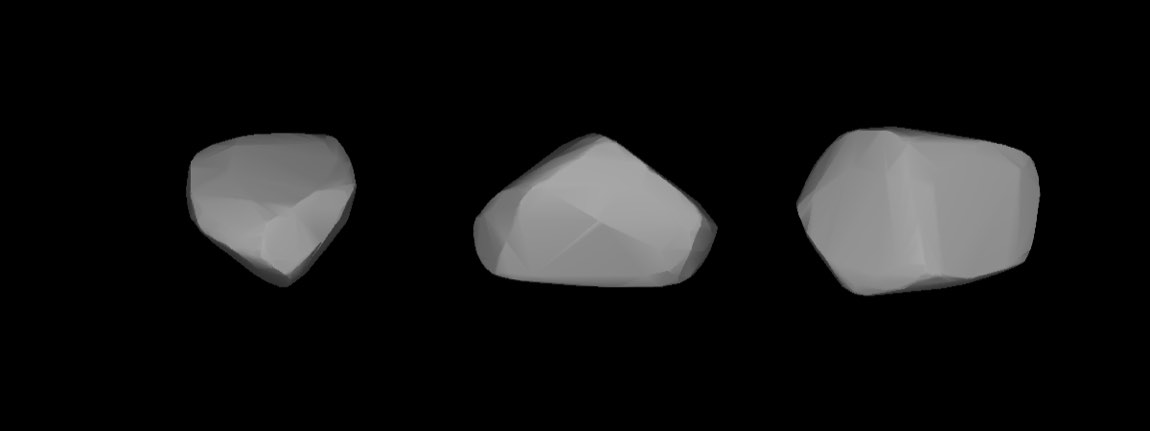
As Achilles rotates, its brightness changes by only 0.02 to 0.11 magnitudes across different observing sessions. That is an exceptionally small range: a strongly elongated or irregular body tumbling through space would show brightness swings of half a magnitude or more as different cross-sections face the observer. The near-flatness of Achilles's lightcurve therefore implies a shape close to spherical — a world that presents almost the same silhouette regardless of viewing angle. This is consistent with an object large enough that its own gravity has pulled it toward equilibrium over geological time, though it has not been confirmed through direct imaging. The brightness amplitude of 0.02 magnitude at the low end is so slight it is near the threshold of reliable measurement, which is part of why the multi-site 2007–2008 campaign, achieving consistent results across four independent observatories, was important for establishing confidence in the shape interpretation.
10 The myth behind the name
The asteroid's name reaches back to the central hero of Homer's Iliad, the epic poem recounting the Trojan War — a conflict also commemorated in the names of minor planets 5700 Homerus and 6604 Ilias. In the myth, Achilles's mother Thetis (honored by 17 Thetis) dipped her infant son in the River Styx to make him invulnerable, holding him by the heel — the one spot the water never touched. Achilles grew to become the greatest Greek warrior and slew Hector, the mightiest Trojan champion (preserved in the name 624 Hektor). He was eventually killed by an arrow to that vulnerable heel, shot by Paris (see 3317 Paris). The network of mythological cross-references embedded across trojan asteroid names is deliberate: the entire population forms a kind of extended cast of Homeric characters, frozen in orbit around Jupiter, still divided into their warring camps more than three thousand years after the poems were composed.
11 Open questions about a dark world Deeper
Despite being the historically first Jupiter trojan discovered and one of the ten largest, Achilles leaves many questions unanswered. Its D-type spectrum is flagged as unusual (DU in the Tholen system), but the exact nature of its surface chemistry — whether carbon-rich organics, silicates, or a mixture — has not been resolved. No spacecraft has yet visited Achilles; the NASA Lucy mission launched in 2021 targets other trojans but not Achilles itself. The spread in albedo values between IRAS, Akari, and NEOWISE surveys means even something as basic as its precise diameter carries real uncertainty. The near-spherical shape inferred from lightcurves has never been confirmed by direct imaging or radar. And while its rotation period is well constrained at 7.306 ± 0.002 hours, the orientation of its spin axis in space — which would reveal seasonal patterns and aid shape modeling — remains unknown.
 ⤢