Asteroid · Deep guide
5261 Eureka
Also called: 5261 Eureka · (5261) Eureka · 1990 MB
The first Trojan asteroid ever found sharing the orbit of Mars.
What is it?
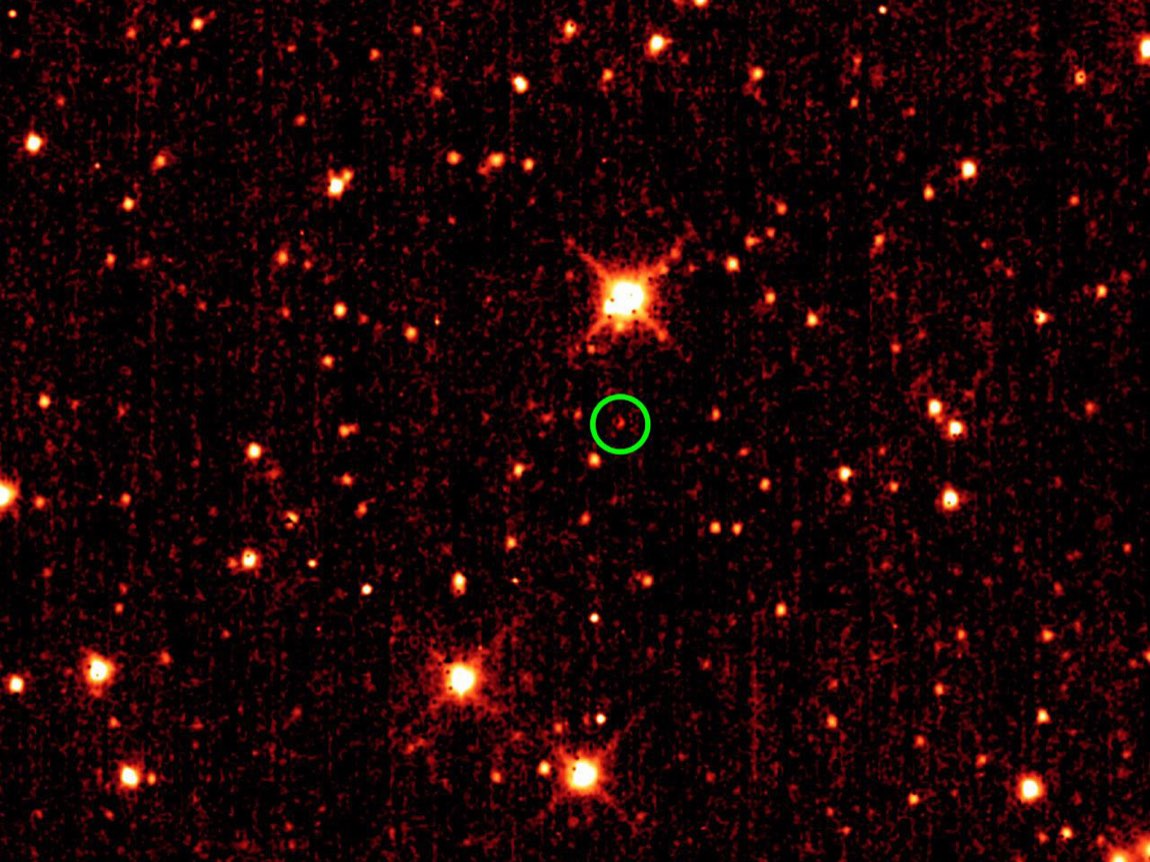
Eureka is a small asteroid that trails Mars around the Sun, sitting near the stable Lagrange point behind the planet. Discovered in 1990 by David Levy and Henry Holt at Palomar, it was the first known Mars Trojan. Computer simulations suggest its orbit is stable for millions of years. In 2011 astronomers found that it has a small moon about half a kilometre across.
The deep dive
Researched for the Atlas from Wikipedia — 5261 Eureka (2,101 characters read) · updated Nov 14, 2026
01 The Discovery That Opened a New Family
On 20 June 1990, astronomers David H. Levy and Henry Holt were scanning the sky from Palomar Observatory when they picked up the faint signal of an asteroid trailing Mars. Neither the planet nor the discovery was unusual on its own, but the orbital geometry was extraordinary: this was the first Mars trojan ever found. Mars had long been expected to host trojan asteroids by analogy with Jupiter, whose Trojan swarms contain hundreds of thousands of objects, yet no one had actually caught one before Eureka turned up. The find opened a small but scientifically rich family of objects that planetary scientists now study as potential relics of the early Solar System. Without that June night at Palomar, the entire category of Martian trojans might have remained theoretical for years or decades longer.
02 Sharing an Orbit With a Planet
Eureka occupies the L5 Lagrangian point of Mars, the gravitationally stable spot that trails the planet by roughly 60 degrees along its orbital path. It is not hovering at a fixed distance from Mars — the separation varies by as much as 0.3 AU over each revolution of the pair around the Sun. That range is also slowly shifting on a longer timescale: around the year 1850 the distance fluctuated between roughly 1.5 and 1.8 AU from the Sun, and by around 2400 it will fluctuate between 1.3 and 1.6 AU. Despite this drift, the relationship is gravitationally locked. Long-term numerical integration confirms the orbit is stable, and researchers Kimmo A. Innanen and Seppo Mikkola noted that — counterintuitively — the L4 and L5 points of all the terrestrial planets show clear evidence of stable motion over several million years.
03 A Rock That Predates the Planets' Arrangement Deeper
Eureka sits deep within a stable Lagrangian zone, and that depth of stability carries a profound implication: the asteroid is considered to have a primordial origin, meaning it has most likely occupied this orbit for much of the history of the Solar System. If Eureka had been scattered into its current position later — during the period of planetary migration or heavy bombardment — the odds of it ending up stably locked at L5 would be very low. The far more parsimonious explanation is that it was swept into this niche during the formation era and has simply never left. This makes Eureka not merely an interesting orbital curiosity but a potential time capsule, a body that may preserve compositional and structural information about the material that existed in the Mars-forming region before the planets finished assembling.
04 Spectral Clues: Angrites and Ancient Melts Deeper
Eureka's spectrum tells a complicated story that depends on which wavelength range you examine. In the infrared, it looks like a classic A-type asteroid — a class characterized by a reddish hue and moderate albedo, generally thought to represent olivine-rich material. But in visible wavelengths the spectrum matches an angrite, an evolved class of achondrite meteorite. Angrites are among the oldest igneous rocks in the Solar System and are thought to come from a differentiated parent body that melted and chemically separated early in Solar System history. If Eureka truly shares their composition, it could be a fragment of such a differentiated body — or even a remnant of the original material that failed to be incorporated into Mars itself. The dual-spectrum character remains an active subject of interpretation.
05 A Family Broken Apart by Sunlight
Eureka appears to be the patriarch of a small clan. The Minor Planet Center has recognized three additional Mars trojans: (121514) 1999 UJ7 at the L4 point, (101429) 1998 VF31 at the L5 point, and (311999) 2007 NS2, also at the L5 point. Most of the smaller L5 members share orbital characteristics so similar to Eureka that researchers hypothesize they are actual fragments — pieces that broke away after Eureka was spun up by the YORP effect. YORP, the Yarkovsky–O'Keefe–Radzievskii–Paddack effect, is a subtle radiation pressure that can gradually increase or decrease an asteroid's rotation rate. Eureka's current rotation period of 2.69 hours is fast enough to be consistent with this scenario: if it once spun up to a critical speed, surface material could have been flung off, seeding the smaller L5 companions we see today.
06 Near-Twins That Are Not Quite Trojans Deeper
Beyond the confirmed Mars trojans, at least five other asteroids have been found in near-1:1 mean-motion resonances with Mars — meaning they circle the Sun in almost exactly the same time as the planet — but they do not display true trojan behavior. These objects are 2001 FR127, 2001 FG24, (36017) 1999 ND43, 1998 QH56, and (152704) 1998 SD4. The distinction matters scientifically. A true trojan is gravitationally anchored near an L4 or L5 point and librates around it; a near-resonant object merely shares a similar period without the accompanying orbital stability. The existence of both populations around Mars — genuine trojans and near-resonant wanderers — gives dynamicists a richer dataset for understanding how objects get trapped, perturbed, and released in planetary resonances over time.
07 A Tiny Moon Hiding in Plain Sight
On 28 November 2011, observers detected a natural satellite orbiting 5261 Eureka — a remarkable find given how small everything involved is. The moon measures approximately 0.46 km in diameter and circles Eureka at a distance of only 2.1 km, an orbit so compact it would fit comfortably inside a medium-sized city. Despite the detection occurring in late 2011, the satellite's existence was not publicly announced until September 2014, a gap that reflects the careful confirmation process required before such discoveries are formally recognized. The moon remains unnamed. Its presence raises interesting questions about how Eureka acquired a companion: possibilities include a co-formation scenario, capture, or the same YORP-driven mass-shedding process hypothesized to have produced the smaller L5 trojans.
08 How Close Can We Get From Earth?
Eureka and its companions are not hopelessly remote, but they are not easy targets either. The minimum possible distance from Earth to Eureka is 0.5 AU — roughly half the distance between Earth and the Sun, or about 75 million kilometers, comparable to the distance a spacecraft travels on its way to Venus. Its minimum distance from Venus is 0.8 AU, and from Jupiter 3.5 AU. These figures set the floor of how close the asteroid can ever approach each body, and they help mission planners calculate fuel budgets and communication lag times. Because Eureka trails Mars at the L5 point, any spacecraft sent to study it would essentially be conducting a dual mission, operating in the Martian gravitational neighborhood while examining an object that may predate Mars itself.
09 The Stability Paradox of Terrestrial Trojans Deeper
Common intuition might suggest that the Lagrangian points of small terrestrial planets — Earth, Venus, Mars — would be too gravitationally weak to hold trojan companions for geologically meaningful timescales. The massive gravitational influence of Jupiter, which dominates the inner Solar System's dynamics, would seem poised to disrupt any such arrangement quickly. Yet the numerical modeling work of Innanen and Mikkola directly challenges this intuition. Their integrations found clear empirical evidence for stability around the L4 and L5 points of all the terrestrial planets over timeframes of several million years. For Eureka specifically, the orbit is confirmed to be stable in long-term numerical integration. The word 'primordial' used by researchers to describe its origin suggests confidence that this stability extends not just millions but potentially billions of years into the past.
10 Naming an Asteroid After a Famous Exclamation
The name Eureka needs little introduction: it is the Greek exclamation meaning 'I have found it,' famously associated with Archimedes and his discovery of the principle of displacement. As the first Mars trojan ever identified, the asteroid earned a name that doubles as a commentary on the significance of the discovery itself — finding something long theorized but never observed is precisely the kind of moment the word was coined to celebrate. The name also carries a certain geographic resonance, as 'Eureka' has been adopted by regions and institutions around the world as a symbol of discovery, most notably by the state of California, where Palomar Observatory — the site of the asteroid's detection — is located.
11 What Remains Unknown About Eureka Deeper
Despite more than three decades of study since its 1990 discovery, Eureka leaves several key questions open. The dual spectral character — infrared consistent with an A-type asteroid, visible light consistent with an angrite — has not been fully reconciled, and researchers have not yet determined definitively whether the body is a differentiated fragment, a primitive assemblage, or something else entirely. The mechanism by which Eureka acquired its satellite is unconfirmed, and the moon itself remains unnamed and poorly characterized. The precise extent to which YORP spinning was responsible for creating the smaller L5 companions has not been rigorously quantified. And the deeper question of exactly when Eureka settled into its primordial orbit — whether at the very beginning of Solar System formation or somewhat later — remains open, constrained more by inference than by direct measurement.