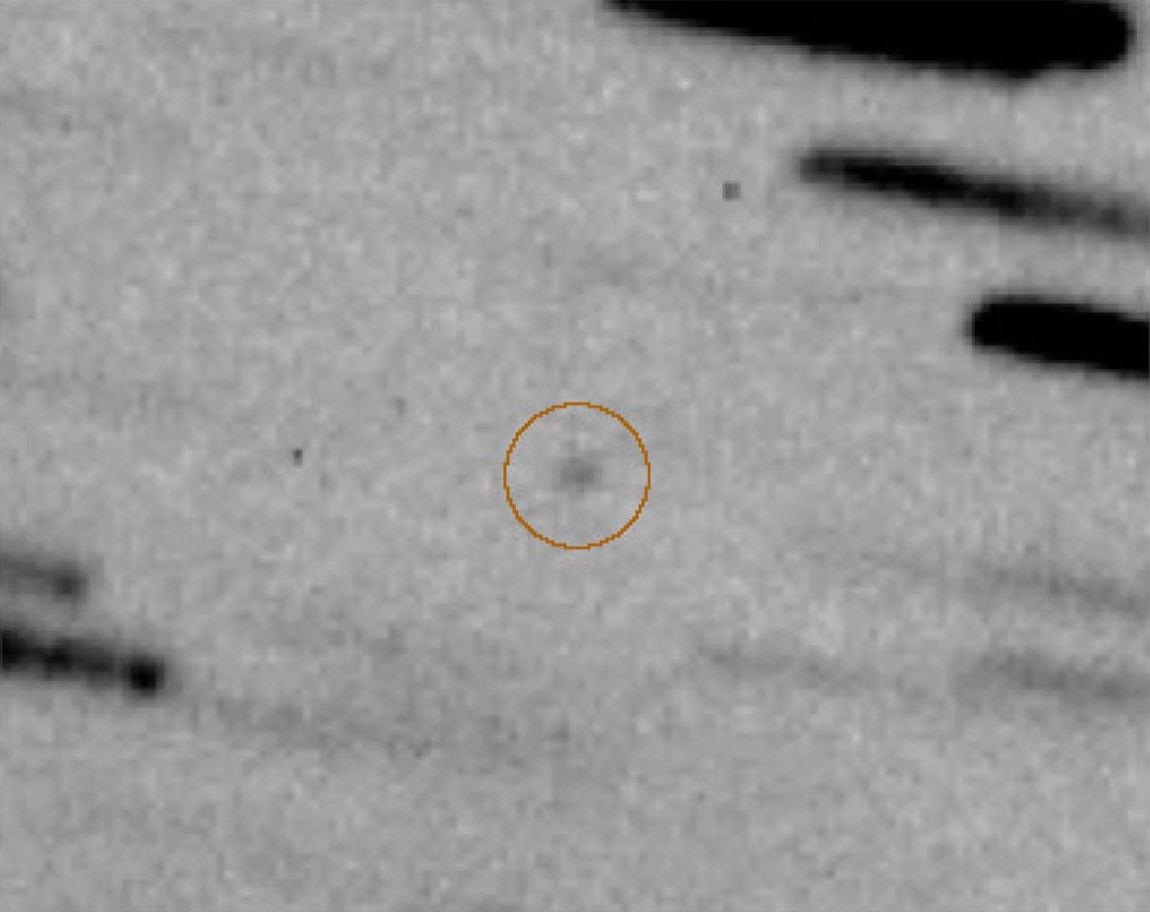
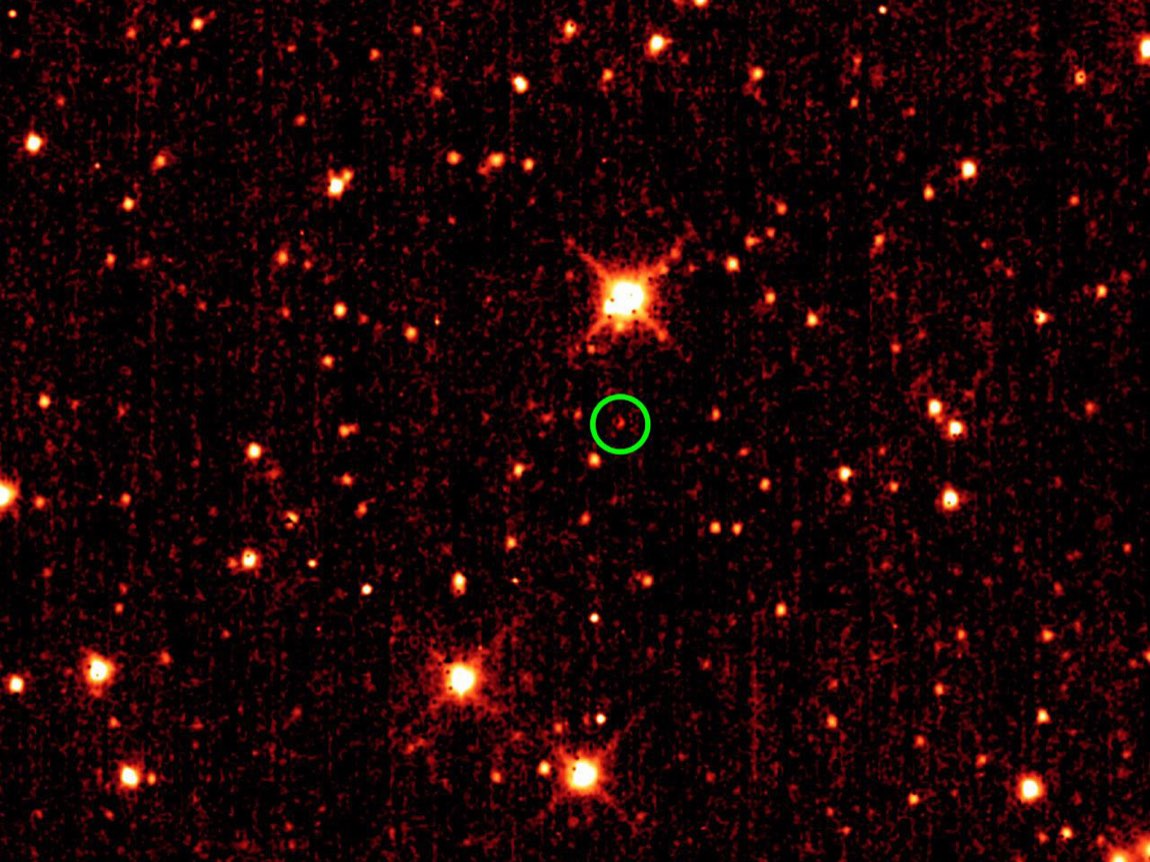
 Photograph · NASA/Jet Propulsion Lab-Caltech/UCLA · Public domain
Asteroid · Deep guide
(706765) 2010 TK7
Also called: (706765) 2010 TK7 · 2010 TK7 · 706765
Earth's first known Trojan asteroid, leading our planet around the Sun.
What is it?
2010 TK7 is a near-Earth asteroid a few hundred metres across that shares Earth's orbit. It wanders around the stable Lagrange point 60° ahead of Earth, oscillating in a long, looping path. It was found in October 2010 in infrared images from NASA's WISE space telescope, becoming the first Earth Trojan known. Similar Trojans had already been seen around Mars, Jupiter and Neptune.
The deep dive
Researched for the Atlas from Wikipedia — (706765) 2010 TK7 (4,329 characters read) · updated Nov 14, 2026
01 How the WISE telescope found it first
Spotting an Earth trojan from the ground is exceptionally hard: because these objects share Earth's orbit, they tend to lurk in the part of the sky closest to the Sun, which is only visible during daylight. The breakthrough came from orbit. WISE — the Wide-field Infrared Survey Explorer — was launched in December 2009 and spent roughly a year scanning the entire sky in infrared light. It imaged 2010 TK7 in October 2010 as part of that all-sky survey. Even then, confirming what it had found required follow-up observations at the University of Hawaii and the Canada–France–Hawaii Telescope. Only after that additional work was the orbit evaluated, on 21 May 2011. The discovery was formally announced in July 2011 in the journal Nature, authored by Paul Wiegert of the University of Western Ontario, Martin Connors of Athabasca University, and Christian Veillet, the executive director of the Canada–France–Hawaii Telescope. The timing also helped: 2010 TK7 happened to be at the near-Earth end of its tadpole loop in 2010–2011, making it unusually accessible to detection at that moment.
02 Tadpole loops and 395-year wandering
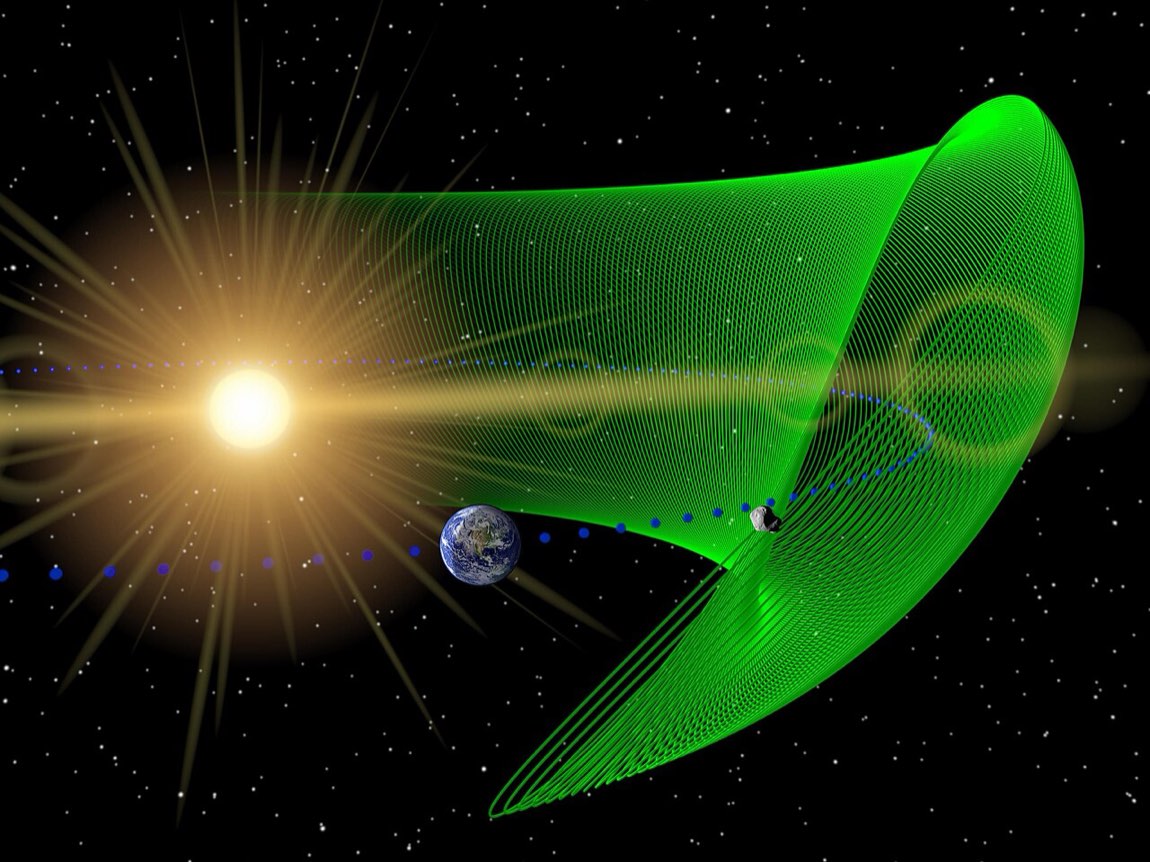
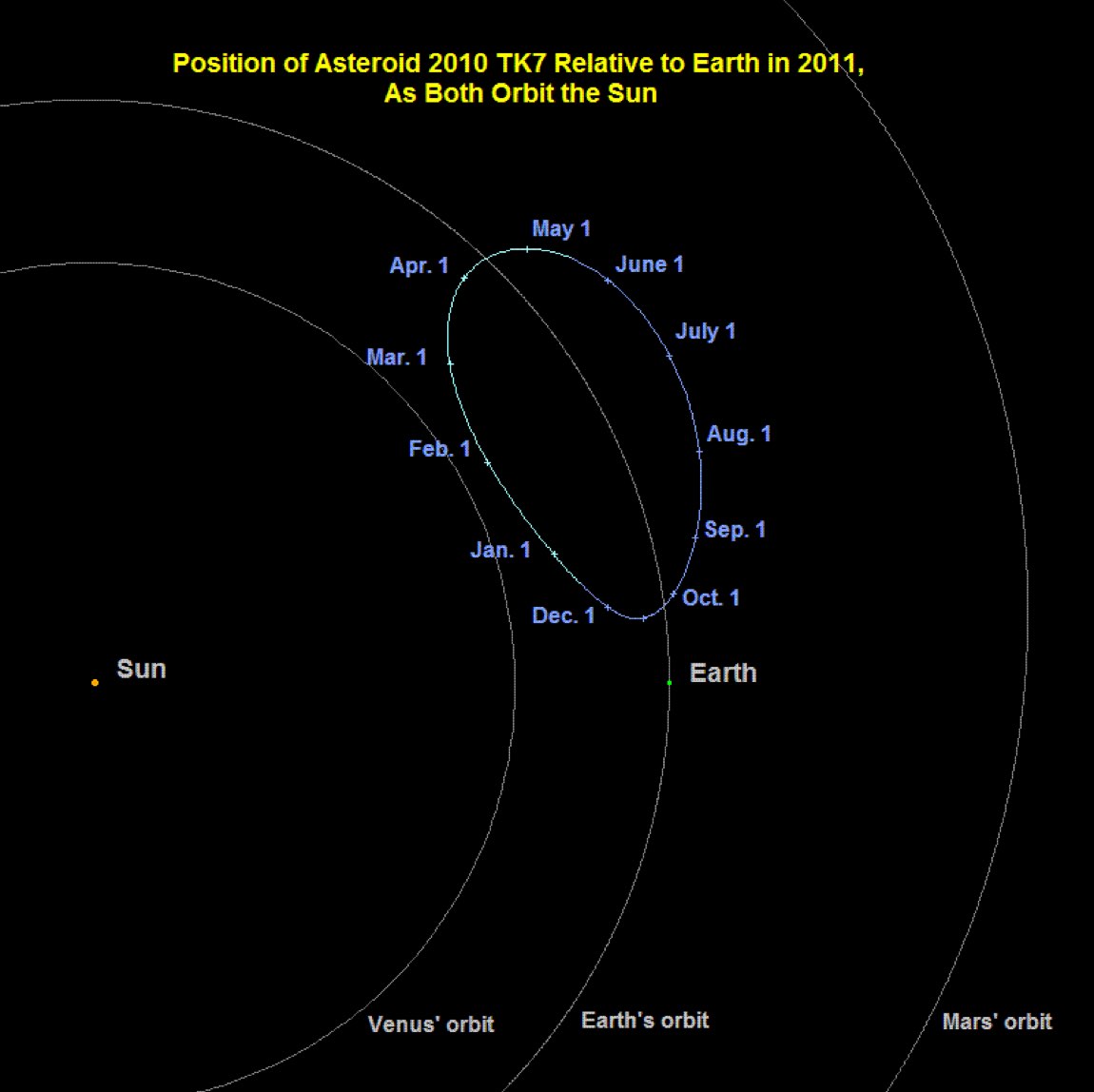
Trojan asteroids do not sit still at their Lagrangian points; they oscillate around them in paths that, when viewed in a reference frame rotating with Earth, trace tadpole-shaped loops. For 2010 TK7, one complete circuit of that tadpole takes 395 years — roughly sixteen human generations. The loop is unusually elongated compared with many trojans, so elongated that the asteroid sometimes swings nearly to the L3 point, which lies almost directly opposite the Sun from Earth, 180 degrees away. Despite this enormous range of travel, its closest approach to Earth never drops below 20 million kilometers — more than 50 times the Earth–Moon distance. The asteroid was near the Earth-end of its tadpole at the time of discovery, which is precisely why the WISE survey was able to detect it when it did. Its apparent magnitude during its 5 December 2012 close approach of 0.197 AU was about 21, far too faint for the naked eye but measurable by telescope.
03 An orbit that defies long-term prediction Deeper
What makes 2010 TK7 particularly interesting to dynamicists is that its orbit has a genuinely chaotic character. Small uncertainties in its current position grow over time in ways that make confident long-range forecasting impossible. Calculations suggest that before 500 AD the asteroid may not have been a leading-point trojan at all — it may have been oscillating around the L5 Lagrangian point, 60 degrees behind Earth rather than 60 degrees ahead. The proposed migration pathway runs from L5 through L3, the unstable point directly opposite Earth, to its current home at L4. The model also allows for shorter episodes of unstable libration around L3 itself, and even transitions into so-called horseshoe orbits, which carry an object back and forth between the L4 and L5 regions in a horseshoe-shaped path around the entire inner solar system. Newer orbital calculations based on improved measurements have confirmed rather than softened these findings, reinforcing that this asteroid's future — and past — are genuinely uncertain.
04 Its eccentric path around the Sun Deeper
Although 2010 TK7 is locked in a 1:1 resonance with Earth, its orbit is far from circular. With an eccentricity of 0.191, it swings between 0.81 AU and 1.19 AU from the Sun over the course of each year — ranging from inside Venus's neighborhood to beyond the orbit of Earth itself. By comparison, Earth's own eccentricity is only about 0.017, making 2010 TK7's path dramatically more stretched. The orbit is also steeply tilted: inclined about 21 degrees to the plane of the ecliptic, the flat disk in which most solar system bodies move. At the time of its discovery, the asteroid's orbital period was measured at 365.389 days, slightly longer than Earth's 365.256 days. Because the resonance keeps the two bodies coupled, however, the asteroid's average period over long time intervals will match Earth's exactly, so long as it remains in that 1:1 lock.
05 Size, brightness, and what we don't know
With a diameter of about 300 meters — roughly three American football fields laid end to end — 2010 TK7 is a sub-kilometer body, relatively modest even by asteroid standards. Its absolute magnitude is about 20.8, a measure of intrinsic luminosity that could be determined reliably because its distance from the Sun and Earth was well known. The diameter estimate of 300 meters rests on an assumed albedo of 0.1, meaning it reflects about 10 percent of incoming sunlight. That assumption is necessary because, as of the time the article's information was current, no spectral data had been collected. Without spectral observations, astronomers cannot determine the asteroid's composition, mineral type, or surface color. It is not known whether 2010 TK7 is a rocky silicate body, a carbon-rich object, or something else entirely. Surface gravity is estimated at less than one twenty-thousandth of Earth's — so slight that a person standing on it could leap away into space with a gentle push.
 ⤢
06 Why it's not an easy spacecraft target Deeper
On paper, Earth trojans seem like convenient destinations: they share Earth's orbit and have almost no gravity well to escape from, so the energy needed to reach them might be less than what it takes to land on the Moon, even though they are vastly more distant. In practice, 2010 TK7 is considered an energetically unattractive mission target, and the culprit is its steep orbital inclination. Because the asteroid sweeps 21 degrees above and below the ecliptic plane, a spacecraft departing from Earth's orbital plane would need to perform a large plane-change maneuver to match its trajectory. That required change in velocity — the delta-v — is 9.4 km/s. For context, some near-Earth asteroids that are considered accessible require less than 4 km/s. That difference matters enormously for mission design: propellant mass scales exponentially with delta-v, so the extra 5-plus km/s could make a mission to 2010 TK7 far heavier and more expensive than a mission to a more favorably inclined near-Earth target.
07 Earth trojans in a solar system context
Before 2010 TK7 was confirmed, astronomers had found trojan objects sharing the orbits of several other solar system bodies — Mars, Jupiter, Neptune, and even the Saturnian moons Tethys and Dione. Jupiter alone hosts hundreds of thousands of trojans in two vast swarms. Neptune's trojans have drawn particular interest because they may preserve material from the outer solar system's early history. Earth's orbital zone, by contrast, was widely expected to host trojans in theory, but none had ever been detected before October 2010. The difficulty is purely observational: Earth-based telescopes must look sunward to search, and space-based infrared surveys like WISE changed what was detectable. The confirmation that at least one Earth trojan exists supports dynamical models of the inner solar system, though whether a stable long-lived population exists, or whether objects like 2010 TK7 are transient visitors cycling through from elsewhere, remains an open question given the orbit's chaotic nature.
08 What the Lagrangian geometry really means
The L4 Lagrangian point that 2010 TK7 orbits around is not a physical object but a location in space where gravitational and centrifugal forces balance in just the right way. For the Sun–Earth system, L4 sits 60 degrees ahead of Earth along its orbit — in the same orbital lane but always about one-sixth of the way around the circle in front of the planet. An object placed there experiences the combined gravitational pull of the Sun and Earth acting through their shared barycenter, keeping it in stable oscillation rather than drifting away. The L3 point, by contrast, is directly opposite Earth on the far side of the Sun and is an unstable equilibrium — objects passing through it do not stay long. The fact that 2010 TK7's tadpole loop stretches far enough to bring it near L3 is what makes its orbit so dynamically interesting and so difficult to model confidently over millennia.
09 The team and journal behind the announcement
The formal scientific announcement of 2010 TK7 as the first Earth trojan was published in the journal Nature in July 2011, one of the most prestigious venues in all of science. The three named authors brought complementary expertise and institutional affiliations. Paul Wiegert, based at the University of Western Ontario, is a specialist in solar system dynamics and resonance orbits. Martin Connors of Athabasca University contributed to the observational and analytical work that nailed down the trojan character of the orbit. Christian Veillet, the executive director of the Canada–France–Hawaii Telescope, helped coordinate the critical follow-up observations at that facility that transformed WISE's initial detection into a confirmed orbit. The WISE mission itself was a NASA project, so the discovery represents a collaboration spanning multiple Canadian and American institutions, coordinated through one of the most powerful infrared space observatories ever flown. The orbit was formally evaluated on 21 May 2011, only about two months before publication.
10 Open questions this small rock raises Deeper
Despite being confirmed and studied since 2011, 2010 TK7 leaves several significant questions unanswered. Its composition is entirely unknown because no spectral observations exist in the published record — astronomers cannot yet say whether it is stony, metallic, or carbon-rich. Its long-term orbital fate is genuinely uncertain: the chaotic dynamics allow for the possibility that it escapes the L4 region within a timescale much shorter than the age of the solar system, which would imply it is a temporary capture rather than a primordial Earth trojan. If it is a transient object, where did it come from and when did it arrive? The pre-500 AD history modeled in published calculations suggests it may have come from L5, but the chaotic nature of the orbit means this is a probabilistic inference rather than a firm historical reconstruction. Perhaps most broadly, astronomers still do not know whether 2010 TK7 is unique or whether a larger, undiscovered population of Earth trojans awaits detection by future infrared surveys.
 ⤢