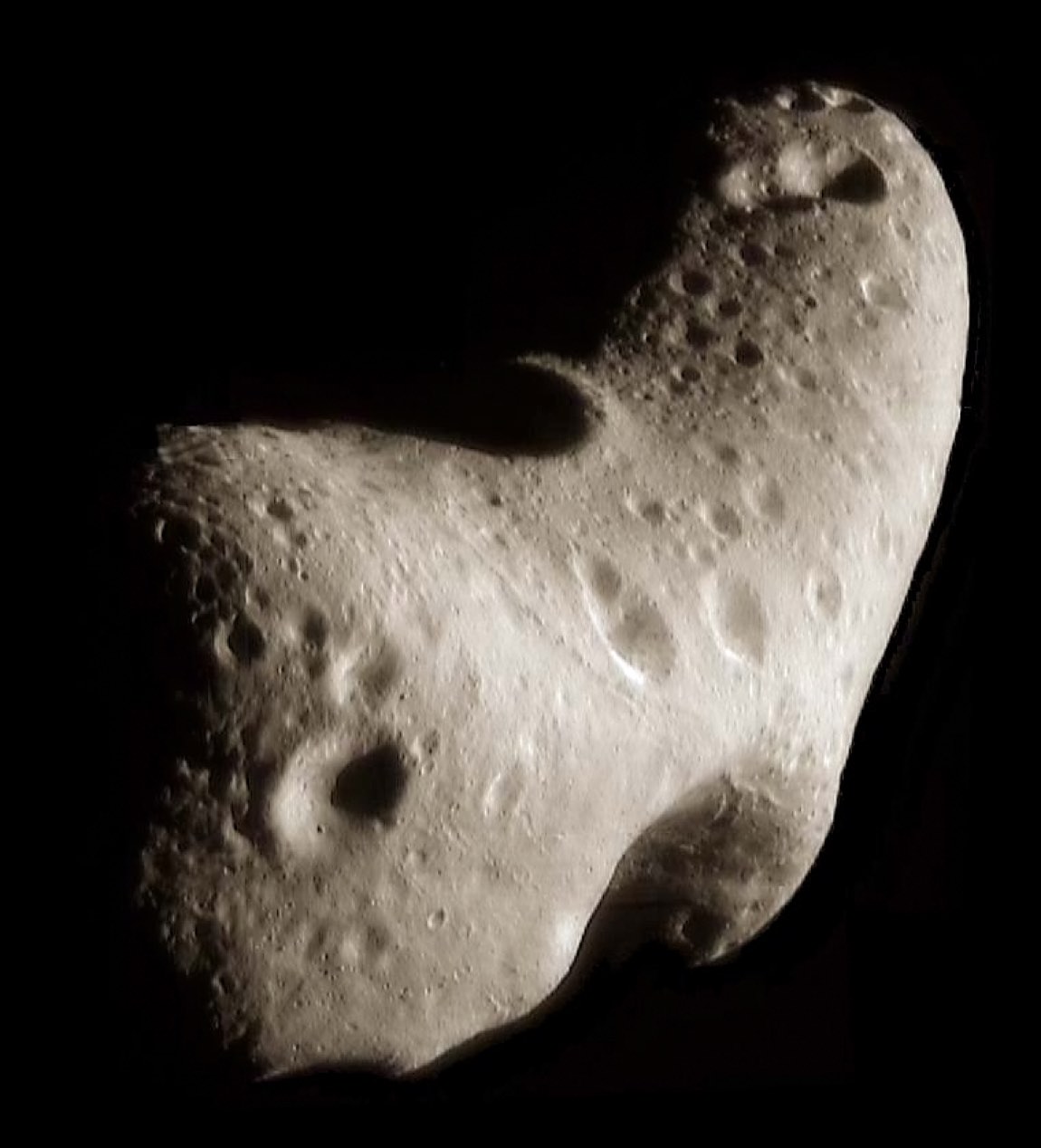
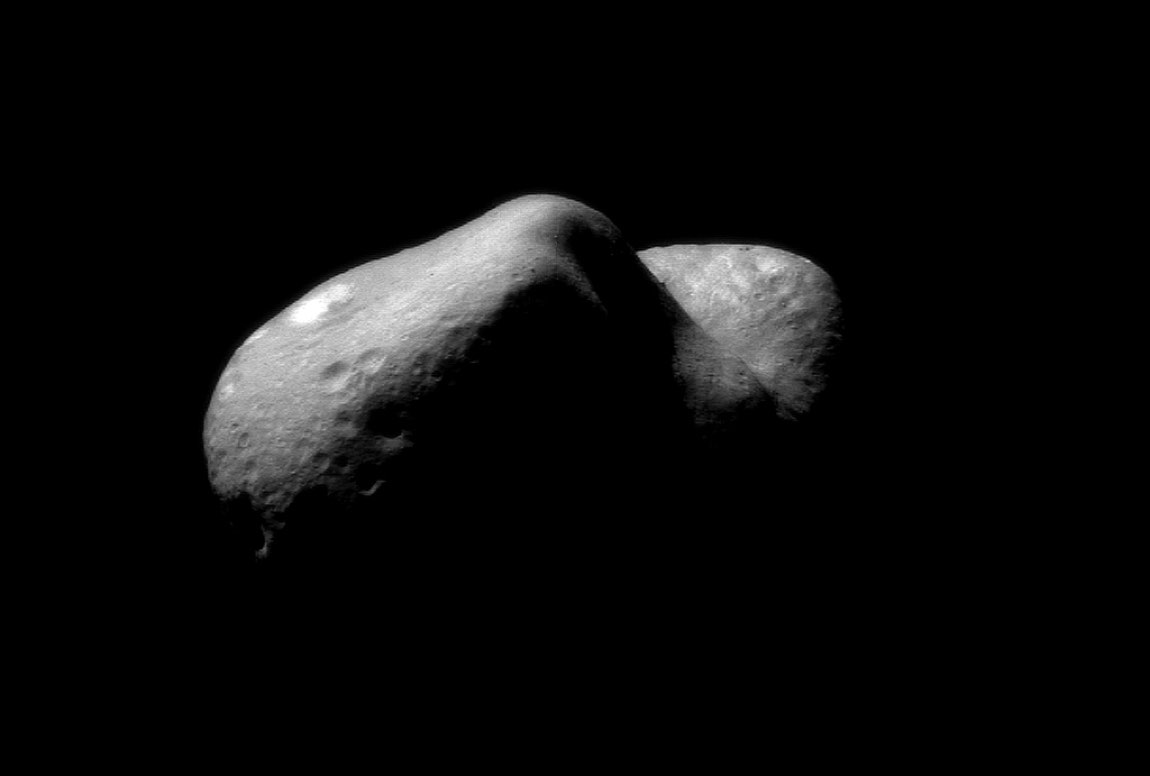
 Photograph · NASA/JPL/JHUAPL (color version published at Planetary Society) · Public domain
Asteroid · Deep guide
433 Eros
Also called: 433 Eros · (433) Eros · A898 PA · 1898 DQ
The first near-Earth asteroid ever found — and the first asteroid a spacecraft landed on.
What is it?
Eros is a stony, peanut-shaped asteroid about 34 km long that loops between the orbits of Earth and Mars. Discovered in 1898, it was the first near-Earth asteroid known, and it never actually crosses Earth's path. NASA's NEAR Shoemaker spacecraft studied it from 1998 to 2001 and, at the end of its mission, gently touched down on the surface — the first landing on any asteroid. Its measured mass, about 6.7 × 10¹⁵ kg, made Eros one of the best-weighed asteroids of its time.
The deep dive
Researched for the Atlas from Wikipedia — 433 Eros (8,015 characters read) · updated Nov 14, 2026
01 The first asteroid ever given a male name
When Eros was discovered in 1898, it broke a long-standing tradition in planetary science. Every minor planet named up to that point had received a female name, following the convention of naming asteroids after goddesses and mythological women. Eros shattered that custom because it was the first near-Earth asteroid ever found — a genuinely new category of object that seemed to warrant a genuinely new kind of name. The choice of Eros, the Greek god of love and son of Aphrodite, carried an additional logic: Aphrodite is the Greek equivalent of Venus, and Eros orbits in a region of space that brings it closer to the Sun than any asteroid previously known. The name was therefore a small astronomical pun as much as a cultural statement. Auguste Charlois at Nice Observatory independently discovered the same object on the same night as Carl Gustav Witt at Berlin Urania Observatory, so the discovery credit is shared — though it was Witt who was specifically imaging the sky around the star beta Aquarii in a two-hour exposure, trying to pin down astrometric positions of the unrelated asteroid 185 Eunike, when Eros appeared in his field of view.
02 How Eros helped measure the solar system Deeper
Before radar existed, astronomers had to measure the Earth–Sun distance — the Astronomical Unit — through painstaking geometric techniques. Eros turned out to be one of the best rulers available. During its opposition of 1900–1901, a worldwide observing campaign was organized specifically to use Eros's parallax — the tiny apparent shift in its position when viewed from different points on Earth — to calculate how far away the Sun is. Arthur Hinks of Cambridge and Charles D. Perrine of the Lick Observatory, University of California, published the results in 1910. Perrine alone took 965 photographs with the Crossley Reflector and selected 525 of them for careful measurement. The campaign was repeated during a closer approach in 1930–1931, led by Harold Spencer Jones, and the value of the Astronomical Unit obtained from that effort was considered the definitive standard for nearly four decades — right up until 1968, when radar and dynamical parallax methods finally surpassed it in precision. The fact that a single asteroid's close passes could anchor humanity's understanding of the scale of the solar system for so long is a remarkable testament to how useful Eros proved to be even before any spacecraft ever visited it.
03 An orbit that flirts with catastrophe
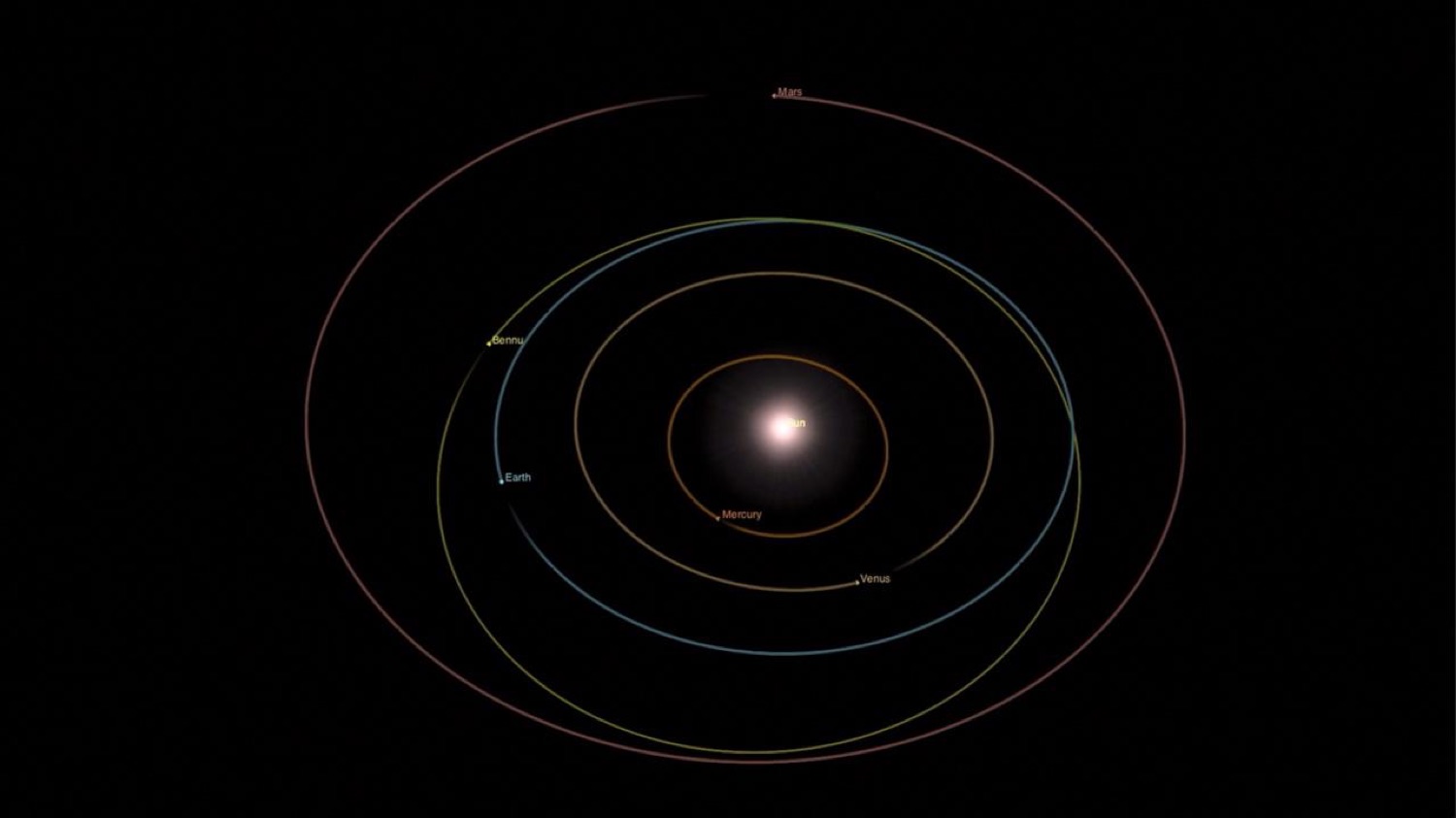
Eros is a Mars-crosser, meaning its path around the Sun crosses inside the orbit of Mars — it was the first asteroid known to do so. Its orbit is tilted about 10.8° to the solar ecliptic, which currently keeps it above the plane of the ecliptic when it crosses Mars's orbit, so the two objects do not actually threaten each other. But no orbit this close to multiple planets stays stable forever. Gravitational nudges accumulate over time, and dynamical modeling suggests Eros could evolve into an Earth-crossing asteroid within as little as two million years. Over a longer timescale of 100 million to 1 billion years, it carries roughly a 50% chance of making that transition. If it ever does strike Earth, the consequences would be severe: Eros is estimated to be about five times more massive than the impactor that carved out the Chicxulub crater and triggered the extinction of the non-avian dinosaurs. Objects in a Mars-crossing orbit can persist there for only a few hundred million years before gravitational interactions shuffle them onto a new path, so Eros is in a temporary, geologically speaking, situation.
 ⤢
04 One giant impact that reshaped a world
About one billion years ago, something large slammed into Eros and left a mark that still dominates the asteroid's surface today. NEAR Shoemaker scientists found that most of the large rocks scattered across Eros appear to have been ejected from a single crater during that ancient impact. The crater was informally proposed to be named Shoemaker, but the International Astronomical Union declined to recognize that name; it has been formally designated Charlois Regio instead. The impact did more than scatter boulders — it appears to have erased roughly 40 percent of the Erotian surface's small craters. Any crater smaller than 0.5 kilometers across is dramatically underrepresented across that fraction of the surface. Analysis of crater density patterns shows the low-density zones all sit within 9 kilometers of the impact point — not just measured along the surface, but in straight-line distance through the interior of the asteroid. Because Eros is peanut-shaped rather than spherical, regions on the opposite side of the asteroid can still be geometrically close through its interior even when they are far apart along its irregular surface. Seismic shockwaves propagating through the body are thought to have shaken smaller craters into rubble, while compression from the same event likely created the thrust fault now known as Hinks Dorsum.
05 Dust ponds: an unexpected smooth landscape Deeper
In October 2000, NEAR Shoemaker spotted something unexpected on the surface of an airless, rocky asteroid: smooth, flat deposits of fine dust pooled inside depressions, looking almost like calm ponds frozen in stone. These features, named dust ponds, stand in sharp contrast to the rough, boulder-strewn terrain surrounding them. They collect in crater floors and other low-lying areas where the slope is less than 10°, and they display a slightly bluer color and different albedo compared to the adjacent rocky surface. Scientists identified 334 such ponds with diameters of about 10 meters, of which 255 are larger than 30 meters. Perhaps most striking is their distribution: 231 of the identified ponds — about 91 percent — cluster within 30° of the asteroid's equator. This concentration hints that some combination of Eros's rotation, its irregular gravity field, and electrostatic or seismic processes preferentially moves fine material toward the equatorial zone. How dust behaves on the surface of a small, airless, irregularly shaped body in space is still an active area of research, and Eros's dust ponds provided some of the clearest early evidence that such migration can occur.
06 A peanut-shaped world with wild gravity swings
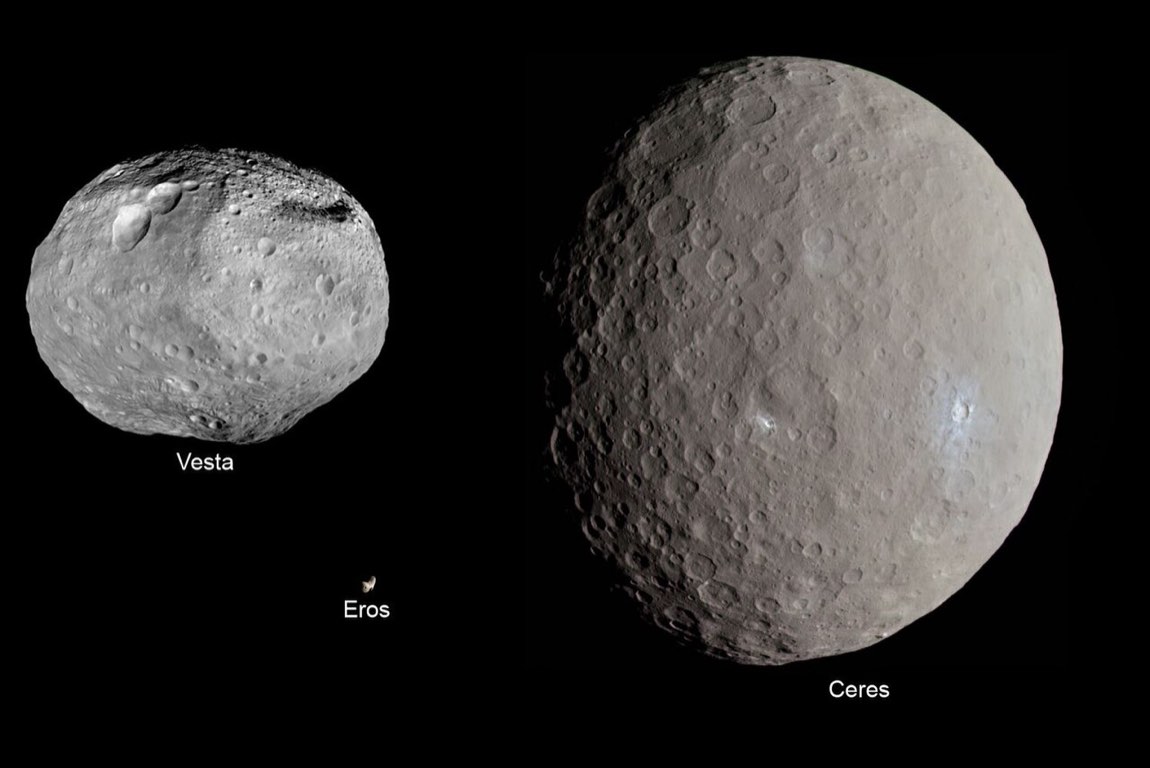
Eros is not even close to spherical. Its elongated, peanut-shaped body means that the distance from any spot on its surface to its center of mass varies enormously depending on where you stand — and because surface gravity depends directly on that distance, gravity across Eros swings through a wide range from place to place. Stand near the waist of the peanut and you are relatively close to the center of mass; stand near one of the lobes and you are farther away. The asteroid has a volume-equivalent diameter of approximately 16.8 kilometers, making it the second-largest near-Earth object known. Its density is 2.67 g/cm³, strikingly similar to the density of Earth's own crust, suggesting a composition of ordinary stony material rather than a loosely packed rubble pile with large internal voids. Temperature swings on the surface are extreme by Earth standards: daytime temperatures can reach about 100 °C at perihelion, while the surface cools to around −150 °C at night — a range of roughly 250 degrees Celsius between the sunlit and shadowed sides of the same small world.
 ⤢
07 A treasure chest of rare metals
Data collected by the Near Earth Asteroid Rendezvous spacecraft during its December 1998 flyby of Eros raised eyebrows in both the scientific and economic communities. The measurements suggested that Eros could contain approximately 20 billion tonnes of aluminum, along with comparable quantities of metals that are rare and extremely valuable on Earth, including gold and platinum. To put that in perspective, 20 billion tonnes of aluminum is orders of magnitude more than humanity has ever mined in its entire industrial history. These estimates come with real uncertainty — remote sensing from a passing spacecraft cannot directly sample the interior, and the actual distribution and concentration of metals through the asteroid's volume is unknown. Nevertheless, Eros has frequently appeared in discussions about the long-term future of asteroid mining, precisely because it is a large, well-studied near-Earth object with a known composition profile. Whether any of this material could ever be extracted economically is an entirely separate question, but the numbers themselves illustrate why some scientists and entrepreneurs view near-Earth asteroids as potential resource depots.
08 NEAR Shoemaker's long road to orbit Deeper
NASA launched the NEAR Shoemaker probe in 1996 with a straightforward primary mission: get to Eros, orbit it, and study it in detail. The journey did not go smoothly. The spacecraft made a flyby of Eros in December 1998, during which it observed more than 60 percent of the asteroid's surface and gathered new data on its size, density, and surface features — but an aborted engine burn prevented it from successfully entering orbit at that point, pushing back the orbital insertion that had originally been planned for 1999. Engineers corrected the spacecraft's trajectory, and NEAR Shoemaker finally slipped into orbit around Eros on 14 February 2000 — Valentine's Day, a date that the mission team certainly appreciated given their target was named after the god of love. Over the following year, the spacecraft mapped the global surface, captured more than 160,000 photographs, and gathered a comprehensive dataset on the asteroid's composition and structure. On 12 February 2001, with its mission objectives complete, NEAR Shoemaker was guided down to the surface using its maneuvering jets, becoming the first spacecraft to soft-land on an asteroid. Radio contact was lost shortly after landing. The mission represented three firsts: first near-Earth asteroid closely orbited, first near-Earth asteroid soft-landed upon, and first radar detection of an asteroid via the Arecibo Observatory.
09 Catching Eros with your own eyes
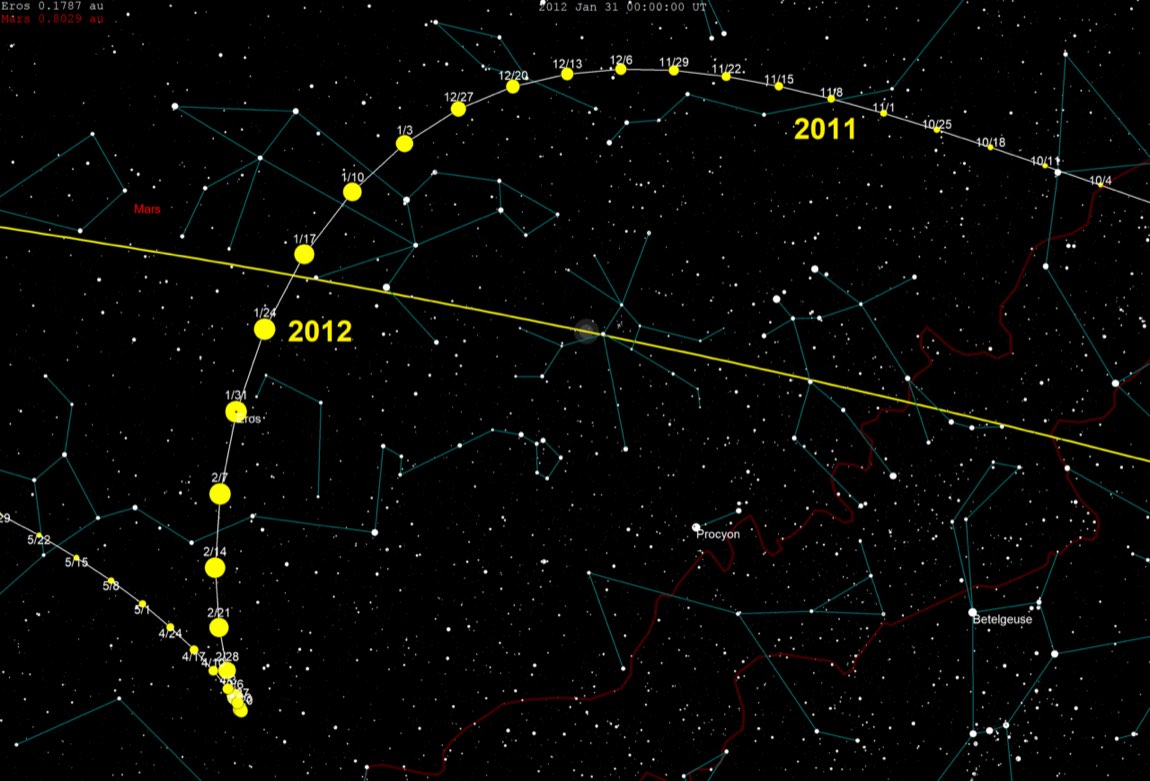
Eros is not a naked-eye object under ordinary circumstances, but amateur astronomers with binoculars or a small telescope can track it during favorable approaches. On 31 January 2012, Eros passed Earth at a distance of 0.17867 AU — about 26,729,000 kilometers, or roughly 70 times the distance to the Moon — and reached a visual magnitude of +8.1, comfortably within the range of binoculars under dark skies. During rare oppositions that occur approximately every 81 years, such as those in 1975 and 2056, Eros can brighten to magnitude +7.0. That makes it brighter than Neptune and brighter than every main-belt asteroid except 1 Ceres, 4 Vesta, and occasionally 2 Pallas and 7 Iris. During these exceptional close passes, Eros exhibits unusually small retrograde motion compared to what you would expect from a body in that part of its orbit. For instance, during January and February 2137, it is predicted to move retrograde by only 34 minutes of arc in right ascension — a sluggish crawl across the sky that reflects its orbital geometry relative to Earth at that moment. Planning an observation around one of the 81-year oppositions is a genuinely rare astronomical event worth marking on a calendar.
 ⤢
10 Open questions Eros left behind Deeper
Even after a year in orbit and a landing, NEAR Shoemaker left important questions unanswered. The process by which dust ponds form and migrate toward the equator is not fully explained; electrostatic levitation, seismic shaking, and the YORP effect have all been proposed as contributing mechanisms, but no consensus exists. The precise nature of the billion-year-old impact that created Charlois Regio — including the size and composition of the impactor — remains uncertain. It is also unclear whether the seismic shockwave explanation for the erasure of small craters fully accounts for all the observed crater density patterns, or whether additional processes such as regolith gardening or ejecta blanketing played significant roles. Eros's long-term dynamical fate is a statistical question rather than a determined one: the 50% probability of becoming an Earth-crosser over 100 million to 1 billion years is a modeling result that carries inherent uncertainties. And the tantalizing estimates of 20 billion tonnes of aluminum and rare metals like gold and platinum are based on remote sensing data that cannot substitute for direct sampling of the interior. Future missions returning physical samples from Eros, or deploying surface geophysical instruments, could address many of these open questions directly.