Asteroid · Deep guide
253 Mathilde
Also called: 253 Mathilde · (253) Mathilde · A885 VA
A coal-dark, slowly tumbling asteroid riddled with craters almost as wide as itself.
What is it?
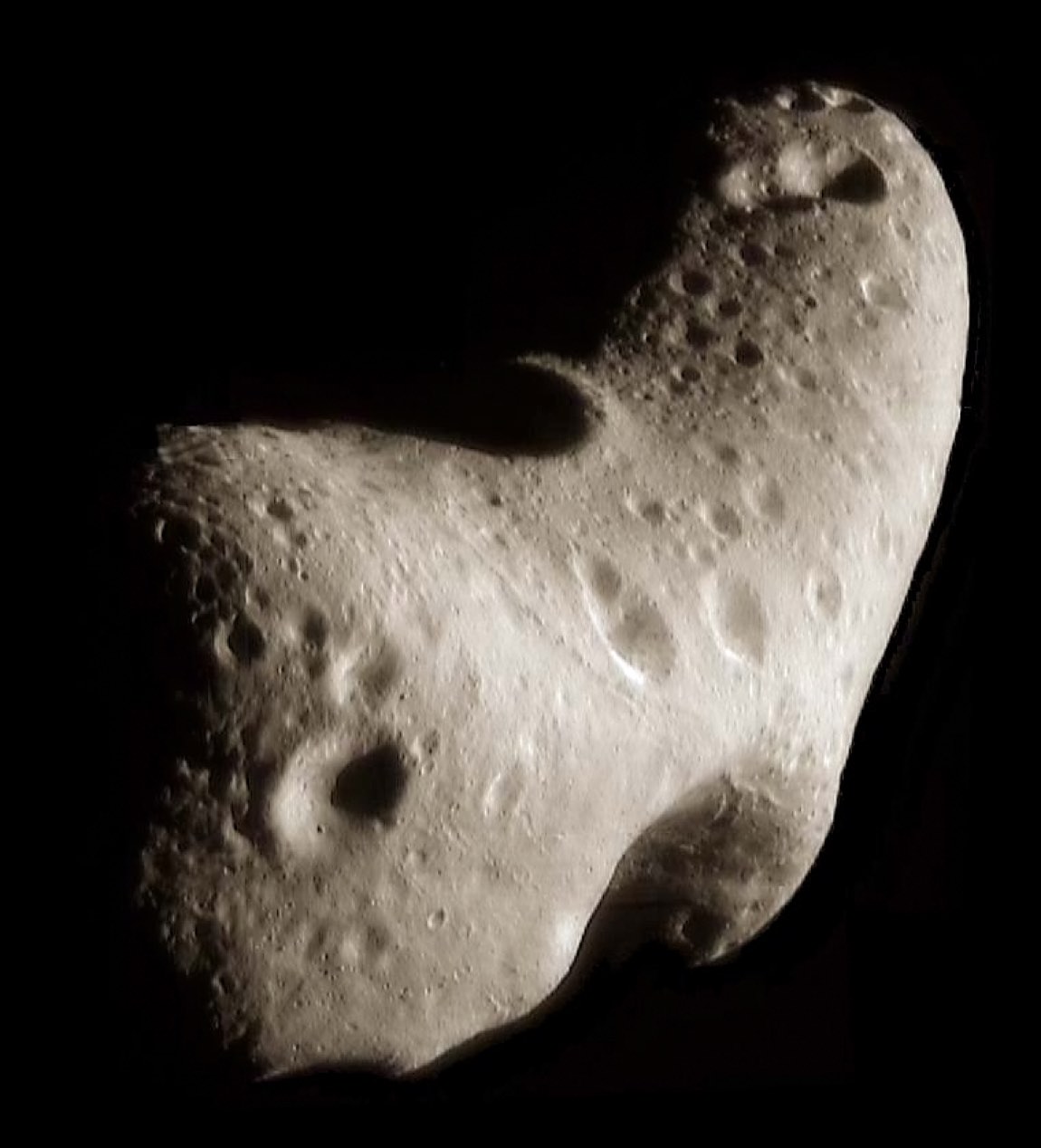
Mathilde is a carbon-rich asteroid about 50 km across in the middle of the asteroid belt. It reflects only about 4% of the sunlight that hits it, making it very dark, and it turns remarkably slowly — once every 17.4 days. NASA's NEAR Shoemaker flew past in June 1997 on its way to Eros and saw huge craters gouged into the surface. It was the first carbonaceous asteroid explored by a spacecraft.
The deep dive
Researched for the Atlas from Wikipedia — 253 Mathilde (4,850 characters read) · updated Nov 14, 2026
01 Johann Palisa and the Vienna 27-inch
When Johann Palisa accepted a step down in rank — from director of the Austrian Naval Observatory to assistant at the newly completed Vienna Observatory — he gained something invaluable in return: access to the world's largest refracting telescope at the time, a 27-inch (690 mm) refractor. By the moment he moved to Vienna in 1880, he had already discovered 27 asteroids. Using both the 27-inch and a 12-inch (300 mm) instrument at the same observatory, he would go on to find an additional 94 before retirement, a staggering personal tally. Mathilde, spotted on 12 November 1885, was one of those discoveries. The name did not come from Palisa himself, but from fellow Austrian astronomer V. A. Lebeuf, who was working at the Paris Observatory and computed the asteroid's first orbital elements. Lebeuf named it after Mathilde, the wife of Moritz Loewy, then vice director of the Paris Observatory — a small act of collegial tribute embedded forever in the asteroid belt.
02 A rotation so slow it puzzled everyone
Most asteroids spin at a brisk pace, completing a full rotation somewhere between 2 and 24 hours — roughly comparable to Earth's own day. Mathilde is a dramatic outlier. Ground-based observations in 1995 confirmed what orbital watchers had suspected: its rotation period is 418 hours, or about 17.4 days. To put that in everyday terms, a person standing on Mathilde would wait longer than two Earth weeks to see a single sunrise. This extraordinary sluggishness places Mathilde among the slowest rotators in the known asteroid population. One hypothesis is that the same massive impacts that carved the enormous craters visible on its surface gradually braked its spin over geological time. Another idea floated by researchers was that an orbiting moonlet could be sapping angular momentum through tidal effects — but when NEAR Shoemaker scrutinized its images, no satellite larger than 10 km in diameter was found out to a distance of 20 times Mathilde's own radius, leaving the question of what originally slowed it unresolved.
03 A surface as dark as fresh asphalt
Mathilde reflects only 4% of the sunlight that strikes it, an albedo the article explicitly compares to fresh asphalt. That extraordinary darkness stems from its classification as a primitive C-type asteroid, where the surface is dominated by carbon-rich material and phyllosilicate minerals — the same clay-like silicates found in certain meteorite families. Specifically, scientists believe Mathilde shares its composition with CI1 or CM2 carbonaceous chondrite meteorites, some of the most chemically primitive rocks known, thought to preserve the raw ingredients of the early solar system. Ground-based spectroscopy in 1995 confirmed this C-type identity. The near-uniform darkness posed a photographic challenge for NEAR Shoemaker: with so little reflected light and such muted contrast across the surface, distinguishing subtle surface textures required careful image processing. Crucially, the NEAR images showed no detectable variation in brightness or color even inside the giant craters, implying a remarkably homogeneous interior rather than a layered body whose deeper strata might differ in composition.
04 Giant craters named for coal fields
Mathilde's surface is dominated by impact craters of remarkable size, and the International Astronomical Union followed a thematic naming scheme that feels almost poetically appropriate for such a carbon-rich world: individual craters are named after coal fields and coal basins from around the globe. The two largest are Karoo, at 33.4 km wide, and Ishikari, at 29.3 km wide. To appreciate the scale, Mathilde's average radius is only about 25 km — meaning these craters are as wide as the asteroid's own radius. That these basins exist at all without shattering the body is itself scientifically significant. The crater edges appear angular, suggesting that impacts spalled — blasted away — large volumes of surface material rather than simply compressing it. Yet despite that violence, no layering is visible inside any of the craters. The interior, as far as the cameras could tell, is uniform in both brightness and color from the outer crust all the way down to the exposed crater floors, pointing to a body that is compositionally consistent throughout its depth.
05 A rubble pile with half its volume as void Deeper
When NEAR Shoemaker swept past Mathilde, its trajectory was bent ever so slightly by the asteroid's gravity. That gravitational nudge, combined with the spacecraft's known mass and velocity, let scientists calculate Mathilde's mass and therefore its bulk density: 1,300 kg per cubic meter. That figure is less than half the density of a typical carbonaceous chondrite meteorite, the very rock type Mathilde's surface most resembles. The discrepancy has a compelling explanation — Mathilde is almost certainly a rubble pile, a loosely aggregated collection of fragments held together by gravity rather than any rigid internal structure. The article states that up to 50% of Mathilde's interior volume may be open space, essentially a rocky sponge on a grand scale. The same low-density pattern has been documented for other C-type asteroids — 45 Eugenia, 90 Antiope, 87 Sylvia, and 121 Hermione — studied through ground-based adaptive optics, suggesting this architecture is common among carbonaceous bodies. Counterintuitively, the looseness may be protective: low-density material transmits impact shockwaves inefficiently, helping preserve surface features that might otherwise be erased.
06 A scarp that hints at hidden strength Deeper
The rubble-pile model for Mathilde's interior is compelling, but it may not tell the whole story. NEAR Shoemaker images revealed a scarp — an elongated cliff-like feature — stretching roughly 20 km across the surface. The existence of such a structure implies that some portion of Mathilde has genuine mechanical strength, capable of maintaining a sharp topographic feature against the slow pull of the asteroid's own gravity over millions of years. This detail is scientifically awkward for a pure rubble-pile interpretation: a body of loosely packed fragments with half its volume as empty space would be expected to gradually slump and smooth out such features. One reconciling possibility is that the asteroid contains some larger, consolidated internal components — perhaps a few monolithic or partially consolidated blocks — embedded within a more porous matrix of smaller debris. This hybrid interior architecture would allow both the extreme porosity and the preservation of large-scale surface structures to coexist. The question remains open, as NEAR Shoemaker's flyby was brief and imaged only one hemisphere.
07 The NEAR Shoemaker flyby in numbers
On 27 June 1997, the NEAR Shoemaker spacecraft made its closest approach to Mathilde, passing within 1,212 km of the surface while traveling at 9.93 km/s — roughly 35,000 km/h, or about 29 times the speed of sound at sea level. During this brief encounter, the spacecraft captured more than 500 images of the surface. The flyby was not NEAR's primary mission; Mathilde was an opportunistic target visited en route to the spacecraft's true destination, asteroid 433 Eros. The geometry of the encounter, combined with Mathilde's painfully slow rotation, meant that only one hemisphere was ever photographed — 60% of the total surface. The gravitational effect of the asteroid on the spacecraft's trajectory provided the data needed to calculate Mathilde's mass, which in turn yielded the density estimate of 1,300 kg/m³. Despite the limitations, the encounter made history: Mathilde became the first carbonaceous asteroid ever explored by a spacecraft, and it held the record as the largest asteroid visited until the European Space Agency's Rosetta mission flew past 21 Lutetia in 2010.
08 An eccentric orbit between two planets
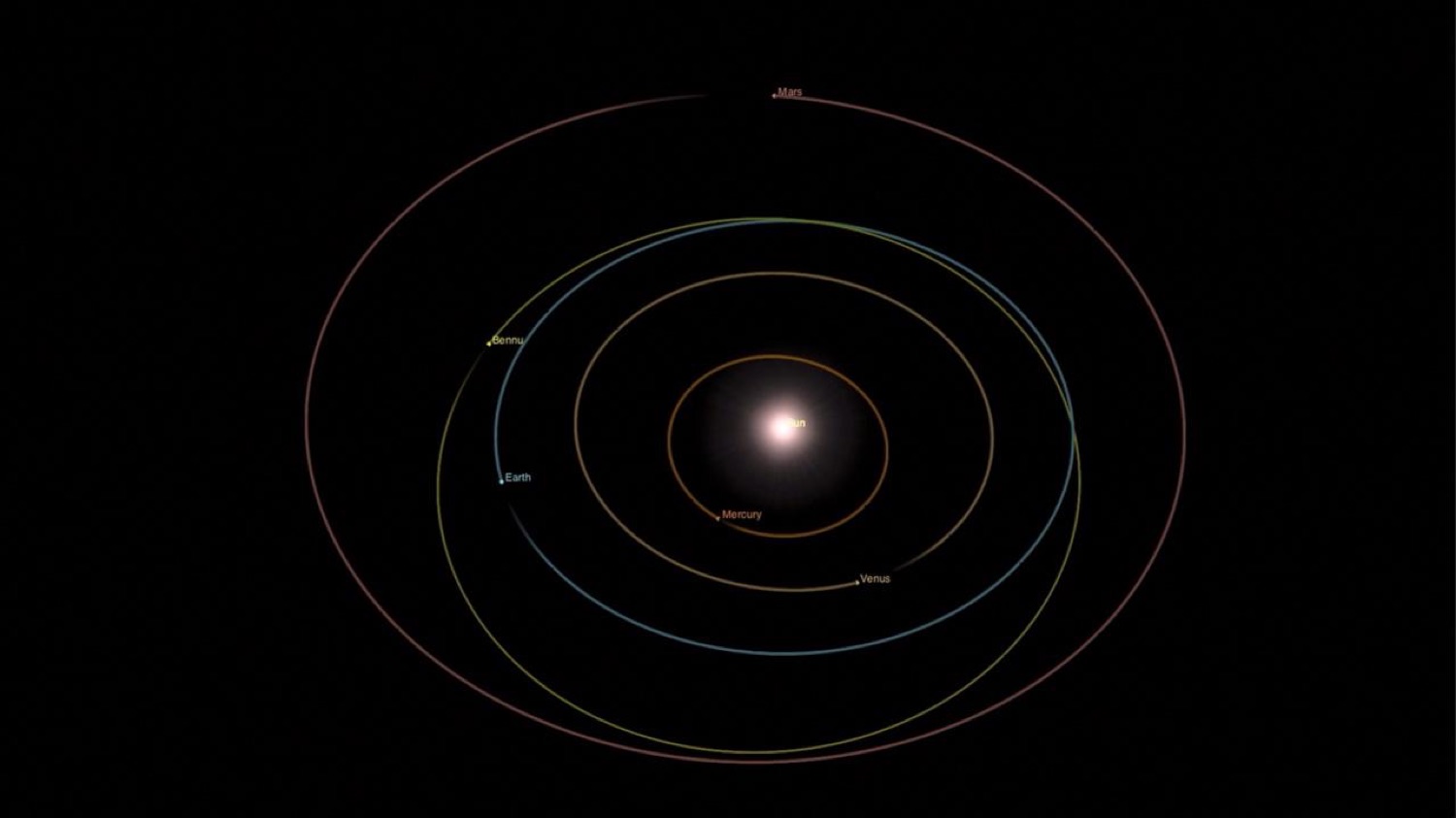
Mathilde travels an elliptical path through the intermediate asteroid belt, taking more than four years to complete a single orbit around the Sun. The orbit is notably eccentric — stretched enough to carry the asteroid toward the outer reaches of the belt — yet it remains entirely contained between the orbits of Mars and Jupiter, never crossing either planet's path. This non-planet-crossing character makes Mathilde dynamically stable over long timescales compared with near-Earth asteroids, which routinely intersect planetary orbits. The combination of a long orbital period and an extraordinarily slow rotation means that for most of its journey around the Sun, Mathilde presents nearly the same face to space for weeks at a time. That slow spin was what ultimately limited NEAR Shoemaker's coverage: even with more than 500 images captured during the flyby, the hemisphere facing away from the spacecraft never rotated into view before the probe had moved too far along its own trajectory to look back.
09 What the craters reveal about impact physics Deeper
The enormous craters on Mathilde are not just visually striking — they carry important information about how low-density, porous bodies respond to high-energy collisions. On a dense, solid rocky body, a large impact generates powerful shock waves that propagate throughout the interior, often triggering secondary fracturing and large-scale reshaping. On Mathilde, the porous rubble-pile structure acts as a shock absorber. The voids between fragments dissipate energy locally rather than transmitting it efficiently across the body, which is why craters as wide as the asteroid's own radius exist without apparently destroying the whole object. The angular edges of the craters suggest material was violently ejected — spalled — during the impacts, rather than flowing plastically as it might in a warmer or more coherent body. Meanwhile, the absence of any color or brightness variation inside the craters implies that the material exposed at depth is essentially identical to the surface layer, reinforcing the picture of a homogeneous, well-mixed interior. There are also indications of downslope material movement, suggesting that even under Mathilde's very weak gravity, loose surface material gradually migrates.
10 Records set and later broken
At the time of the NEAR Shoemaker encounter in 1997, Mathilde held two notable records simultaneously. It was the first carbonaceous asteroid — a C-type body — ever to be imaged up close by a spacecraft, opening a new chapter in the direct study of primitive, carbon-rich objects from the early solar system. It was also, at approximately 50 km in diameter, the largest asteroid that any spacecraft had visited. That second record stood for thirteen years, until 2010, when the European Space Agency's Rosetta spacecraft flew past 21 Lutetia, a significantly larger asteroid. The first record — first C-type visited — remains historically fixed. These milestones matter scientifically because C-type asteroids are thought to be among the most chemically pristine objects in the solar system, preserving materials that predate the formation of the planets. Every close encounter with such a body adds to the sample of primitive compositions that scientists can compare against meteorite collections on Earth, particularly the carbonaceous chondrite families that Mathilde most closely resembles.
11 Open questions after the flyby Deeper
Despite the wealth of data returned by NEAR Shoemaker, the brief single-hemisphere flyby left several significant questions unanswered. The hemisphere never photographed remains entirely unknown in terms of crater count, topography, and surface variation — a literal blind spot on a world only visited once. The cause of Mathilde's exceptionally slow rotation is still debated: massive ancient impacts are the leading candidate, but the absence of any detected satellite means tidal braking from a moonlet cannot be confirmed as a contributing factor. The precise internal structure — whether truly a homogeneous rubble pile or a hybrid body with some consolidated internal blocks, as the 20-km scarp hints — cannot be determined from surface imagery alone and would require a dedicated orbiter or seismometer. The relationship between Mathilde's low density and the density of CI1 and CM2 meteorites in laboratory collections also remains a subject of investigation, since the gap implies large-scale porosity that is difficult to reproduce or directly measure from a flyby. These open threads make Mathilde a compelling target for any future mission to the intermediate asteroid belt.