Asteroid · Deep guide
1221 Amor
Also called: 1221 Amor · (1221) Amor · 1932 EA1
The namesake of the Amor asteroids, which approach Earth's orbit without crossing it.
What is it?
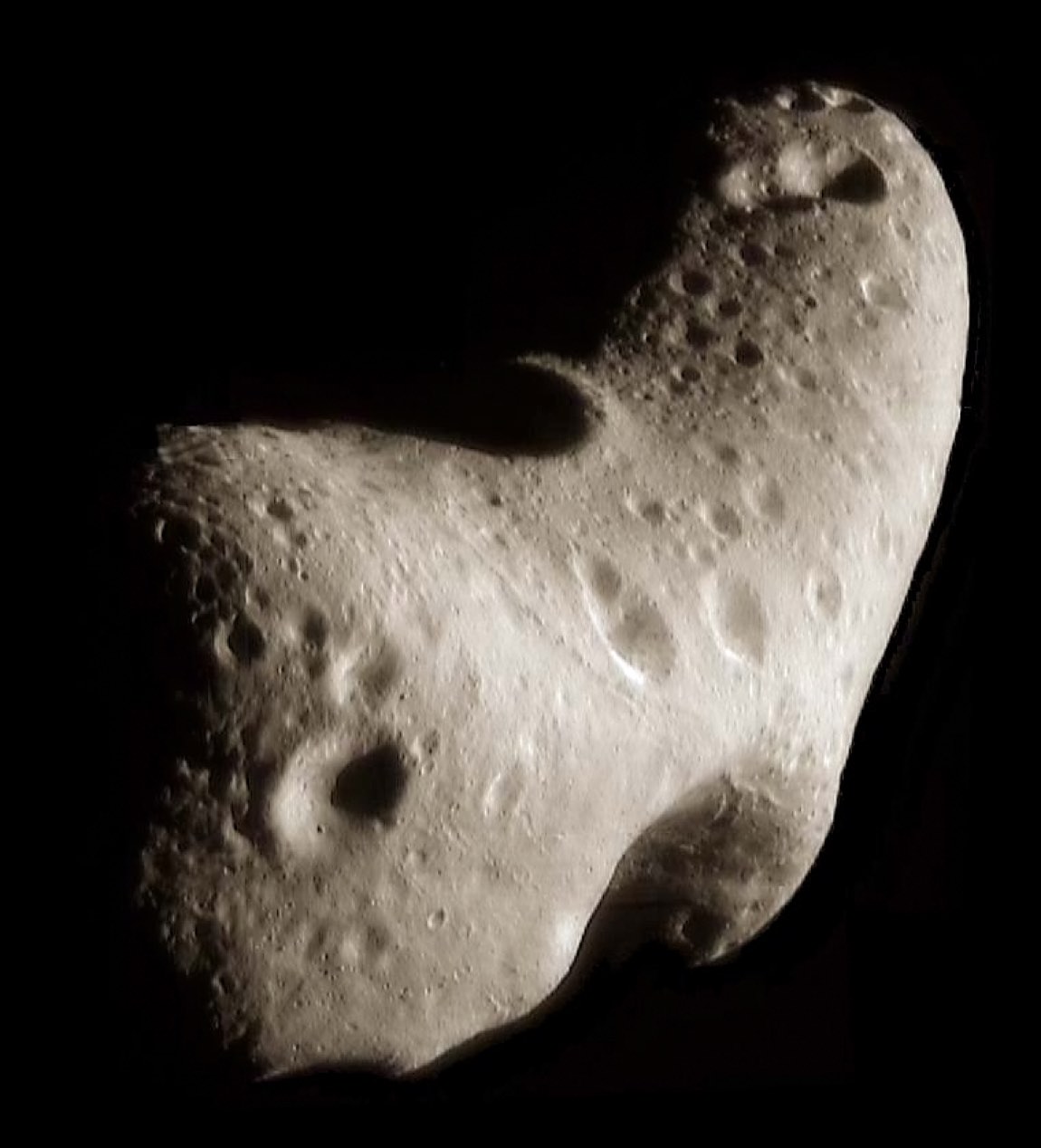
Amor is a near-Earth asteroid about 1 km across on an eccentric orbit. Discovered by Eugène Delporte in Belgium in 1932, it was the first asteroid seen to come so close to Earth, and it gave its name to the Amor group — asteroids that come within Earth's neighbourhood but stay just outside its orbit. Amor is the Latin name for Cupid. Unusually for an asteroid known so long, its rotation period has never been measured.
The deep dive
Researched for the Atlas from Wikipedia — 1221 Amor (3,121 characters read) · updated Nov 14, 2026
01 The discovery that changed how we see danger
Before March 1932, astronomers had no direct evidence that an asteroid could venture anywhere near Earth's cosmic neighbourhood. That changed on 12 March 1932, when Belgian astronomer Eugène Delporte photographed a faint moving speck from the Royal Observatory of Belgium at Uccle. The object was closing to within 16 million kilometres of Earth — roughly 40 times the distance from Earth to the Moon. For context, that is close enough that, on a Solar System map drawn to scale on a basketball court, the gap would be about the width of a finger. On the same night, observers at Heidelberg independently caught the same object, giving the discovery a simultaneous, corroborating record. The provisional designation 1932 EA1 was assigned, and the event marked the first time any asteroid had been witnessed approaching Earth so closely. That single photographic plate quietly opened a new field of planetary science: the systematic search for objects that share our neighbourhood.
02 Naming three gods of love at once
The name Amor comes from the Latin word for love and is the Roman identity of Cupid, the winged deity better known today for Valentine's Day arrows. The choice was deliberate and poetic: Amor approaches Earth's orbit but never quite crosses it, forever reaching but never arriving — much like the mythological figure. What makes the naming landscape particularly rich is that two other asteroids share the same divine genealogy. Asteroid 433 Eros carries the Greek name of the same god, while 763 Cupido uses the alternative Latin form. All three names refer to essentially the same deity across two languages and multiple mythological traditions. The official naming citation appeared in Paul Herget's reference work The Names of the Minor Planets, published in 1955, recorded at entry H 113. Delporte, the discoverer, chose a name that would eventually lend its identity to an entire class of thousands of objects — every Amor asteroid owes its group name to this single kilometre-wide rock.
03 What it means to be an Amor asteroid
Amor is not just an individual asteroid — it is the defining example of a whole population. Amor-type asteroids are near-Earth objects that approach Earth's orbit from the outside but never actually cross it. This sets them apart from the Apollo group, whose members do cross Earth's orbital path. Despite being second in size to the Apollo group, the Amor family is still enormous: more than 7,000 members are known. All of these objects are classified as near-Earth asteroids because their orbits bring them close enough to the inner Solar System to be considered relevant to Earth's vicinity, even if they never become true Earth-crossers. Amor itself skirts just inside the boundary of this definition. It is also a Mars-crosser, meaning its elliptical path carries it across the orbit of Mars at a distance of 1.66 AU from the Sun. This dual classification — Amor-type and Mars-crosser — reflects how orbits in this region of the Solar System can simultaneously thread through the paths of multiple planets.
04 An orbit that stretches almost to the asteroid belt Deeper
Amor follows a markedly elongated path around the Sun, swinging between 1.08 AU at its closest point and 2.76 AU at its farthest. That outer limit places it well into the main asteroid belt region, while the inner limit brings it just beyond Earth's orbit at 1.0 AU. The semi-major axis — the average of those two extremes — sits at 1.92 AU. The orbit's eccentricity of 0.44 is high by inner Solar System standards; for comparison, Earth's eccentricity is only about 0.017. The orbital plane is tilted 12 degrees relative to the ecliptic, the flat reference plane of the Solar System. One complete trip around the Sun takes 971 days, or approximately 2 years and 8 months. This orbital geometry means Amor spends significant time in the cooler, dimmer reaches between Mars and the asteroid belt before looping back inward toward the warmer inner Solar System. The combination of high eccentricity and moderate inclination makes precise long-term orbit prediction more complex than for objects on nearly circular, coplanar paths.
05 Its closest brush with Earth, past and future Deeper
Among all recorded close encounters since 1900, Amor's nearest pass to Earth occurred in March 1940, when it reached a distance of 0.1052 AU — equivalent to about 15,700,000 kilometres. The minimum orbital intersection distance, a measure of how close the two orbital paths can theoretically come to each other, stands at 0.1069 AU, or 16,000,000 kilometres, which corresponds to 41.6 lunar distances. That is a comfortable margin by planetary defence standards, but it places the orbit well within the range that qualifies an object as a near-Earth asteroid. Looking forward, the next approach of comparable closeness is not expected until March 2129, when Amor will pass at approximately 0.1082 AU — just slightly farther than its 1940 record. The long gap between notable encounters reflects the rhythm of its 971-day orbit and the geometry of how Earth and Amor's paths align over decades. For observers and researchers, these predictable windows are the primary opportunities to study the asteroid in any detail from ground-based telescopes.
06 A stony surface with two competing size estimates Deeper
Amor is classified as an assumed S-type asteroid, meaning it is thought to be composed of silicate rock — the same broad family as ordinary chondrite meteorites that fall to Earth. The word "assumed" matters here: the classification is an inference based on its orbital and spectral context rather than confirmed by high-resolution observations. Two different estimates exist for its diameter. Tom Gehrels's 1994 publication Hazards due to Comets and Asteroids gives a diameter of 1.0 kilometre and an albedo — a measure of surface reflectivity — of 0.15. The Collaborative Asteroid Lightcurve Link takes a different approach, applying a standard albedo of 0.20 for stony asteroids and calculating a smaller diameter of 0.857 kilometres from the asteroid's absolute magnitude of 17.7. These two values differ by roughly 15 percent, a gap that matters when estimating mass and potential impact energy. Until dedicated observations resolve the albedo precisely, both figures remain in circulation.
07 The rotation period nobody has measured yet
Despite being discovered in 1932 and lending its name to a class of thousands of objects, Amor has never yielded a reliable rotation period. As of 2018, no rotational lightcurve had been successfully obtained through photometric observations. A lightcurve is produced by measuring how an asteroid's brightness changes over time as it rotates, with brighter and dimmer phases revealing the spin rate and sometimes the shape. For Amor, the rotation period, pole orientation, and overall shape all remain unknown. This is unusual: Amor is a low-numbered asteroid, and low-numbered objects tend to have long observational histories that usually produce at least some physical data. The gap likely reflects the asteroid's infrequent close approaches — without a nearby pass, it is simply too faint for the extended, careful photometry that lightcurve analysis demands. It stands as one of few low-numbered asteroids for which this fundamental physical property is still missing.
08 Eugène Delporte and the Uccle Observatory
The man behind the discovery, Eugène Delporte, was a Belgian astronomer working at the Royal Observatory of Belgium, located in the Brussels suburb of Uccle. Delporte had a habit of finding things others missed — he is credited with discovering dozens of minor planets over his career, and Amor was among his most consequential finds. The Royal Observatory at Uccle was equipped to conduct the kind of systematic photographic sky surveys that made asteroid discovery possible in the early twentieth century. Astronomers of that era would expose glass plates to the night sky and then compare images taken at different times, hunting for the telltale streaks or position shifts that betrayed a moving object. When Delporte photographed Amor on 12 March 1932, the asteroid's closeness to Earth made its motion across the sky unusually rapid, almost certainly making it easier to identify as something worth following up. The simultaneous observation from Heidelberg the same night confirmed the find independently.
09 How to observe Amor from Earth today
Observing 1221 Amor from a backyard telescope is not a casual undertaking. The asteroid has an absolute magnitude of 17.7, which means that even at its theoretical brightest — perfectly placed and reflecting maximum sunlight — it is a faint object. Its closest recorded approach since 1900 was just under 15.7 million kilometres, still far enough to make it dim. The next approach at a comparable distance is not expected until March 2129, well beyond any living observer's horizon. In the intervening years, Amor recedes into the main belt region at distances beyond 2.7 AU, fading to the point where only large professional telescopes could detect it. Amateur observers looking to track it would need to plan around its orbital rhythm and use finder charts generated from current ephemeris data. Its status as a low-numbered asteroid means its orbit is very well known, so predictions of its position at any future date are highly reliable — it is the brightness, not the location uncertainty, that limits observation.
10 Open questions and what researchers still want to know Deeper
For an asteroid that defines an entire class of near-Earth objects, 1221 Amor remains surprisingly poorly characterised at the physical level. The most pressing gap is the absence of any confirmed rotation period — a basic property that has been measured for the vast majority of comparably important asteroids. Without a lightcurve, researchers cannot determine the shape, the pole orientation, or whether the asteroid is a monolithic rock or a loosely bound rubble pile, which are properties with real implications for understanding how such objects respond to slow thermal forces over millions of years. The two competing diameter estimates, differing by about 150 metres, also leave the object's mass and density unconstrained. Whether the S-type classification holds up under spectroscopic scrutiny has not been definitively tested for this particular body. All of these unknowns point toward the same conclusion: despite its historical importance as the first asteroid seen to approach Earth so closely, Amor itself has never been a primary target for dedicated observational campaigns.