 Photograph · ESO · CC BY 4.0
Asteroid · Deep guide
7968 Elst–Pizarro (133P)
Also called: 7968 Elst–Pizarro · 133P/Elst–Pizarro · P/1996 N2 · 1979 OW7
An asteroid that grows a comet tail — the prototype of the 'main-belt comets'.
What is it?
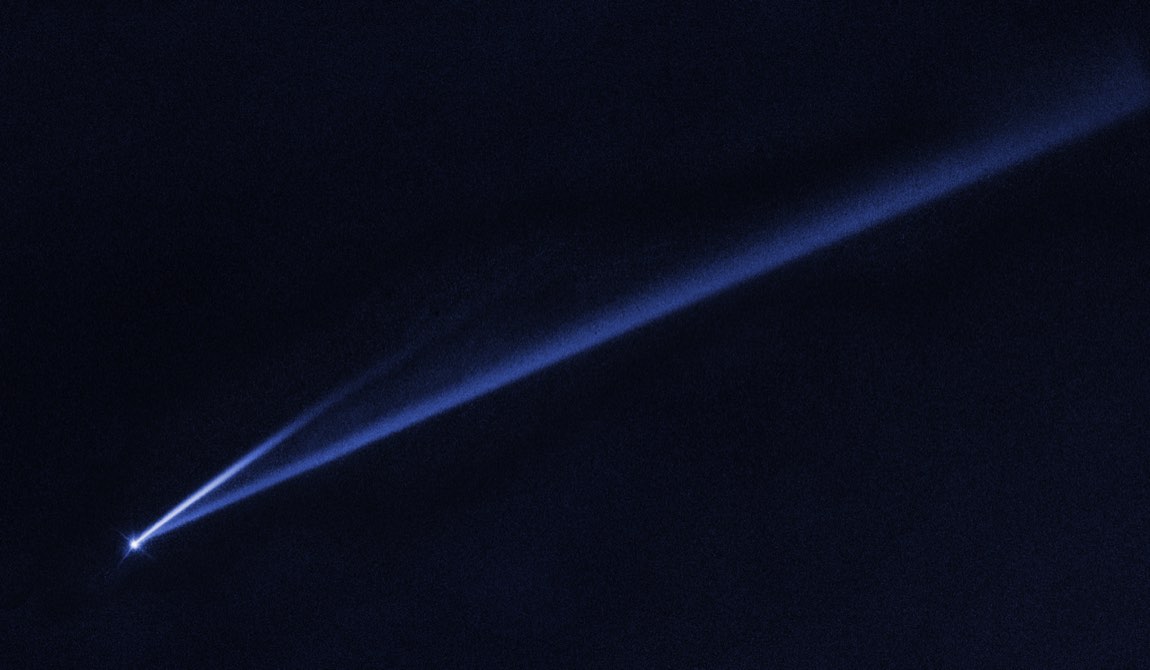
Elst–Pizarro orbits the Sun entirely within the asteroid belt like any ordinary asteroid, yet near its closest approach to the Sun it sprouts a thin dust tail. The tail was first seen in 1996 by Eric Elst and Guido Pizarro, and it returned in 2001 and 2007. Because of this it holds both an asteroid number (7968) and a comet name (133P). It is thought to contain buried ice that sublimates when warmed, making it the prototype of active main-belt asteroids.
The deep dive
Researched for the Atlas from Wikipedia — 7968 Elst–Pizarro (2,882 characters read) · updated Nov 14, 2026
01 A Tail Where No Tail Should Be
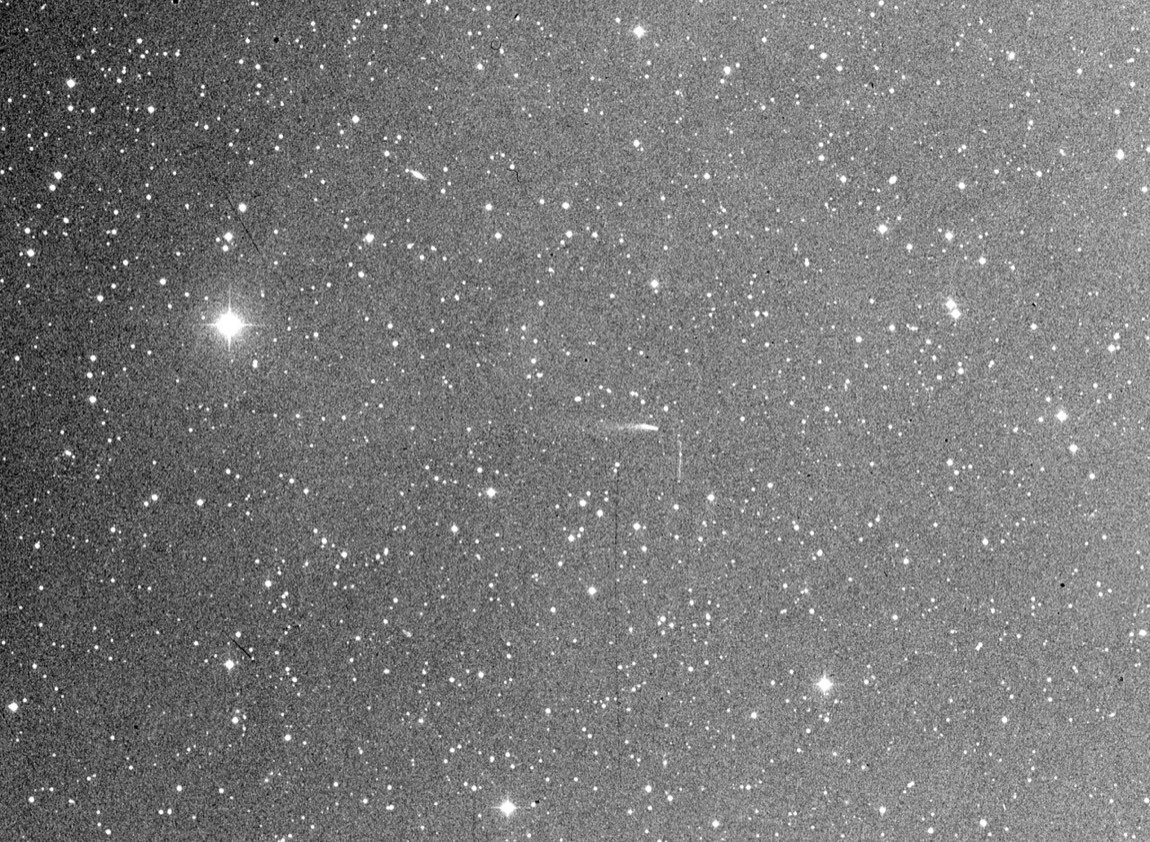
On 7 August 1996, astronomers Eric W. Elst and Guido Pizarro were observing with the ESO 1-metre Schmidt telescope at La Silla Observatory in Chile when they spotted something that simply should not have been there: a linear dust tail streaming from what everyone assumed was an ordinary asteroid. Cometary tails are driven by solar heat vaporising ices, and ices are not supposed to survive for billions of years in the warm, collision-rich inner solar system. Yet the evidence was unambiguous — a streak of dust, unmistakably cometary in character, attached to a body whose orbit never ventures beyond the asteroid belt. That single observation on a single August night forced planetary scientists to reconsider what the asteroid belt actually contains and opened an entirely new category of solar system object. Elst–Pizarro was not just a curiosity; it was proof that the boundary between asteroids and comets, long treated as a clean divide, is blurrier than anyone had supposed.
02 Three Outbursts, One Tiny Active Patch Deeper
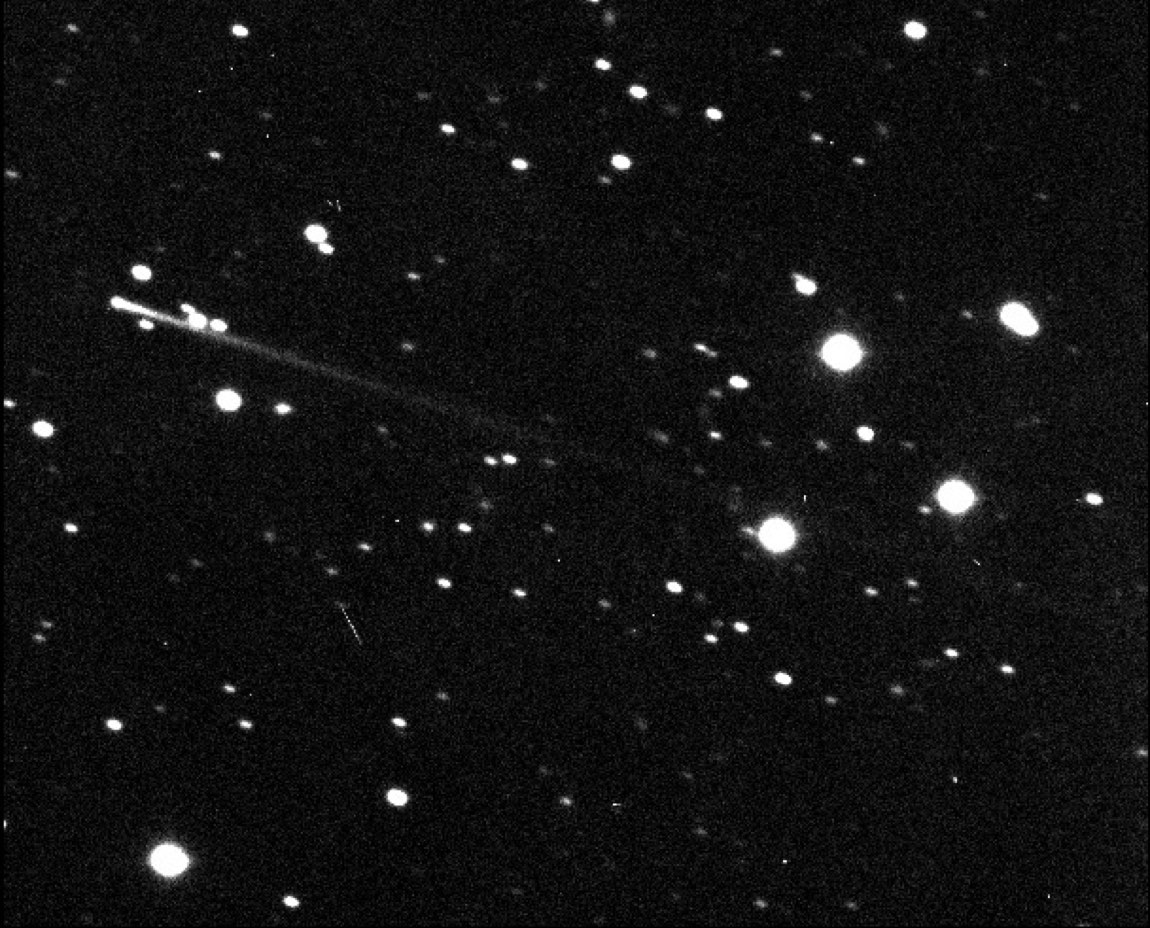
What makes Elst–Pizarro especially compelling is the repeatability of its activity. After the 1996 discovery, astronomers watched for the next perihelion passage, and right on schedule, around November 2001, the cometary activity reappeared and persisted for five months — far longer than a one-off event could explain. It then showed activity again near perihelion in 2007, and came to perihelion again on 8 February 2013. This periodic recurrence is a critical clue: a single catastrophic impact might release a one-time dust cloud, but activity that returns with each perihelion passage points strongly toward sublimating ice responding to solar heating. Even more striking is how geographically confined the outgassing is. Research has pinpointed the active region to a surface area measuring less than 600 metres in effective diameter — roughly six city blocks. Scientists believe this small active patch is a relatively young impact crater, formed less than 100 million years ago, whose collision excavated buried ice that had been shielded from solar heat by an insulating layer of dust and rock.
03 An Orbit That Refuses to Leave the Belt
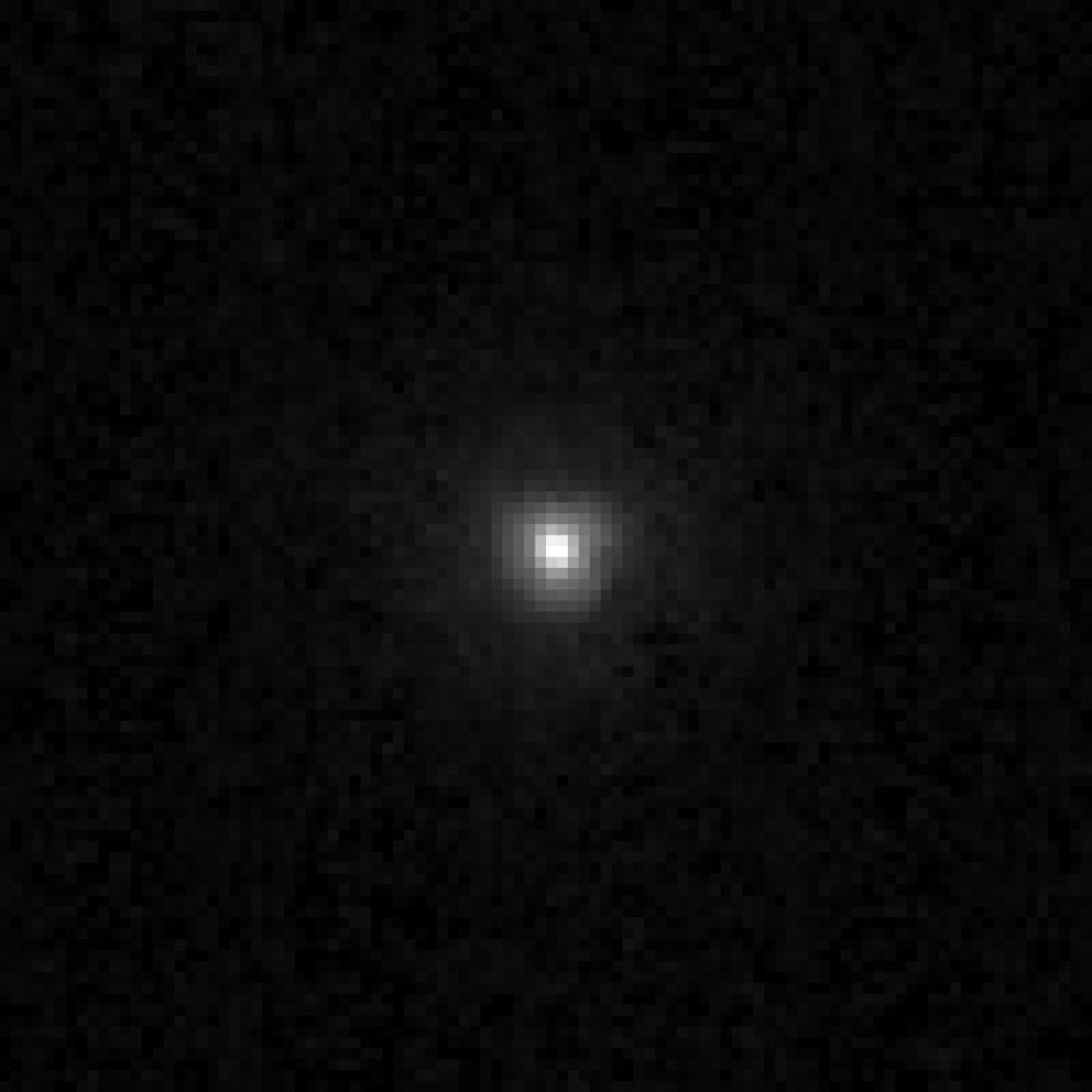
What sets Elst–Pizarro apart from classical comets almost as much as its tail is where it lives. Its orbit stays entirely between the orbits of Mars and Jupiter — the main asteroid belt — with an orbital eccentricity of just 0.165, a figure typical for unremarkable minor planets rather than icy visitors from the outer solar system. Classical comets usually arrive from the distant Kuiper Belt or Oort Cloud on highly elongated paths, spending most of their lives far from the Sun and swinging close only briefly. Elst–Pizarro does none of that. It was first recorded as long ago as 1979, logged as minor planet 1979 OW7, its image on a photographic plate described as completely stellar in appearance — no fuzz, no tail, nothing unusual. For seventeen years it sat uneventfully in the catalogues before its dramatic reveal in 1996, demonstrating that an icy body can lurk unrecognised in a part of the solar system we thought we understood.
04 Prototype of a New Class: Active Asteroids
Elst–Pizarro is not merely an interesting oddball; it is formally the prototype of an entire class of objects now called active asteroids. When a solar system body displays cometary behaviour — dust emission, tails, outgassing — but follows an asteroidal orbit, it qualifies for this dual status. At the time of writing, eight other objects share the distinction of being cross-listed as both comets and asteroids: 2060 Chiron (95P/Chiron), 4015 Wilson–Harrington (107P/Wilson–Harrington), 60558 Echeclus (174P/Echeclus), 118401 LINEAR (176P/LINEAR), (323137) 2003 BM80 (282P), (300163) 2006 VW139 (288P), (457175) 2008 GO98 (362P), and (248370) 2005 QN173 (433P). As the prototype, Elst–Pizarro sets the template against which all these later discoveries are measured. Its formal comet designation is 133P/Elst–Pizarro, while for astrometric reporting purposes the community uses the minor planet designation 7968 Elst–Pizarro, illustrating how awkward existing classification systems become when nature refuses to stay in one box.
05 Ice in the Asteroid Belt and Earth's Oceans Deeper
The existence of active asteroids like Elst–Pizarro has direct implications for one of planetary science's most debated questions: where did Earth's water come from? One leading hypothesis holds that icy bodies from the outer solar system delivered water to the early Earth through impacts. But Elst–Pizarro demonstrates that water ice can be preserved inside main-belt asteroids, raising the possibility that the asteroid belt itself was a significant water reservoir close to home. If numerous belt objects harbour buried ice, they would have been frequent impactors on the young Earth and could have contributed substantially to the oceans. This is precisely the science question motivating the proposed Castalia mission — to make the first in situ measurements of water in the asteroid belt. Such a measurement would not merely characterise one strange object; it could help quantify the entire main belt's contribution to Earth's water budget and reshape models of how habitable planets form.
06 The Young Crater That May Drive It All Deeper
The leading explanation for Elst–Pizarro's periodic activity centres on a relatively recent impact. Over billions of years, solar radiation and cosmic-ray bombardment process the outermost layers of asteroids, destroying volatile molecules and leaving behind a dry, insulating lag deposit — essentially a crust of dehydrated rubble. Ice underneath such a crust could persist for the age of the solar system. When a impactor punches through the lag, it exposes fresh ice to sunlight for the first time. Scientists estimate that the active crater on Elst–Pizarro is younger than 100 million years — geologically recent but still ancient by human standards, roughly twice as old as the dinosaur extinction. The small size of the active patch, less than 600 metres in effective diameter, is consistent with a modest impact event rather than a global resurfacing. Each perihelion passage warms this exposed patch, sublimating ice and lofting dust into the observed tail, while the ice supply slowly depletes. Eventually the activity should cease, leaving another inert asteroid indistinguishable from its neighbours.
07 How Elst–Pizarro Got Its Names
The body carries the names of the two astronomers who first documented its cometary appearance in 1996: Eric W. Elst and Guido Pizarro. Its comet designation, 133P, reflects that it was the 133rd periodic comet to receive an official designation, while the prefix P indicates it has been observed at more than one perihelion passage — a standard confirmation that the activity is genuinely periodic. The earlier asteroid designation, 7968, was assigned based on its 1979 discovery as minor planet 1979 OW7, when nothing about it suggested anything other than an unremarkable belt object. Carrying both a numbered asteroid designation and a periodic comet designation simultaneously is unusual and highlights the object's peculiar nature. For the purposes of positional astronomy, astrometric observations should be reported under the minor planet designation, a practical convention reflecting the fact that its orbit is classified among the asteroids.
08 Castalia: A Mission Concept for a Hybrid World
Recognising that Elst–Pizarro offers a unique window into asteroid-belt water ice, a team led by Colin Snodgrass of The Open University in the United Kingdom proposed the Castalia mission concept. Castalia would send a robotic spacecraft to Elst–Pizarro to make the first direct, in situ measurements of water in the asteroid belt. The team submitted proposals to the European Space Agency under the Cosmic Vision programme in both 2015 and 2016, targeting the M4 and M5 mission slots, but Castalia was not selected on either occasion. Despite the setbacks, the team continued developing the concept and refining its science objectives. Because of the time needed to build a spacecraft and the constraints imposed by orbital dynamics, the team identified October 2028 as a proposed launch date. The mission's name, Castalia, echoes a tradition of naming space mission concepts evocatively, though the article does not elaborate on the mythological reference.
09 China's ZhengHe Mission and 2032 Rendezvous
Even as the European Castalia concept awaits its chance, another path to Elst–Pizarro has opened. The Castalia science team is now exploring contributing instruments to China's ZhengHe comet exploration mission, which is proposed for launch in 2025. If the mission proceeds as planned, ZhengHe would conduct detailed remote sensing and in situ measurements at Elst–Pizarro in 2032. This would represent the first spacecraft visit to an active asteroid and the first direct sampling of the conditions driving its cometary behaviour. The involvement of Castalia scientists as instrument contributors, even on a mission led by another space agency, illustrates how the scientific community's desire to understand this object has persisted through years of funding disappointments. A 2032 rendezvous would almost certainly occur near enough to a perihelion passage to observe the active region in action, potentially catching the sublimation process as it happens.
10 What We Still Do Not Know Deeper
Despite three well-documented activity episodes and decades of telescopic study, Elst–Pizarro leaves fundamental questions unanswered. The ice hypothesis is strongly favoured but has never been confirmed by direct measurement — no spacecraft has yet visited the object, and remote spectroscopy of water ice on a dust-covered surface at this distance is extraordinarily difficult. It remains uncertain exactly how much ice is present, how deep it extends beneath the surface, and whether the active crater will continue sublimating for centuries or exhaust its supply within a few more perihelion passages. The composition of the dust in the tail is also poorly constrained. More broadly, it is unknown how many other main-belt asteroids harbour similar buried ice deposits without yet having experienced the impact that would expose them to sunlight. Elst–Pizarro may be unusual, or it may be one visible member of an enormous hidden population of icy belt objects — a distinction with profound consequences for understanding solar system history and the delivery of water to Earth.