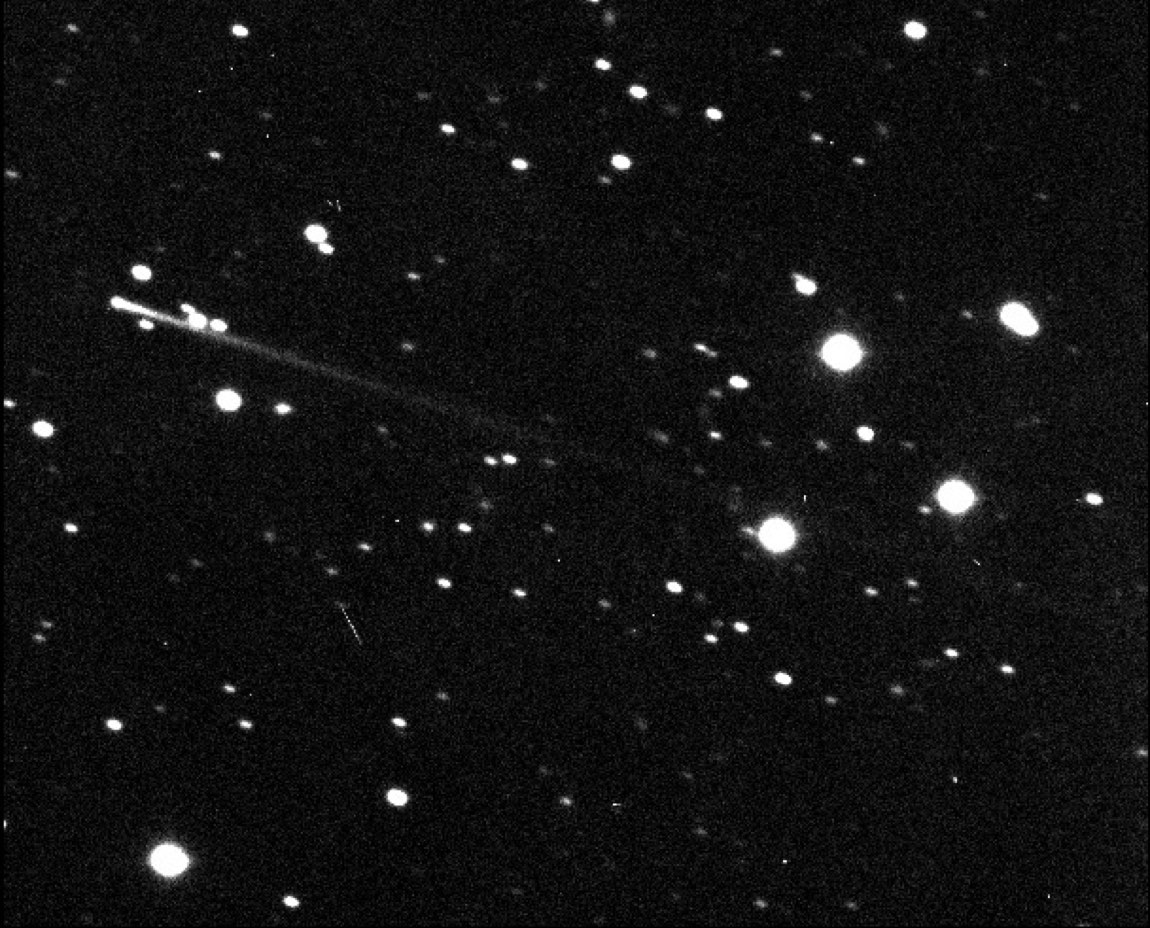
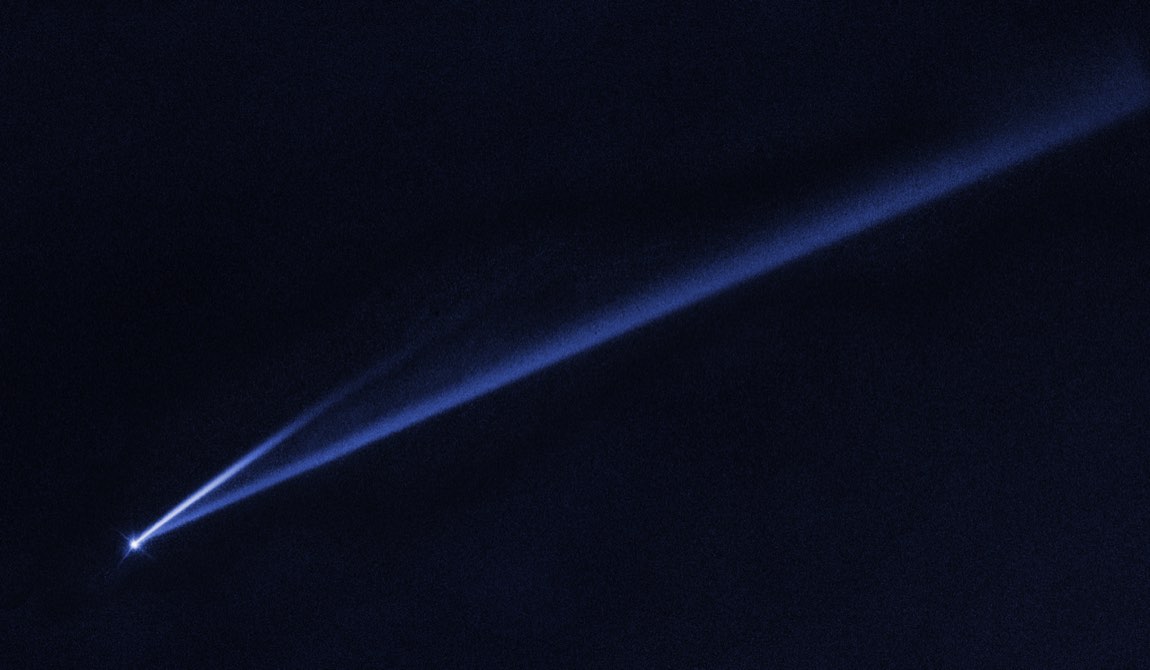
 Photograph · , , K. Meech and J. Kleyna (University of Hawaii), and O. Hainaut (European Sout · Public domain
Asteroid · Deep guide
6478 Gault
Also called: 6478 Gault · (6478) Gault · 1988 JC1
An ordinary-looking asteroid that sprouted comet-like tails in 2019, probably from spinning too fast.
What is it?
Gault is a small asteroid a few kilometres across in the inner asteroid belt. In January 2019 telescopes caught it with multiple dust tails, like a comet, and older images showed it had been active since at least 2013. It rotates once every 2.5 hours. It was found in 1988 by Carolyn and Eugene Shoemaker.
The deep dive
Researched for the Atlas from Wikipedia — 6478 Gault (4,608 characters read) · updated Nov 14, 2026
01 A family of ancient stony wanderers
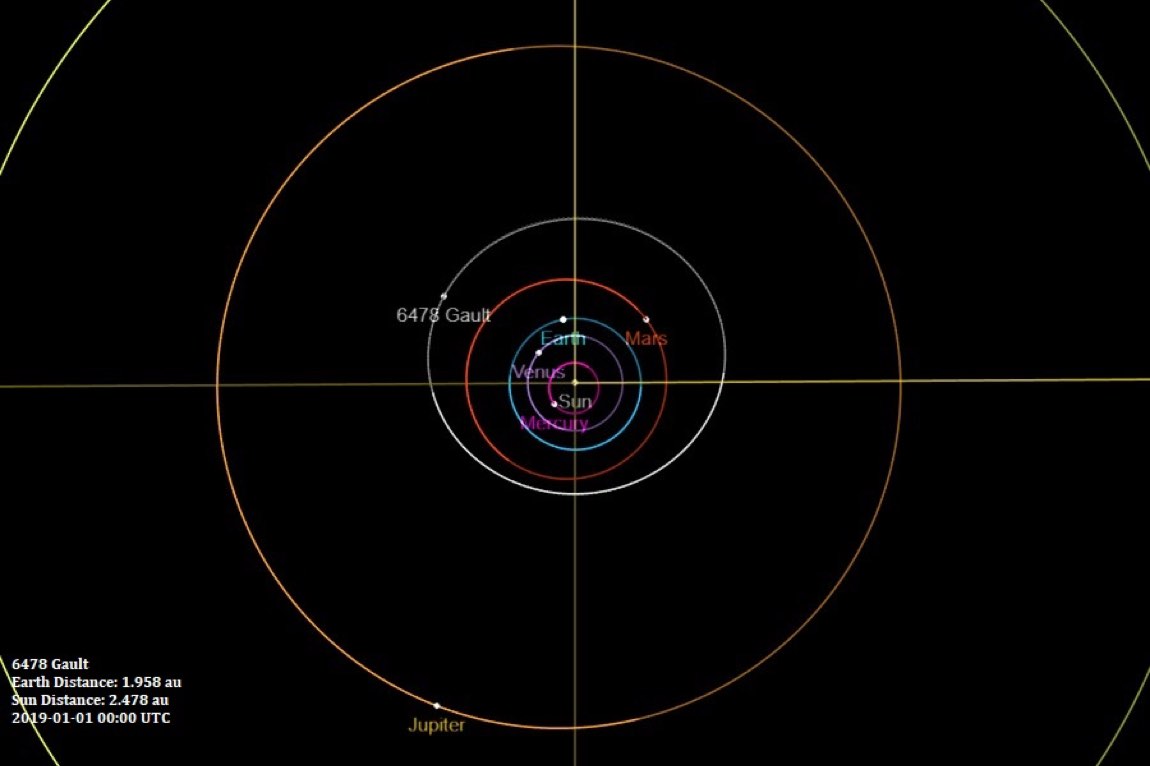
Gault belongs to the Phocaea family, a grouping of nearly 2,000 known stony asteroids in the inner asteroid belt, all named after the family's largest member, 25 Phocaea. This family is notable for holding the highest orbital inclination of any asteroid family in the inner belt — a tilt that sets its members apart from the more crowded, flatter swarms closer to the ecliptic plane. The family itself is old: it formed up to 2.2 billion years ago, meaning these fragments have been drifting through the inner solar system since before complex animal life existed on Earth. Some Phocaea members have orbits eccentric enough to cross the path of Mars, making them occasional interlopers in the red planet's neighborhood. Gault shares this heritage, orbiting the Sun on a moderately elliptical path with an eccentricity of 0.19 and an inclination of 23 degrees, swinging between 1.9 and 2.8 astronomical units from the Sun over a period of 3 years and 6 months — or 1,278 days.
02 Spinning itself to pieces: the YORP effect
The most remarkable thing about Gault is that it appears to be tearing itself apart — not through a collision, but through sunlight. The mechanism responsible is called the YORP effect, a subtle but relentless process in which uneven thermal radiation from an irregularly shaped asteroid creates a tiny torque that gradually spins the body faster over time. As Gault's rotation accelerated toward a period of roughly two hours, it approached the critical spin limit at which centrifugal force at the surface overcomes gravity. At that threshold, loose material can no longer hold on. The result was a series of dust ejections that produced the dramatic tails first spotted in January 2019. This makes Gault one of the clearest real-world demonstrations of the YORP effect actually spinning a body fast enough to trigger mass loss — a process long theorized but rarely caught in such vivid action. The collision hypothesis was considered and ruled out, leaving rotational breakup as the leading explanation.
03 Two tails and what they tell us Deeper
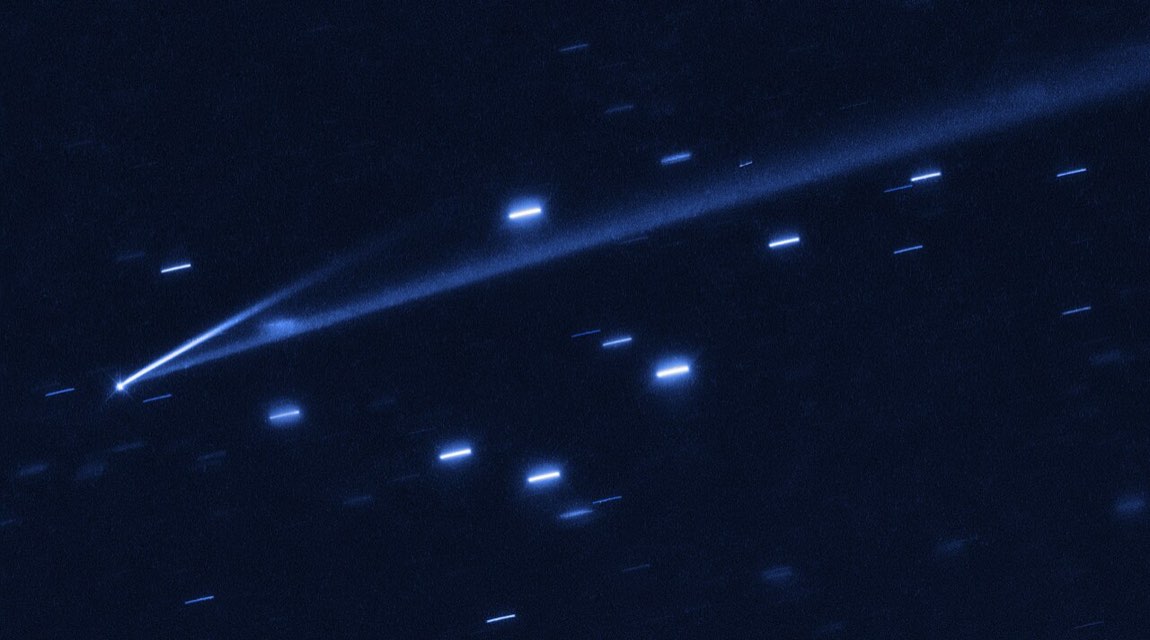
When astronomers analyzed images from the 2018–19 opposition, they found not one but two distinct dust tails streaming away from Gault. The longer of the two has been estimated at over 800,000 kilometers in length — roughly twice the distance from Earth to the Moon — which made it unmistakable even in archival data. The two tails were traced back to separate ejection events: the first outburst is pinned to around 18 October 2018 and the second to around 24 December 2018. These weren't equal events. The October outburst released an estimated 2×10⁷ kilograms of material, while the December event shed approximately 1×10⁶ kilograms — an order of magnitude less. The ejected dust grains are tiny, reaching up to 10 micrometers in size, and they travel slowly, with velocities below one meter per second regardless of grain size. This slow, fine-grained character of the ejecta was itself a clue pointing away from a violent impact and toward a gentler, rotation-driven shedding process.
04 Morphology echoing a famous spacecraft experiment Deeper
Scientists examining Gault's outburst tails between late 2018 and early 2019 noted a striking resemblance to a very different astronomical event: the ejecta plume created when NASA's Double Asteroid Redirection Test — DART — deliberately slammed a spacecraft into Dimorphos in September 2022. The morphology of Gault's tails is described as similar to the structure of that intentionally produced ejecta cloud. This parallel is scientifically useful because it offers a natural analog for studying how fine debris spreads and evolves in space after a sudden mass-ejection event, without the need for an artificial impactor. It also highlights how processes that look exotic or engineered — like deliberately crashing a probe into a small body to study ejecta — may have natural counterparts playing out quietly in the asteroid belt, driven entirely by sunlight and spin rather than by any external force.
 ⤢
05 Active for years before anyone noticed
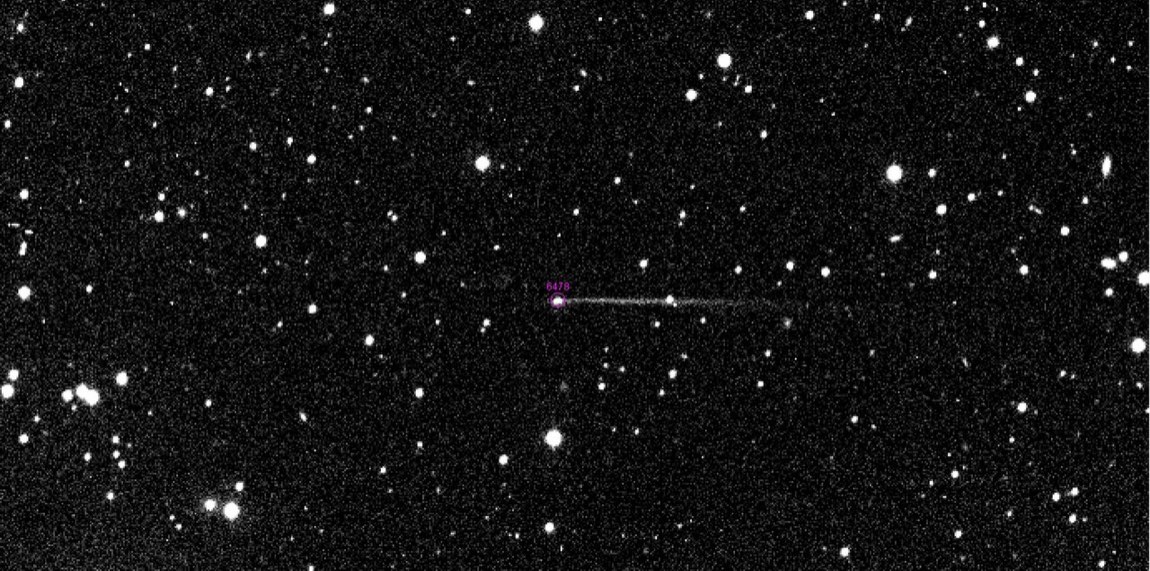
The January 2019 discovery of Gault's tail seemed sudden, but a deeper look at archival images told a more patient story. When astronomers went back through observatory images taken in 2013, 2016, and 2017, they found evidence that Gault had been continuously active the entire time — including a visible tail during its 2013 apparition, when the asteroid was near its greatest distance from the Sun. That pushed the confirmed start of activity back by at least five years before the announced discovery. Even more striking, no earlier observations had ever recorded any sign of activity, suggesting the onset of this behavior was a genuine change in the asteroid's condition rather than a permanent feature. This prolonged activity record sets Gault apart: if rotational breakup truly drives it, Gault has sustained that behavior far longer than any other known object of its type, challenging models of how quickly such events should exhaust themselves.
06 A possible new class of active asteroid
Active asteroids — objects that orbit like asteroids but display cometary features like tails — are themselves a rare and diverse group. What makes Gault particularly unusual is the combination of its activity duration, its spin-driven mechanism, and the absence of any confirmed icy composition to explain sublimation in the conventional cometary sense. Scientists have not ruled out the possibility that solar heating could cause sublimation of ice hidden beneath Gault's surface in a kind of subsurface pocket, with the force of escaping gas also contributing to the spin acceleration. But whether ice or pure spin-up is responsible, the duration of Gault's activity — at least five years — has led researchers to suggest it may represent a genuinely new category of object. Prior examples of YORP-driven mass shedding existed in the scientific literature, but none had been observed to remain active on this timescale, making Gault a benchmark case.
07 An ambiguous spectral identity Deeper
Classifying Gault by its light spectrum is not entirely straightforward. Its membership in the Phocaea family points toward a stony S-type composition — silicate-rich, relatively bright, and typical of the inner asteroid belt. The family-specific albedo used to estimate its size is 0.22, consistent with that S-type expectation. However, some features of Gault's actual spectrum more closely resemble those of carbonaceous C-type asteroids, which are darker, richer in carbon compounds, and more commonly found in the outer belt. This ambiguity has not been fully resolved. The asteroid's pole orientation and three-dimensional shape remain unknown, though its lightcurve reveals that the surface is not smooth — irregularities and concavities are inferred from the way brightness varies during rotation. Its absolute magnitude is 14.4, and from that figure combined with the assumed albedo, its diameter is estimated at approximately 3.7 kilometers.
08 The spin rate riddle: 1.79 or 3.36 hours? Deeper
Measuring Gault's rotation period in 2019 — right as it was actively shedding material — produced a result with a built-in ambiguity. Photometric observations yielded two candidate rotation periods: either 1.79 hours or 3.36 hours, the second being almost exactly double the first. This kind of ambiguity is common in asteroid lightcurve analysis, where a single-peaked and double-peaked light curve can produce different period solutions from the same dataset, and distinguishing between them requires additional observations or a well-constrained shape model. For Gault, the distinction matters enormously: at 1.79 hours, the asteroid would be spinning extremely close to — or even past — the theoretical breakup limit for a rubble-pile body held together only by self-gravity. The fact that the YORP effect was already shedding material at this spin rate is consistent with that near-critical interpretation. Resolving which period is correct would sharpen our understanding of exactly how close Gault is to full disintegration.
 ⤢
09 Donald Gault: the man behind the name
The asteroid carries the name of Donald Gault (1923–1999), an American planetary geologist whose career centered on understanding how impact craters form. Gault was not simply a theorist: he conducted hands-on field experiments to study cratering processes, then applied what he learned to interpreting real impact data returned from the surfaces of the Moon, Earth, Mars, and Mercury. This combination of experimental rigor and planetary-scale application made him an influential figure in the early decades of planetary science. The official naming citation was published by the Minor Planet Center on 28 July 1999, under M.P.C. 35484 — the same year Gault died, making the honor a posthumous one. There is a certain fittingness to the choice: an asteroid named for an expert in violent surface-reshaping processes turns out to be reshaping its own surface through spin-driven ejection, a gentler but no less dramatic form of geological transformation.
10 Discovery at Palomar and the Shoemakers' legacy
Gault was discovered on 12 May 1988 by Carolyn and Eugene Shoemaker, one of astronomy's most celebrated partnerships, working at the Palomar Observatory in California. The Shoemakers were prolific discoverers of minor planets and comets — Eugene in particular is remembered as one of the founders of the scientific study of cosmic impacts and planetary geology, while Carolyn holds a record for the number of comets discovered by a single person. At the time of Gault's discovery it was assigned the provisional designation 1988 JC1, a label that tracked it through the catalog system until its official naming a decade later. The body's observation arc begins with that May 1988 detection at Palomar. Its most recent perihelion passage — its closest approach to the Sun along its orbit — occurred in July 2023, and the next is projected for January 2027, giving observers a predictable window to study its ongoing activity.
11 How Gault's orbit traces a predictable path
Gault follows a well-characterized elliptical orbit with a semi-major axis of 2.31 astronomical units, placing it firmly in the inner asteroid belt. At perihelion it closes to 1.9 AU from the Sun, and at aphelion it retreats to 2.8 AU — a range that keeps it entirely within the main belt and well outside the orbit of Mars for most of its journey, though the broader Phocaea family does include Mars-crossing members with higher eccentricities. Gault's own eccentricity of 0.19 is moderate rather than extreme, and its 23-degree inclination relative to the ecliptic tilts it noticeably out of the plane in which most of the inner solar system orbits. That inclination is a family trait: the Phocaea group carries the highest orbital inclination of any family in the inner belt, a characteristic that has been preserved for up to 2.2 billion years since the family's formation event.
 ⤢