Asteroid · Deep guide
3753 Cruithne
Also called: 3753 Cruithne · (3753) Cruithne · 1986 TO
Sometimes called 'Earth's second moon' — but it actually orbits the Sun in step with us.
What is it?
Cruithne is a near-Earth asteroid that takes almost exactly one year to orbit the Sun, locking it into a 1:1 dance with Earth. Seen from Earth, its path traces a bean shape that slowly drifts into a horseshoe pattern taking about 770 years to complete. It does not orbit Earth — at times it is on the far side of the Sun — but its curious path earned it the nickname 'Earth's second moon'. Its orbit reaches inside Mercury's and beyond Mars's.
The deep dive
Researched for the Atlas from Wikipedia — 3753 Cruithne (6,409 characters read) · updated Nov 14, 2026
01 How its strange orbit was finally decoded
Although Cruithne was spotted on a photographic plate as early as 1986 — and a precovery image from 1983 was later credited to Giovanni de Sanctis and Richard M. West of the European Southern Observatory in Chile — astronomers had no idea what they were really looking at for over a decade. It was not until 1997 that Paul Wiegert and Kimmo Innanen, working at York University in Toronto, together with Seppo Mikkola at the University of Turku in Finland, worked out the asteroid's remarkable orbital behaviour. The 11-year gap between discovery and understanding reflects just how counterintuitive the orbit is: nothing about routine survey photography hints that an object is tracing a slow, looping path across Earth's orbital neighbourhood on a 770-year cycle. The team's analysis required numerical integration of the equations of motion over long timescales, and their 1997 result fundamentally expanded how planetary scientists think about Earth's gravitational neighbourhood.
02 The kidney-bean path explained step by step
Cruithne is in a perfectly ordinary elliptical orbit around the Sun — the strangeness only appears when you watch it from Earth's moving vantage point. Because its orbital period of approximately 364 days is slightly less than Earth's year, Cruithne completes each circuit around the Sun just a little faster. From Earth, this makes the asteroid appear to trace a kidney-bean or horseshoe shape ahead of us. Because it finishes each loop slightly early, the bean drifts slowly rearward relative to Earth year by year — Earth "falls behind" the bean a little more each time. Eventually, after roughly 380 to 390 years, Cruithne approaches from the other direction, makes a series of close passes, and gravitational energy is exchanged. Its orbital period then flips to slightly more than a year, and the drift reverses. The whole pattern — one complete transit around the horseshoe — takes 770 years to finish.
03 A gravitational handshake at close approach Deeper
The moment of closest approach is not just a spectacular alignment — it is a genuine dynamical event. When Cruithne catches up to Earth after centuries of slow drift, it makes a series of annual close approaches and the two bodies exchange orbital energy gravitationally. The result is that Cruithne's orbit shifts by a little over half a million kilometres, nudging its period from just-under to just-over one Earth year. Earth is affected too, but because of its vastly greater mass, its orbit changes by only about 1.3 centimetres (0.51 in) — less than the length of a fingernail. The next such series of close approaches will be centred on the year 2292, when in July of that year Cruithne will approach Earth to about 12.5 million kilometres (0.084 AU). A subsequent series, in which Cruithne again approaches from the opposite side, is expected around 2676.
04 How close does it actually get?
Even at its nearest, Cruithne is nowhere near as close as it might seem from the "second moon" nickname. Its closest approach to Earth is 12 million kilometres (0.080 AU), which is approximately thirty times the separation between Earth and the Moon. That enormous buffer means there is no danger of a collision with Earth for millions of years, if ever, according to calculations by Wiegert and Innanen. The orbital paths of the two bodies do not even cross, and Cruithne's orbital plane is tilted relative to Earth's by 19.8°, adding a vertical offset that provides further separation. For the period from 1994 through 2015, Cruithne made its annual closest approach to Earth every November. In 2058 it will come within 0.09 AU (13.6 million kilometres) of Mars — a reminder that its wandering path reaches well beyond Earth's neighbourhood.
05 An orbit that swings from Mercury to beyond Mars Deeper
Because Cruithne is classified as an Aten asteroid and has a high orbital eccentricity, its distance from the Sun and its orbital speed vary far more dramatically than Earth's relatively circular orbit allows. At one extreme its path brings it near the orbit of Mercury; at the other extreme it reaches outside the orbit of Mars. This wide swing means the asteroid spends parts of its journey in a very different thermal and radiation environment than Earth does, baking close to the Sun and then cooling in the outer reaches of the inner solar system. The same eccentricity is responsible for the kidney-bean appearance of its Earth-relative path: because it speeds up near perihelion and slows near aphelion, its apparent motion as seen from Earth traces that characteristic looping shape rather than a simple arc.
06 Long-term stability: synchronized but uncertain Deeper
Cruithne's 1:1 orbital resonance with Earth is real and measurable, but whether it will persist indefinitely is an open question. Calculations by Wiegert and Innanen showed that Cruithne has probably been synchronized with Earth's orbit for a long time, suggesting the resonance is not a recent accident. However, the orbit is not thought to be stable over the long term. Gravitational nudges from other planets, particularly during those periods when Cruithne strays near Mercury's or Mars's orbital zone, can gradually perturb the resonance. The asteroid could eventually be scattered onto a different orbit entirely. This uncertainty is one reason researchers track it carefully: the boundary between a co-orbital object that remains locked in resonance for geological timescales and one that escapes within astronomically short periods is subtle, and Cruithne sits in an instructive grey zone.
07 Cruithne is not alone — Earth has company
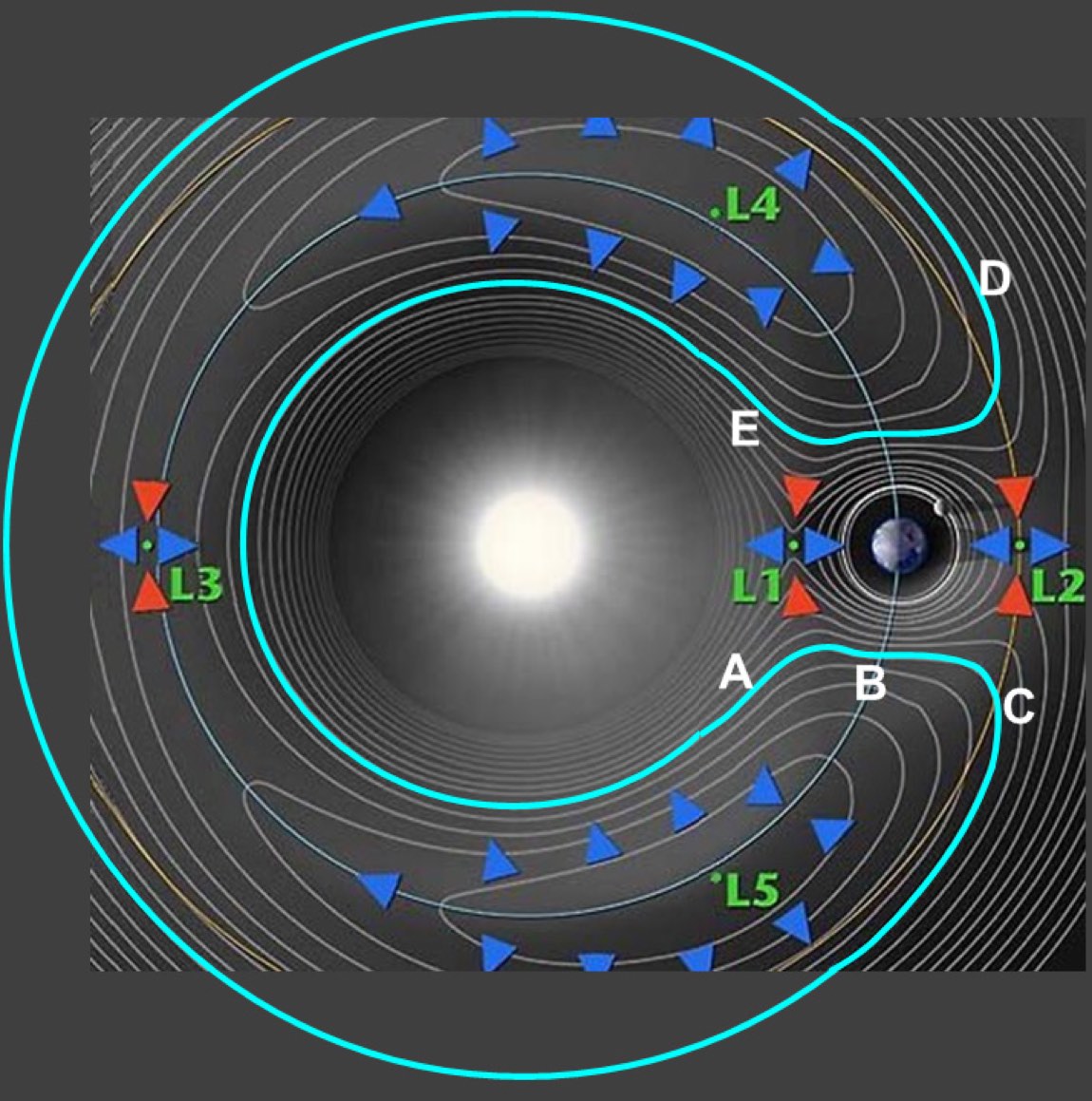
Cruithne was the first co-orbital object discovered for Earth, but it is no longer unique. Subsequent surveys have identified several more near-Earth objects in resonant or quasi-resonant orbits: 54509 YORP, (85770) 1998 UP1, 2002 AA29, and 2009 BD all occupy orbits similar in character to Cruithne's. Perhaps most importantly, (706765) 2010 TK7 became the first confirmed Earth trojan — an asteroid sitting at one of Earth's stable Lagrangian points — and as of 2024 only two Earth trojans are known. The existence of this growing family shifts Cruithne from curiosity to representative: Earth's gravitational neighbourhood turns out to harbour a population of transient and semi-permanent companions, each tracing its own variant of the resonant-orbit zoo that Cruithne first revealed.
08 Horseshoe orbits elsewhere in the solar system
The horseshoe orbit mechanism is not unique to Cruithne. The best-studied natural examples are Janus and Epimetheus, two moons of Saturn that exchange orbits with each other roughly every four years. The article notes that the orbits these two moons follow around Saturn are much simpler than the one Cruithne follows, but operate along the same general principles — the more complex shape of Cruithne's path arises from the high eccentricity that carries it across a wide range of solar distances. Mars has four known co-orbital asteroids (5261 Eureka, 1999 UJ7, 1998 VF31, and 2007 NS2) sitting at its Lagrangian points, and Jupiter hosts an estimated one million trojan asteroids greater than 1 km in diameter. The Saturnian system also contains co-orbital moon pairs Telesto and Calypso with Tethys, and Helene and Polydeuces with Dione — though none of these follow horseshoe orbits.
09 Observing Cruithne from Earth
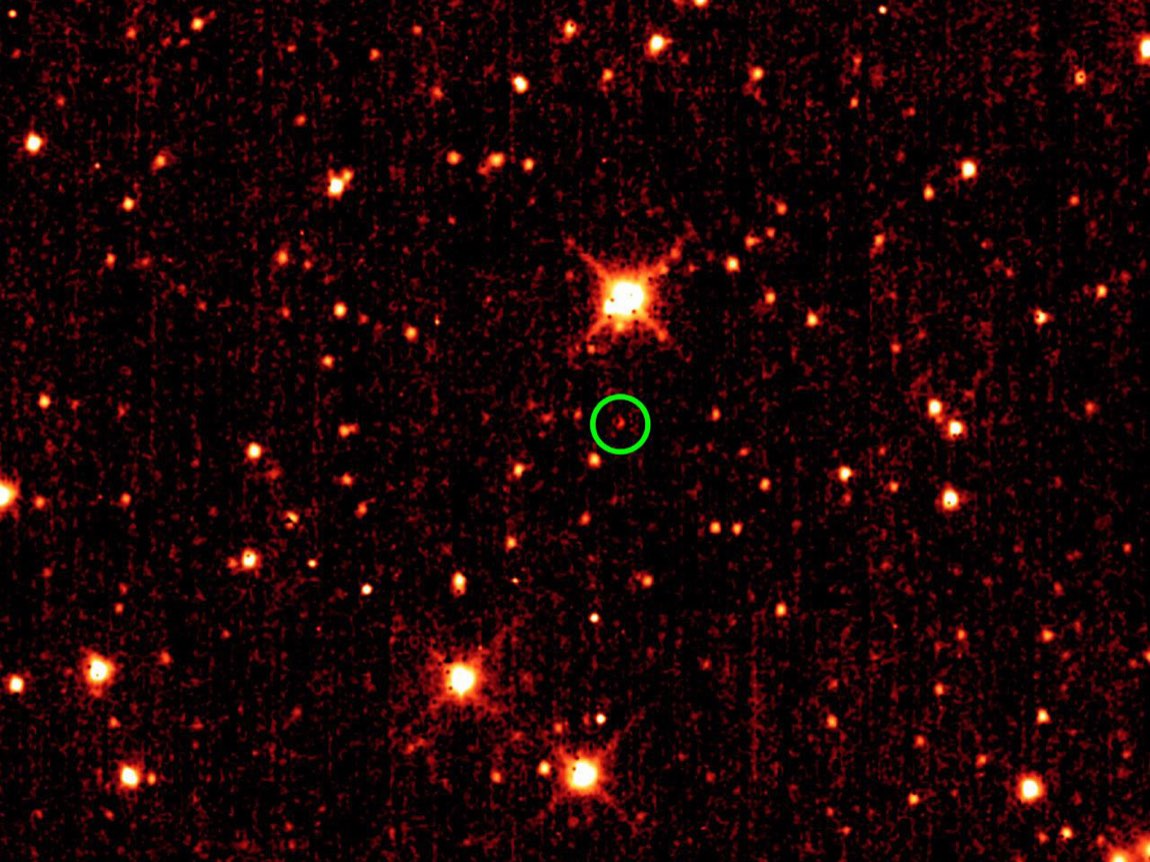
Despite its proximity in solar-system terms, Cruithne is genuinely difficult to observe. Its maximum near-Earth apparent magnitude is +15.8, which makes it fainter than Pluto as seen from Earth. To spot it at all requires at least a 320-millimetre (12.5-inch) reflecting telescope — a serious instrument well beyond typical amateur equipment. This faintness is partly a consequence of its small size: Cruithne is only approximately 5 kilometres (3 miles) in diameter, modest even by asteroid standards. For the two decades from 1994 through 2015, astronomers who wanted to plan observations had a convenient calendar hook: the asteroid made its annual closest approach to Earth every November. Its classification as a Q-type asteroid indicates a surface composition resembling ordinary chondrite meteorites, which tend to have moderate reflectivity.
10 The name and the people behind it
The asteroid's name reaches back into early medieval Irish history. It is named for the Cruithne, a people mentioned in early Irish annals — a group whose identity has been debated by historians but who appear in sources as inhabitants of early Ireland and northern Britain. The choice of such a specifically Celtic historical name for an object that turned out to have such an unusual relationship with Earth gives it a particular resonance: the Cruithne were a people on the edge of the known world to classical writers, and the asteroid named after them turns out to occupy the edge of what astronomers had imagined Earth's orbital neighbourhood to contain. The asteroid was originally found by Duncan Waldron on 10 October 1986, using the UK Schmidt Telescope at Siding Spring Observatory in Coonabarabran, Australia.
11 Cruithne in fiction and popular culture
Cruithne has attracted more fictional attention than most minor planets. Stephen Baxter placed it at the centre of his novel Manifold: Time, which was nominated for the Arthur C. Clarke Award for best science fiction in 2000, treating the asteroid as a location of profound scientific and philosophical significance. In the comic series Astonishing X-Men it becomes the site of a secret laboratory destroyed by Abigail Brand and her S.W.O.R.D. team after they find it harbouring Brood aliens. The young-adult Insignia trilogy takes the most dramatic fictional licence: in that series Cruithne is physically moved into Earth orbit to serve as a military training ground, then deliberately aimed at Earth in the climax of the third novel, Catalyst, with catastrophic results for the planet's surface. The asteroid also appeared on the British panel show QI in its series A episode "Astronomy", where it was described as Earth's second moon.
 ⤢