Asteroid · Deep guide
469219 Kamoʻoalewa
Also called: 469219 Kamoʻoalewa · Kamooalewa · 2016 HO3
A tiny companion of Earth that may be a chip knocked off the Moon — now being visited by China's Tianwen-2.
What is it?
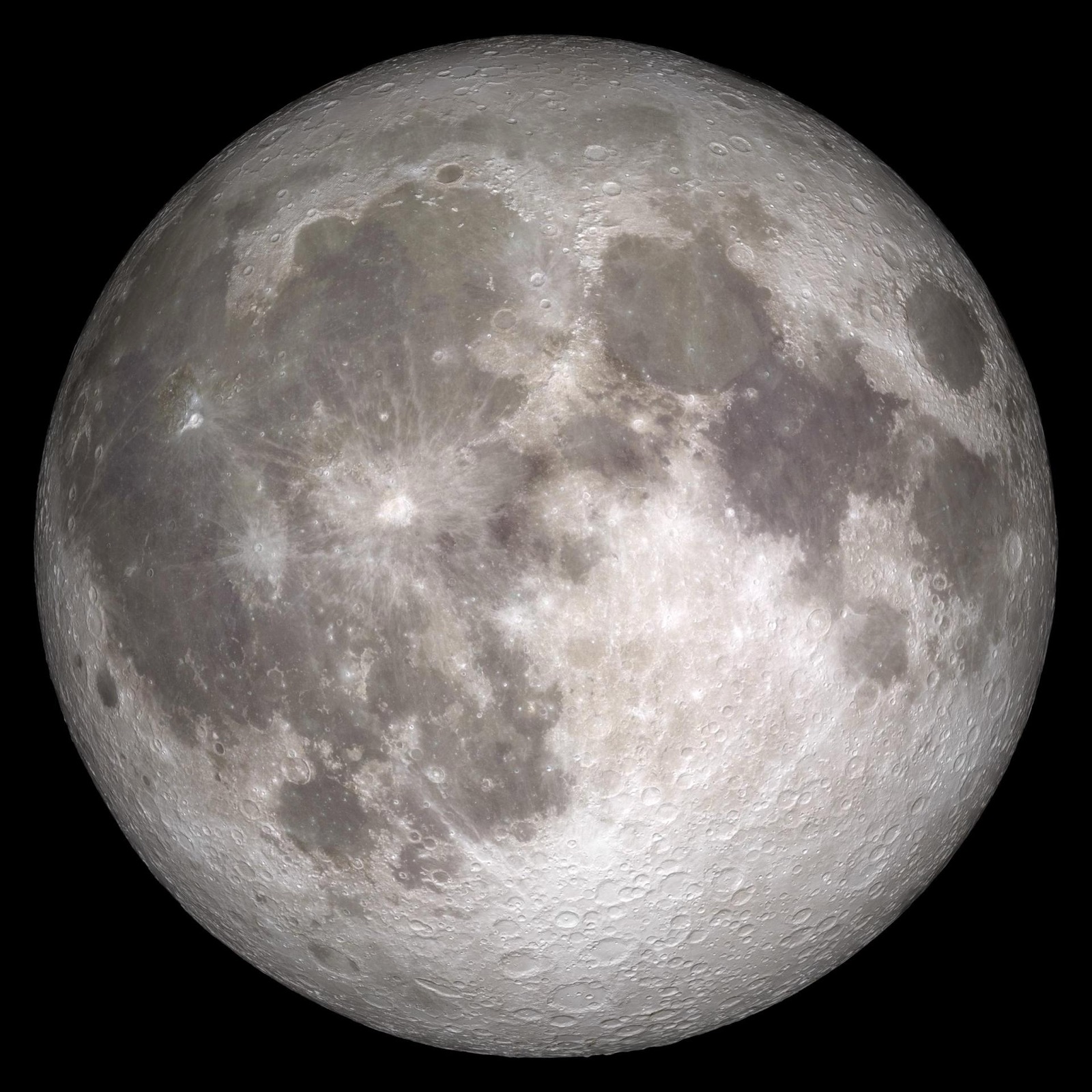
Kamoʻoalewa is a small, fast-spinning asteroid only about 27 m across that circles the Sun in near-lockstep with Earth as a 'quasi-satellite'. Its reddish spectrum resembles weathered lunar rock, suggesting it could be debris blasted off the Moon by an impact. China's Tianwen-2 spacecraft arrived on 4 July 2026 and plans to study it for months before collecting samples and returning them to Earth. Its Hawaiian name refers to an oscillating fragment.
The deep dive
Researched for the Atlas from Wikipedia — 469219 Kamoʻoalewa (8,255 characters read) · updated Nov 14, 2026
01 A name born from a Hawaiian chant
The asteroid's name did not come from an international committee of astronomers but from A Hua He Inoa, a naming program run at the ʻImiloa Astronomy Center of Hawaiʻi. In 2019 they drew the name from the Kumulipo, a traditional Hawaiian creation chant, choosing words that capture the object's character with unusual precision. Ka means 'the'; moʻo means 'fragment,' pointing to the idea that this rock is a piece broken from something larger; a means 'of'; and lewa means 'to oscillate,' describing exactly how the asteroid appears to sway through the sky when watched from Earth. The Minor Planet Center made the name official on 6 April 2019, publishing it in circular M.P.C. 112435. The whole phrase therefore roughly translates as 'the oscillating fragment,' a poetic description that also happens to be scientifically accurate — the object genuinely does oscillate above and below Earth's orbital plane each year as it circles the Sun.
02 How Pan-STARRS caught a tiny rock
Kamoʻoalewa was first detected on 27 April 2016 by the Pan-STARRS 1 telescope on Haleakalā, Hawaiʻi, operated by the University of Hawaiʻi's Institute for Astronomy and funded by NASA's Planetary Defense Coordination Office. Pan-STARRS is designed specifically to sweep the sky repeatedly for small, fast-moving objects that might threaten Earth, so finding a 27.4-metre rock — roughly the width of a tennis court — in a single night's data was well within its design goals. What made the discovery remarkable was what follow-up observations revealed about the orbit: rather than the typical chaotic trajectory of a near-Earth interloper, this tiny body was shadowing Earth with eerie steadiness. The provisional designation 2016 HO3 was assigned at discovery, and the object was later numbered 469219 once its orbit was confirmed with enough precision. It is worth noting that at roughly 27 metres across, Kamoʻoalewa is too faint to see with any amateur telescope.
03 The peculiar dance of a quasi-satellite
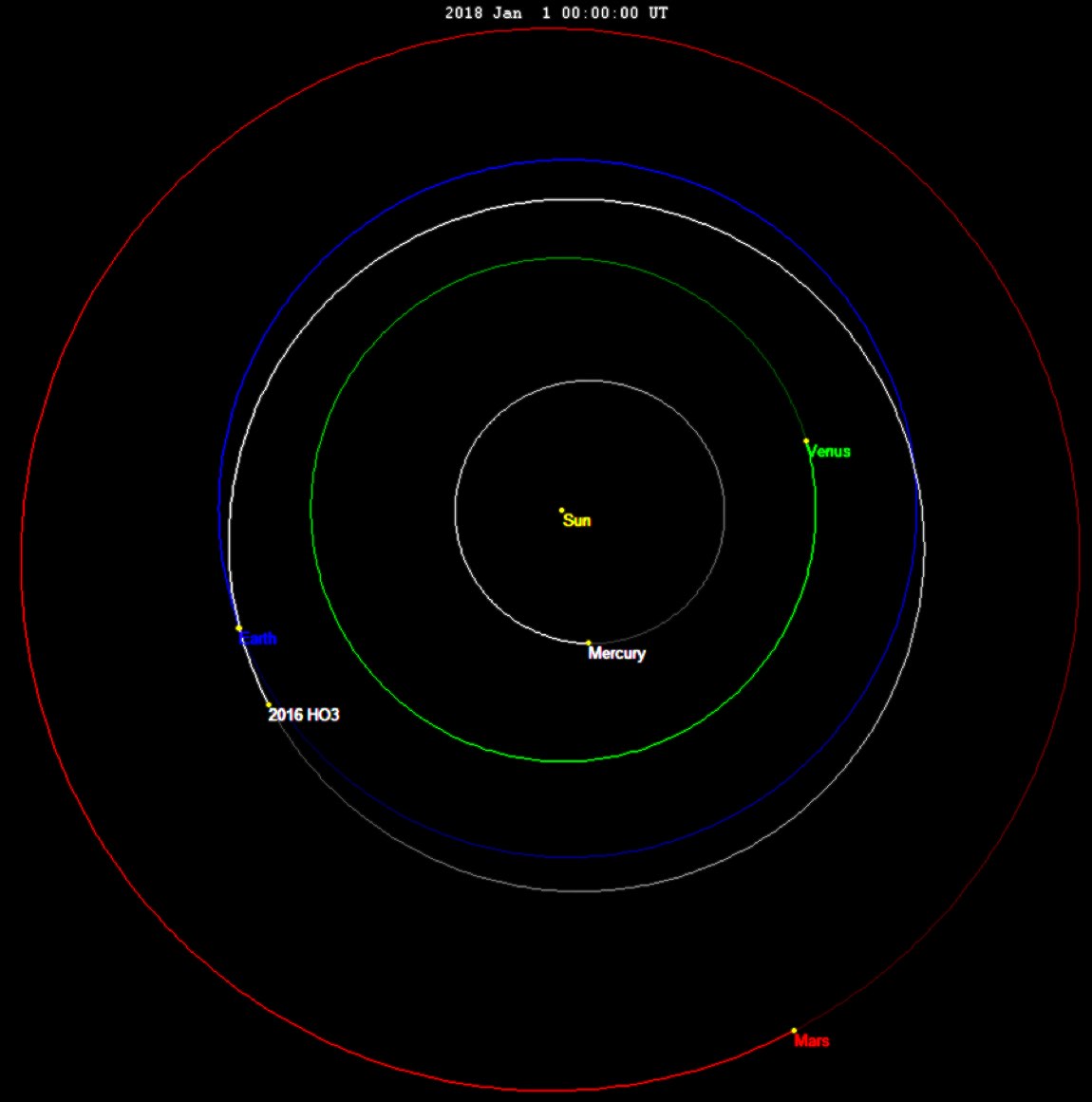
Kamoʻoalewa is not a moon. Earth's gravity does not hold it, and it never crosses inside Earth's Hill sphere — the bubble of gravitational dominance that extends roughly 1.5 million kilometres from our planet. Yet in a rotating reference frame that moves with Earth around the Sun, the asteroid traces a large elliptical loop around Earth, completing one of these apparent circuits roughly every 45 years. The reality behind that illusion is a nearly Earth-matching solar orbit: its year is about 366 days now, with a long-term average near 365 days. It spends half its orbit a little closer to the Sun than Earth and half a little farther out, which makes it drift above and below Earth's orbital path each year — the oscillation embedded in its name. Its orbit also periodically shifts between a quasi-satellite configuration, loitering near the L1 and L2 Lagrange points, and a horseshoe orbit that swings between L4 and L5. Paul Chodas of NASA's Center for Near-Earth Object Studies at JPL has described it as the most stable near-Earth companion known at the time.
04 Long past and longer future as Earth's companion Deeper
Orbital and Yarkovsky-effect modelling place the duration of Kamoʻoalewa's current quasi-satellite relationship with Earth at roughly 0.3 to 0.5 million years — a figure that spans both its past tenure and its expected future. The closest approach on record happened on 27 December 1923, when the asteroid passed 12.44 million kilometres (0.0832 AU, or 32.4 lunar distances) from Earth. Over its current phase it stays between 38 and 100 times the Moon's distance; Earth's gravity gently corrects small orbital drifts to maintain that range. By contrast, by late May 2369, Kamoʻoalewa will have drifted 2.0 AU — 300 million kilometres — from Earth, illustrating how gradually but inevitably the dance unravels. The long-term prognosis for all objects in such orbits is bleak: most are eventually gravitationally perturbed into collisions with Earth, Venus, or the Sun, or ejected from the Solar System entirely. Modelling suggests Kamoʻoalewa will probably strike Earth within the next 100 million years. Unlike asteroid 2003 YN107, which previously followed a similar orbit but left it, Kamoʻoalewa has already been Earth's companion for more than a century.
05 A spinning, elongated speck of rock
Pinning down the size of Kamoʻoalewa has proven surprisingly contentious. Early estimates put the diameter around 27.4 metres. A 2024 inversion model built from light-curve data produced a three-dimensional shape of roughly 100 × 81 × 46 metres, implying a mean diameter near 72 metres. A 2026 light-curve refinement shrank that to 68 × 46 × 39 metres. Then thermal measurements made with the James Webb Space Telescope in 2026 suggested a much smaller mean diameter of just 18 ± 2 metres, with a best-fit visible albedo of 0.59 — meaning the surface reflects nearly 60 percent of incoming sunlight, far more than a typical dark asteroid. JWST's brightness variations independently confirmed a rotation period of about 27.9 minutes and an axis ratio of roughly 1.4, implying dimensions in the range of 15 to 21 metres. The original 2017 photometric lightcurve had already established the rapid spin at 27.66 minutes with a brightness variation of 0.80 ± 0.05 magnitudes. Whatever its true size, Kamoʻoalewa is unambiguously elongated and spinning fast — most asteroids of comparable size rotate far more slowly.
06 Lunar castaway or stony asteroid? Deeper
The question of where Kamoʻoalewa came from has generated genuine scientific debate. Spectroscopic observations in 2021 using the Large Binocular Telescope and the Lowell Discovery Telescope showed higher spectral reddening than most asteroids and a strong resemblance to space-weathered lunar materials, particularly soils returned by Apollo 14 and Luna 24 from lunar mare regions. That, combined with the Earth-like orbit, led researchers to propose it as a piece of the Moon flung into space by an ancient impact — lunar ejecta. The leading candidate source crater is Giordano Bruno on the lunar far-side highland crust. However, new JWST NIRSpec observations in 2026, along with fresh Large Binocular Telescope data, complicated the picture considerably. The 2026 spectrum is notably less red in the 1.0–2.5 μm range than the 2021 data suggested. A faint silicate absorption feature appears at 0.93 ± 0.01 μm, but no absorption is detected at 2.0 μm, and the high albedo points toward an oldhamite-bearing, enstatite-rich composition. These traits resemble S-, V-, or E-type asteroids more than weathered lunar mare soils, leaving the origin genuinely unresolved. It might still be lunar ejecta, or it might be an ordinary S-type or L-type asteroid that happens to share Earth's orbital neighbourhood.
07 Temperature swings on a tiny world
With no atmosphere to buffer incoming sunlight or radiate heat gradually, Kamoʻoalewa experiences brutal temperature swings across its surface. The article gives a range of 253.15 kelvin on the cold end — that is minus 20 degrees Celsius, colder than many winter nights in Siberia — up to 473.15 kelvin on the hot side, which is 200 degrees Celsius, well above the boiling point of water. That 220-kelvin spread across a rock only tens of metres wide is driven entirely by its rotation rate and the angle at which sunlight strikes different surface patches. At 27.66 minutes per rotation, every point on the surface cycles from full sunlight to full shadow in roughly the time it takes to watch a sitcom episode. The high albedo inferred from JWST measurements — around 0.59 — means the surface reflects more light than average rocky asteroids, which limits some solar heating but does not eliminate the extreme range. The composition suggested by 2026 spectroscopy, possibly rich in enstatite or oldhamite, would itself influence how efficiently the surface absorbs and re-emits energy.
08 A possible family of broken companions Deeper
Kamoʻoalewa may not be alone in its peculiar orbital neighbourhood. Orbital similarity analysis raises the possibility that it forms a co-orbital pair with asteroid 2000 WN10, implying both objects share a common dynamical history and perhaps a common origin. A broader grouping has also been proposed linking Kamoʻoalewa to three other near-Earth objects — 2020 KZ2, 2020 PN1, and 2020 PP1 — as the broken remnants of a single larger body. If confirmed, this would mean the original impactor that created Giordano Bruno, or whatever collision produced this debris, shattered into several pieces that have spread along a common orbital thread. This kind of co-orbital grouping, sometimes called a co-orbital cluster, is rare and difficult to confirm because the objects' orbits must be traced backward through millions of years of gravitational perturbations to find a common ancestor event. The proposed connection to 2000 WN10 and the three 2020-designated objects represents an open research question: a confirmed genetic family among near-Earth quasi-satellites would be a first.
09 Tianwen-2: China's sample-return mission
China's National Space Administration launched the Tianwen-2 spacecraft in May 2025, sending it on a journey to become only the second mission ever to retrieve material from a near-Earth asteroid and the first to target a quasi-satellite. The spacecraft arrived at Kamoʻoalewa on 4 July 2026, and the mission plan calls for several months of close-range surveying and imaging before sample collection begins, with departure scheduled for April 2027 and Earth return in 2027. Even before sample collection, Tianwen-2 began contributing science: relative position measurements from the spacecraft, combined with ground-based orbital tracking, generated new ephemeris data refining knowledge of the asteroid's precise trajectory. The mission grew out of an earlier Chinese concept called ZhengHe, and to support it researchers at the Qian Xuesen Laboratory of Space Technology developed three chondritic simulant materials — QLS-1, QLS-2, and QLS-3 — to practise handling and analysing material that might resemble what the probe will collect. If the samples reach Earth as planned, they will be the first physical specimens from an Earth quasi-satellite.
10 Early mission concepts that paved the way Deeper
Before Tianwen-2 was approved, Kamoʻoalewa attracted a surprisingly diverse collection of proposed missions that illustrate how accessible its orbit makes it. In 2019, NASA studied a solar-sail mission concept that would use radiation pressure instead of propellant to reach the asteroid — a low-cost approach suited to a target that stays relatively close to Earth. The University of Colorado Boulder proposed a flyby combined with an impact experiment to probe the surface. At the 2017 Astrodynamics Specialist Conference in Stevenson, Washington, a joint team of graduate researchers from the University of Colorado Boulder and the São Paulo State University (UNESP) won recognition for presenting the first detailed spacecraft investigation framework, called the Near-Earth Asteroid Characterization and Observation (NEACO) mission to asteroid (469219) 2016 HO3. That work established the first astrodynamical baselines for reaching the object. Perhaps the most ambitious idea floated in the literature is using Kamoʻoalewa as a waystation for Earth-to-Mars travel — a natural space station in an orbit that makes it a relatively low-energy stepping stone between the two planets.
11 What 2026 observations changed about everything Deeper
The year 2026 delivered a cascade of new data that forced researchers to reconsider almost every physical parameter established before Tianwen-2's arrival. JWST's NIRSpec instrument and new Large Binocular Telescope observations produced a spectrum that is markedly less red than the 2021 data in the 1.0–2.5 μm range, shifting the composition hypothesis from weathered lunar silicates toward enstatite-rich mineralogy. At the same time, JWST thermal emission measurements revised the mean diameter downward sharply — from estimates in the 68–100 metre range to just 18 ± 2 metres — while pushing the visible albedo up to 0.59, far higher than the dull surfaces typical of primitive asteroids. The revised rotation period of 27.9 minutes and axis ratio of roughly 1.4 closely matched earlier photometric results, providing confidence in those numbers even as the size shrank. Meanwhile, Tianwen-2's proximity allowed the spacecraft itself to begin refining the asteroid's ephemeris through direct positional measurements. The convergence of JWST remote sensing and in-situ spacecraft data in a single year makes 2026 a pivotal moment in the study of this object — and also highlights how much can change between a discovery observation and a dedicated mission.
12 Open questions science still cannot answer
Despite being discovered in 2016 and visited by a spacecraft in 2026, Kamoʻoalewa leaves several fundamental questions unanswered. Its true size remains contested: ground-based models favour diameters of 46–100 metres, while JWST thermal data suggests something closer to 18 metres. These are not small differences — the two estimates imply volumes that differ by more than an order of magnitude. Its origin is similarly unresolved: the lunar ejecta hypothesis is elegant and consistent with the orbital dynamics, but the 2026 spectroscopy points toward an enstatite-rich composition more typical of certain stony asteroid classes. Whether it truly shares a family history with 2000 WN10 and the trio of 2020-designated near-Earth objects is an open orbital dynamics problem. Lunar ejecta modelling has shown that some pathways can produce a stable quasi-satellite orbit, but it has not ruled out alternatives. The answers most likely to arrive first will come from the Tianwen-2 sample return: physical grains brought back to Earth in 2027 will carry chemical and isotopic fingerprints that no telescope — ground-based or space-borne — can read from a distance.
 ⤢