 Photograph · NASA/JHUAPL/SwRI/Roman Tkachenko · Public domain
Asteroid · Deep guide
486958 Arrokoth
Also called: 486958 Arrokoth · 2014 MU69 · Ultima Thule
A frozen 'snowman' from the dawn of the Solar System — the most distant world ever visited.
What is it?
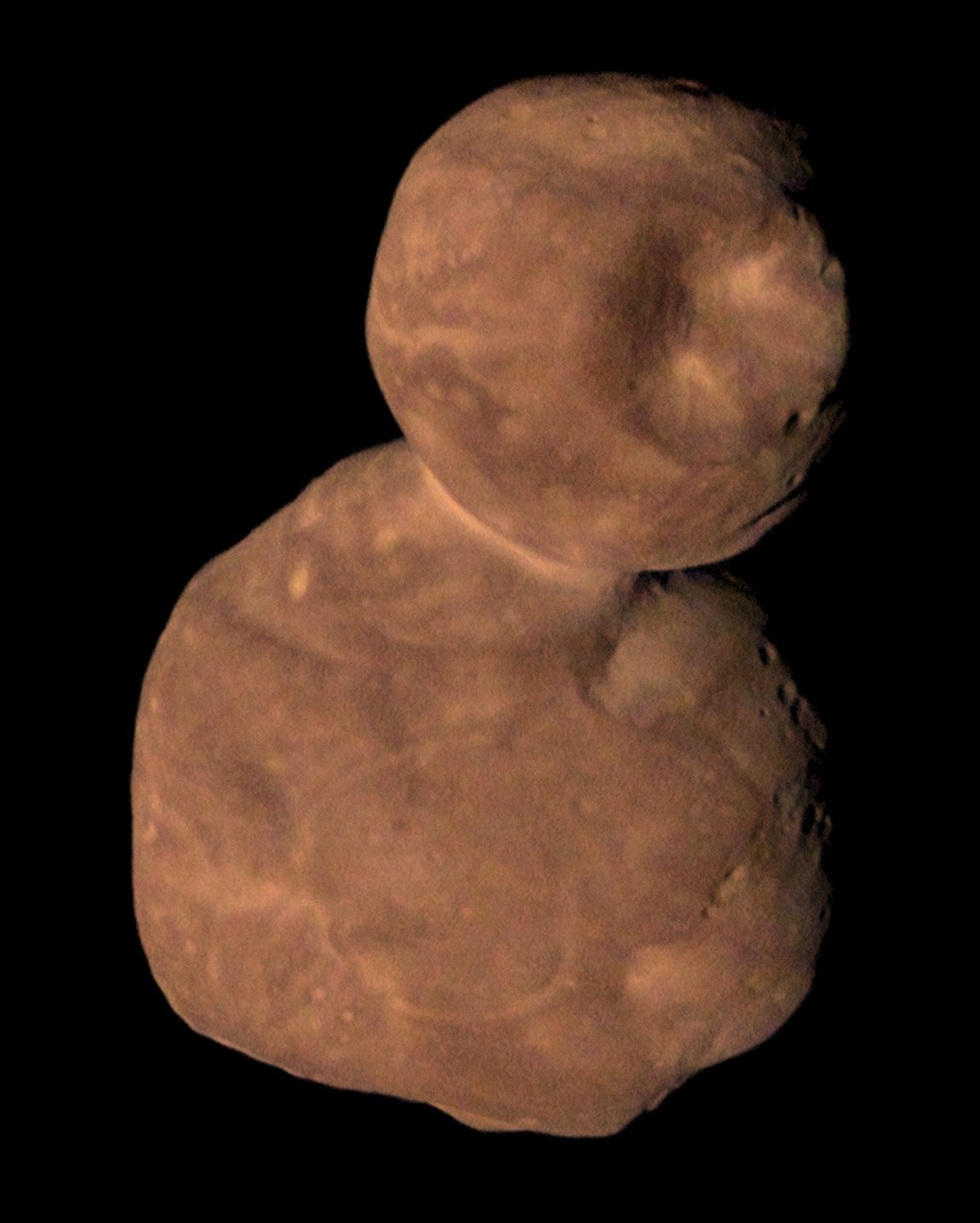
Arrokoth is a small, icy Kuiper belt object orbiting beyond Pluto, about 44 times farther from the Sun than Earth. On 1 January 2019 NASA's New Horizons flew past it, making it the farthest object ever explored by a spacecraft. It is a contact binary: two flattened lobes, Wenu and Weeyo, that slowly drifted together and merged. Its reddish, lightly cratered surface suggests it has barely changed in about 4.5 billion years.
The deep dive
Researched for the Atlas from Wikipedia — 486958 Arrokoth (36,216 characters read) · updated Nov 14, 2026
01 A Snowman Built from Eight Smaller Worlds
Arrokoth's larger lobe, Wenu, is not a single smooth blob but an aggregate of roughly eight distinct blocks of rolling topography, each approximately 5 km (3.1 mi) across — about the length of Manhattan. These blocks are separated by relatively bright boundary regions and are thought to be individual planetesimals that slowly clumped together before Wenu ever merged with the smaller lobe Weeyo. The similar sizes of all eight units is a striking clue: if they had grown chaotically, you would expect a wide range of sizes, but their near-uniformity points to a common formation environment. The same stacking process left its mark on Weeyo too, though less distinctly. This nested hierarchy — sub-kilometer particles built centimeter-sized grains, those built kilometer-scale planetesimals, those built the two lobes, and the two lobes built Arrokoth — gives scientists a rare, mostly unaltered record of how the Solar System assembled its small bodies 4.5 billion years ago.
02 The Gentlest Collision in Solar System History
When Wenu and Weeyo finally came together, they were moving at roughly 2 m/s (6.6 ft/s) — comparable to the average walking speed of a person. That is extraordinarily slow for an astronomical impact, and it shows: Arrokoth bears no compression fractures, no obvious deformation zones, no evidence of violent crushing at the junction. The two lobes had already been tidally locked in synchronous rotation before contact, meaning they always showed each other the same face as they spiraled inward, the way the Moon always faces Earth. Their longest axes were nearly aligned with each other and with the shared rotation axis — a geometrical tell-tale of that mutual tidal locking. For the collision to produce Arrokoth's thin neck without shattering either lobe, the objects must also have struck obliquely, at angles greater than 75 degrees. The result is an object whose seam is a record of the softest handshake in planetary science.
03 Red as Mars, Cold as Deep Space
Arrokoth belongs to the "ultra red" population of cold classical Kuiper belt objects, meaning it reflects even less blue light than the already-ruddy surface of Pluto. That deep reddish-brown hue comes from tholins — complex organic molecules produced when cosmic rays and ultraviolet sunlight break apart simpler compounds like methane, ammonia, and hydrogen sulfide, then reassemble the fragments into tarry macromolecules. New Horizons's LEISA spectrometer detected methanol and sulfur-rich organic compounds on the surface, with a distinctive absorption band at 1.8 μm. No water ice was detected on the surface, though water ice is thought to dominate the interior. The average surface temperature is roughly 42 K (−231.2 °C), barely above absolute zero. The sunlit subsolar point can reach about 60 K, while the permanently shadowed face registers only 29 ± 5 K — still warmer than models predicted, suggesting that heat leaks outward from a warmer subsurface.
04 Why Arrokoth's Surface Is So Smooth Deeper
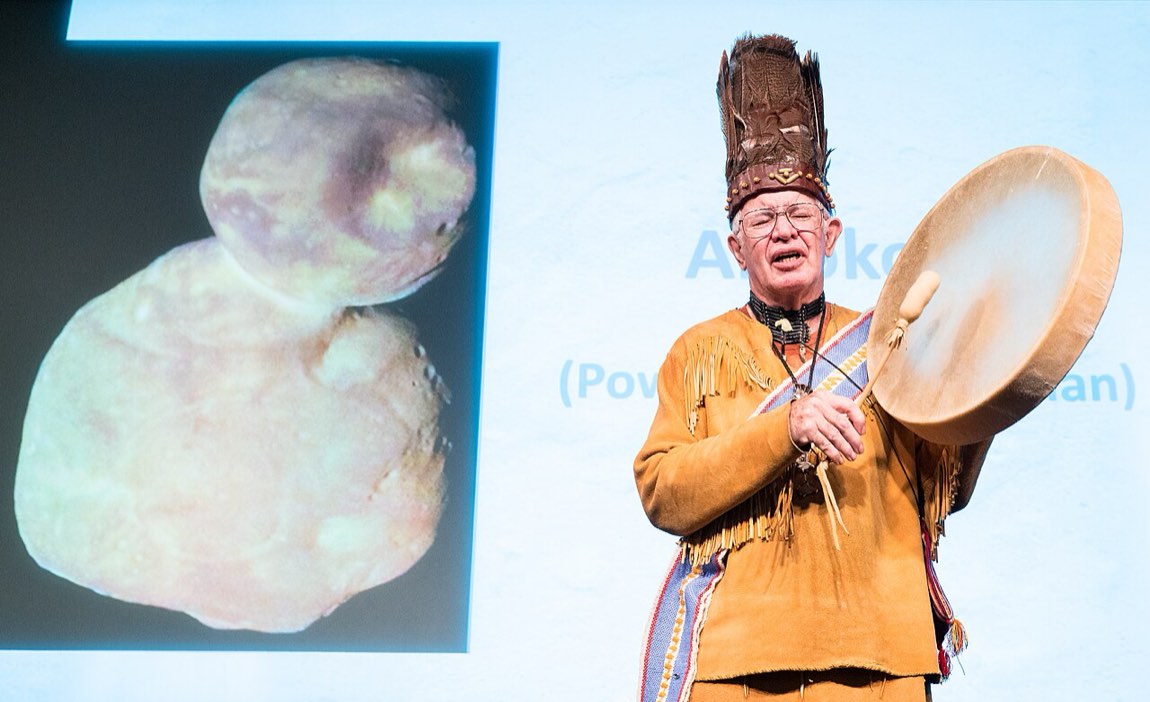
Kuiper belt objects collide rarely and slowly. At Arrokoth's location, typical impactors arrive at around 300 m/s (980 ft/s) — far slower than the kilometers-per-second speeds common in the inner Solar System — so even modest craters are uncommon. Over 4.5 billion years, photon-induced sputtering of water ice would shave only about 1 cm (0.39 in) from the surface. The combined effect is a world that looks nearly pristine. New Horizons imagery does show numerous small pits about 700 m (2,300 ft) across, but their origin is debated: they could be impact scars, collapse features left by sublimating volatiles, or vents where gases escaped from the interior. The largest confirmed depression, Sky Crater on Weeyo, is 6.7 km (4.2 mi) in diameter and 0.51 km (0.32 mi) deep, probably blasted out by an impactor roughly 700 m (2,000 ft) wide. Two bright streaks inside Sky are interpreted as avalanche deposits, where material rolled down into the bowl after the impact, hinting that even at Arrokoth's feeble gravity, landslides happen.
 ⤢
05 The Strange Brightness of the Neck Deeper
Akasa Linea — the narrow waist connecting Wenu and Weeyo — is notably brighter and less red than the surfaces of either lobe. Two competing explanations have been proposed. The first suggests that fine particles eroded from the sloping sides of both lobes gradually roll downhill toward the center of mass, which lies in the neck region, depositing fresher, more reflective material there over geological time. The second hypothesis invokes ammonia ice: ammonia vapor present across Arrokoth's surface would preferentially condense in the concave neck, where the geometry traps cold gas. Supporting the second idea, the brightness of Akasa Linea appears to be sustained by Arrokoth's extreme axial tilt of 99 degrees. During parts of its 294-year orbit, the lobes are coplanar with the direction of sunlight, casting Akasa Linea into deep shadow. Without solar heating, the neck chills further and traps volatiles — a seasonal refrigeration cycle operating on century-long timescales. As of 17 December 2025, the IAU formally renamed this feature Akasa Collum.
06 An Extreme Tilt and a Polar Deep-Freeze
Arrokoth spins on its side — its rotational axis is tilted 99 degrees to its orbit, more extreme than even Uranus. One consequence is that one polar region stares at the Sun continuously for half of each 294-year orbit, while the opposite pole sits in perpetual darkness for the same period. The solar irradiance still varies by about 17 percent over the orbit because Arrokoth's nearly circular path is not perfectly round. The rotation period is precisely 15.938 hours, determined from occultation data combined with New Horizons imagery. When New Horizons approached, it detected no rotational light-curve amplitude at all — Arrokoth was presenting its south pole almost directly at the incoming spacecraft, making the irregular shape look nearly featureless from that angle. This pole-on geometry initially fooled scientists who were expecting brightness variations and left them puzzled until the geometry became clear.
07 Chasing Shadows: The Occultation Campaigns Deeper
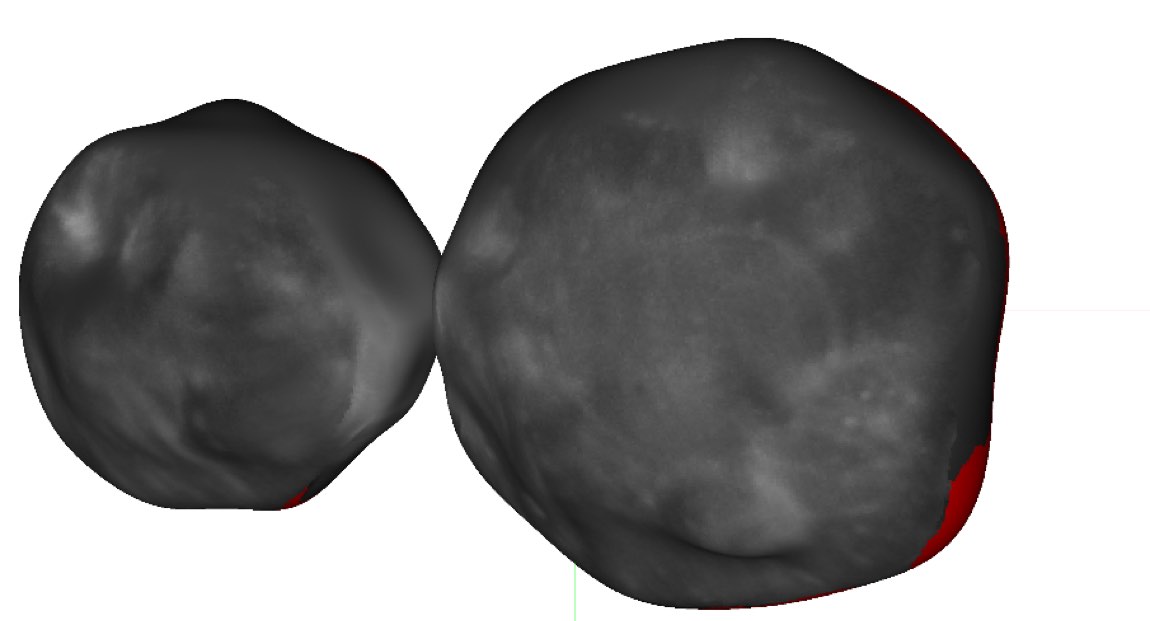
Because Arrokoth is too small and distant for Earth-based telescopes to resolve its shape directly, the New Horizons team orchestrated a series of stellar occultation campaigns in 2017 and 2018. Using predictions derived from Hubble and ESA's Gaia observatory, they identified three events in 2017 (3 June, 10 July, and 17 July) and deployed mobile telescopes across Argentina, South Africa, and the Pacific. The 10 July event was observed by the SOFIA airborne telescope flying out of Christchurch, New Zealand, primarily to search for rings or dust that could endanger New Horizons during its flyby — none were found. For the 17 July event, 24 telescopes were spaced about 4 km (2.5 mi) apart in a fence line across southern Argentina; at least five recorded Arrokoth's shadow, and the chord durations revealed two lobes approximately 20 km (12 mi) and 18 km (11 mi) across. A 2018 occultation on 4 August, observed by roughly 50 researchers in Senegal and Colombia, let Hubble probe for debris down to just 1,600 km (990 mi) from Arrokoth's center — finding none.
08 How New Horizons Found and Reached Its Target
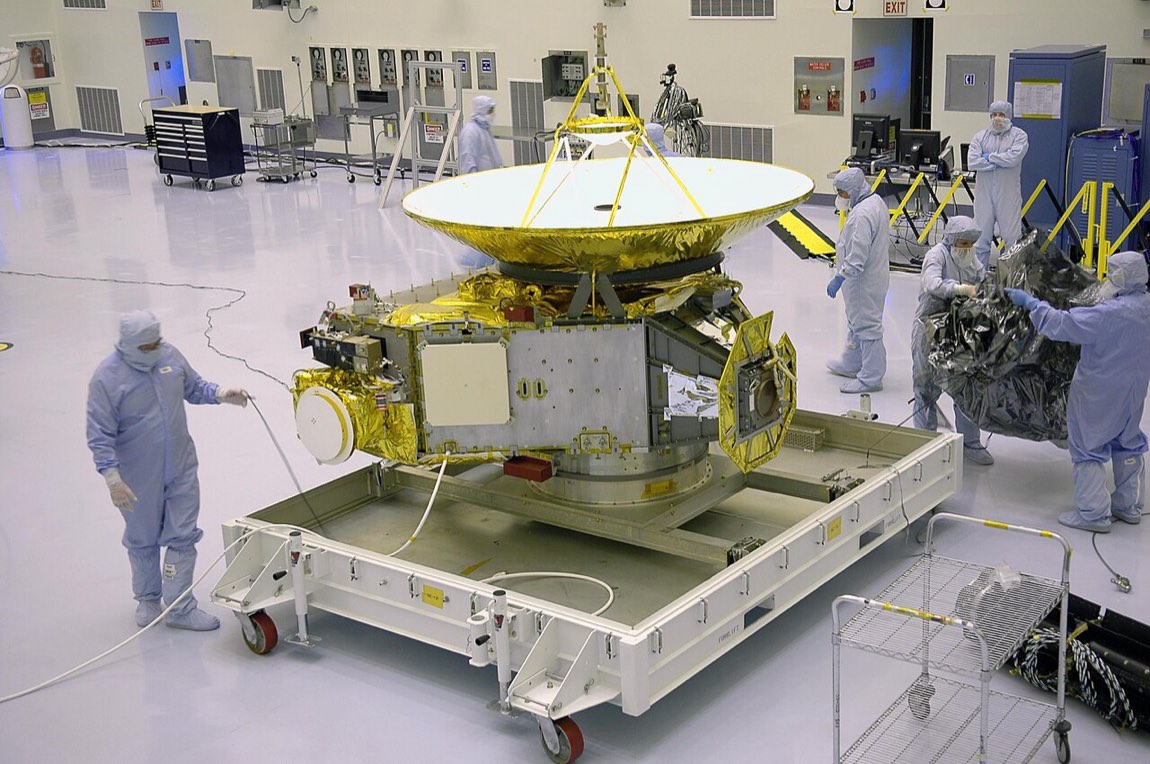
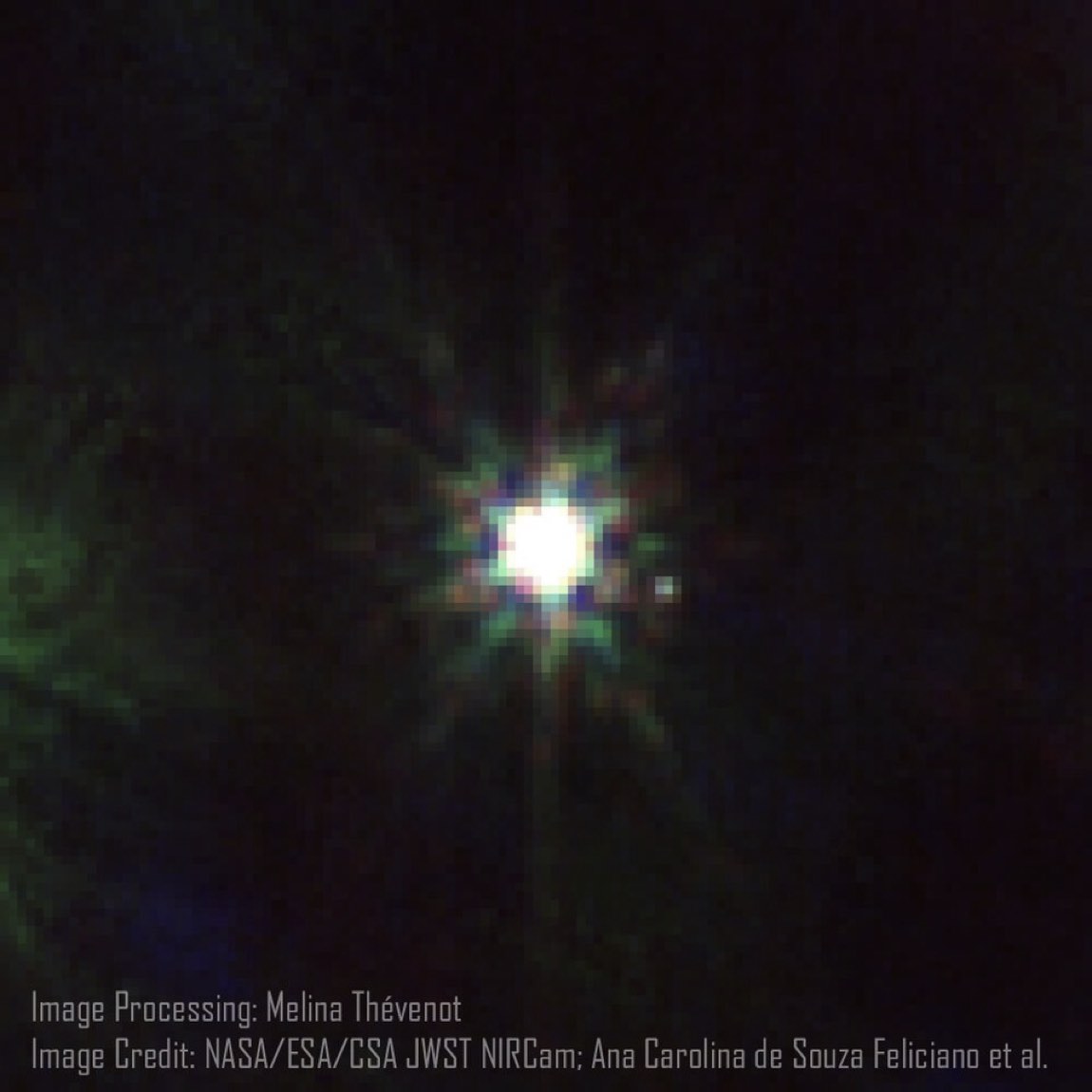
Searching for a post-Pluto target began on the ground in 2011, but every candidate found through Earth's atmosphere was either unreachable on New Horizons's remaining fuel or too faint to characterize. The team turned to Hubble, launching a dedicated search on 16 June 2014. Arrokoth was spotted just ten days later, on 26 June, by Marc Buie while digitally processing Hubble frames — the second object found in the entire campaign. After NASA officially selected Arrokoth as the flyby target on 28 August 2015, the spacecraft executed four trajectory correction maneuvers in October and November 2015 to adjust its course. New Horizons first detected Arrokoth from 172 million km (107 million mi) away on 16 August 2018, when the object glowed at magnitude 20. As the spacecraft closed in at 51,500 km/h (14.3 km/s), Arrokoth brightened until it reached naked-eye magnitude (about 6) from the spacecraft's perspective just 3–4 hours before closest approach on 1 January 2019 at 05:33 UTC. The flyby distance was 3,538 km (2,198 mi), one-third the closest distance New Horizons had achieved at Pluto.
 ⤢
09 What New Horizons Could and Could Not Measure Deeper
New Horizons carried a suite of instruments specifically tasked at Arrokoth: LEISA mapped surface composition, REX measured thermal emission, and SWAP and PEPSSI looked for signs of solar wind interaction. LEISA successfully identified methanol and sulfur-rich organics. REX found the unilluminated face at 29 ± 5 K, warmer than theoretical models of 12–14 K, implying subsurface heat. SWAP and PEPSSI, however, detected no solar wind interaction at all, ruling out any significant outgassing of hydrogen or other species that would form a detectable exosphere. The spacecraft's cameras achieved resolutions showing details of 30 m (98 ft) to 70 m (230 ft). No satellites larger than 1.6 km (1 mi) in diameter, no rings, and no detectable atmosphere were found. Mass and density remain unknown because the two lobes are touching rather than orbiting each other, eliminating the standard gravitational method. The estimated minimum density is 0.29 g/cm3, with a maximum possible density of 1 g/cm3. Downloading all flyby data took approximately 20 months, completing around September 2020.
10 Formation in a Dark, Dusty Nursery
Arrokoth likely formed inside a dense, opaque clump of the early Kuiper belt, where dust was thick enough to heavily obscure the young Sun. In that environment, icy particles experienced streaming instability — a process in which drag against surrounding gas slows particles down until gravity wins and they clump rapidly into larger bodies. Because both Wenu and Weeyo share nearly identical albedo, color, and spectral composition, they almost certainly condensed from the same parcel of material rather than forming independently and then meeting by chance. After forming as a gravitationally bound binary pair, the two objects slowly lost orbital energy — through impacts with small debris and by transferring angular momentum to other bodies — and spiraled toward each other over millions of years. Crucially, all of this happened before the surrounding dust and gas dissipated, shielding the nascent Arrokoth from intense solar radiation. Once the nebula cleared, sublimation began reshaping the surface, but the fundamental architecture — a contact binary built from nested planetesimals — was already locked in.
11 A Name Drawn from the Powhatan Sky
The road to Arrokoth's permanent name was contentious. NASA's public nickname contest in early 2018 selected "Ultima Thule," a Latin phrase for the farthest known place, and the New Horizons team used "Ultima" and "Thule" informally for the two lobes. Within months, journalists and historians pointed out that "Thule" had been appropriated by 19th-century racists as a mythical Aryan homeland and later by the Nazi Party, prompting discomfort among scientists and the public. In November 2019 the IAU announced a permanent replacement: Arrokoth, chosen to honor the Powhatan people, indigenous to the Tidewater region of Virginia and Maryland — the same region where the Hubble Space Telescope is operated and where the Johns Hopkins University Applied Physics Laboratory is based. The name was proposed with the permission of elders of the Pamunkey Indian Tribe and formally announced at NASA Headquarters on 12 November 2019. The Powhatan language went extinct in the late 18th century, and the word arrokoth was intended to mean "sky," though linguistic evidence now suggests it actually meant "cloud."
12 Open Questions That Keep Scientists Busy Deeper
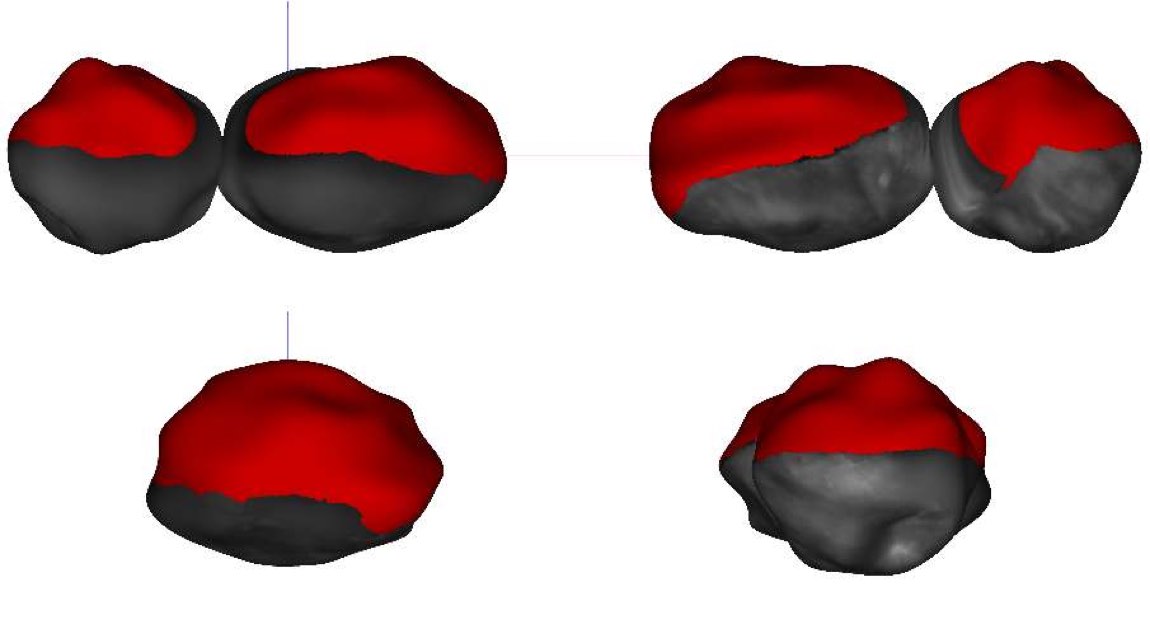
Despite the richness of New Horizons data, several fundamental questions about Arrokoth remain unresolved. Its mass and density are still unknown, with only broad bounds: a minimum of 0.29 g/cm3 and a maximum of 1 g/cm3. The exact mechanism behind its flattened shape is contested: the New Horizons team favors rapid initial rotation that gradually slowed through impacts, while researchers from the Chinese Academy of Sciences and the Max Planck Institute proposed in 2020 that sublimation-driven mass loss over millions of years after the lobes merged could instead explain the flattening. The origin of the roughly 700-m-wide pits scattered across the surface — impact, collapse, sublimation, or venting — has not been definitively settled. A 2024 reanalysis of New Horizons imagery also revised the degree of flattening downward from earlier estimates, reopening shape debates. And while no satellites were detected down to 1.6 km (1 mi), a search for smaller moons continues, since any orbiting companion would immediately provide the mass measurement that all other density and structure models desperately need.
 ⤢