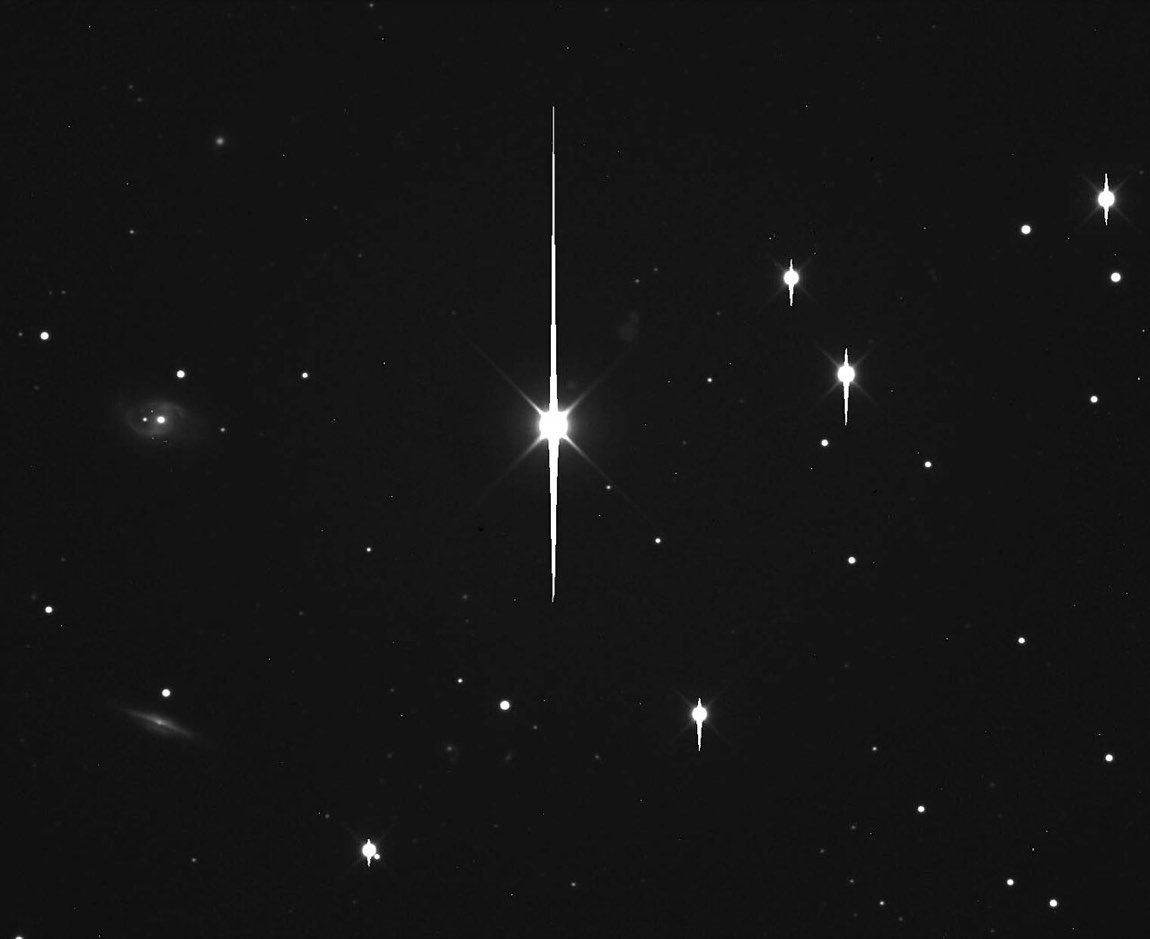
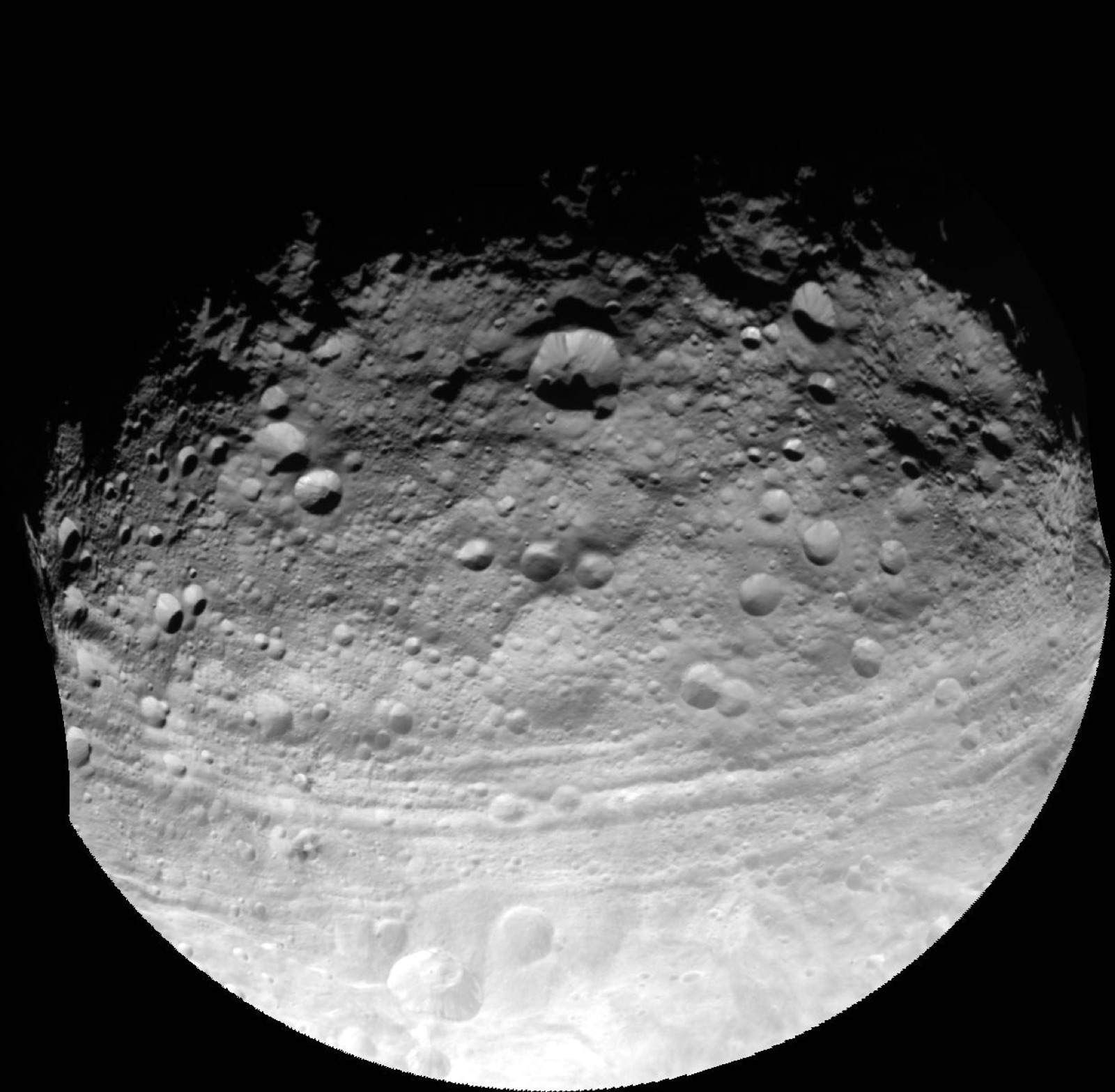
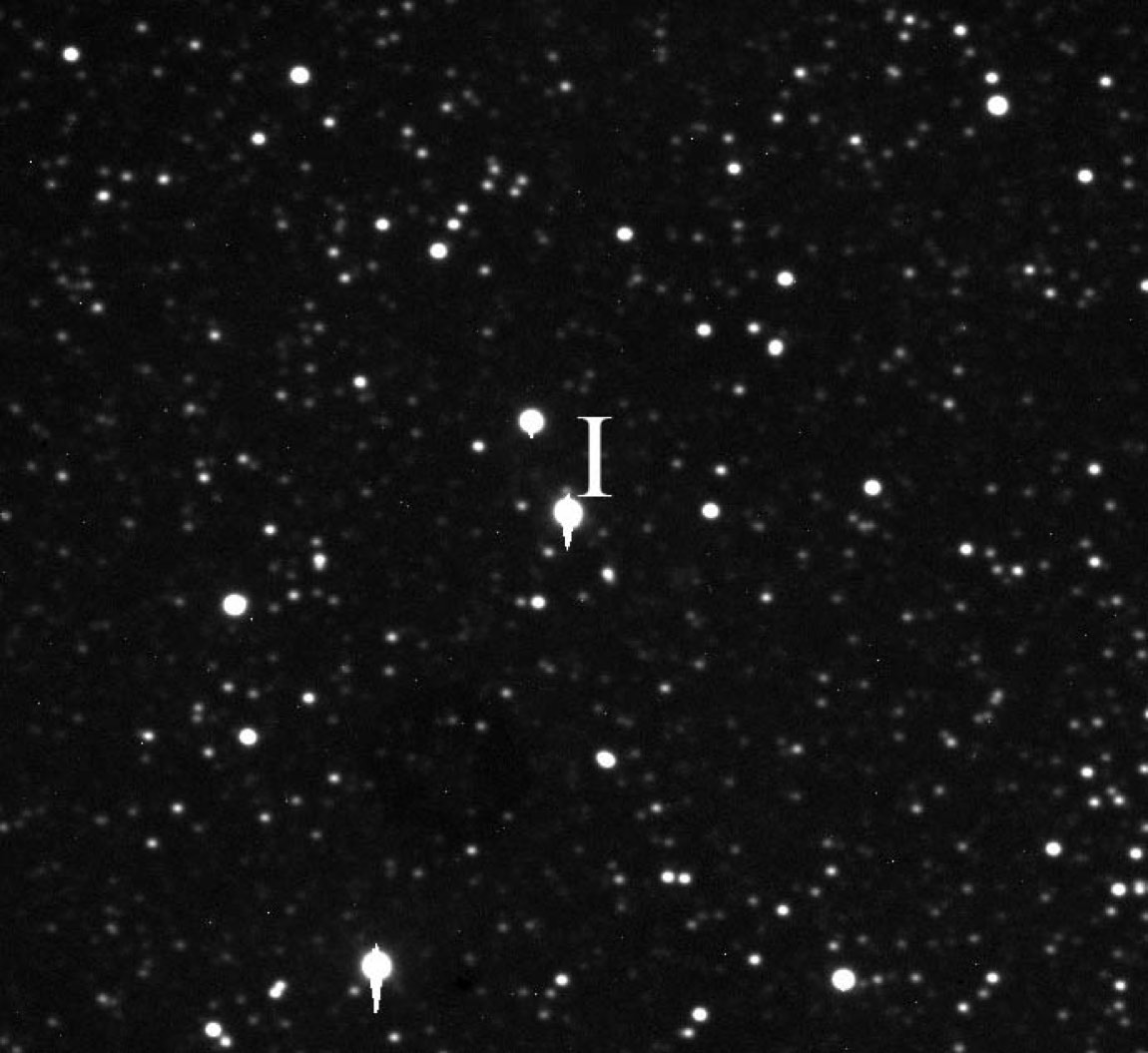
 Photograph · Kevin Heider @ LightBuckets · CC BY-SA 3.0
Asteroid · Deep guide
7 Iris
Also called: 7 Iris · (7) Iris · A847 PA
One of the brightest asteroids in the sky — a stony remnant of an early planet-building block.
What is it?
Iris is a large stony asteroid about 200 km across in the inner main belt and the fourth-brightest object in the asteroid belt. It may be a remnant planetesimal, one of the small bodies from which planets were assembled. John Russell Hind discovered it in London in 1847, and it was named after Iris of Greek mythology.
The deep dive
Researched for the Atlas from Wikipedia — 7 Iris (3,451 characters read) · updated Nov 14, 2026
01 A messenger goddess hiding in plain sight
John Russell Hind spotted Iris on 13 August 1847 from London, making it the seventh asteroid ever identified and his very first discovery. The name choice was deliberately clever: Iris is the rainbow goddess of Greek mythology and a personal messenger to Hera, queen of the gods. Hind noticed that the new object was trailing 3 Juno — the asteroid named for Hera's Roman equivalent — by less than an hour of right ascension in the sky. An attendant of Hera chasing Juno across the heavens felt almost too perfect to pass up. Iris even received its own astronomical symbol: a rainbow paired with a star, rendered in two slightly different forms. Centuries later, Unicode 17.0 formally encoded that symbol as U+1CEC1, giving the glyph a permanent home in the digital alphabet alongside emoji and ancient scripts.
02 Why Iris glows so brightly
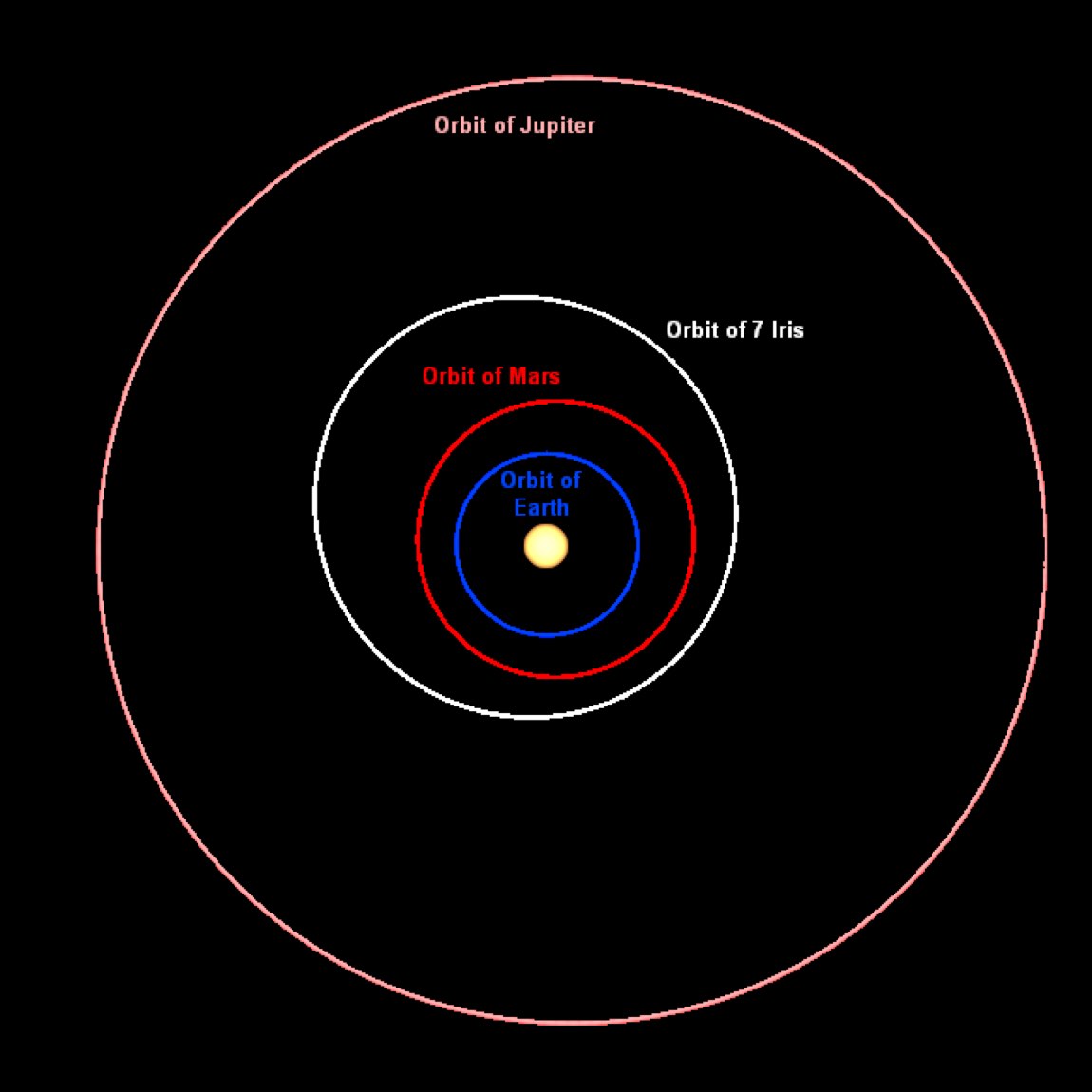
Iris is not the largest asteroid in the main belt, yet it ranks as the fourth-brightest object there, trailing only Vesta, Ceres, and Pallas. Two factors conspire to make it unusually conspicuous. First, its surface is genuinely reflective — bright enough that sunlight bounces back toward Earth at high efficiency. Second, its orbit keeps it relatively close to the Sun compared with many belt neighbors, which means it intercepts more intense sunlight to begin with. The result is a mean opposition magnitude of +7.8, almost identical to that of Neptune, and easily within reach of ordinary binoculars at most oppositions. At typical oppositions Iris even edges out the physically larger Pallas, which is darker and therefore dimmer despite its greater size. Near perihelion the numbers get more dramatic: at rare close oppositions Iris can brighten to magnitude +6.7, matching the best Ceres ever achieves. The most recent such event came on 31 October 2017, when Iris reached +6.9.
03 Stone, metal, and a meteorite connection Deeper
As an S-type asteroid, Iris carries a surface that is almost certainly a mixture of nickel-iron metals and magnesium- and iron-bearing silicates — a rocky, metallic blend broadly similar to stony meteorites found on Earth. The spectral fingerprint is a particularly important clue: it closely matches L and LL chondrites once researchers apply corrections for space weathering, the slow darkening and reddening that solar wind and micrometeorite bombardment inflict on exposed surfaces over millions of years. L and LL chondrites are among the most common types of stony meteorites that fall to Earth, so a giant S-type source capable of launching debris toward the inner Solar System matters for understanding where our meteorite collections actually come from. Planetary dynamics calculations independently support the idea that Iris should be a significant contributor of meteorites, reinforcing what the spectroscopy suggests. In short, fragments of Iris may already be sitting in museum drawers, just waiting to be formally linked to their parent body.
04 An oblate world with a massive scar Deeper
Iris is not perfectly round. Its overall shape is consistent with an oblate spheroid — flattened at the poles and bulging at the equator — but with an additional large equatorial excavation carved into one side. That excavation is the most dramatic clue to Iris's violent past. Despite this enormous gouge, researchers have found no collisional family associated with Iris: no cluster of smaller asteroids orbiting nearby that would represent the shattered debris from the impact that made the scar. The leading explanation is timing. If the collision happened very early in Solar System history, the ejected fragments would have had billions of years to disperse, spreading so widely through the belt — and beyond — that no coherent family signature survives today. This makes Iris what geologists might call a cold case: the wound is clearly visible, but the evidence linking it to specific perpetrators or descendants has long since scattered across the inner Solar System.
05 Eight named craters, seven mysteries
High-resolution imaging from the SPHERE instrument on the Very Large Telescope gave astronomers their sharpest view yet of Iris's pockmarked surface. A study by Hanus and colleagues identified eight craters ranging from 20 to 40 kilometers in diameter and proposed names for all of them drawn from Greek words for colors — a fitting tribute to the rainbow goddess whose name the asteroid bears. Beyond those eight, the same study spotted seven additional recurring surface features of an entirely unknown nature. Because the features appeared inconsistently across observations and often fell near the edge of the visible disk, they were left nameless and simply labeled A through G. Whether the eight proposed crater names will receive official approval from the International Astronomical Union remains unclear; the article notes the names are of unknown IAU status. The seven lettered features remain scientifically unclassified, hinting that there is still much about Iris's surface that even the VLT cannot yet resolve.
06 A tilted world of endless summer and winter
Iris rotates once every 7.14 hours — faster than Earth's 24-hour day — and its north pole is estimated to point toward ecliptic coordinates of roughly 20° longitude and +23° latitude, with an uncertainty of about 3°. That orientation produces an axial tilt of 72°, far more extreme than Earth's modest 23.5°. The practical consequence is dramatic: for large portions of each hemisphere, the Sun simply does not set during summer, nor does it rise during winter. On an airless body like Iris, with no atmosphere to redistribute heat, this creates enormous temperature swings between sun-baked and permanently shadowed terrain. Sun-facing surfaces can bake while shadowed regions plunge to the frigid temperatures of deep space — all on the same small world only about 200 kilometers across.
07 Sizing up Iris by starlight Deeper
Before spacecraft imagery became routine, astronomers used a technique called stellar occultation to measure asteroid sizes with surprising precision. When an asteroid passes directly in front of a distant star, the star winks out for observers in the asteroid's shadow path, and the duration of that disappearance — combined with the asteroid's known velocity — yields a direct measurement of its width. Iris was observed occulting a star on 26 May 1995 and again on 25 July 1997. Both events independently produced a diameter of about 200 kilometers, giving astronomers confidence in that figure long before adaptive-optics images became available. Occultations remain one of the most elegantly simple tools in planetary science: no spacecraft, no radar — just a telescope, a stopwatch, and a star briefly going dark.
08 Water on a stony asteroid — a 2024 surprise
In February 2024, researchers announced the detection of water molecules on the surface of 7 Iris, discovered simultaneously on 20 Massalia. The announcement was notable because it marked the first time water molecules had ever been identified directly on asteroids. This was not water ice locked in a shadowed crater, but water molecules detected on what had been considered a dry, stony S-type body. The discovery raises new questions about how widely water is distributed across the inner Solar System and whether S-type asteroids — previously considered among the driest asteroid classes — might hold more water than expected. It also adds an intriguing layer to Iris's potential role as a meteorite source: if water molecules are present on its surface, L and LL chondrites falling to Earth might carry traces of that history as well.
09 Where Iris stands among the S-types Deeper
Among S-type asteroids specifically, Iris ranks fifth in mean diameter. Four S-type bodies are larger: Eunomia, Juno, Amphitrite, and Herculina. This ranking matters because S-type asteroids are the most common variety in the inner and middle main belt, and understanding the size distribution within the class helps planetary scientists reconstruct how the belt evolved through collisions and gravitational stirring over the past 4.5 billion years. Iris, at roughly 200 kilometers across, sits in a size range large enough to have survived mostly intact since the early Solar System — consistent with the interpretation that it is a remnant planetesimal rather than a fragment of something larger. Its fifth-place standing also means it is massive enough to have a measurable gravitational influence on smaller neighbors, though the article does not quantify that effect.
10 How Hind's discovery fit into asteroid history
When Hind found Iris in 1847, the asteroid belt was still a novelty. The first asteroid, Ceres, had only been discovered in 1801, and the entire concept of a population of rocky bodies between Mars and Jupiter was just taking shape. Iris was the seventh member added to that growing census, arriving at a moment when each new discovery still felt individually momentous rather than routine. For Hind personally, it was a career-defining find: his very first asteroid. He would go on to discover more, but Iris, the rainbow-goddess attendant chasing Juno across the sky, remains his most mythologically satisfying catch. The discovery was made from London, demonstrating that even from a city increasingly plagued by gas-lamp light pollution in the mid-nineteenth century, careful telescopic work could still uncover new worlds hiding in the solar neighborhood.
11 Observing Iris without a telescope
With a mean opposition magnitude of +7.8, Iris sits just below the conventional naked-eye limit of about +6.5, but comfortably within the reach of ordinary binoculars. At most oppositions — the moment every 14 to 15 months when Iris is closest to Earth and opposite the Sun in the sky — any pair of 7×50 or 10×50 binoculars will show it as a steady point of light among the stars. The trick, as always with asteroids, is confirming movement: sketch or photograph the field on two successive nights, and the dot that shifted is Iris. At rare oppositions near perihelion the situation becomes even more accessible, with Iris brightening to magnitude +6.7 or so — theoretically at the naked-eye threshold under ideal dark-sky conditions. The 31 October 2017 opposition, when it reached +6.9, was the most recent such opportunity.
 ⤢