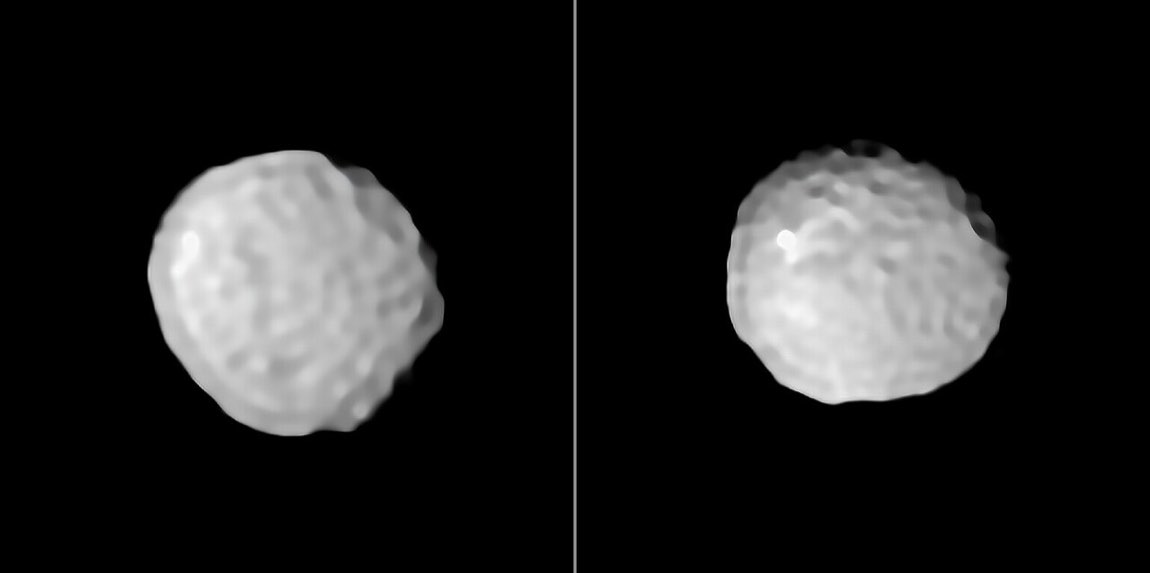
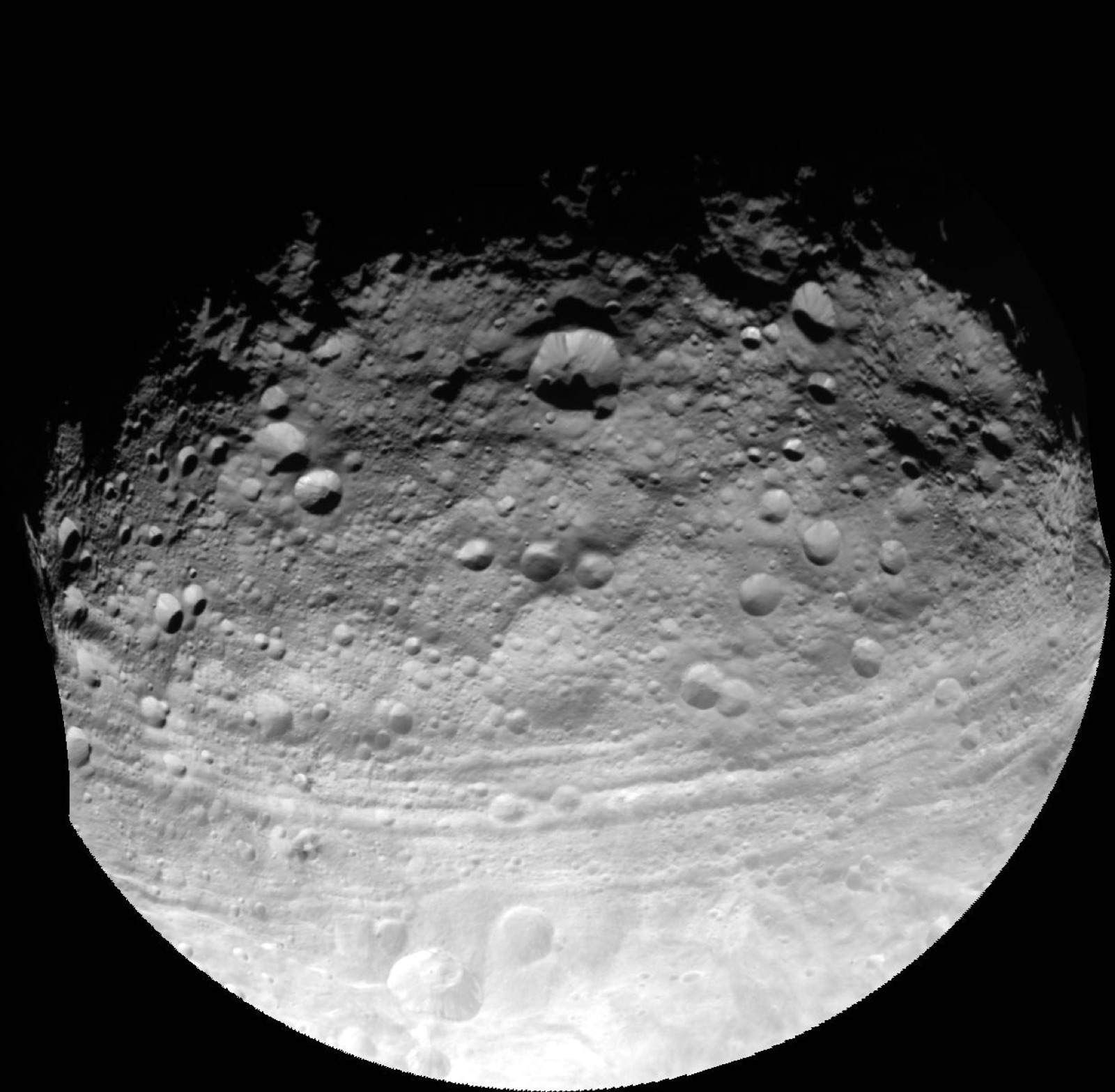
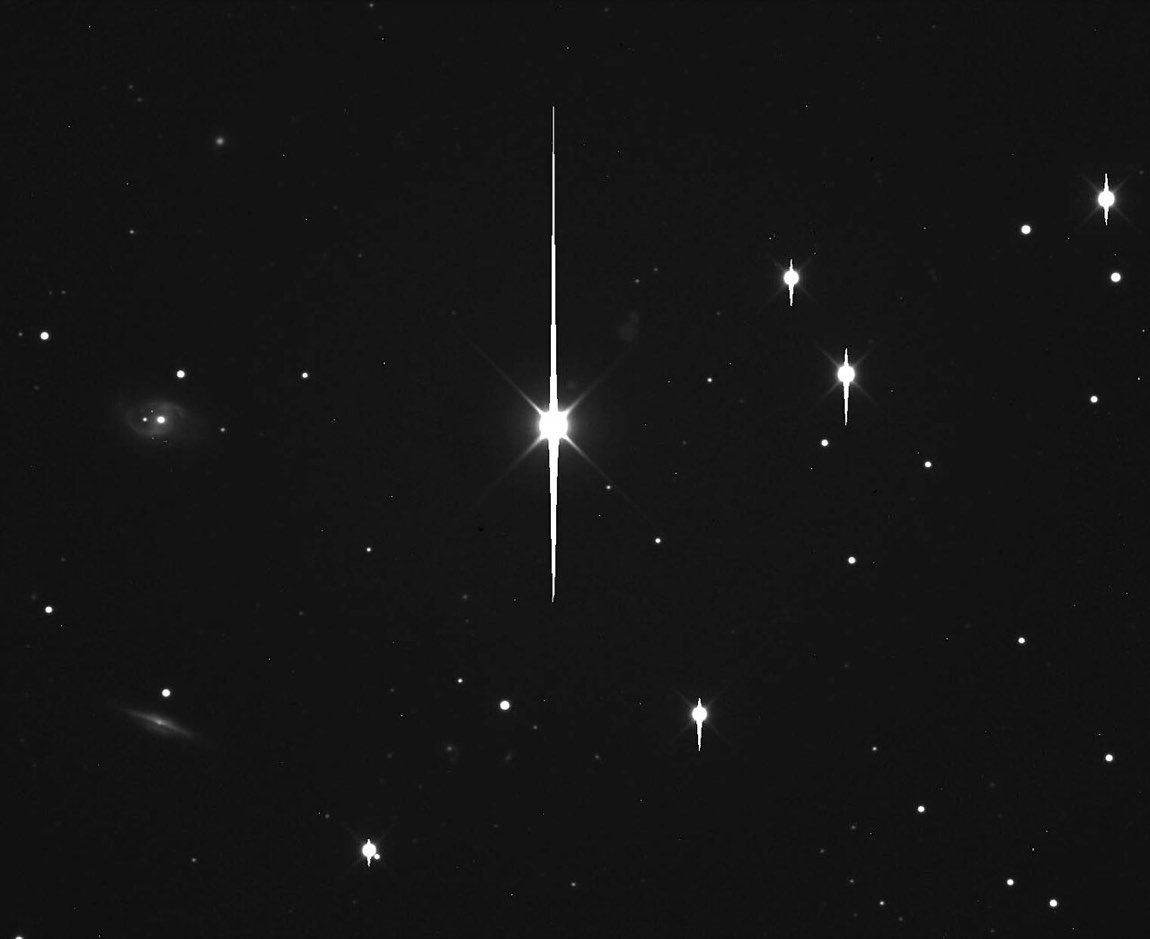
 Photograph · Kevin Heider @ LightBuckets · CC BY-SA 3.0
Asteroid · Deep guide
3 Juno
Also called: 3 Juno · (3) Juno · A804 RA · Juno (asteroid)
The third asteroid ever found and one of the two biggest stony asteroids.
What is it?
Juno was discovered in 1804 by Karl Harding, making it the third asteroid known after Ceres and Pallas. It is about 250 km across and is one of the two largest S-type (stony) asteroids, alongside 15 Eunomia. Juno holds roughly 1% of the asteroid belt's total mass. Its name comes from the Roman queen of the gods — not to be confused with NASA's Juno spacecraft at Jupiter.
The deep dive
Researched for the Atlas from Wikipedia — 3 Juno (5,774 characters read) · updated Nov 14, 2026
01 From Planet to Asteroid: Juno's Reclassification
When Karl Ludwig Harding spotted Juno on 1 September 1804, the solar system appeared to have gained a new planet. Astronomers of the era grouped it alongside 1 Ceres, 2 Pallas, and 4 Vesta as full planetary bodies orbiting between Mars and Jupiter. The illusion held for decades. In 1811, Johann Schröter estimated Juno's diameter at a whopping 2,290 km — a figure that would have made it a respectable world. That estimate turned out to be wildly wrong; modern measurements put its average radius at just 135.7 ± 11 km, meaning Schröter was off by a factor of roughly eight. As telescopes improved and additional small bodies accumulated in the catalog, the community gradually accepted that these objects formed a distinct class. Juno was formally reclassified as an asteroid and minor planet during the 1850s, the same decade that the generic numbered-disk symbol (③ for Juno) replaced its original scepter-and-star glyph. Its small size and irregular shape also permanently bar it from the newer category of dwarf planet.
02 A Name Fit for the Queen of the Gods
Juno takes its name from the highest Roman goddess, queen of the pantheon and consort of Jupiter. The choice was fitting given astronomers' early habit of assigning mythological names to what they believed were planets. The adjectival form — Junonian — follows the same pattern as Plutonian for Pluto, with the historical final 'n' of the Latin root resurfacing, still visible in the French form Junon and the Italian Giunone. In Russian the asteroid is known as Юнона (Yunona). Juno's original astronomical symbol was a scepter topped by a star, with many elaborate graphic variants featuring more ornate scepters, sometimes tilted at an angle purely for decorative reasons. That symbol fell out of scientific use when the numbered-disk convention was introduced in 1852 but was revived specifically for astrological practice in 1973. Today astronomers use the minor-planet designation 3 Juno, while astrologers continue working with the old scepter imagery.
03 An Unusually Shiny Surface Among Stony Worlds Deeper
Among S-type asteroids — the stony, silicate-rich class — Juno stands out as unusually reflective. This high albedo has real observational consequences: at a favorable opposition, Juno can reach an apparent magnitude of +7.5, outshining both Neptune and Saturn's moon Titan in the sky. That brightness is what allowed Harding to discover it before far larger asteroids such as Hygiea, Europa, Davida, and Interamnia, which remain hidden from casual view despite their greater bulk. At a typical opposition, Juno fades to around magnitude +8.7, just within range of binoculars, and at smaller elongations a 76 mm (3-inch) telescope is required to pick it out. The source of the elevated reflectivity is not fully explained; the article notes only that it may indicate distinctive surface properties. Spectroscopic studies suggest the surface contains iron-bearing silicates — specifically olivine and pyroxene — consistent with Juno being the possible parent body of ordinary chondrite meteorites, some of the most common stony meteorites that fall to Earth.
04 An Extreme Orbit With a Record-Breaking Past Deeper
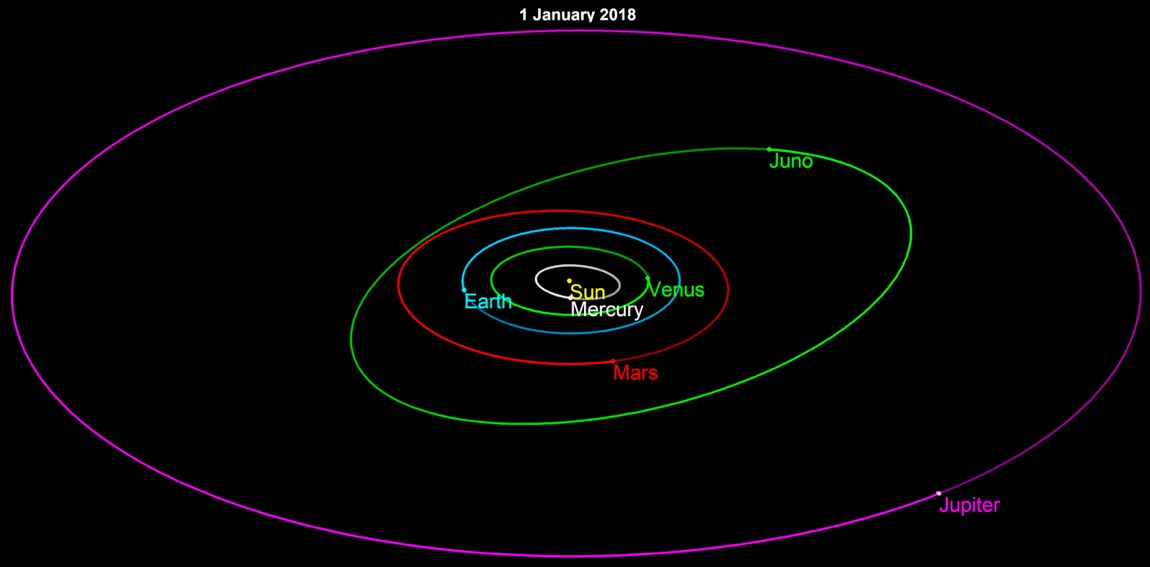
Juno's orbit is moderately inclined at around 12° to the ecliptic, but its most striking orbital trait is its eccentricity, which exceeds even that of Pluto. This elongated path means Juno swings closer to the Sun at perihelion than Vesta does, then retreats further from the Sun at aphelion than Ceres — a wide range of heliocentric distances for a main-belt body. Its mean distance from the Sun is slightly less than that of either Ceres or Pallas. Historically, this eccentricity was record-setting: Juno held the title of most eccentric orbit of any known body until 33 Polyhymnia was discovered in 1854. Among all asteroids exceeding 200 km in diameter, only 324 Bamberga has a more eccentric orbit today. The orbit appears not to have been perfectly stable throughout recorded history — perturbations almost certainly from a passing, still-unidentified asteroid caused a slight but detectable shift in Juno's orbital path around 1839, a subtle reminder that the asteroid belt is a dynamically crowded place.
05 Surface Temperatures and the Chondrite Connection Deeper
On 2 October 2001, astronomers measured Juno's maximum surface temperature — the warmest point on the directly sunlit face — at approximately 293 K (about 20 °C). Accounting for where Juno was in its orbit at that moment, they extrapolated that the peak temperature at perihelion, when it is closest to the Sun, reaches an estimated 301 K, or +28 °C — roughly a warm spring day on Earth, though on an airless, rocky body the comparison ends there. Juno rotates in a prograde direction with an axial tilt of approximately 60°, meaning its seasons are pronounced. More scientifically significant than the temperature is what spectroscopy reveals about the mineralogy: the surface is rich in olivine and pyroxene, iron-bearing silicate minerals that are the hallmarks of ordinary chondrites. This compositional match has led researchers to propose that Juno may be the parent body from which many chondrite meteorites ultimately originate, fragments blasted off by ancient impacts and eventually delivered to Earth.
06 A Giant Crater Hinting at Violent Youth
Infrared imaging of Juno has revealed a crater or ejecta feature approximately 100 km wide — an enormous scar for an object whose average radius is only about 135.7 km. The feature is described as geologically young, meaning it was formed relatively recently in solar system terms rather than in the chaotic early bombardment era. A collision energetic enough to gouge out such a feature could plausibly have launched significant debris into space, some of which may have eventually crossed into Earth-approaching orbits and fallen as meteorites. This connects the visible crater directly to the hypothesis that Juno is a chondrite parent body. Adaptive optics imaging carried out at the Hooker Telescope at Mount Wilson Observatory in 1996 — covering a full rotation period at visible and near-infrared wavelengths — also identified a dark albedo feature interpreted as a fresh impact site, lending additional support to the idea that Juno's surface continues to be shaped by impacts.
07 Juno's Size and Its Place in the Belt
Juno is tied with three other asteroids as the thirteenth largest asteroid and ranks as the second-most-massive S-type asteroid, behind only 15 Eunomia. Based on data from the Mid-Infrared Asteroid Spectroscopy (MIDAS) survey using the Hale Telescope, an average radius of 135.7 ± 11 km was reported in 2004. Despite this respectable bulk, Juno contains only 3% of the mass of the largest asteroid, Ceres, illustrating how dramatically mass is concentrated at the top of the size ladder. Across the entire asteroid belt, Juno accounts for approximately 1% of the total mass — a notable fraction for a single body in a belt containing countless thousands of objects. Its irregular shape prevents it from achieving the hydrostatic equilibrium that would qualify it as a dwarf planet. It is also the main body of the Juno dynamical family, a group of asteroids that likely share a common origin from a past collision event involving Juno's surface.
08 The First Asteroid Caught Crossing a Star
Juno earned a historic first on 19 February 1958 when it became the first asteroid ever observed in stellar occultation — that is, astronomers watched it pass directly in front of a background star, designated SAO 112328, briefly blotting out the star's light. Timing such an event from multiple ground stations allows scientists to reconstruct the shape and size of the passing object with surprising precision. Juno has since provided several additional occultation opportunities. The most productive came on 11 December 1979, when Juno occulted the star SAO 115946 and no fewer than 18 separate observers recorded the event, yielding a rich data set for size and shape analysis. More recently, Juno occulted the magnitude 11.3 star PPMX 9823370 on 29 July 2013, and the star 2UCAC 30446947 just one day later on 30 July 2013, giving researchers back-to-back chances to refine their models of its irregular outline.
09 Weighing Juno From 140 Million Miles Away Deeper
Measuring the mass of an asteroid that no spacecraft has ever visited is a genuine technical challenge. For Juno, scientists found an elegant solution: radio signals from spacecraft in orbit around Mars and from landers on its surface have been analyzed with extreme precision. Juno's gravity, though small, produces tiny but measurable perturbations in the motion of Mars as the two bodies periodically come relatively close to each other in their orbits. By carefully tracking the radio signals and modeling the gravitational tugs mathematically, researchers have been able to estimate Juno's mass without any need for a dedicated flyby or orbiter. This technique exemplifies how the interplanetary navigation infrastructure built for Mars exploration provides a bonus scientific dividend — a mass determination for a third body that happens to wander nearby. The result feeds directly into our understanding of how much mass Juno contributes to the asteroid belt's total inventory.
10 How and When to Catch Juno in the Sky
Juno reaches opposition — its closest and brightest point in the sky for any given year — roughly every 15.5 months. However, because of its pronounced orbital eccentricity, not all oppositions are equal: when opposition coincides with perihelion, Juno can brighten dramatically, while aphelion oppositions are far less rewarding. The best viewing windows cluster together in sequences, with a truly favorable opposition arriving approximately every ten opposition cycles, or just over every 13 years. Recent favorable oppositions occurred on 1 December 2005, when Juno reached magnitude 7.55 at a distance of 1.063 AU, and on 17 November 2018, when it reached magnitude 7.45 at a minimum distance of 1.036 AU. The next favorable opposition is predicted for 30 October 2031, with Juno expected to reach magnitude 7.42 at a distance of 1.044 AU — bright enough to find with binoculars under dark skies, and a compelling target for small telescopes.
11 Open Questions: What Juno Still Won't Tell Us Deeper
Despite nearly two centuries of observation, Juno still holds genuine mysteries. The source of its unusually high albedo for an S-type asteroid has not been definitively explained; it may reflect distinctive mineralogy or surface processing, but no consensus exists. The identity of the asteroid whose gravitational nudge altered Juno's orbit around 1839 has never been determined, leaving an unsolved puzzle about the population of objects passing through that region of the belt at that time. The 100 km-wide impact feature is described as geologically young, but precisely how young — and whether the collision event is linked to any identified group of near-Earth objects or meteorite falls — remains an open question. Juno has never been visited by a spacecraft, so all knowledge of its surface comes from Earth-based telescopy, adaptive optics imaging, occultations, and spectroscopy. A dedicated mission would almost certainly transform understanding of S-type asteroids and the chondrite connection in ways that remote observation cannot.
 ⤢
You would weigh…
Surface gravity 0.11 m/s² vs Earth’s 9.81 m/s². Try every world →