 Diagram · Daniel Bamberger (Renerpho) · CC BY-SA 4.0
Asteroid · Deep guide
2024 YR4
Also called: 2024 YR4
The asteroid that briefly had a 3% chance of hitting Earth in 2032 — until more observations ruled it out.
What is it?
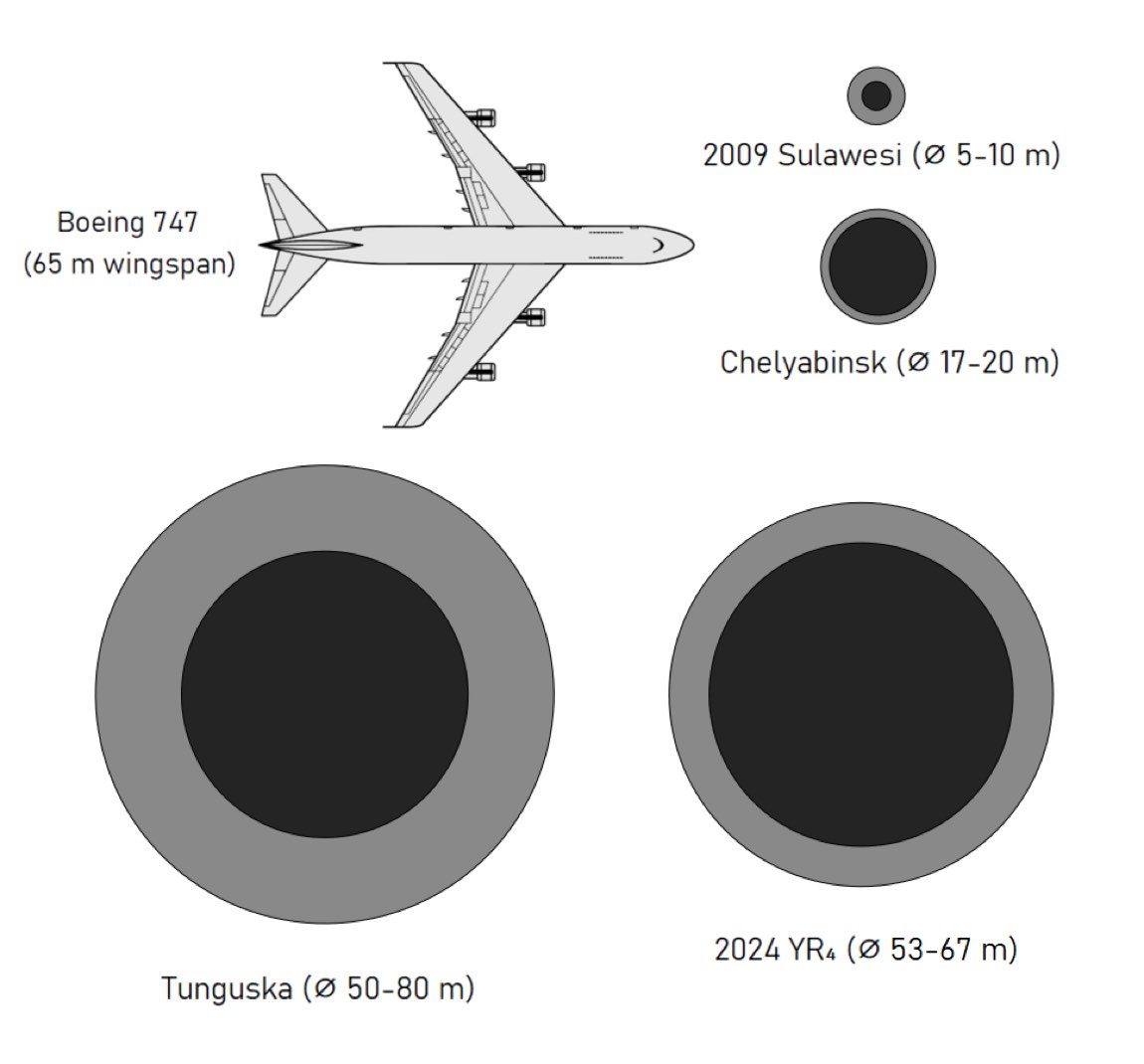
2024 YR4 is a near-Earth asteroid about 60 m across, discovered in December 2024. Early orbit estimates gave it a rising chance of striking Earth on 22 December 2032, peaking at 3.1% in February 2025 and reaching level 3 on the Torino scale. Further observations quickly ruled out an Earth impact. A small chance of it hitting the Moon remained, but James Webb Space Telescope measurements in February 2026 eliminated that too.
The deep dive
Researched for the Atlas from Wikipedia — 2024 YR4 (20,350 characters read) · updated Nov 14, 2026
01 How its size was finally pinned down
Before the James Webb Space Telescope turned its instruments toward 2024 YR4, scientists had to estimate the asteroid's size indirectly, using how bright it appeared and guessing at how reflective its surface might be. That approach gave a frustratingly wide range: anywhere from 40 to 90 metres across, depending on whether the surface was dark or mirror-like. Everything changed on 26 March 2025, when JWST measured the asteroid's mid-infrared thermal emission — essentially detecting the heat the sunlit rock radiates — and returned a diameter of 60 metres with an uncertainty of just 7 metres. That measurement is about as precise as measuring a city block from space. The result also constrained the geometric albedo to between 0.08 and 0.18, confirming the surface is relatively dark for a stony body. NASA had previously used an assumed albedo of 0.154 to estimate 55 metres; the JWST result validated that the assumption was close but slightly low. JWST also used its NIRCam and Mid-Infrared Instrument together, measuring the asteroid's position and infrared emission simultaneously — a combination that made the 60-metre figure the most reliable physical measurement the asteroid has received.
02 A pancake tumbling through space
2024 YR4 is not a tidy sphere. Photometric observations by the Very Large Telescope and the La Silla Observatory's 1.54-metre telescope reveal a rotation period of roughly 19.5 minutes — fast enough to be notable but not fast enough to rule out a loosely bound rubble-pile interior. As the asteroid spins, its brightness varies by 0.42 magnitudes, which tells astronomers its longest equatorial dimension is at least 1.4 times its shortest. Gemini South telescope measurements at multiple phase angles went further, showing the shape is highly flattened: the equatorial diameter is roughly three times the polar diameter. Picture a flattened disk, like a thick hockey puck, spinning end-over-end every 19 and a half minutes. Gemini South also determined the rotation is retrograde — the asteroid spins in the opposite direction from most Solar System bodies when viewed from above the ecliptic. This retrograde spin has an important consequence for the asteroid's long-term fate: through the Yarkovsky effect, thermal radiation pushes a retrograde rotator inward, slowly shrinking its orbit over geological time.
03 Composition clues from multiple telescopes Deeper
Several major observatories weighed in on what 2024 YR4 is made of, and the answers are consistent if not perfectly unanimous. Preliminary spectroscopic work from the Gran Telescopio Canarias and the Lowell Discovery Telescope suggested either an S-type, L-type, or K-type classification — all stony compositions. S-types make up about 17 percent of the known asteroid population and are dominated by silicate minerals mixed with metal. Spectro-photometry from the Gemini South telescope in February 2025 pointed instead toward an R or Sa spectral type, which still falls within the broader stony category. JWST measurements added an unexpected nuance: the asteroid's thermal emission suggests a rockier surface than is commonly inferred for objects of its spectral class, hinting at a surface with less fine-grained regolith and more bare rock than typical. The article notes that S-type and C-type asteroids are the most abundant types in the central main asteroid belt, the region from which 2024 YR4 is thought to have originated, so the stony composition fits its probable birthplace. No single composition has been definitively confirmed, and the ambiguity between spectral subtypes remains an open question.
04 A long, chaotic journey from the main belt Deeper
2024 YR4 did not begin life as a near-Earth asteroid. Its retrograde rotation drives a slow inward spiral through the Yarkovsky effect — sunlight absorbed on one side and re-radiated as heat gives the spinning body a tiny but persistent orbital nudge. Over millions of years, this shrinks the orbit, implying the asteroid originated farther out in the Solar System, specifically in the central main asteroid belt. That inward migration was not smooth. To reach near-Earth space, 2024 YR4 had to cross two powerful gravitational barriers: the 3:1 mean-motion resonance with Jupiter at 2.5 AU, where an asteroid completes three orbits for every one of Jupiter's, and the ν6 secular resonance with Saturn's orbital precession at 2.2 AU. These resonances act like gravitational catapults, kicking asteroids onto chaotic, high-eccentricity orbits that can intersect Earth's path. The article describes this migration as "likely chaotic," which is the standard understanding — once an asteroid enters a resonance zone, its path becomes unpredictable on human timescales. The 2015 Porangaba meteorite's orbit has a 5 percent probability of matching that of 2024 YR4, raising the intriguing possibility of a shared origin.
 ⤢
05 Orbital relatives and the group connection Deeper
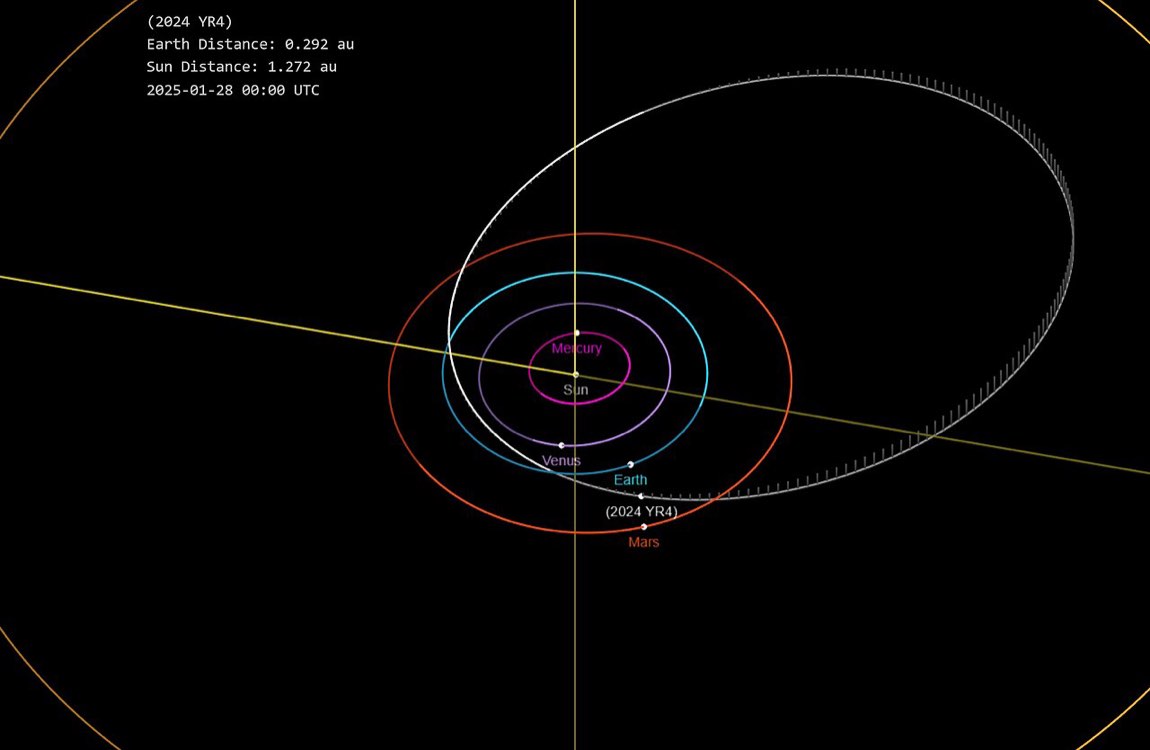
2024 YR4 may not be a lone traveler. Astronomers Carlos and Raúl de la Fuente Marcos have proposed that the asteroid could be related to a small group of near-Earth objects on similar orbits: 2017 UW5, 2018 GG4, 2019 SC, and 2020 MQ61. Notably, all of these are also classified as virtual impactors, meaning they currently carry non-zero Earth-impact probabilities in planetary defense risk tables. If the group shares a common origin — perhaps a larger body that broke apart in the main belt before migrating inward together — that would have implications for understanding how clusters of near-Earth objects form and evolve. The asteroid's orbital period is currently about 3.99 years (1,458 days), with an inclination of just 3.41 degrees relative to Earth's orbit. That nearly coplanar, relatively circular Apollo orbit is what makes repeated Earth encounters geometrically possible. After the December 2028 flyby the period will slowly rise to around 4.01 years (1,463 days) by 2031, before the 2032 close encounter with the Earth-Moon system perturbs everything significantly.
06 How the impact probability rose and fell
The story of 2024 YR4's impact probability is a vivid demonstration of how planetary defense actually works. The asteroid was discovered on 27 December 2024 by the ATLAS station at Río Hurtado, Chile. As more observations came in and refined the orbit, the calculated chance of an Earth impact on 22 December 2032 climbed above 1 percent — triggering the first formal step in planetary defense response protocols and prompting the International Asteroid Warning Network to issue a notice on 29 January 2025. The probability peaked at 3.1 percent on 18 February 2025, when the observation arc was 55 days long. At that point NASA's Sentry system assigned a Palermo scale rating of −0.18, meaning the impact hazard was 66 percent of the background rate for a random asteroid of that size. By 23 February 2025, with a 60-day arc, the Earth-impact probability collapsed to effectively zero and the Torino rating dropped to 0. ESA removed the Earth-impact risk on 8 March; NEODyS on 1 March; and NASA on 2 April 2025, by which point the observation arc had grown to 91 days. The sequence illustrates a recurring pattern in asteroid science: early probabilities can be alarming, but more data almost always resolves the uncertainty.
07 The Torino scale and what rating 3 meant
From 27 January to 20 February 2025, 2024 YR4 held a Torino scale rating of 3, making it only the second asteroid ever to reach that level. The first was 99942 Apophis, which briefly achieved a similar impact probability in late 2004 but reached a Torino rating of 4 because of its considerably larger size — the scale weights both probability and destructive energy. A rating of 3 reflects a close encounter meriting attention by astronomers, with an impact probability greater than 1 percent. For context, most newly discovered asteroids spend a few days at Torino 1 before additional observations push the probability to zero. Remaining at Torino 3 for more than three weeks was extraordinary. The European Space Agency's Aegis system independently listed a 2.8 percent Earth-impact chance on 18 February 2025, closely matching NASA's figure. The Palermo scale rating of −0.18 at peak meant the cumulative impact hazard was 66 percent of background — not exceeding the statistical expectation for random asteroid strikes, but approaching it uncomfortably closely. The asteroid never crossed zero on the Palermo scale, meaning it technically never exceeded the routine background impact risk for objects its size.
08 What a 2032 impact would have unleashed
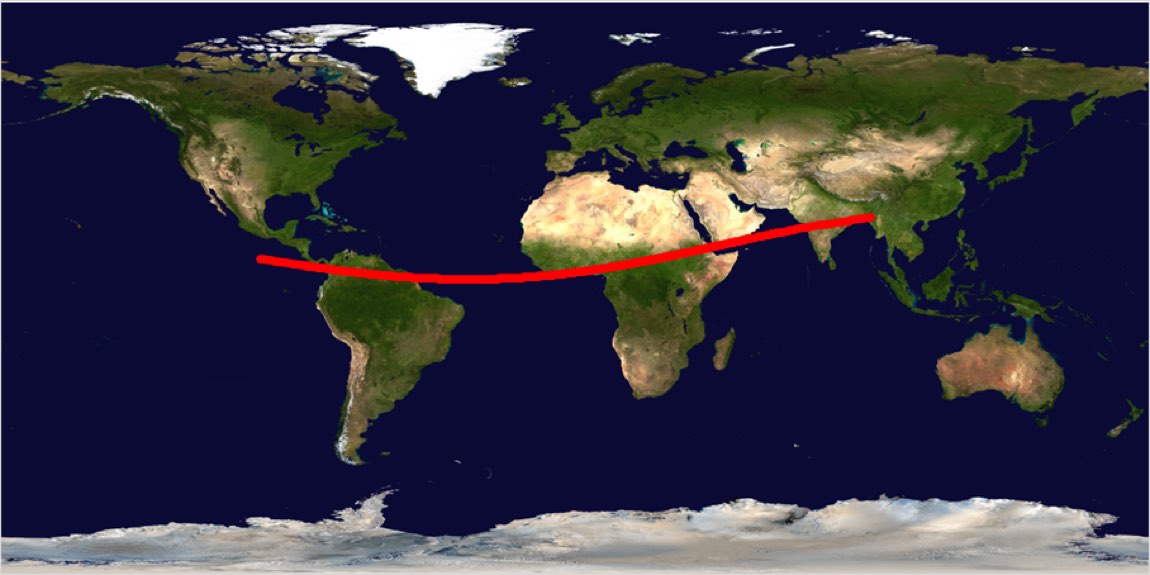
Had 2024 YR4 been on a collision course, the consequences would have been severe but geographically limited. At its predicted atmospheric entry velocity of 17.20 km/s, the asteroid would have released energy equivalent to 7.7 megatonnes of TNT — roughly 500 times the yield of the Little Boy bomb dropped on Hiroshima, about 50 percent of the Castle Bravo thermonuclear test, or 15 percent of the Tsar Bomba, the largest nuclear weapon ever detonated. Because of its stony composition, scientists expected an airburst rather than a crater-forming impact on land, similar to but far larger than the 1908 Tunguska event. Damage could have extended as far as 50 kilometres from the impact site. Notably, 2024 YR4 is not classified as a potentially hazardous object under the official definition, because its absolute magnitude is dimmer than 22 — implying a diameter below 140 metres — meaning any damage would be localized rather than civilisation-threatening. The projected risk corridor ran from the eastern Pacific across northern South America, the Atlantic, Nigeria, central Africa, the Arabian Peninsula, the Indian Ocean, and ended in Bangladesh.
 ⤢
09 The brief, real prospect of a lunar impact
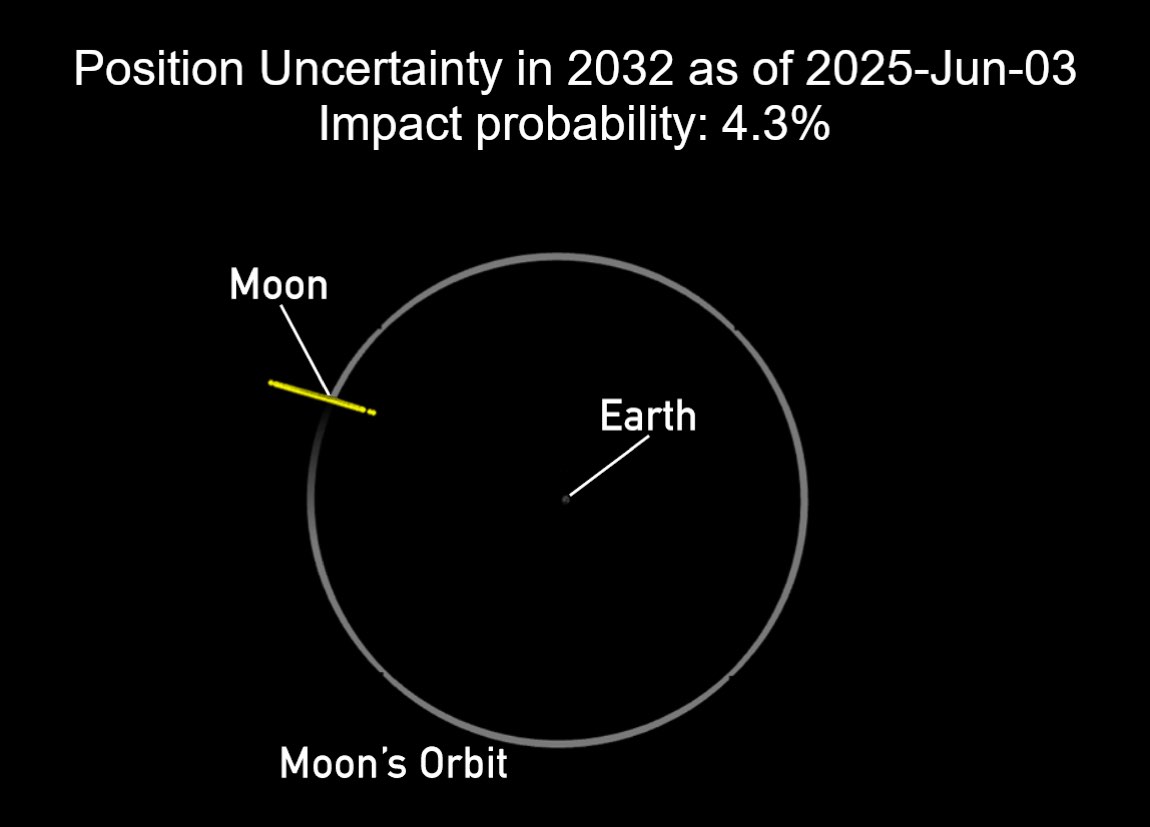
Even after Earth was ruled safe, the Moon remained at risk for nearly a year. Using observations through 11 May 2025, the probability of 2024 YR4 striking the Moon on 22 December 2032 stood at 4.3 percent — a figure that JWST observations on that same date had actually nudged upward from 3.8 percent by reducing the Earth-approach uncertainty region by 20 percent. The nominal closest approach to the Moon was calculated at about 22,900 kilometres from the lunar center, with a 3-sigma uncertainty of 2,300 kilometres. Had an impact occurred, models suggested a crater 500 to 2,000 metres across, an energy release of 5.2 megatonnes of TNT at an impact velocity of 13.9 km/s — about 340 times the Hiroshima yield — and roughly 100,000 tonnes of debris ejected into space. That debris cloud could have produced an extraordinary meteor shower and posed hazards for Earth-orbiting satellites. Astronomers disagreed about naked-eye visibility: Michael Busch of the SETI Institute was cautious, while Gareth Collins and Daniel Bamberger suggested the flash could be visible even in daylight or brighter than the full Moon. The chance was eliminated entirely by JWST observations in February 2026, announced on 5 March 2026.
10 The exhaustive hunt for earlier sightings Deeper
Extending an asteroid's observation arc dramatically improves orbital precision, so astronomers launched a broad search through archival images hoping to find 2024 YR4 before its official discovery date. The asteroid passed within 11.4 million kilometres of Earth on 8 September 2016 and within 20.8 million kilometres on 26 October 2020 — both close enough that existing sky surveys might have captured it. A search of Subaru Telescope images from 2016 found nothing in part of the expected sky region. Catalina Sky Survey inspected Mount Lemmon Survey images and found no candidates. Pan-STARRS identified images from 2012, 2016, and 2020 but found nothing, with the 2012 and 2020 frames too shallow to detect the asteroid at its predicted brightness. Paolo Tanga checked Gaia spacecraft records but determined the asteroid never entered its field of view. James Bauer searched NEOWISE data, Deborah Woods examined Space Surveillance Telescope data, and Julien de Wit searched TESS and other exoplanet survey archives — all without success. The most promising lead came from Sam Deen, who may have found the asteroid in Intermediate Palomar Transient Factory images from 2016, which would extend the arc by 8 years — from 428 days to roughly 3,495 days — a transformative improvement if confirmed.
11 How JWST became the asteroid's last observer
Ground-based telescopes can only do so much. As 2024 YR4 receded from Earth after its December 2024 flyby, it faded rapidly: by 14 March 2025 it had reached apparent magnitude 26, roughly 63 million times fainter than the naked-eye limit. The last ground-based observation was made on 23 March 2025 by Paranal Observatory, at which point the asteroid was 1.8 AU from the Sun — just beyond Mars's orbit. Only space-based infrared telescopes could follow it further. JWST observed the asteroid on 8 March (the first date its position was compatible with the telescope's pointing restrictions), 26 March, and finally 11 May 2025 — almost certainly the last observations before the 2028 approach. JWST used both its NIRCam and Mid-Infrared Instrument to measure position, thermal emission, and size simultaneously. In 2026, the telescope was again allocated NIRCam time on 17 and 26 February, specifically to narrow the orbital uncertainty. By comparing the asteroid's position against stars in the Gaia catalog, those observations extended the arc by 291 days — from 137 to 428 days — which was sufficient to eliminate the 4 percent lunar-impact probability entirely. The next realistic observation window opens in June 2028, when the asteroid brightens as it approaches for its next Earth flyby.
12 Why the post-2032 trajectory is so uncertain Deeper
Even with 2024 YR4's Earth and Moon impacts ruled out, its long-term future remains genuinely murky. The 2032 flyby will carry the asteroid to within 278,000 kilometres of Earth at 08:22 UTC on 22 December, with a 3-sigma position uncertainty of just 2,200 kilometres — a remarkably tight prediction for a decade-long forecast. But that tight number conceals a problem: the asteroid will then pass roughly 22,900 kilometres from the Moon's center, and the gravitational focusing from that near-miss amplifies trajectory uncertainties enormously. By mid-2034, the 3-sigma position uncertainty already balloons to about 430,000 kilometres. Using data only through 2025, the greatest post-2032 Earth-impact risk would have fallen in December 2047, with the uncertainty in the asteroid's position along its orbit reaching at least 2 billion kilometres — wrapping all the way around the orbit. Around January 2052 the asteroid could pass as close as 3 million kilometres from Earth or as far as 25 million kilometres. By the year 2123, the position uncertainty reaches 4 AU, or about 600 million kilometres — wider than the entire inner Solar System. The 2028 flyby observations will be crucial for constraining this cascade of uncertainty before the pivotal 2032 encounter.
 ⤢