Asteroid · Deep guide
(29075) 1950 DA
Also called: (29075) 1950 DA · 29075 · 2000 YK66
A kilometre-wide asteroid with a small but real chance of hitting Earth in the year 2880.
What is it?
1950 DA is a near-Earth asteroid about 1.3 km across that spins very fast, once every 2.1 hours. It was discovered in 1950 by Carl Wirtanen at Lick Observatory. Precise tracking shows a small chance it could strike Earth on 16 March 2880 — currently about 1 in 3,000. Because that date is centuries away, it carries no Torino-scale rating, but it has the highest cumulative Palermo-scale score on NASA's risk list.
The deep dive
Researched for the Atlas from Wikipedia — (29075) 1950 DA (4,259 characters read) · updated Nov 14, 2026
01 Lost for 50 years, then found again
The story of 1950 DA is one of astronomy's more striking cases of a lost-and-found object. Carl A. Wirtanen spotted it on 23 February 1950 at Lick Observatory, but the team only managed to track it for seventeen days before it faded from view. That brief window was not long enough to pin down its orbit with confidence — the observation arc was simply too short, leaving uncertainties too large to predict where to look next. For half a century, the asteroid was essentially forgotten. Then, on 31 December 2000, observers at Lowell Observatory picked up what they initially catalogued as a new object, announcing it on 4 January 2001 under the temporary label 2000 YK66. Just two hours after that announcement, someone ran the numbers and realized the orbit matched the long-lost 1950 DA. The recovery dramatically extended the observation arc to fifty years, which is precisely why astronomers have since been able to calculate its future trajectory — including the 2880 close approach — with unusual precision.
02 Radar reveals a surprisingly dense world Deeper
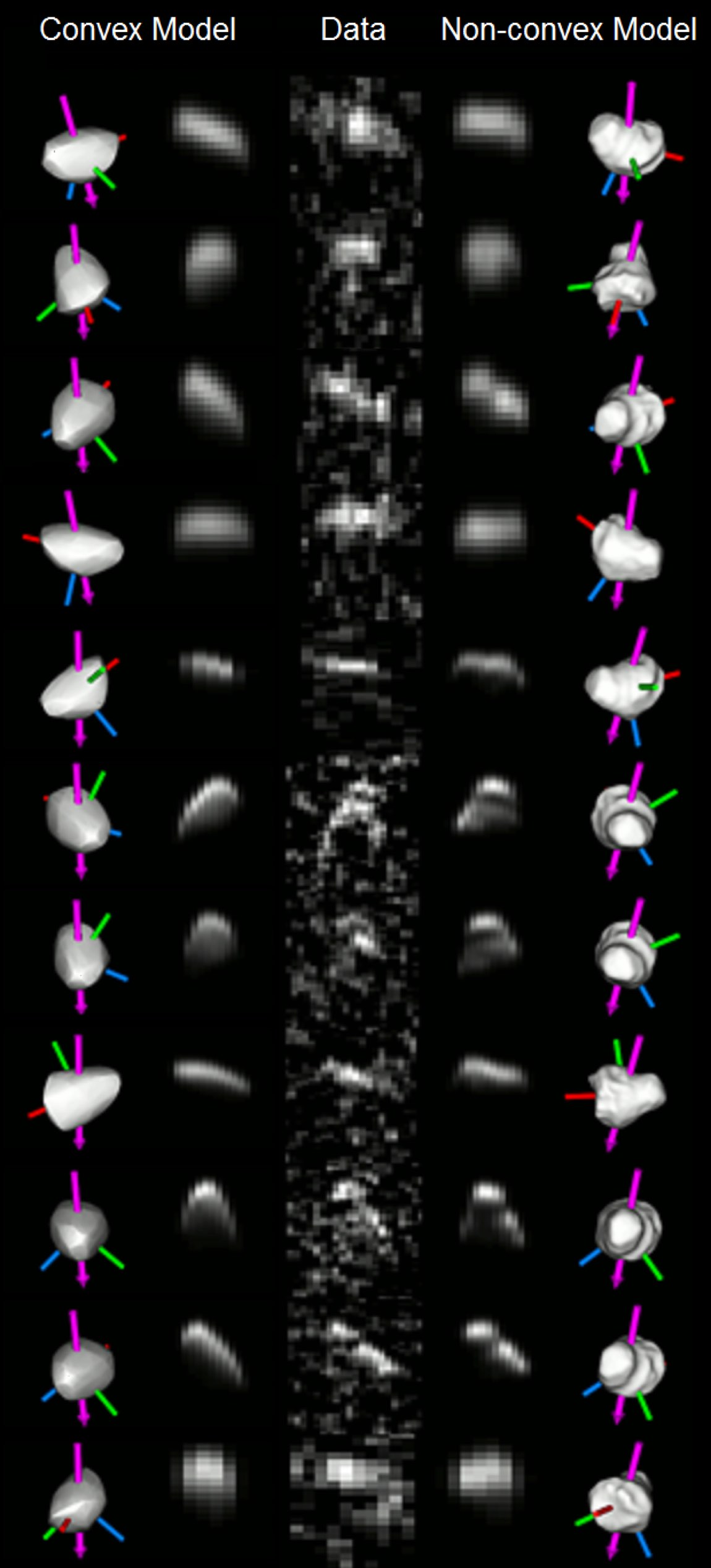
When 1950 DA swung past Earth on 5 March 2001 at 0.05207 AU — about 7.790 million kilometres, or roughly 20 times the Earth-Moon distance — scientists were ready. Radar dishes at the Goldstone and Arecibo observatories tracked the asteroid from 3 to 7 March 2001, bouncing radio signals off its surface and timing the echoes. The technique is powerful because it measures distance directly, complementing the angular-position data that optical telescopes supply. The radar returns indicated a mean diameter of 1.1 km, assuming the asteroid rotates in the retrograde direction. The high radar albedo also hinted at composition: 1950 DA is thought to be fairly dense — more than 3.5 g/cm³ assuming it has no internal strength — and likely composed of nickel-iron. That density figure is striking; it would place 1950 DA among the denser small bodies in the solar system, comparable in density to iron meteorites rather than the loose, rocky rubble that makes up many near-Earth asteroids.
03 Spinning faster than gravity can hold it together
One of the most counterintuitive discoveries about 1950 DA concerns its spin. Optical lightcurve analysis by Lenka Šarounová and Petr Pravec measured a rotation period of just 2.1216 ± 0.0001 hours. That is extremely fast for an object this size. For comparison, a rotation period that short means the surface near the equator is effectively being flung outward, and for a loosely packed rubble pile, gravity alone would not be enough to prevent the whole thing from flying apart. In August 2014, scientists from the University of Tennessee confirmed exactly this: 1950 DA is rotating faster than the breakup limit for its density. The surprising implication is that it must be held together by something other than gravity. Their conclusion was that van der Waals forces — the same weak electrostatic attractions that allow geckos to walk on ceilings — are binding the surface grains together. It is a remarkable situation: an asteroid roughly a kilometre across, potentially kept intact by forces more familiar from physics at the molecular scale.
04 Why its orbit is unusually well known Deeper
Most near-Earth asteroids accumulate orbital uncertainty rapidly because they are observed for only short stretches. 1950 DA is different. Its orbital solution is one of the best-determined of any risk-listed asteroid, the product of several factors working together. The orbit is moderately inclined at 12 degrees to the ecliptic plane, which reduces the gravitational nudges that planets deliver most effectively to objects orbiting in roughly the same plane. High-precision radar astrometry, which measures distance rather than just angle, adds a dimension of data that optical observations cannot provide alone. The observation arc now spans 74 years, stretching from 1950 to the present. And crucially, an uncertainty region controlled by orbital resonance keeps the range of possible trajectories from spreading chaotically. Each of these factors alone would help; together they give scientists an unusually sharp picture of where 1950 DA is and where it is heading, which is exactly what makes the 2880 impact scenario calculable at all rather than simply unknowable.
05 A passing asteroid that could nudge the future Deeper
The 2880 impact question is complicated by an encounter that will happen long before then. On 5 August 2150, the main-belt asteroid 78 Diana — a considerably larger body, roughly 125 km in diameter — will pass approximately 0.003 AU from 1950 DA, equivalent to about 450,000 km, which is barely greater than the Earth-Moon distance. At that range, Diana's gravity will perturb 1950 DA's trajectory enough that the change becomes significant 730 years later, when the asteroid reaches the vicinity of Earth in 2880. The Yarkovsky effect adds another layer of complexity: as 1950 DA rotates, the uneven way it absorbs sunlight and re-radiates heat as infrared energy gradually pushes its orbit in a direction that depends sensitively on the asteroid's surface properties and spin. Both effects must be accounted for when forecasting the 2880 encounter, which is part of why the probability estimate has been revised multiple times as new data come in.
06 How the impact probability has shifted over time
When researchers first calculated the risk from 1950 DA in 2002, the numbers were startling enough to make headlines: a 1-in-306 probability (0.33%) of collision in 2880, earning it the highest Palermo scale rating known at the time, a value of 0.17. The Palermo scale compares a threat's probability to the statistical background rate of similarly energetic impacts, so a positive value means the specific risk exceeds the random baseline — a genuinely unusual situation. By December 2015, the revised odds had fallen to 1 in 8,300 (0.012%), with the Palermo scale rating dropping to −1.42, meaning the risk had moved below the background level. As of October 2025 it sits atop the Sentry Risk Table again with a cumulative Palermo scale rating of −0.98, and as of 21 October 2026 the stated probability stands at 1 in 3,000 (0.033%). The fluctuations reflect improving orbit solutions, not any real change in the asteroid's path; each new radar or optical observation refines the calculation.
07 The Torino scale and a 100-year rule
Despite being the top-ranked object on the Sentry Risk Table by Palermo scale, 1950 DA carries no Torino scale rating at all. The reason is a deliberate design choice built into the Torino scale: it is not applied to events more than 100 years in the future. The 2880 impact date is roughly eight and a half centuries away, well beyond that threshold. The Torino scale was designed to communicate near-term risk to the public in a way that is actionable, and rating centuries-distant scenarios was judged to be more alarming than useful. The Palermo scale has no such cutoff, which is why it remains the tool scientists use to compare long-horizon threats like 1950 DA. The distinction matters for science communication: an asteroid can simultaneously hold the highest Palermo score on a risk table and receive a Torino score of zero, which can appear contradictory but is simply a reflection of the two scales serving different purposes.
08 What a collision would actually mean
If 1950 DA did strike Earth in 2880, the consequences would extend far beyond the immediate impact zone. The article states that the energy released by a collision with an object of this size would cause major effects on the climate and biosphere that would be devastating to human civilization. At 1.1 to 1.3 kilometres across, 1950 DA falls into the category sometimes called a civilisation-threatening impactor: large enough to inject enormous quantities of dust and aerosols into the stratosphere, potentially triggering years of reduced sunlight, disrupted agriculture, and cascading ecological damage across the planet. This is distinct from a mass-extinction-level event (which requires an impactor an order of magnitude larger) but would nonetheless be catastrophic at a global scale. The discovery of the potential impact directly heightened interest in asteroid deflection strategies — the recognition that a known, trackable object could pose this kind of threat gave real urgency to research into how humanity might redirect such an asteroid if necessary.
09 Planning a better look in 2032
Since its closely watched radar session in 2001, 1950 DA has made several distant approaches to Earth — on 20 May 2012, 5 February 2021, and 5 February 2023 — but at each of those passes it was between a quarter and half an AU away. At those distances, radar and precise timing measurements become far less effective, limiting what scientists can learn. The next genuinely useful observing opportunity comes on 2 March 2032, when 1950 DA will approach to within 0.076 AU, or about 11.4 million km. That is still much farther than the 2001 flyby but close enough for high-quality radar returns that could sharpen the orbital solution further. Better astrometry from that encounter could meaningfully update the probability of the 2880 scenario. Beyond 2032, the close approach predictions in the article's table extend to the year 2500, though the article notes that by 2136 the solutions for close approaches are already becoming notably more divergent — a reflection of the accumulated uncertainties that build over centuries.
10 Carl Wirtanen and the observatory behind the find
The astronomer who first spotted 1950 DA, Carl A. Wirtanen, worked at Lick Observatory on Mount Hamilton in California, one of the pioneering mountaintop observatories of the twentieth century. Wirtanen is perhaps better known in astronomy for the comet that bears his name — 46P/Wirtanen — but his survey work at Lick also turned up this unassuming point of light in February 1950. At the time there was no way to know the object would eventually rank as one of the more statistically interesting near-Earth asteroids on record. The asteroid's formal designation, (29075) 1950 DA, encodes both its discovery year and its provisional survey label. The two-letter suffix DA indicates it was the first object designated in the second half of January's second survey slot of 1950, following standard Minor Planet Center naming conventions, though the object itself was physically found on 23 February of that year.
11 Van der Waals forces at asteroid scale Deeper
The 2014 finding from the University of Tennessee researchers carries implications that go well beyond one unusual asteroid. If a kilometre-scale body can be held together by van der Waals forces rather than gravity or material strength, that changes how scientists think about the structure and long-term behaviour of rubble-pile asteroids in general. Van der Waals forces arise from temporary fluctuations in electron distribution that create weak, transient attractions between molecules or grains. They are normally relevant at microscopic scales, but if the grains on 1950 DA's surface are fine enough, and if the asteroid is indeed spinning faster than its self-gravity can counteract, then these molecular forces could collectively be sufficient to prevent disaggregation. The finding also has practical implications for deflection planning: an asteroid held together by van der Waals cohesion might respond to a kinetic impactor very differently from one held together by gravity or by monolithic rock. Understanding the internal structure is therefore not merely academic.