Asteroid · Deep guide
2023 DW
Also called: 2023 DW
A Tunguska-sized asteroid that briefly topped the risk lists in 2023 before being cleared.
What is it?
2023 DW is a near-Earth asteroid roughly 50 m across — about the size of the object behind the 1908 Tunguska blast. Days after its discovery in February 2023, early orbit estimates gave it a Torino-scale rating of 1 for a possible impact on 14 February 2046. As more observations came in, the risk vanished: it was removed from both NASA's and ESA's risk lists by 20 March 2023. It is a textbook example of how impact odds usually fall as an orbit is refined.
The deep dive
Researched for the Atlas from Wikipedia — 2023 DW (1,944 characters read) · updated Nov 14, 2026
01 How 2023 DW was found
The discovery of 2023 DW came from a dedicated asteroid-hunting partnership called the MAP program — short for Maury, Attard, and Parrott — operating out of San Pedro de Atacama in Chile. Georges Attard and Alain Maury made the detection on 26 February 2023, when the asteroid was just 0.07 AU from Earth, equivalent to about 10 million kilometers. That is a relatively close range in astronomical terms — roughly 26 times the distance to the Moon. The fact that it was spotted at all while this near speaks to the improving sensitivity of dedicated survey programs targeting small, fast-moving objects. Because it was approaching from the direction of the Sun, it had been hidden in solar glare during its closest pass on 18 February 2023, meaning it was only caught as it was already pulling away. This geometrical challenge — objects sneaking in from the Sun's direction — is one of the central blind spots of current asteroid detection infrastructure.
02 The Aten group and an unusual orbit Deeper
2023 DW belongs to the Aten group, a class of near-Earth asteroids whose orbits are mostly confined within Earth's own orbit around the Sun. Aten asteroids complete their solar circuits in less than a year, and 2023 DW is no exception: it orbits the Sun once every 271 days, compared to Earth's 365. It reached perihelion — its closest point to the Sun — on 26 November 2022, then swung outward and made its closest approach to Earth on 18 February 2023, at a distance of approximately 8.7 million kilometers. The Aten classification is relevant to impact risk assessments because Aten members repeatedly cross Earth's orbital path, creating recurring opportunities for a close encounter. Their tendency to approach from the sunward direction also means ground-based telescopes, which cannot safely point close to the Sun, may catch them late or not at all on any given pass.
03 What the Torino scale actually told us
When 2023 DW was assigned a Torino scale rating of 1 on 28 February 2023, it joined a very short historical list of asteroids to have ever received a non-zero score on that scale. The Torino scale runs from 0 to 10: zero means no consequential risk, ten means certain catastrophic impact. A rating of 1 signals that an object merits monitoring but that current data suggest the collision probability will almost certainly drop to zero as more observations come in. At the time of that rating, astronomers had tracked the asteroid for only 1.2 days — an extremely short observation arc. With so few data points, the calculated orbit carried large uncertainties, and a small slice of the probability cloud overlapped Earth's position in February 2046. The rating was never an alarm; it was a flag to keep watching.
04 The Palermo scale: a quieter number Deeper
While the Torino scale grabbed headlines with its integer ratings, the Palermo scale offers a more nuanced statistical picture. It compares an asteroid's calculated impact probability not to an absolute threshold but to the expected background rate of similarly destructive impacts from all known and unknown objects over the same timeframe. A Palermo scale value of 0 means the specific threat exactly equals the background hazard; negative values mean the threat is less worrying than the statistical baseline. At its worst, 2023 DW reached a Palermo scale rating of –1.89 with a 13-day observation arc. That figure means the impact odds at that moment were about 78 times less than the background hazard level — in other words, even at peak concern, the specific danger from 2023 DW was statistically minor compared to the generalized cosmic risk we live with every day. This context is frequently lost in news coverage of such events.
 ⤢
05 How the risk corridor was mapped Deeper
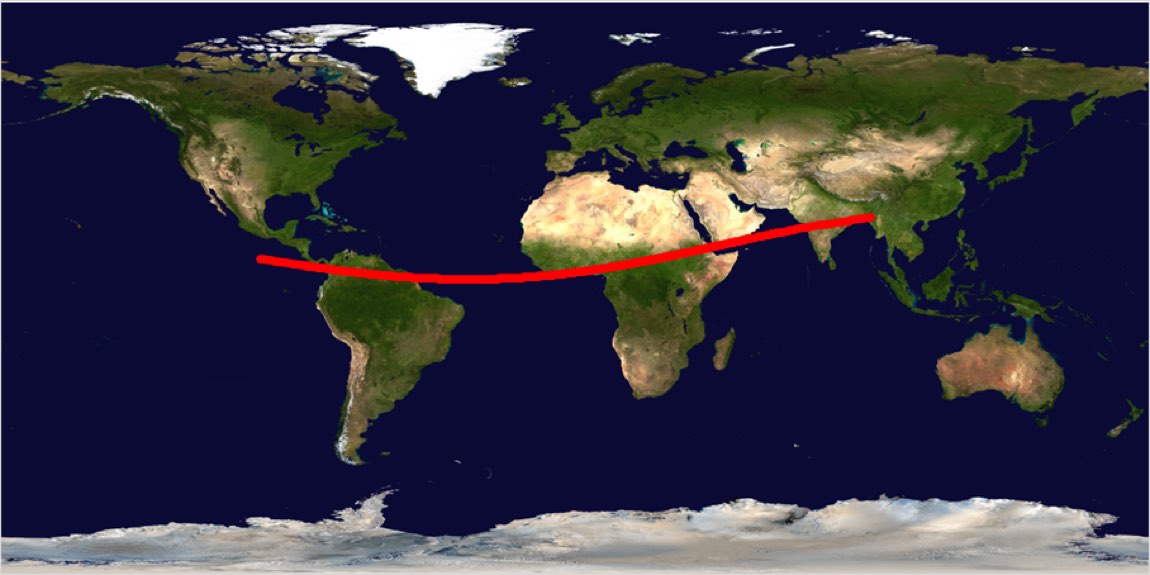
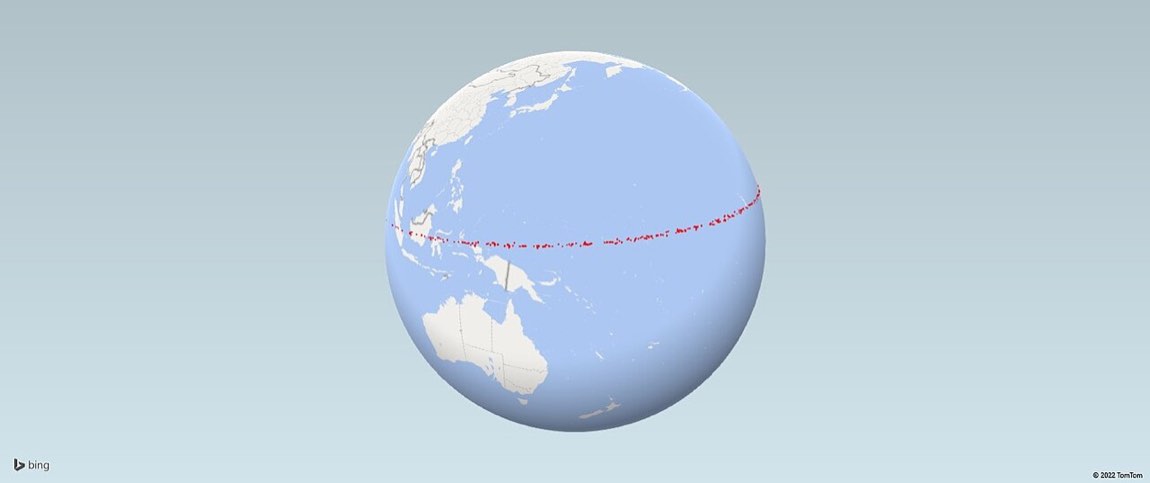
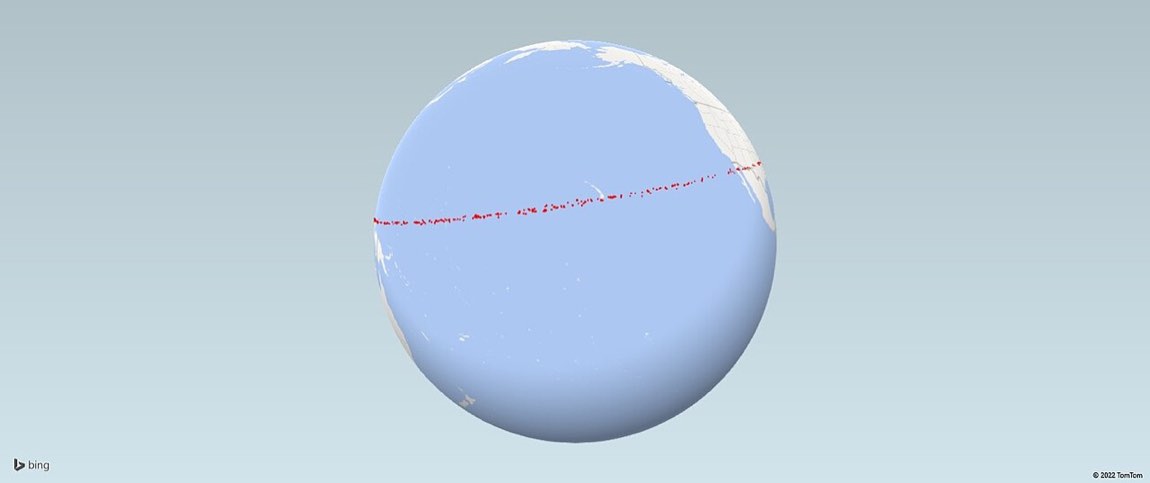
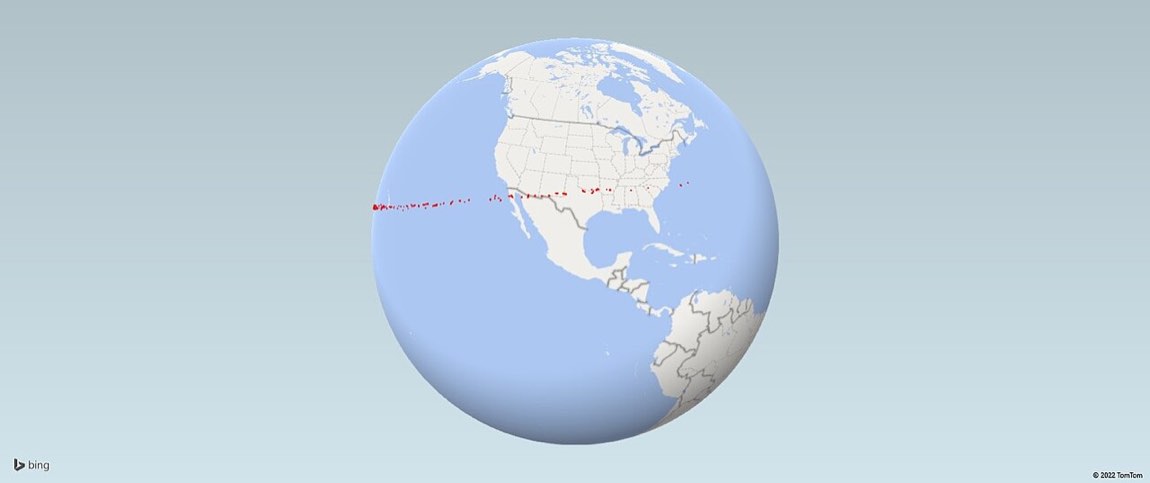
As of 3 March 2023, with four days of observational data and 55 individual measurements, scientists had constructed what is called a risk corridor — a geographic strip on Earth's surface representing where, if an impact occurred, it would most likely strike. For 2023 DW, that corridor pointed most strongly toward the Pacific Ocean. The projected miss distance at that time was approximately 4.7 million kilometers, but the three-sigma uncertainty region — encompassing 99.7 percent of the statistical probability cloud — spanned plus or minus 3 million kilometers. This enormous uncertainty range is key to understanding how early impact assessments work: the Earth itself is roughly 12,742 kilometers in diameter, so a 6-million-kilometer uncertainty band dwarfs the target entirely. As additional observations narrow that band, the probability of impact can counterintuitively rise before it falls, because the shrinking region may for a time overlap Earth more precisely before finally excluding it.
06 The moon that blocked the view
Between 5 and 8 March 2023, astronomers were unable to gather fresh observations of 2023 DW because the asteroid was within 40 degrees of the waxing gibbous Moon in the sky. A bright Moon can overwhelm the faint reflected light from a small, distant asteroid, effectively blinding telescopes to anything nearby in the sky. This four-day gap in tracking data illustrates a mundane but real limitation of ground-based monitoring: even when scientists know where to look, nature does not always cooperate. The lunar interference came at a critical moment when the observation arc was still short and the impact probability was under active reassessment. The inability to observe did not raise the risk estimate, but it delayed the gathering of the data needed to bring the probability down more quickly.
07 How the risk dissolved, and who called it first
The resolution of 2023 DW's brief moment of concern unfolded over about three weeks and involved two separate risk-tracking systems reaching the same conclusion independently. On 14 March 2023, the European Space Agency became the first agency to lower the asteroid's Torino scale rating to 0, clearing it from their risk list. Two days later, on 16 March 2023, NASA's Sentry impact monitoring system followed with its own downgrade to Torino 0. By 20 March 2023 — less than a month after discovery — the asteroid had been removed entirely from both agencies' risk tables. The sequence reflects the competitive but complementary nature of international planetary defense tracking: ESA and NASA run independent orbital calculations, and when both systems converge on a zero-risk result, the scientific community has strong grounds for confidence.
08 If it had hit: scale and precedent
At roughly 50 meters in diameter, 2023 DW was described as approximately the size of the asteroid responsible for the Tunguska event — the 1908 explosion over Siberia that flattened an estimated 2,000 square kilometers of forest. That comparison anchors the object's potential destructive scale in a way that abstract numbers cannot. An impactor of this size would not threaten civilizational collapse, but it would cause severe regional devastation if it struck a populated area. The projected impact scenario, had the probability not dissolved, was dated to 14 February 2046 at 21:36 UTC, with the nominal closest approach predicted about eight hours earlier at 13:15 UTC, plus or minus 72 minutes. The Pacific Ocean location indicated by the early risk corridor would have meant a primary threat from tsunami rather than direct impact damage on land.
 ⤢
09 Why uncertainty can temporarily raise risk odds Deeper
One of the more counterintuitive aspects of asteroid risk assessment is that gathering more data can, for a time, appear to make an asteroid more dangerous before it becomes obviously safe. This phenomenon is explicitly noted for 2023 DW: as the uncertainty region shrinks with additional observations, the probability of impact can increase before it suddenly drops to zero. Early on, a large probability cloud is spread across a wide swath of space, and only a tiny fraction of it overlaps Earth. As the cloud shrinks, if the remaining central region aligns more closely with Earth's position, the overlap fraction — and thus the calculated probability — temporarily grows. When observations finally pinpoint the orbit well enough that Earth is definitively excluded from the uncertainty region, the probability collapses to zero instantly. This dynamic explains why a rising impact percentage in news reports is not necessarily a sign of growing danger.
10 The discovery team and their program
The MAP asteroid search program that found 2023 DW takes its name from the initials of its founding collaborators: Maury, Attard, and Parrott. Operating from San Pedro de Atacama — a high-altitude desert site in northern Chile prized for its exceptional atmospheric clarity — the program is representative of the smaller-scale, dedicated survey efforts that contribute meaningfully to global asteroid cataloguing alongside larger institutional surveys. Georges Attard and Alain Maury are credited as the discoverers of 2023 DW specifically. The choice of San Pedro de Atacama as a base is scientifically sound: the Atacama Desert hosts some of the world's premier observatories precisely because its arid, high-altitude conditions minimize atmospheric water vapor and light interference, giving a clearer view of faint moving objects against the stellar background.
11 Open questions after the all-clear Deeper
Although 2023 DW was removed from risk tables by 20 March 2023, the episode left several broader questions in sharper focus for the planetary defense community. The asteroid's approach from the direction of the Sun prior to discovery highlights the ongoing vulnerability in detection infrastructure: objects coming from the sunward quadrant can reach close-approach distances before any telescope catches them. Additionally, the brief observational gap caused by lunar interference during a critical tracking window underscores how dependent current monitoring is on favorable geometric conditions. The case also demonstrated the global system working as designed — multiple independent agencies computing, sharing, and ultimately converging on a zero-risk verdict. What remains unknown is the full population of similarly sized Aten-class objects whose orbits have not yet been characterized, and how many might follow sunward approach geometries that delay or prevent early detection.
 ⤢