Asteroid · Deep guide
367943 Duende
Also called: 367943 Duende · 2012 DA14
A 30-metre asteroid that skimmed past Earth closer than many satellites — on the same day as the Chelyabinsk meteor.
What is it?
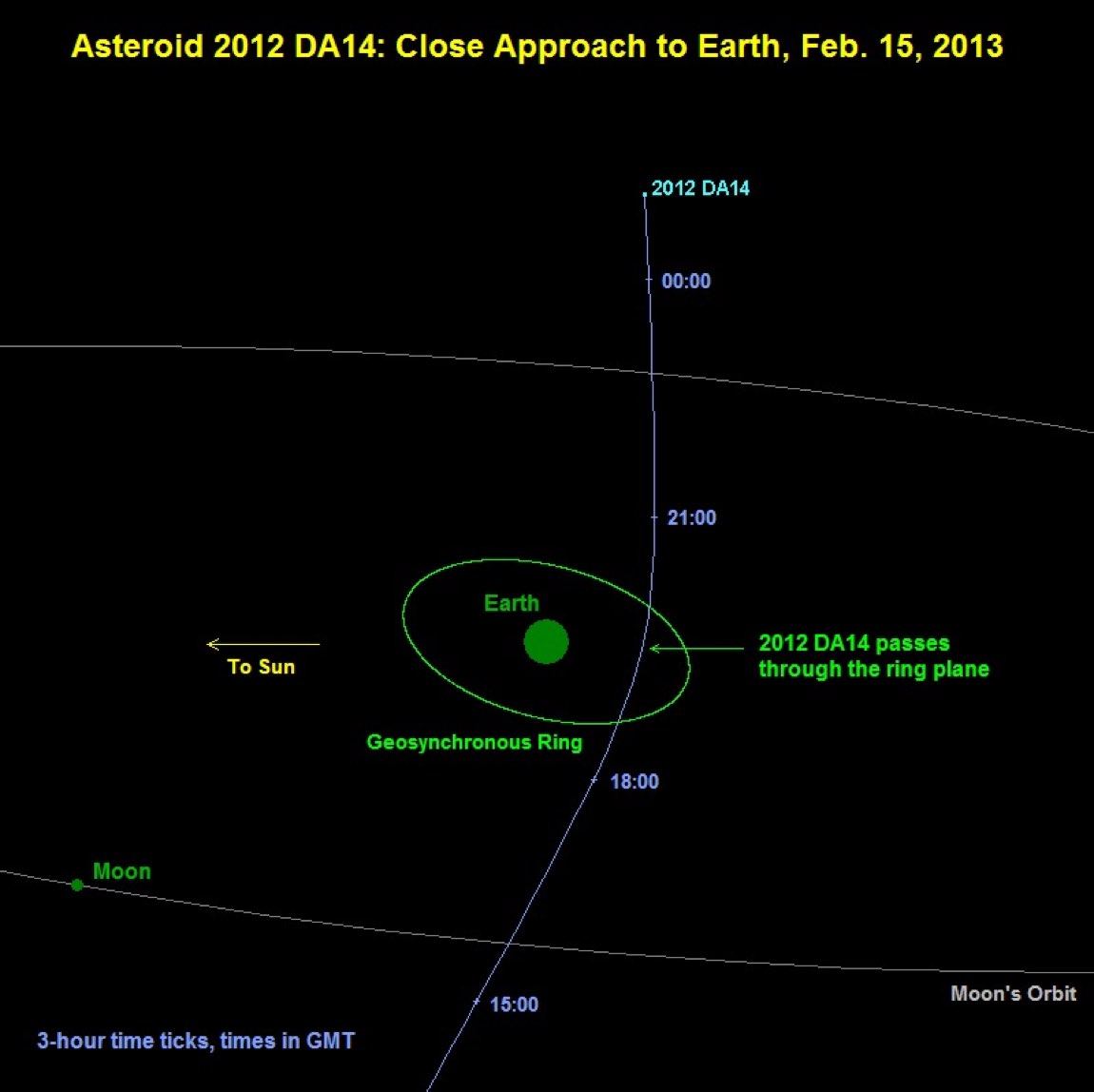
Duende is a small, elongated asteroid about 30 m across. On 15 February 2013 it passed just 27,700 km above Earth's surface, inside the ring of geostationary satellites. By coincidence, the unrelated Chelyabinsk meteor exploded over Russia about 16 hours earlier. Earth's gravity bent Duende's path so much that it changed from an Apollo-type to an Aten-type orbit.
The deep dive
Researched for the Atlas from Wikipedia — 367943 Duende (7,209 characters read) · updated Nov 14, 2026
01 A Goblin by Name and by Nature
The asteroid's official name, Duende, comes from a fairy- or goblin-like creature rooted in Iberian, Latin American, and Filipino folklore — a fitting choice for a small, elusive rock that crept up on Earth almost undetected. The approved naming citation was published by the Minor Planet Center on 17 November 2013 (M.P.C. 85916). The name is especially apt because the asteroid was not discovered until 23 February 2012, a full seven days after it had already made a relatively close pass of 0.0174 AU (about 2,600,000 km) from Earth. In other words, the goblin had already snuck past before anyone noticed it was there. The discoverers were amateur astronomers affiliated with the Astronomical Observatory of Mallorca, working remotely through the robotic La Sagra Observatory in Granada Province, Spain, using a modest 0.45-meter reflector telescope. That a rock capable of devastating a city was found by hobbyist astronomers using a telescope smaller than many backyard instruments speaks to both the vigilance of the amateur community and to how many such objects remain lurking, undiscovered, in the inner solar system.
02 How Its Orbit Was Measured and Refined Deeper
When Duende was first spotted in February 2012, its orbit could only be traced across a short 79-day arc of observations, leaving meaningful uncertainties in its predicted path. Even so, that early orbital solution was precise enough for astronomers to confirm that the 2013 flyby would bring it no closer than 3.2 Earth radii from the surface — safely clear of a collision course. The situation improved dramatically on 9 January 2013, when Las Campanas Observatory reacquired the asteroid and extended the observational arc overnight from 79 days to 321 days. This leap in coverage sharpened the orbit prediction enormously. By the time of closest approach on 15 February 2013 at 19:25 UT, the uncertainty region around Duende's position had collapsed to just about 0.0000001 AU — roughly 15 km (9.3 mi). The final measured closest-approach distance was 0.0002276 AU (34,050 km; 21,160 mi) from Earth's center, translating to 27,743 km (17,239 mi) above the surface. Following the flyby, Goldstone Observatory conducted radar observations from February 16 through February 20, and based on 7 radar observations in total, the uncertainty region for Duende's future encounters is now well constrained all the way through 2123.
03 The Spin-Up: Earth's Gravity Changed Its Rotation Deeper
One of the most scientifically striking results of the 2013 flyby was the detection of a measurable change in Duende's rotation rate caused by Earth's gravitational tidal forces during the close passage. Before the encounter, the asteroid's rotation period was measured at 9.8 ± 0.1 hours. After the flyby, that period had decreased to 8.8 ± 0.1 hours — a genuine spin-up. A more precise value of 8.95 ± 0.08 hours was pinned down by building a combined lightcurve from time-series photometry collected over two consecutive nights (15–16 February 2013) at the Observatorio de La Hita and the Observatorio de Sierra Nevada, then cross-checked against all photometry reported to the Minor Planet Center both before and after the event. The article currently listed on the page gives a rotation period of 9.485 hours, which reflects the broader dataset. This spin-up is a real physical effect: as a small, elongated body passes within a few Earth radii, differential gravitational forces across its body exert a torque capable of altering its spin state. Detecting and quantifying this change in real time, using ground-based telescopes during a single night's pass, was a notable observational achievement.
04 Radar Reveals a Lumpy, Stretched Pebble
Before the 2013 flyby, Duende's size was estimated purely from its brightness, which pointed to a diameter of around 45 meters. Radar changed everything. Goldstone Observatory's radar observations revealed an elongated body measuring approximately 20 by 40 meters (66 by 131 feet) — roughly the shape of a large bus end-to-end paired with a smaller one. Converting those two axes into a single spherical equivalent gives a geometric mean diameter of about 28 meters (92 ft), substantially smaller than the pre-flyby brightness-based estimate. A separate analysis using lightcurve data suggested an even smaller equivalent diameter of about 18 meters. The lightcurve itself is double-peaked and shows large swings in brightness as the asteroid rotates, which is a classic signature of a highly elongated shape tumbling through space — consistent with what radar imaging showed directly. The elongation matters not just for size estimates but also for understanding how tidal forces acted on the body during its close approach and why its spin rate changed measurably. Duende is now classified as a micro-asteroid, a designation reflecting its diminutive scale compared to the more commonly discussed near-Earth objects in the tens-to-hundreds-of-meters range.
05 An L-Type Asteroid: A Rare Spectral Class Deeper
Duende is classified as a likely L-type asteroid, a relatively uncommon spectral category. The classification was made using visible and near-infrared photometry combined with visible spectroscopy gathered during the 2013 flyby by an observational campaign spanning five telescopes at four observatories: Gran Telescopio Canarias, Telescopio Nazionale Galileo, Calar Alto Observatory, and two others providing photometric time series. The combined dataset was analyzed with the M4AST online classification tool. L-type asteroids have a distinctive spectral signature: a strongly reddish spectrum shortward of 0.8 micrometers, and then a featureless, nearly flat spectrum longward of that wavelength. Critically, they show little or no concave-up curvature that would signal the 1-micrometer silicon absorption band typical of many stony asteroid classes. The physical meaning of this spectrum is not entirely settled — L-types are thought to have unusual surface mineralogy, possibly involving high-calcium pyroxenes or spinel-bearing assemblages, but they remain one of the less well-understood spectral groups among near-Earth objects. That this classification was pinned down during a single brief flyby using coordinated multi-telescope observations across two nights demonstrates how much can be extracted from a rare close-approach event.
06 The Orbital Class Change: Apollo to Aten
Before the 2013 flyby, Duende was classified as an Apollo asteroid — a group whose orbits cross Earth's path with orbital periods longer than one year. Its orbital period at that time was 368 days, and its aphelion (farthest point from the Sun) reached 1.110 AU, placing it just outside Earth's orbit at its most distant. The gravitational pull of Earth during the close passage changed all of that. The orbital period shrank from 368 days to 317 days, and the aphelion dropped from 1.110 AU to 0.9917 AU — meaning Duende's entire orbit now fits almost entirely inside Earth's orbit around the Sun. This reclassified it from the Apollo group into the Aten group, whose members have semi-major axes less than 1 AU and aphelia that barely graze Earth's orbital path. Duende also belongs to the even more tightly bound Atira subgroup. This kind of orbital class change driven by a planetary flyby, and documented in real time, is rare and illustrates vividly how the inner solar system sculpts the trajectories of small bodies through repeated gravitational nudges.
07 What Would Have Happened If It Had Hit
Although there was never any risk of Duende striking Earth in 2013, pre-flyby risk assessments — based on a then-estimated diameter of 45 meters and mass of 130,000 tonnes — painted a vivid picture of what such an impact could mean. Entering the atmosphere at 12.7 km/s, Duende would have delivered a kinetic energy equivalent to 2.4 megatons of TNT at the moment of atmospheric entry. It would not have reached the ground as a solid object; instead it would have exploded as an air burst at an altitude of roughly 10.1 kilometers (33,000 ft), releasing energy equivalent to 2.1 megatons of TNT. For comparison, the Tunguska event of 1908 has been estimated at 3 to 20 megatons, so Duende would have been in a broadly similar — if perhaps somewhat smaller — class of event. Asteroids larger than 35 meters across can threaten a town or city; Duende, now known to be about 30 meters in diameter, sits right at that boundary. Asteroids of roughly 50 meters in diameter are expected to strike Earth roughly once every 1,200 years. After actual radar measurements confirmed its smaller size, Duende was removed from NASA's Sentry Risk Table on 16 February 2013.
08 The Chelyabinsk Coincidence
The day of Duende's closest approach, 15 February 2013, became unexpectedly dramatic when a completely unrelated object entered Earth's atmosphere above Russia just 16 hours earlier. That was the Chelyabinsk meteor, produced by a roughly 17-meter asteroid — smaller than Duende — that released enough energy to shatter windows across a wide region and injure more than a thousand people. Despite the apparent cosmic synchronicity, astronomers confirmed that the two events were entirely unrelated; the Chelyabinsk impactor arrived from a completely different direction and had no orbital connection to Duende whatsoever. The coincidence was, by any measure, extraordinary: on the single day in living memory when a known asteroid passed closer to Earth than any other on record, an unknown asteroid happened to strike the planet. The juxtaposition sharpened public and political attention on planetary defense in a way that abstract statistics about impact probabilities never had, and it underscored a stark reality — the Chelyabinsk object gave no warning at all, while Duende had been tracked for a year.
09 Future Close Approaches and Long-Term Tracking Deeper
With its orbit now well constrained through 7 radar observations, Duende's future trajectory can be predicted with reasonable confidence for more than a century. Its next notable close approach will be on 15 February 2046, when it will pass about 0.0148 AU (2,210,000 km; 1,380,000 mi) from Earth — a comfortable distance, roughly six times farther than the Moon. The next passage that will approach the drama of 2013 is not expected until 16 February 2123, when Duende will pass no closer than 0.0002 AU (30,000 km; 19,000 mi) from Earth's center. The nominal prediction for that encounter places it at 0.003 AU (450,000 km; 280,000 mi) from the Moon's center and then 0.005 AU (750,000 km; 460,000 mi) from Earth's center, suggesting a significantly more distant flyby than 2013. Duende was removed from the Sentry Risk Table on 16 February 2013, the day after its famous pass, once radar data had refined the orbit sufficiently to rule out impact risk. It serves as a productive test case for the broader challenge of tracking the more than one million estimated near-Earth asteroids smaller than 100 meters — most of which remain undiscovered.
10 How Bright It Got and Who Could Watch
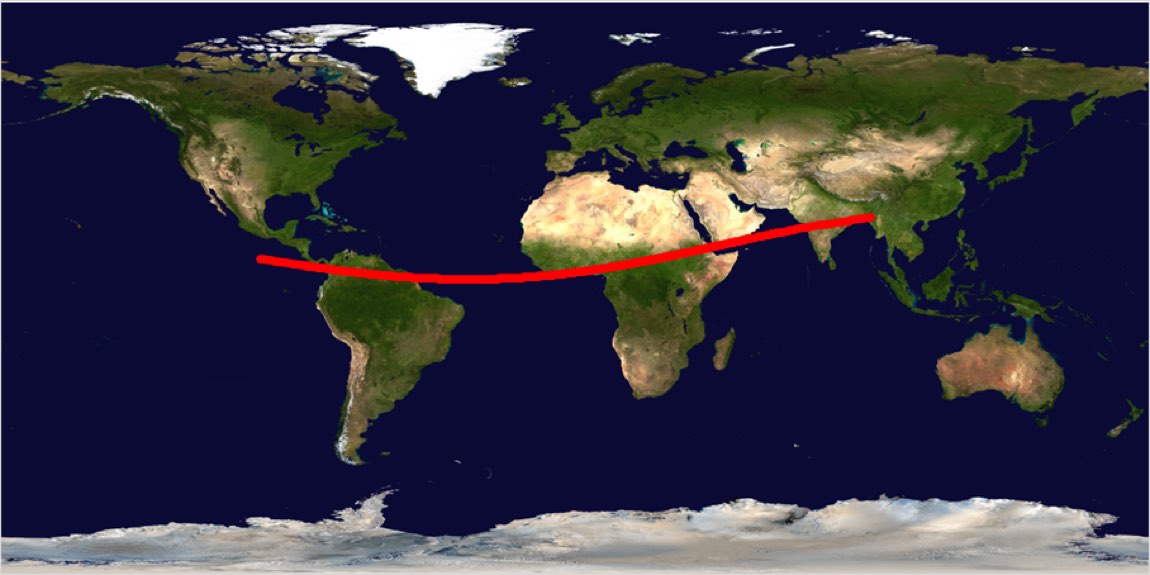
During its closest approach on 15 February 2013, Duende briefly reached an apparent magnitude of roughly 7.2. That is several times fainter than the typical naked-eye limit of about magnitude 6, so it was not visible to the unaided eye even at its brightest. Through binoculars or a small telescope, however, it was detectable, and because it moved rapidly against the star field — crossing the sky noticeably within minutes — it was a striking sight for observers who knew exactly where to look. The best location on Earth to witness the closest approach was Indonesia, which lay beneath the asteroid's ground track at the moment of minimum distance. Eastern Europe, Asia, and Australia were also well-placed for observing Duende during the close-approach window. Observers elsewhere either faced daylight or had the asteroid below their horizon at the critical moment. The event attracted widespread public interest and was broadcast live by several astronomy organizations, making it one of the most-watched asteroid passes in history despite the object being far too small to see without optical aid.
11 Early Risk Assessments Before the Flyby Deeper
Even before the 2013 flyby confirmed that Duende posed no immediate danger, the initial orbital solution from the short 2012 observational arc had already established that the February 2013 passage would miss Earth's surface by no less than 3.2 Earth radii. That was reassuring for the near term. Looking further ahead, however, the picture was less clear. At the time of discovery, Duende carried a cumulative impact probability of 0.033% — equivalent to 1 chance in 3,030 — that it would strike Earth during one of its approaches between 2026 and 2069. For context, those pre-flyby risk assessments used an assumed diameter of 45 meters and a mass of 130,000 tonnes; both figures turned out to be overestimates once radar data constrained the true dimensions to roughly 20 by 40 meters. The 1-in-3,030 risk figure sounds small, but for a potential impactor in the multi-megaton energy class, it was significant enough to warrant sustained tracking. The orbit refinement enabled by Las Campanas Observatory's January 2013 recovery observation, followed by the dense radar coverage after the flyby, was precisely what planetary defense protocols are designed to accomplish: turning uncertain risks into well-characterized ones.
 ⤢