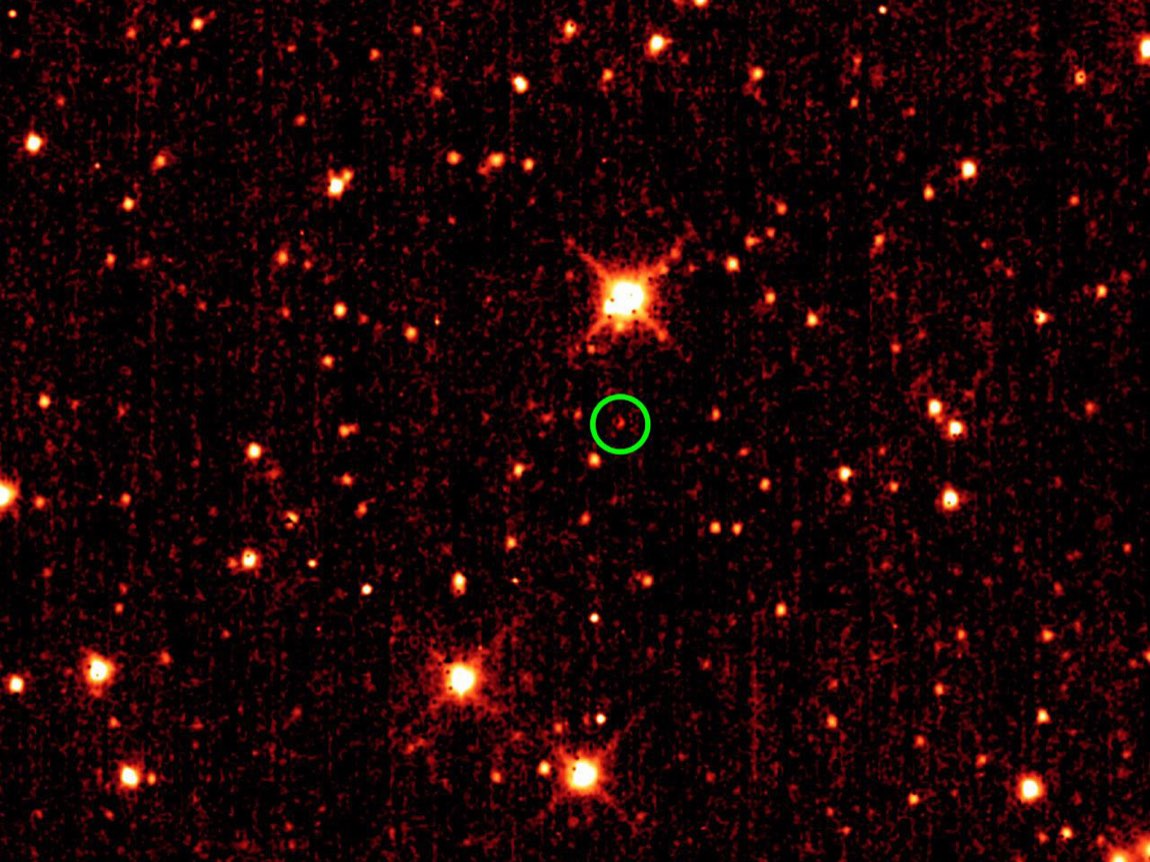
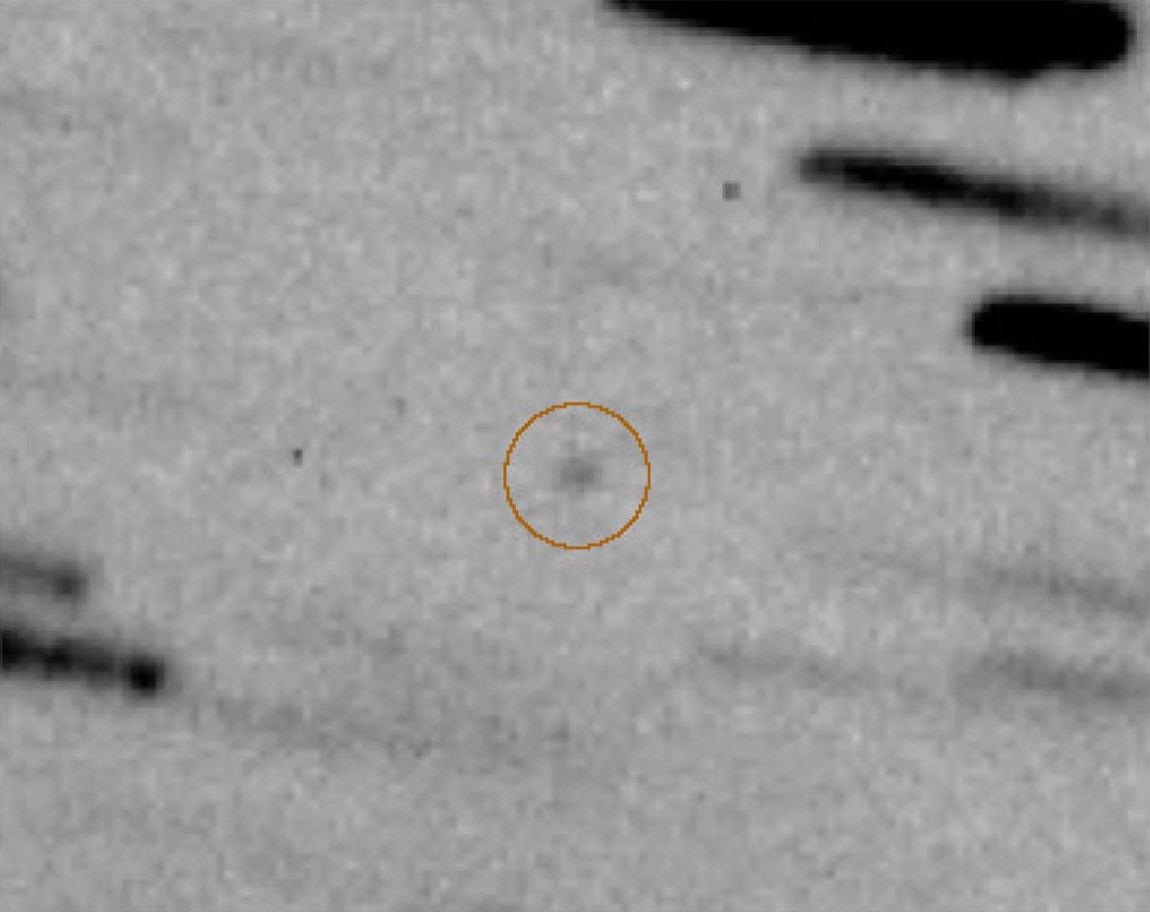
 Photograph · Cennamo, R.; Devogèle, M.; Alvarez-Candal, A.; et al. · CC BY-SA 4.0
Asteroid · Deep guide
(614689) 2020 XL5
Also called: (614689) 2020 XL5 · 2020 XL5 · 614689
The second Earth Trojan ever found — and much larger than the first.
What is it?
2020 XL5 is an asteroid about 1.2 km across that shares Earth's orbit around the Sun as an Earth Trojan. It was discovered in December 2020 by the Pan-STARRS 1 survey in Hawaii and was the second Earth Trojan identified, after 2010 TK7. It takes about a year to go around the Sun, just like Earth, while slowly oscillating around a stable point in Earth's orbit. Its dark surface, reflecting only about 6% of sunlight, suggests a carbon-rich C-type composition.
The deep dive
Researched for the Atlas from Wikipedia — (614689) 2020 XL5 (5,927 characters read) · updated Nov 14, 2026
01 How Pan-STARRS Caught a Hidden Companion
The discovery of 2020 XL5 on 12 December 2020 came from the Pan-STARRS 1 survey operating atop Haleakala Observatory in Hawaii. When the telescope first caught it, the asteroid appeared in the constellation Crater at an apparent magnitude of 21.4 — far too dim for any amateur eye and requiring a large automated survey to notice at all. At that moment it sat 0.68 AU (102 million km) from Earth and was drifting across the sky at 3.02 arcseconds per minute. The discovery was not quite instant: within two days, three separate observatories — Višnjan Observatory, ESA's Optical Ground Station, and Cerro Tololo — contributed follow-up measurements. Even more usefully, observers then dug back through archival images from the Mount Lemmon Survey and found the asteroid hiding in frames taken as early as 26 November 2020, two weeks before the official discovery night. Its trojan nature was first flagged not by a professional institution but by amateur astronomer Tony Dunn on 26 January 2021, who noticed the nominal trajectory librating around Earth's L4 point. Subsequent professional analysis confirmed and refined this identification.
02 An Eight-Year Paper Trail in the Sky Deeper
One of the most striking things about 2020 XL5's orbital knowledge is how well-constrained it already is: the Minor Planet Center assigns it an uncertainty parameter of 0, the best possible rating. That confidence comes partly from an observation arc stretching back over eight years. By sifting through precovery images from Pan-STARRS and other sky surveys, astronomers found 2020 XL5 captured in archival data dating as far back as December 2012 — eight years before the December 2020 discovery night. Having positions spread across such a long baseline allows orbital calculators to pin down the asteroid's path with extraordinary precision. The formal permanent number, 614689, was assigned by the Minor Planet Center on 28 March 2022, making the object eligible for an official name. Under International Astronomical Union conventions for near-Earth objects, that future name must come from mythology, though as of the article's writing no mythological name has yet been chosen. The long precovery arc also fed directly into the numerical simulations that assessed the trojan orbit's long-term stability.
03 The Tadpole Path of a Trojan Asteroid
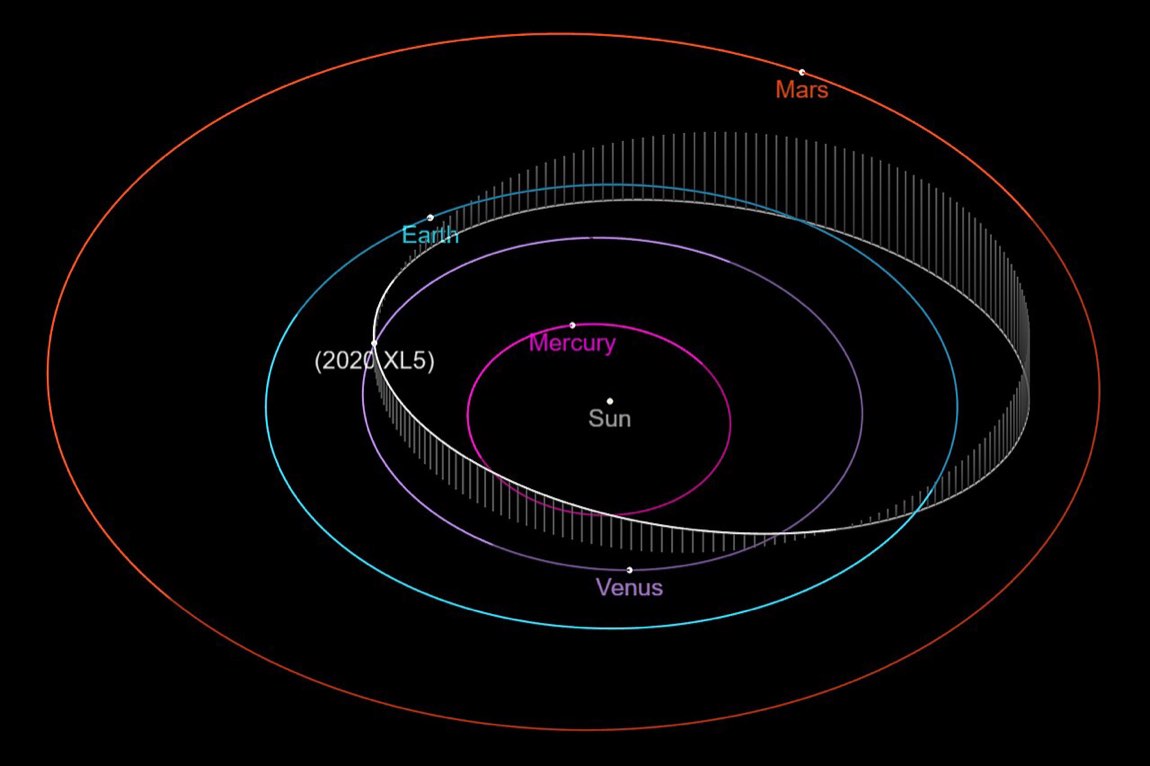
Most people picture a trojan asteroid as sitting quietly at a fixed point 60 degrees ahead of or behind a planet. The reality is livelier: trojans actually oscillate, or librate, around that Lagrangian point in looping paths. For 2020 XL5, the high orbital eccentricity of 0.388 makes those loops especially wide. When the motion is plotted in a reference frame that rotates with Earth and its Lagrangian points, the asteroid traces a broad, tadpole-shaped curve around the L4 position, never settling into a simple fixed location. This eccentricity also carries the asteroid far from Earth's immediate neighborhood: at perihelion it swings in to just 0.61 AU from the Sun, dipping inside Venus's orbit, while at aphelion it reaches out to 1.39 AU, beyond Earth's path. The average orbital distance is 1.001 AU and one full trip around the Sun takes 365.8 days — almost exactly one Earth year — which is precisely why the 1:1 resonance with Earth can be maintained in the first place.
04 Why Venus Will Eventually Break the Bond Deeper
Although 2020 XL5 is gravitationally tethered to Earth's L4 point today, that arrangement is temporary. The culprit that will eventually sever it is Venus. The asteroid already crosses Venus's orbital path and has a minimum orbit intersection distance (MOID) with Venus of 0.0273 AU — just 4.1 million km. At the moment, Venus's perturbations are negligible because 2020 XL5's orbit carries it either too high or too low relative to the plane of Venus's orbit for close gravitational nudges to accumulate. Over hundreds of years, however, the longitudes of the ascending node of both orbits will precess, gradually bringing 2020 XL5 closer to Venus's orbital plane and shrinking that effective MOID. As the perturbations grow, they will push the asteroid past Earth's L3 point and out of its trojan configuration entirely. Numerical simulations place this departure at least 4,000 years in the future. For context, 2020 XL5 is already more long-lived than the first known Earth trojan, 2010 TK7, which may become unstable on timescales of less than 2,000 years — making 2020 XL5 the more enduring of the two known Earth trojans.
05 A Captured Visitor from the 15th Century
Numerical simulations do more than predict when 2020 XL5 will leave its trojan orbit — they also suggest when it arrived. According to the simulations, the asteroid was likely captured into Earth's L4 Lagrangian point sometime in the 15th century. That means it has been riding along 60 degrees ahead of Earth for roughly five or six centuries, quietly sharing our planet's orbital neighborhood since before the invention of the telescope. It was not on some primordial path set at the solar system's formation; instead, gravitational dynamics shuffled it into this temporary partnership relatively recently in astronomical terms. This capture-and-release picture — where an asteroid drifts into a trojan configuration, holds it for thousands of years, and then escapes — illustrates how dynamic the inner solar system truly is. Trojan orbits near Earth are not permanent fixtures but transient way-stations along a much longer journey.
06 A Carbon-Rich World the Size of a Mountain
What little is known about 2020 XL5's physical nature comes from photometric measurements taken during optical observations in 2020 and 2021. The color of the light it reflects resembles that of carbonaceous C-type asteroids — the dark, carbon-bearing class that makes up a large fraction of the asteroid population and is thought to preserve some of the most primitive, chemically unprocessed material in the solar system. Using a geometric albedo of 0.06, typical for C-type asteroids, and its absolute magnitude of H = 18.6, astronomers calculated a mean diameter of about 1.18 km (0.73 mi). To put that in everyday terms, the asteroid is roughly as wide as ten city blocks laid end to end. This makes it the largest Earth trojan known, and strikingly larger than the only previously known Earth trojan, 2010 TK7, which measures just 0.3 km (0.19 mi) across — meaning 2020 XL5 is up to three times the size of its predecessor.
07 Why Its Rotation Remains a Mystery
Despite being the largest known Earth trojan, 2020 XL5 has yielded no information about how fast it spins. The reason is entirely geometric. Because the asteroid shares Earth's orbit while librating around the L4 point 60 degrees ahead of us, it maintains a nearly fixed position relative to the Sun as seen from Earth. This means it is always found close to the Sun in Earth's sky, rising and setting roughly when the Sun does. Ground-based observers can only glimpse it low on the horizon during twilight, a window filled with two severe handicaps: heavy atmospheric distortion from looking through a thick column of air near the horizon, and overwhelming scattered light from the recently set Sun washing out the faint asteroid's signal. Any light-curve measurements that might reveal a rotation period are swamped by these effects. Without a reliable light curve, the spin rate, pole orientation, and shape of the asteroid all remain unknown.
08 The Delta-v Arithmetic of Getting There Deeper
Mission planners thinking about visiting 2020 XL5 face a stark division between two types of trajectories. A rendezvous mission — one that actually slows down and matches the asteroid's orbit to stay alongside it — would require a minimum total delta-v of 10.3 km/s from low Earth orbit. Delta-v is the total change in velocity a spacecraft must achieve using its engines, and 10.3 km/s is very high: for comparison, reaching low Earth orbit from the ground already costs about 9.4 km/s. The driving factor is the asteroid's high orbital inclination of 13.8 degrees, which forces a spacecraft to burn large amounts of propellant to tilt its path significantly away from the ecliptic plane. A flyby mission, where the spacecraft zips past without stopping, is a far more accessible option at a minimum total delta-v of just 3.3 km/s. That lower figure means a flyby could realistically be accomplished within existing launch capabilities, though it would allow only a brief observation window rather than the sustained study a rendezvous would permit.
09 Two Trojans and What Sets Them Apart
Before 2020 XL5 was confirmed, Earth was thought to have only one trojan companion: (706765) 2010 TK7, discovered about a decade earlier. The two objects share their broad category but differ in almost every measurable way. 2010 TK7 oscillates around the same L4 Lagrangian point but is much smaller, at roughly 300 m (980 ft) across, compared to 2020 XL5's approximately 1.2 km (0.75 mi). Dynamically, 2010 TK7 is the less stable of the pair, potentially losing its trojan configuration in less than 2,000 years, while 2020 XL5 is expected to persist in its trojan orbit for at least 4,000 years. The existence of two Earth trojans, both at L4, raises questions about whether others remain undiscovered — perhaps too faint, too close to the Sun in our sky, or at the trailing L5 point where observational surveys have had less coverage. Finding 2020 XL5 through Pan-STARRS and confirming it via global follow-up was a proof of concept that such searches can succeed.
10 How the Apollo Classification Fits In Deeper
Although 2020 XL5 is primarily known as an Earth trojan, it also carries the Apollo asteroid classification — a category defined by having a semi-major axis greater than 1 AU while also crossing Earth's orbit. Its semi-major axis of 1.001 AU clears the first bar by just a hair, and its perihelion distance of 0.61 AU carries it well inside Earth's orbital path and even inside Venus's orbit. The Apollo designation might seem at odds with being a trojan, but the two labels describe different aspects: Apollo describes the shape of the orbit relative to Earth's, while trojan describes the resonant dynamical relationship with Earth. The high eccentricity of 0.388 is what makes both labels simultaneously true — it stretches the orbit enough to cross Earth's path even though the average orbital distance stays near 1 AU. This eccentricity is also what gives the asteroid its wide, sweeping tadpole libration path around the L4 point.
11 Open Questions and Future Prospects
Even with an uncertainty parameter of 0 and eight years of observations, 2020 XL5 still has significant gaps in what scientists know about it. Its rotation period is entirely undetermined because of the observational difficulties created by its position near the Sun in Earth's sky. Its physical composition is inferred only from color similarity to C-type asteroids, not from spectroscopic confirmation or any in-situ measurement. The exact moment and mechanism of its capture into Earth's L4 orbit in the 15th century is a statistical estimate from simulations, not a certainty. Looking forward, a flyby mission with a delta-v of 3.3 km/s from low Earth orbit would be the most practical way to gather direct measurements of its surface, composition, and rotation. The object has already received a permanent number and awaits a mythological name, which will mark another formal step in its scientific recognition. Whether additional Earth trojans lurk undiscovered — perhaps even at the trailing L5 point — remains one of the quiet open questions in planetary science.
 ⤢