Asteroid · Deep guide
(308635) 2005 YU55
Also called: (308635) 2005 YU55 · 2005 YU55 · 308635
A dark, 360-metre asteroid that passed inside the Moon's orbit in November 2011.
What is it?
2005 YU55 is a potentially hazardous asteroid about 360 m across with a dark, carbon-rich surface. On 8 November 2011 it flew past Earth at about 324,900 km — closer than the Moon — giving radar astronomers a rare close look. It had been briefly listed as a possible impactor after its discovery, but was removed from NASA's risk list in 2010.
The deep dive
Researched for the Atlas from Wikipedia — (308635) 2005 YU55 (4,852 characters read) · updated Nov 14, 2026
01 How 2005 YU55 Was First Spotted
Robert S. McMillan discovered 2005 YU55 on 28 December 2005 at Steward Observatory on Kitt Peak in Arizona. The designation follows the standard minor-planet naming convention, encoding the year and the half-month of discovery. At the time of discovery the asteroid's size was estimated at roughly 310 meters, later revised upward to about 400 meters before the 2011 flyby nailed it down more precisely at 360±40 meters. That uncertainty range of 40 meters in either direction is itself wider than a city block, illustrating how difficult it is to characterize a dark, fast-moving object from initial survey images alone. Kitt Peak hosts one of the most productive asteroid-search programs in the world, and 2005 YU55 is a typical product of those systematic sky sweeps — a space rock lurking in plain sight until the right telescope happened to catch its motion against the background stars.
02 A Radar Portrait of a Dark Sphere Deeper
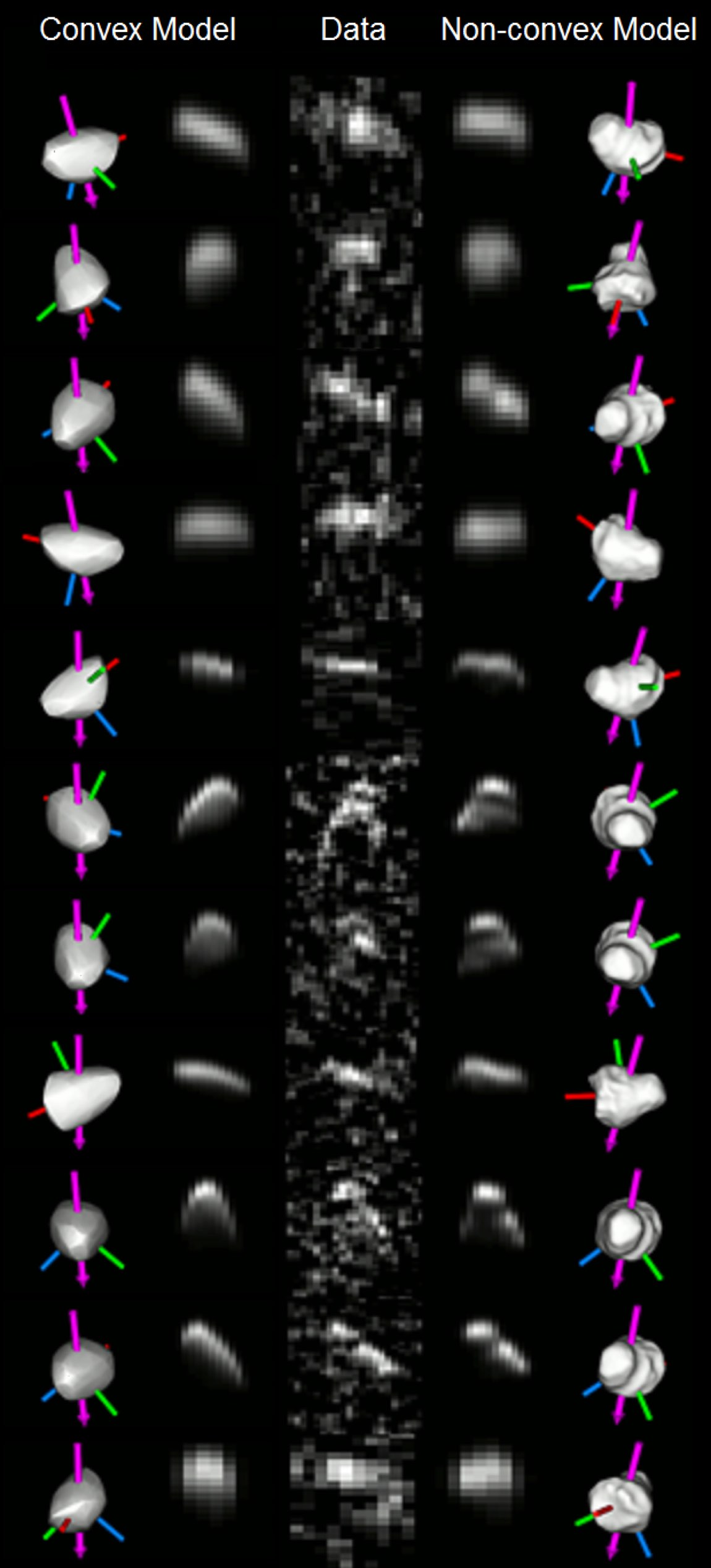
The clearest picture of 2005 YU55 came not from cameras but from radar. During the November 2011 flyby, four major facilities trained their beams on the asteroid: the Goldstone Solar System Radar, the Arecibo Observatory, the Very Long Baseline Array, and the Green Bank Telescope. Working together, they resolved surface details down to the decameter scale. Shape modeling from those radar echoes revealed that the asteroid is close to spheroidal — unusually round for a small body — with maximum dimensions of 360±40 meters and a notable equatorial ridge. A distinct rise within that ridge stretches 150 to 200 meters in length and stands roughly 20 meters tall, comparable in height to a six-story building. The surface is also peppered with features interpreted as boulders at the decameter scale, a texture strikingly similar to what Japan's Hayabusa spacecraft photographed on the asteroid 25143 Itokawa.
03 What the Equatorial Ridge Tells Us Deeper
One of the more intriguing structural findings from the 2011 radar campaign is the ridge running along 2005 YU55's equator. Such equatorial ridges are seen on other small bodies and are thought to arise from the slow migration of loose surface material toward the equator under rotational forces, or from past mass shedding events. The ridge on 2005 YU55 includes a 150-to-200-meter-long rise that climbs about 20 meters above the surrounding terrain. That the asteroid remained nearly spheroidal despite this feature is itself telling: Earth's tidal forces during the close 2011 flyby were not strong enough to measurably distort its shape, and there is no evidence of non-principal-axis rotation — the kind of tumbling that would indicate a recent gravitational disturbance. The body appears to be spinning cleanly around its principal axis, which is consistent with a relatively consolidated or at least coherently structured interior.
04 Measuring Darkness: Albedo From Radar Deeper
One of the quieter scientific achievements of the 2011 campaign was a more precise determination of the asteroid's albedo — its diffuse reflectivity, or how much sunlight it bounces back. Radar measurements cannot detect visible light, but they can pin down an object's distance and size with high accuracy. When those radar-derived size measurements are combined with visible-light brightness readings, astronomers can calculate how reflective the surface must be to produce the observed brightness at the known distance. This cross-calibration yields a more accurate absolute magnitude and, from that, a reliable albedo. For a C-type asteroid like 2005 YU55, low albedo is expected — C-types are among the darkest objects in the solar system, their surfaces darkened by carbon-rich minerals. The infrared component of the study, contributed by the Herschel Space Observatory on 10 November 2011, added thermal measurements that helped constrain both temperature and surface composition independently.
05 Spectral Type and Surface Composition
Optical, near-infrared, and ultraviolet spectroscopy collected during the flyby confirmed that 2005 YU55 belongs to the C spectral class. C-type asteroids are the most common type in the outer regions of the main asteroid belt and are thought to be compositionally primitive — meaning their materials have changed relatively little since the early solar system. Their spectra are dominated by dark, carbon-bearing minerals, and many C-types are associated with carbonaceous chondrite meteorites. This classification, combined with the Herschel Observatory's far-infrared measurements of the asteroid's temperature and composition made on 10 November 2011, gives scientists a fuller picture of what 2005 YU55 is made of without requiring a sample-return mission. The convergence of radar sizing, optical brightness, and spectral chemistry makes this one of the better-characterized near-Earth objects of its size class.
06 The Torino Scale Saga: From 1 to 0
In February 2010, 2005 YU55 briefly earned a Torino Scale rating of 1 for a potential close pass on 10 November 2103 — not a predicted impact, but enough orbital uncertainty to flag it as worthy of monitoring. A rating of 1 means the event merits attention from astronomers but poses no unusual danger to the public. Everything changed on 19 April 2010, when the Arecibo radio telescope performed radar ranging that slashed the orbital uncertainties by 50 percent. That single observing campaign was enough to eliminate any possibility of an Earth impact within the next 100 years. The asteroid was removed from NASA's Sentry Risk Table on 22 April 2010, resetting its Torino rating to 0. For the date that had triggered the initial concern — 10 November 2103 — it is now known that 2005 YU55 will be approximately 2 AU from Earth, roughly twice the Earth–Sun distance and nowhere near a threat.
07 The 2011 Flyby in Numbers
At 23:28 Universal Time on 8 November 2011, 2005 YU55 swept past Earth at a distance of 0.85 lunar distances, equal to about 330,000 kilometers or roughly 200,000 miles. Less than eight hours later, at 07:13 UT on 9 November, it made its closest approach to the Moon, passing just 0.6231 lunar distances away — about 239,500 kilometers. During the encounter the asteroid reached an apparent magnitude of approximately 11, faint enough to require optical aid but potentially within reach of large binoculars. However, a bright gibbous Moon washed out the sky, forcing visual observers to use a telescope with an aperture of at least 6 inches, or 15 centimeters, to have any chance of spotting it. Despite the moonlit interference, the event was a landmark moment for planetary defense science, delivering some of the richest observational data ever collected on a near-Earth asteroid during a flyby.
08 Hypothetical Impact: What the Math Says
Although 2005 YU55 poses no impact threat in the foreseeable future, planetary scientists have worked through the hypothetical numbers to understand what an object this size could do. According to Jay Melosh, an impact by an asteroid approximately 400 meters across striking land would excavate a crater 6.3 kilometers wide and 518 meters deep — a hole roughly the size of a medium city and deeper than the Empire State Building is tall. The seismic energy released would be equivalent to a magnitude-7 earthquake, capable of causing widespread structural damage far beyond the crater itself. As a broader statistical context, the article notes that the chance of a collision with any asteroid similar in size to 2005 YU55 is roughly 1 percent over the next thousand years. That is a low probability but not a negligible one when the consequences at this scale are considered.
09 Context Among Upcoming Large Flybys
The 2011 flyby of 2005 YU55 set a benchmark for how close a large, well-characterized asteroid has come to Earth in the modern observational era. Looking ahead, the article identifies two upcoming events that will rival or surpass it. In 2028, the asteroid (153814) 2001 WN5 will pass just 0.65 lunar distances from Earth — slightly closer than 2005 YU55 managed in 2011. Then in 2029, the 325-meter asteroid 99942 Apophis will come dramatically closer still, skimming by at only 0.10 lunar distances. Each of these encounters offers a future window for intensive radar and optical study. The sequence underscores a broader truth about planetary defense: large near-Earth asteroids visit our neighborhood more frequently than the public generally realizes, and each close pass is simultaneously a potential hazard to monitor and a scientific opportunity that cannot be replicated in a laboratory.
10 A Venus Keyhole and the 2041 Question Deeper
The long-term trajectory of 2005 YU55 is shaped in part by a close encounter with Venus, not Earth. On 19 January 2029, the asteroid will pass 0.0023 AU from Venus — about 340,000 kilometers, comparable in scale to the Earth–Moon distance. Venus's gravity will subtly bend the asteroid's path, and the precise amount of bending determines how close 2005 YU55 will come to Earth in 2041. Before the November 2011 observations, that 2041 passage was deeply uncertain, with possibilities ranging from 0.002 AU to as far as 0.3 AU from Earth. The 2011 radar astrometry tightened the picture considerably: on 12 November 2041, the asteroid is now expected to pass between 0.1017 AU and 0.1020 AU of Earth — a narrow uncertainty band that represents a safe but relatively close passage at around 15 million kilometers.
11 Looking Further: The 2075 Approach Deeper
Beyond the 2041 flyby, orbital calculations reach further into the future with growing but still manageable uncertainty. The 2075 approach to Earth is currently bracketed between 0.0013 AU and 0.0021 AU — a range of 190,000 to 310,000 kilometers. For context, the lower end of that range is closer to Earth than the Moon. Whether the actual distance falls toward the near end or the far end depends on how precisely the Venus encounter in 2029 and the Earth flyby in 2041 are resolved by ongoing observations in the years ahead. This sensitivity to gravitational keyhole passages is a hallmark of near-Earth asteroid dynamics: small differences in position during one encounter cascade into large trajectory differences decades later. The 2075 prediction will sharpen considerably once ground-based and space-based assets track the 2041 passage.
12 Spin, Shape, and Why They Matter Deeper
The 2011 flyby yielded an improved spin period of about 19.3 hours, derived from optical lightcurve measurements made as the asteroid tumbled past. This relatively slow rotation — taking more than three-quarters of an Earth day to complete one spin — is consistent with 2005 YU55 being a coherent body rather than a loosely bound rubble pile, though the article does not definitively settle the interior structure question. Crucially, because the asteroid is so nearly spheroidal, Earth's tidal forces during the flyby could not generate a significant torque on it. No evidence of non-principal-axis rotation was found, meaning the asteroid is not tumbling chaotically. This stability matters for impact modeling, for spacecraft rendezvous planning, and for understanding whether the equatorial ridge is a stable long-term feature or something that could shed material during a future close gravitational encounter.