Asteroid · Deep guide
4660 Nereus
Also called: 4660 Nereus · (4660) Nereus · 1982 DB
A small, bright near-Earth asteroid that has long been considered an easy spacecraft target.
What is it?
Nereus is a near-Earth asteroid about 330 m across with a bright, enstatite-type surface. Its orbit comes within about 460,000 km of Earth's, so it is classed as potentially hazardous, though it has no known impact risk. Its spectrum links it to aubrites, a rare kind of meteorite. Eleanor Helin discovered it in 1982, about a month after it had passed Earth.
The deep dive
Researched for the Atlas from Wikipedia — 4660 Nereus (3,335 characters read) · updated Nov 14, 2026
01 An egg-shaped world measured by radar
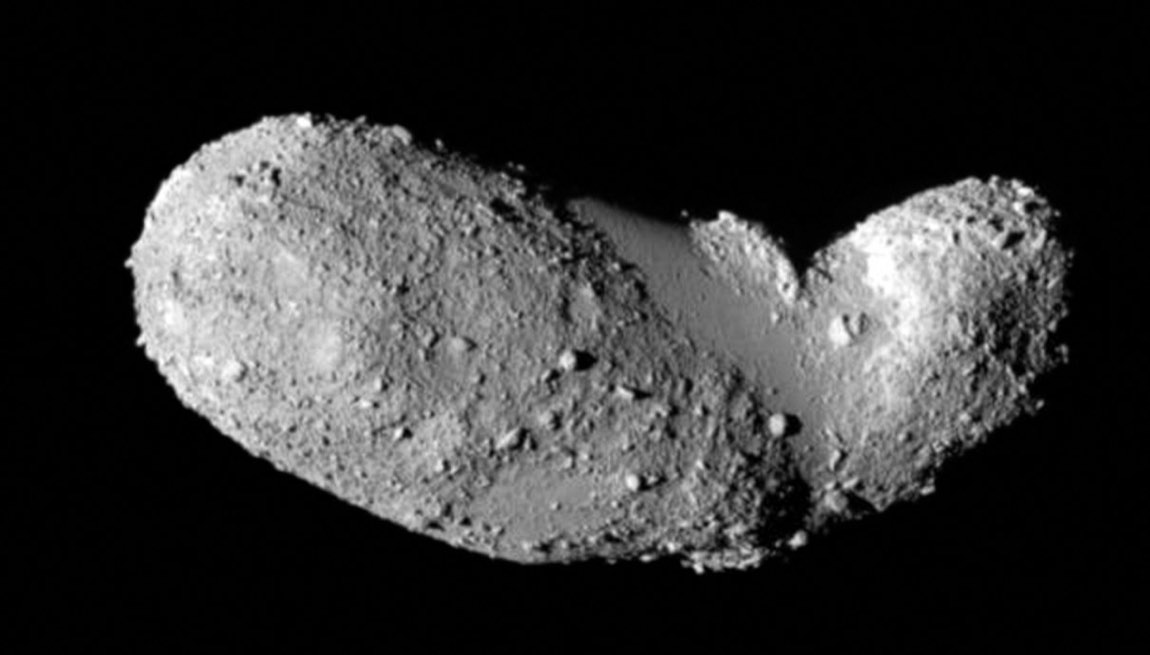
For a long time, astronomers estimated Nereus's size from optical brightness alone, arriving at a diameter of roughly 330 ± 50 meters — about three football fields end to end. Radar imaging sharpened that picture dramatically, revealing that Nereus is not a simple sphere but a genuinely elongated body with three distinct dimensions: 510 meters along its longest axis, 330 meters across its middle, and 241 meters from top to bottom. That makes it roughly the shape of a flattened egg. One end of the long axis is narrower and rounder; the other is broader and even has a flatter region on one side. Radar data also produced a fairly detailed terrain map of the surface, something impossible to achieve with optical telescopes at such small sizes. The same radar observations confirmed that Nereus has a slightly elongated shape compatible with stable orbits around it — a detail that matters enormously for any future spacecraft that might hover beside or circle the asteroid rather than simply flying past.
02 How Nereus spins through space
Nereus rotates about an axis that runs roughly perpendicular to its longest dimension — imagine a silver spoon spinning flat on a table rather than tumbling end over end. This style of rotation, sometimes called short-axis rotation, is common among small asteroids and tends to be more stable than a tumbling motion. The spin axis orientation, combined with the egg-like shape, means that an observer standing near one of the narrow poles would see the asteroid's longest stretch of terrain sweeping past overhead with each rotation. The orbital period of Nereus is 663.6 days — just under two Earth years — and that figure has an interesting orbital consequence: it puts Nereus near a 2:1 resonance with Earth, meaning Nereus completes roughly two orbits for every one Earth completes. This near-resonance is part of why the asteroid keeps returning to Earth's neighborhood on a recognizable schedule.
03 Seven close passes across two centuries
Nereus makes seven approaches to Earth of less than 5 million kilometers between 1900 and 2100 — a remarkable record of repeated proximity for a small body. The most recent of these took place on 11 December 2021, when the asteroid came within about 10 lunar distances of Earth. During that pass it brightened to an apparent magnitude of about 12.6, faint enough that a telescope with roughly a 100 mm objective lens was needed to see it visually. The closest encounter of all is still ahead: on 14 February 2060, Nereus will pass just 1.2 million kilometers from Earth — slightly more than three times the distance to the Moon. Its minimum orbit intersection distance, the closest its orbital path can theoretically bring it to Earth's orbital path, is about 460,000 kilometers, or 1.2 lunar distances, which is why it qualifies as a potentially hazardous object despite not being on a collision course.
04 Why spacecraft engineers love Nereus Deeper
The single most important practical number about Nereus for space mission planners is its delta-V: the change in velocity a spacecraft must achieve to match orbits and rendezvous with the asteroid. For Nereus, that figure is about 5 km/s. To put that in context, reaching the Moon from low Earth orbit requires a delta-V of roughly 6.3 km/s — meaning Nereus is actually easier to reach than Earth's own natural satellite in terms of propellant cost. That low delta-V stems from the combination of Nereus's orbit frequently crossing near Earth and its near 2:1 resonance with Earth's orbital period, which makes alignment windows repeat on roughly 4-year cycles. A mission could depart during one close Earth pass and return during the next favorable one, keeping total travel time and fuel within reach of existing or near-future spacecraft technology. This accessibility is rare among asteroids of comparable scientific interest.
05 A bright surface that puzzles and attracts Deeper
Nereus has a high albedo of 0.54, meaning it reflects 54 percent of incoming sunlight — an unusually bright surface for an asteroid. Most rocky asteroids reflect far less light; the common carbonaceous C-type asteroids can reflect as little as 3 to 5 percent. This brightness is consistent with Nereus's classification as an E-type asteroid, a spectral category associated with surfaces rich in the mineral enstatite. That mineralogy connects Nereus to a rare class of meteorites called aubrites, or enstatite achondrites — igneous rocks that formed under strongly reducing chemical conditions, with almost no iron oxides. If the connection holds, Nereus may be a fragment of a differentiated parent body that melted and chemically sorted itself in the early solar system before being shattered by collisions. Its absolute magnitude of +18.2 reflects both its modest size and its reflective surface working together.
06 The asteroid that three missions almost visited
Nereus has the unusual distinction of having been seriously considered as a target by three separate space missions, none of which ultimately went there. The private Near Earth Asteroid Prospector, or NEAP, proposed visiting Nereus but the project was never realized. Japan's Hayabusa sample-return mission originally had Nereus in its sights, but a 10-month launch delay forced mission planners to redirect the spacecraft to a different asteroid, 25143 Itokawa, which Hayabusa famously reached and sampled. NASA's NEAR robotic spacecraft also considered a Nereus flyby; NEAR was eventually launched and went on to study asteroid 253 Mathilde and then orbit and land on 433 Eros in a landmark mission. Each redirection was driven by timing constraints and orbital mechanics rather than any lack of scientific interest in Nereus itself, leaving the asteroid as one of the most anticipated yet unvisited objects in the near-Earth population.
07 A sea god chosen by public contest
The story behind the asteroid's name involves an unusual act of generosity. Eleanor F. Helin discovered the asteroid on 28 February 1982, and as the discoverer she was given the right to name it. Instead of naming it herself, Helin donated that privilege to the Planetary Society, which organized a public naming contest. The winner was Robert M. Cutler, who at the time worked for The MITRE Corporation, a NASA contractor. Cutler chose Nereus, the ancient Greek proto-god of the sea. The mythological Nereus predates the more familiar Poseidon and shares some of his characteristics — both are sea deities — but Nereus is distinctly a fish-tailed figure rather than a human-legged one. Nereus also carried attributes later absorbed by Apollo, particularly the gift of prophecy. The name links the asteroid to one of the oldest layers of Greek divine tradition, before the Olympian pantheon took its familiar shape.
08 Discovered a month after its closest flyby
There is a small irony in the discovery of Nereus: Eleanor Helin found it on 28 February 1982, but the asteroid had already made its closest recorded pass by Earth about a month earlier, coming within 4.1 million kilometers — equivalent to 11 lunar distances — before anyone knew it existed. This kind of after-the-fact discovery was common in the era before systematic sky surveys with digital detectors; telescopes had to be pointed at the right patch of sky at the right moment, and small fast-moving asteroids often slipped past undetected. The 1982 provisional designation, 1982 DB, reflects the year of discovery and the order in which it was catalogued during that observing period. Knowing the approach happened before discovery also helps astronomers reconstruct the asteroid's orbital history with more data points, improving the accuracy of predictions for future approaches including the notable one in 2060.
09 Open questions about its interior Deeper
Radar imaging has given scientists a detailed outer shape for Nereus and even hints of surface terrain, but what lies beneath the surface remains genuinely unknown. The article does not report a measured bulk density for Nereus, which means researchers cannot yet say with confidence whether it is a solid coherent rock, a loosely bound rubble pile held together by gravity and weak surface forces, or something intermediate. This distinction matters enormously: a solid monolith would respond very differently to a kinetic impactor or gravitational tractor than a rubble pile would. The spectral link to aubrite meteorites suggests the surface at least is enstatite-rich, but whether that composition extends through the interior, or whether the visible surface is just a thin veneer over a different kind of material, cannot be resolved without in-situ measurements. A sample-return or long-duration rendezvous mission would be the most direct way to settle these questions.
10 Orbital resonance and the four-year mission window Deeper
The near 2:1 orbital resonance between Nereus and Earth is not a perfect lock — Nereus does not orbit exactly twice for every one Earth orbit — but it is close enough to structure the timing of mission opportunities in a predictable way. Because the resonance is approximate, the asteroid and Earth return to similar relative positions roughly every four years, creating launch and return windows that repeat on that schedule. Mission planners considering a round trip to Nereus could design a trajectory that departs during one of the asteroid's periodic close approaches, spends time at the asteroid, and then returns to Earth during the next favorable alignment. This kind of planning is routine for missions to the Moon or Mars, but it is comparatively rare for small asteroids, most of which have orbital periods and inclinations that make return missions expensive or awkward. The near-resonance is one of the core reasons Nereus appears on so many mission shortlists.
11 How to observe Nereus from the ground
Under ordinary circumstances Nereus is far too faint to see without a substantial telescope — a small object 330 to 510 meters across at asteroid-belt distances simply does not catch much light. But during its close approaches the picture changes. When Nereus passed Earth in December 2021 at about 10 lunar distances, it reached an apparent magnitude of roughly 12.6. That is about 25 times fainter than the faintest stars visible to the naked eye on a dark night, but well within reach of a modest amateur telescope equipped with a 100 mm objective lens. At that brightness, a patient observer could detect the asteroid as a slow-moving point of light against the background stars. The 2060 close approach, which will bring Nereus to just 1.2 million kilometers from Earth, will almost certainly produce an even brighter apparition, though the article does not specify a predicted magnitude for that event.
12 What makes it a potentially hazardous object
The label "potentially hazardous object" sounds alarming but has a precise technical meaning. An asteroid earns that designation when two conditions are both met: its minimum orbit intersection distance with Earth falls below a threshold, and it is large enough that an impact would cause significant damage. For Nereus, the minimum orbit intersection distance is about 460,000 kilometers, or 1.2 lunar distances — well inside the 7.5 million kilometer cutoff used for the classification. And at roughly 330 to 510 meters across, Nereus is large enough to cause regional or potentially larger devastation if it ever struck Earth. It is worth emphasizing that the potentially hazardous label does not mean an impact is predicted or even considered likely; it means the orbital geometry cannot rule out a future close encounter that warrants monitoring. Nereus is tracked precisely because that monitoring is both possible and prudent.