 Photograph · Published in Toni Santana-Ros et al. (2025), original data by Steven J. Ostro (J · CC BY 4.0
Asteroid · Deep guide
1998 KY26
Also called: 1998 KY26
A spinning 11-metre boulder that will become the smallest asteroid ever visited when Hayabusa2 arrives in 2031.
What is it?
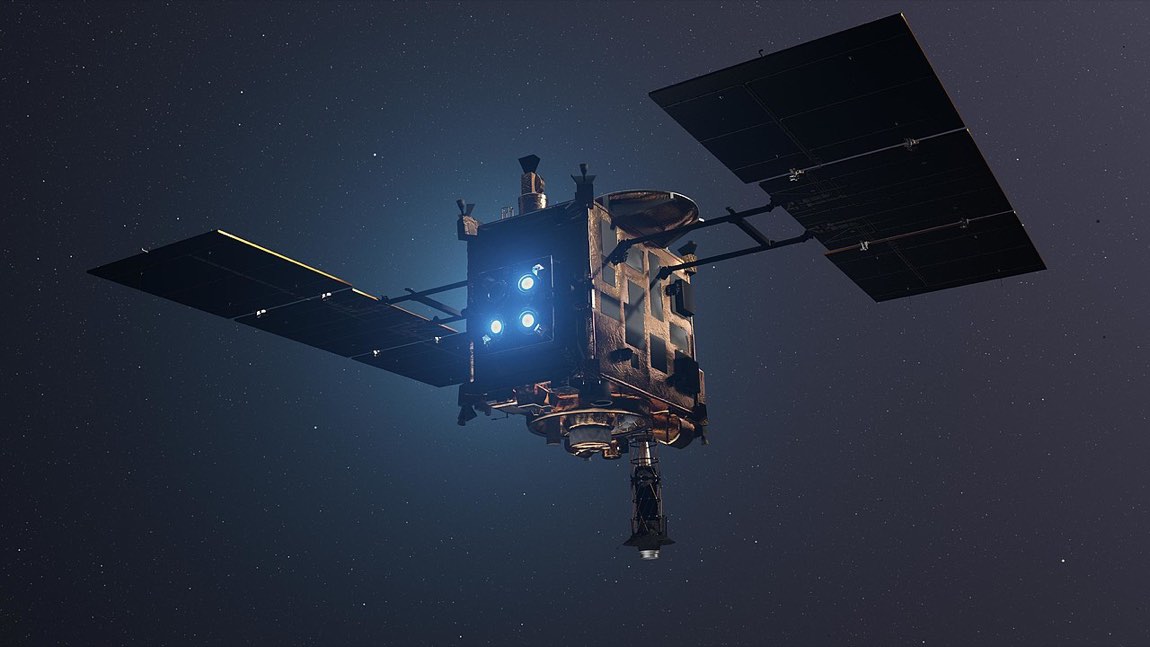
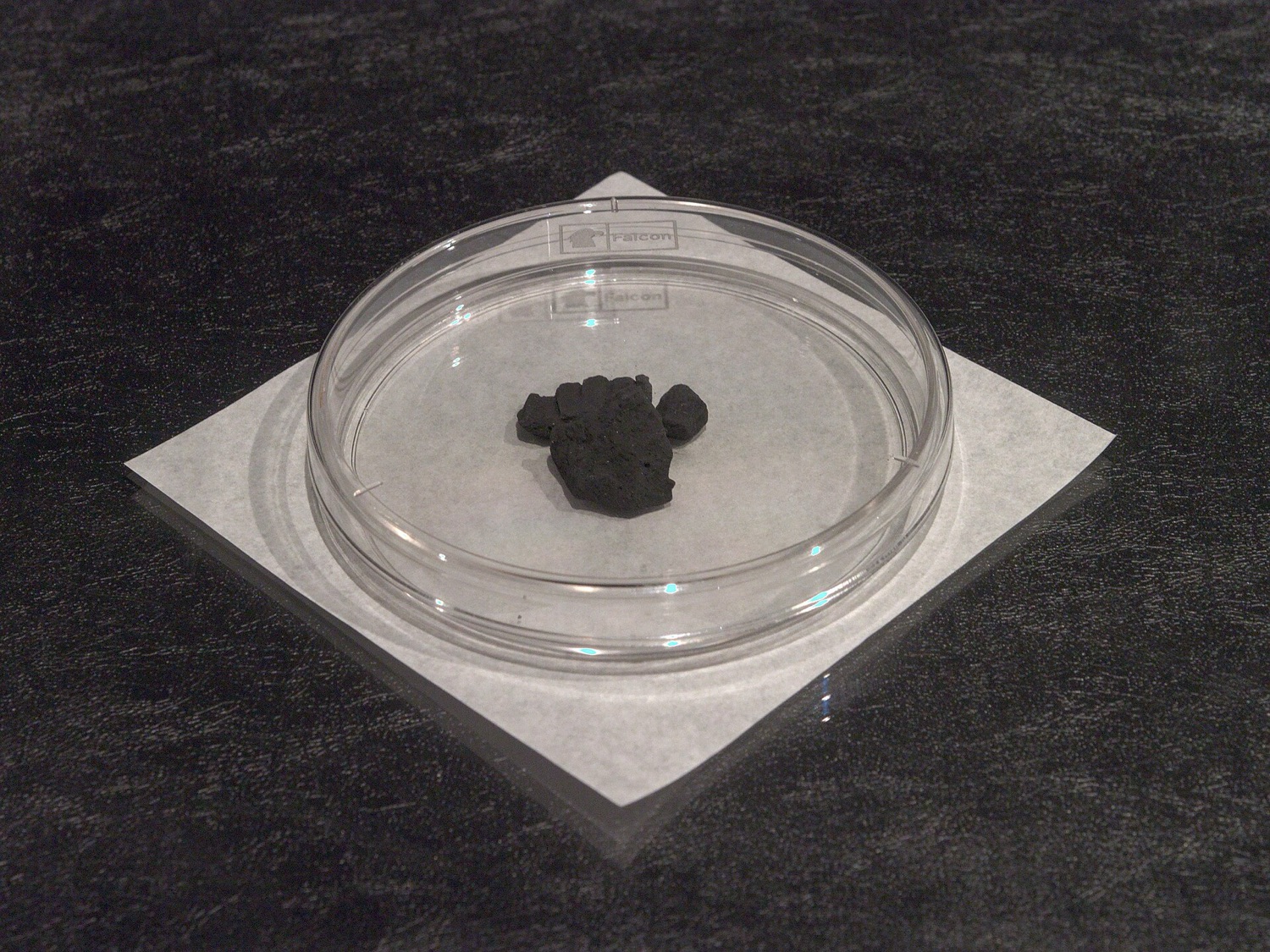
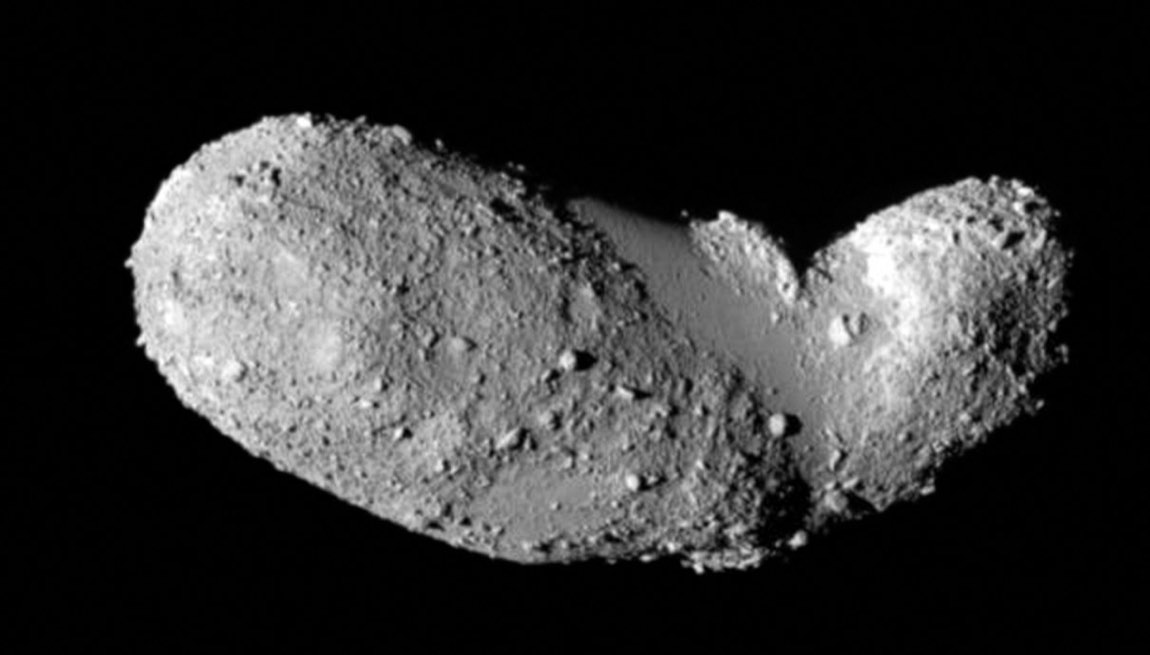
1998 KY26 is a tiny near-Earth asteroid only about 11 m across that whirls around once every 5.35 minutes. It is probably a single solid rock, like the boulders seen on rubble-pile asteroids such as Itokawa and Ryugu. Its bright white surface marks it as a rare enstatite-rich E-type asteroid. Japan's Hayabusa2 spacecraft, on an extended mission after returning samples of Ryugu, is due to reach it in July 2031.
The deep dive
Researched for the Atlas from Wikipedia — 1998 KY26 (17,115 characters read) · updated Nov 14, 2026
01 Discovered in a Single Night's Sweep
Tom Gehrels spotted 1998 KY26 on the night of 28 May 1998 while conducting routine survey work for the University of Arizona's Spacewatch project, whose explicit goal was to hunt down near-Earth asteroids. The instrument doing the work was a modest 0.9-meter (35-inch) telescope at Kitt Peak, Arizona — not a giant by modern standards, yet capable enough to catch a faint, moving dot at apparent magnitude 18.9. At the moment of discovery, the asteroid was closing in on Earth from a distance of only 0.03 astronomical units, equivalent to 4.5 million kilometers. That proximity was a stroke of luck: without it, an 11-meter rock would be almost impossible to detect. Follow-up observations began just three days later, picked up by Spacewatch again and then by observatories in the Czech Republic including Kleť and Ondřejov. The Minor Planet Center formally announced the discovery on 1 June 1998, leaving only one week before the asteroid's closest approach to Earth.
02 A Week That Defined the Asteroid
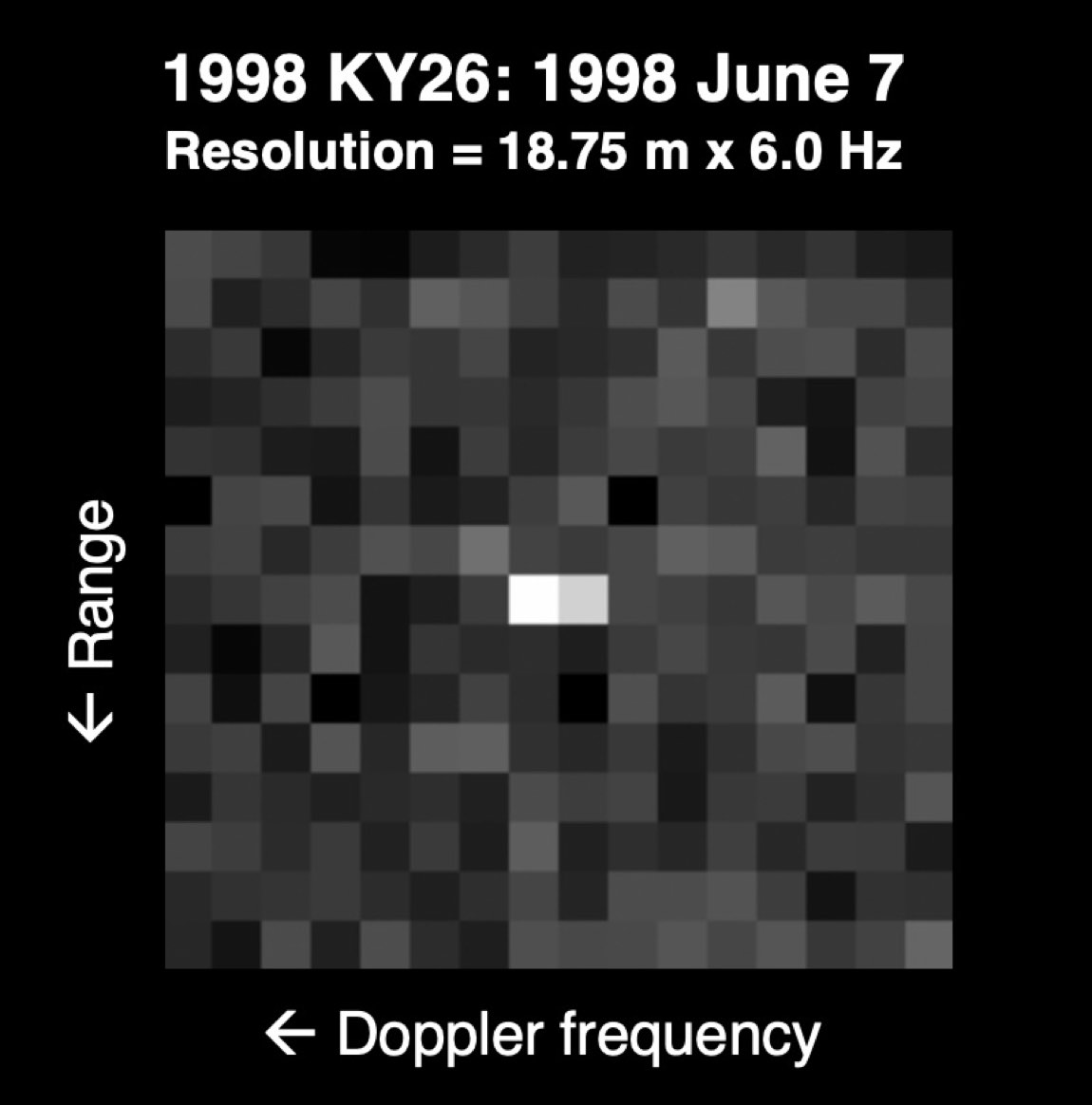
The days surrounding 1998 KY26's closest approach, between 6 and 8 June 1998, gave astronomers a narrow but extraordinary window. As the asteroid swept to within 2.1 lunar distances of Earth — just 810,000 kilometers — it brightened to apparent magnitude 16, bright enough for detailed study. A team led by Steven J. Ostro turned the Goldstone Solar System Radar in California toward it, and the radar echoes confirmed the rapid spin that brightness monitoring from 2 to 8 June had already hinted at. More importantly, Goldstone produced the first direct measurement of the asteroid's size and shape. When Ostro's team published their results in the journal Science in July 1999, accompanied by a Jet Propulsion Laboratory press release, they declared 1998 KY26 the smallest and fastest-rotating asteroid studied in detail at the time. The first color measurement came on 3 June, and those early spectral hints would not be fully resolved for another quarter century.
03 Rediscovering a Lost Rock, Twice
After its spectacular 1998 debut, 1998 KY26 effectively vanished from the observational record. It was last seen in 2002, then faded beyond reach for nearly two decades — too dim and distant to detect between its periodic close approaches, which occur every three and a half years. When JAXA announced in 2020 that Hayabusa2 would visit the asteroid in 2031, there was a problem: the orbital uncertainty was still large. Recovery came in December 2020, when the asteroid passed within 0.47 AU (70 million kilometers) of Earth and brightened to only apparent magnitude 25 — detectable solely by the largest optical telescopes on the planet. European and Japanese teams used the Very Large Telescope and the Subaru Telescope between 10 and 12 December, and the Minor Planet Center confirmed the recovery on 15 December 2020. A second, closer recovery opportunity arrived in June 2024, when the asteroid passed at just 12 lunar distances (4.6 million kilometers), and new observations then overturned several of the original measurements established back in 1998.
04 Three Times Smaller Than Anyone Thought Deeper
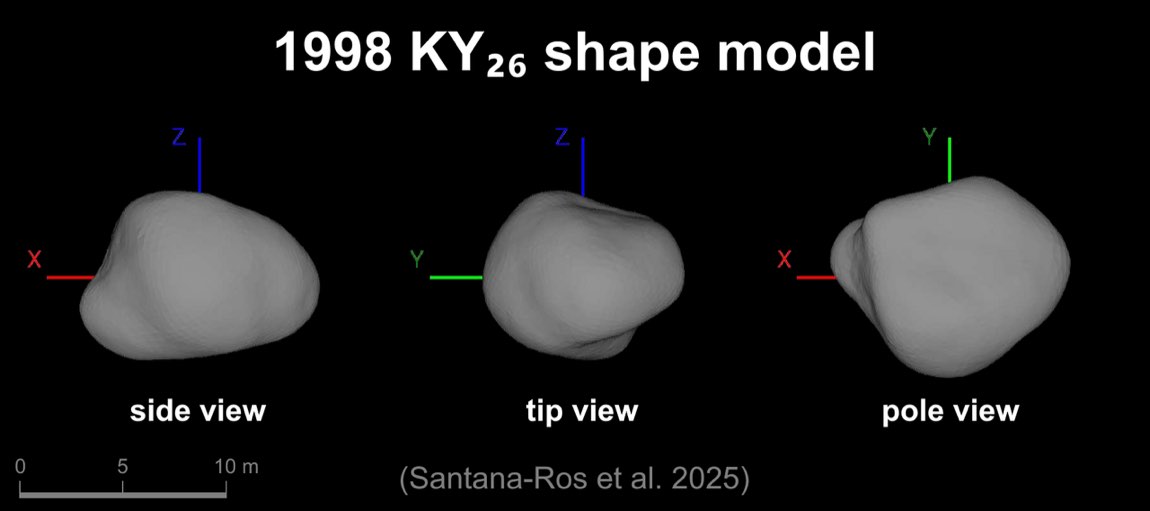
For more than two decades, the size and spin rate derived from Ostro's 1998 radar campaign went largely unchallenged. That changed when a team led by Toni Santana-Ros observed the asteroid extensively from May to November 2024, using multiple large optical telescopes during its June 2024 close approach. Their conclusion was striking: 1998 KY26 is three times smaller and rotating twice as fast as the values that had stood since 1999. The revised diameter is 11 ± 2 meters, and the rotation period is 5.35 minutes, with a measurement uncertainty of only 6 milliseconds. Crucially, when Santana-Ros's team went back and reanalyzed the original 1998 radar data, they found it consistent with their new results — meaning the earlier interpretation had been in error all along, not the data itself. The team published these findings in September 2025 in the journal Nature Communications. With Hayabusa2 approaching in 2031, getting the size right before arrival matters enormously for mission planning.
 ⤢
05 Why Sunlight Steers This Asteroid Deeper
At just 11 meters across, 1998 KY26 is small enough that the gentle push of sunlight measurably bends its path through the solar system. The Yarkovsky effect — in which the asteroid absorbs sunlight and re-emits it as heat in a direction that is not perfectly symmetric — acts as a continuous, tiny thruster. Because 1998 KY26 rotates retrograde, meaning backwards relative to its orbital motion, the Yarkovsky effect gradually shrinks its orbital semi-major axis rather than expanding it. The effect was first predicted for this asteroid in 2000 but was not actually detected until 2023. A second sunlight-driven force, the YORP effect, is simultaneously altering the spin rate. Models estimate that YORP causes an annual fractional change of 7×10⁻⁶ to the rotation period, translating to a decrease of roughly 2 milliseconds per year. This change is too small to measure before Hayabusa2 arrives in 2031, but over geological timescales it reshapes the asteroid's fate entirely. Solar radiation pressure also acts on the asteroid but is less efficient at changing its orbit because it operates mainly in the radial direction.
06 The Dark Comet That Wasn't
In 2023, a team led by Darryl Seligman noticed that 1998 KY26 showed a large normal acceleration — motion perpendicular to its orbital plane — that seemed too big to be explained by the Yarkovsky effect alone. The team proposed a provocative alternative: perhaps 1998 KY26 is a dark comet, an object that looks like an asteroid but is secretly driven by unseen outgassing. It was an intriguing idea, but it did not survive scrutiny. Observations collected in 2024 found no evidence of ejected dust from outgassing. Then, a 2025 reanalysis led by Davide Farnocchia, using the asteroid's freshly updated physical properties from the 2024 campaign, demonstrated that the Yarkovsky effect fully accounts for the non-gravitational acceleration without invoking any cometary activity. As of 2025, the JPL calculates the transverse Yarkovsky component (A2) at (−2.20 ± 0.49) × 10−14 AU/day², a value consistent with a purely rocky body behaving exactly as physics predicts.
07 An Enstatite Pebble With Ancient Roots Deeper
Spectroscopic observations from 2024 firmly established 1998 KY26 as an E-type asteroid, meaning its surface is dominated by enstatite and reflects light with a high geometric albedo of 0.52 — making it appear bright white in visible light. Its spectrum most closely matches EL- and EH-type enstatite chondrite meteorites, though the high albedo also resembles aubrite meteorites. In the Bus–DeMeo classification system the asteroid falls into the Xe subtype, distinguished by a subtle absorption band at 0.49 micrometers that may indicate the presence of troilite or other opaque minerals. Interestingly, early 1998 studies had suggested the asteroid might be carbonaceous and water-rich, a hypothesis directly contradicted by the 2024 data. E-type and Xe-type asteroids are relatively rare in the solar system, making 1998 KY26 a scientifically valuable example. A 2026 study led by Eri Tatsumi connected its composition to the X-type asteroids 44 Nysa and 135 Hertha, suggesting all three trace their origin to different layers of a single destroyed parent body in the inner main asteroid belt.
08 From a Shattered Parent Body to Earth's Doorstep Deeper
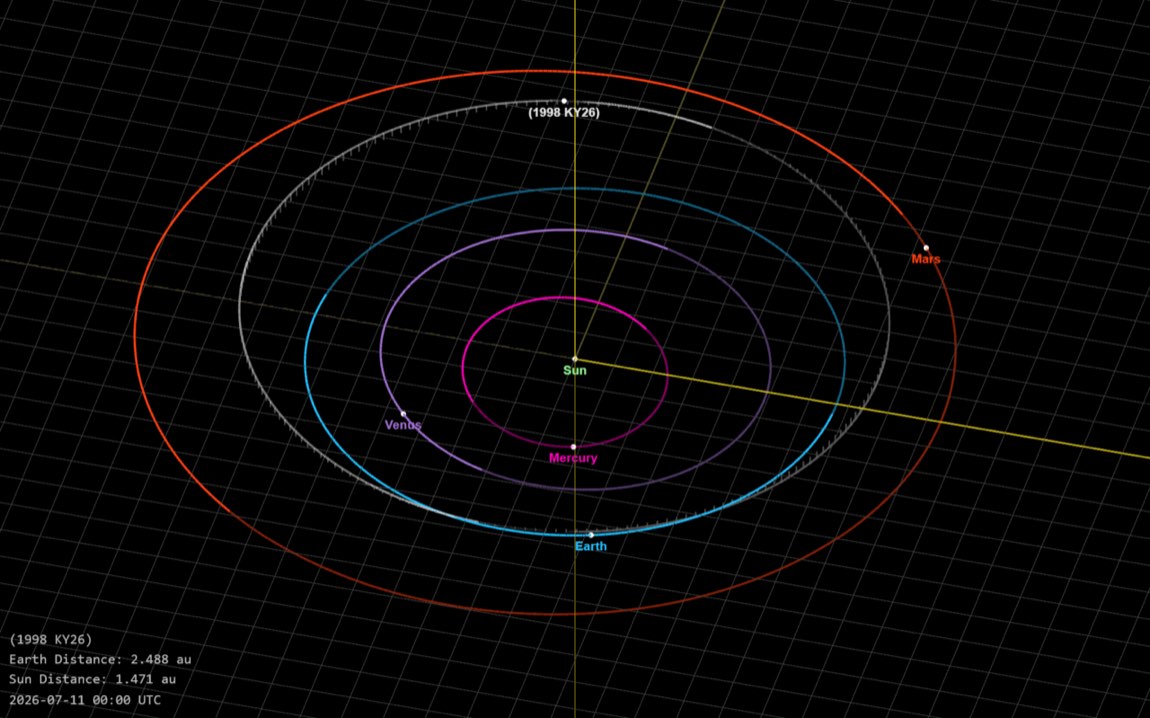
The story of how 1998 KY26 ended up in an Earth-crossing orbit begins with a catastrophic collision deep in the main asteroid belt. Tatsumi and colleagues proposed in 2026 that 1998 KY26 and 44 Nysa both originated as fragments of the enstatite-rich crust of a now-destroyed parent body associated with the Nysa–Polana complex in the inner main belt. After that parent body was shattered, theoretical models show that small fragments like 1998 KY26 drift significantly inward over a few million years under the Yarkovsky effect. Eventually these fragments reach the ν6 secular resonance 2 AU from the Sun, where their apsidal precession rate matches that of Saturn. This resonance pumps up their orbital eccentricity until their paths cross Earth's orbit — which is exactly where 1998 KY26 sits today. The asteroid's current orbital inclination of 1.5° is consistent with other members of the Nysa–Polana complex, reinforcing the shared origin story. An earlier hypothesis pointing to the high-inclination Hungaria family was argued by Tatsumi and colleagues to be implausible, as it would require an unrealistic change in orbital inclination.
 ⤢
09 A Surface That Flings Loose Rock Away
On most asteroids, loose boulders and gravel sit on the surface under the pull of gravity. On 1998 KY26, the physics work against that. The asteroid's escape velocity is a mere 1 centimeter per second — a gentle breath of wind on Earth would exceed it — and its spin is so fast that centrifugal acceleration at the equator actually exceeds surface gravity. Any boulder sitting near the equator would simply drift off into space. For fine-grained material to stay attached, models require a minimum cohesive strength of between 4 and 20 pascals — a small but nonzero sticking force. The only zones where loose material could realistically accumulate are near the poles, where centrifugal forces are minimal. This surface environment also rules out 1998 KY26 being a rubble pile: at decameter scales, rubble piles are unlikely to form or hold together. Instead the asteroid is probably a solid chunk of rock, comparable to one of the boulders dotting the surfaces of larger rubble pile asteroids such as Itokawa and Ryugu. A large concavity near the southern hemisphere has been inferred from shape modeling.
10 Naming Rules That Still Don't Apply
More than two decades after its discovery, 1998 KY26 still carries only its provisional designation, the alphanumeric label the Minor Planet Center assigns at the moment of discovery. The characters encode the year, half-month, and sequence of discovery. A formal name requires that the asteroid first receive a minor planet number, which only happens once it has been observed across enough oppositions to pin down its orbit reliably. That condition has not yet been fully met. Once a number is assigned, the discoverer — Tom Gehrels or his designees — may propose a name, but it must conform to guidelines set by the International Astronomical Union's Working Group for Small Bodies Nomenclature. Because 1998 KY26 has a perihelion distance smaller than 1.15 AU, those guidelines specify that it should receive a mythological name not related to creation or the underworld. For now it remains known only by its catalog code, a situation that will likely resolve as Hayabusa2's 2031 arrival focuses global attention on the asteroid.
11 The Curious Claim It Might Be a Spacecraft
In 2026, Avi Loeb and colleagues put forward an unusual proposal: that 1998 KY26 might not be a natural asteroid at all, but rather the lost Soviet spacecraft Phobos 1, which failed en route to Mars in 1988. Their analysis argued that the difference between the two objects' trajectories could be accounted for by the propulsion available to Phobos 1, and they noted similarities in size, reflectivity, and inferred shape between the spacecraft and the asteroid. The claim attracted significant attention, but as of June 2026, the analysis had not been peer reviewed. The proposed identification remains unconfirmed. If Hayabusa2 arrives in 2031 and finds obvious artificial structures, the question would be settled immediately. If the spacecraft's instruments return data consistent with enstatite-rich rock and the natural history implied by the Nysa–Polana origin model, the spacecraft hypothesis would be effectively ruled out. Until then it stands as an intriguing but unverified outlier in the scientific literature.
12 What Hayabusa2 Will Actually Do There
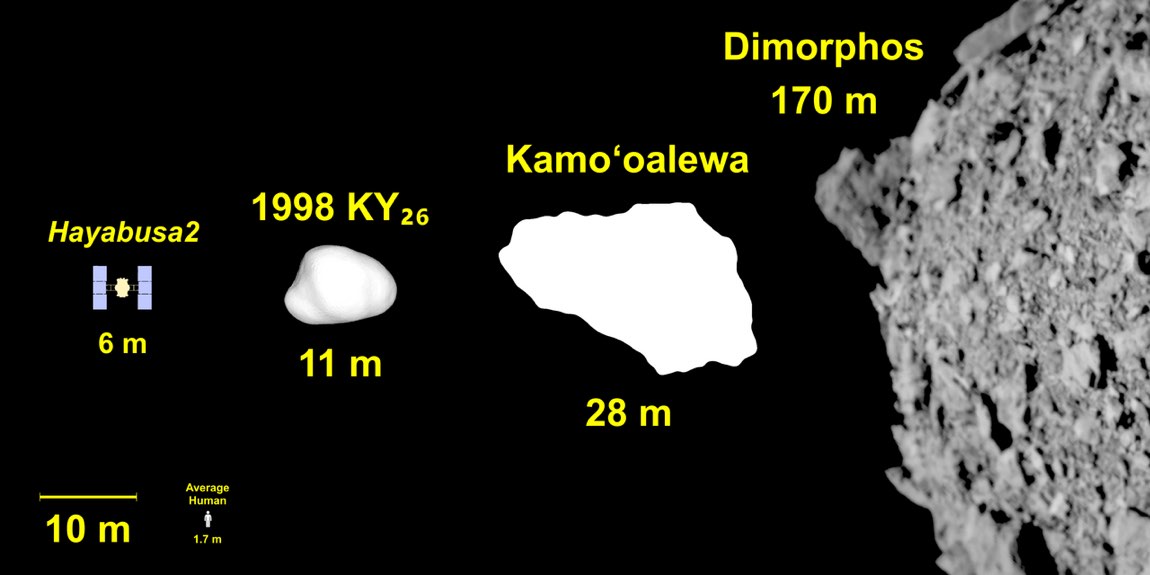
When Hayabusa2 arrives at 1998 KY26 in July 2031, the encounter will be the culmination of a mission extension announced in 2020 and formally titled the Small Hazardous Asteroid Reconnaissance Probe (SHARP, also written ♯). The spacecraft will first conduct a slow approach and attempt to enter orbit around an object that is, at 11 meters across, roughly twice the width of the probe itself. The plan calls for deploying Hayabusa2's final remaining target marker and projectile to deliberately create an impact crater on the surface — an experiment designed to reveal what lies just beneath the skin of a decameter-scale asteroid. The spacecraft will then attempt to land, an operation made dangerous by the rapid 5.35-minute spin: the safest landing zones are near the poles, where centrifugal forces are least disruptive. The mission's scientific payoff would be direct knowledge of the properties of small hazardous asteroids, the class of objects most likely to reach Earth's surface intact, making every measurement relevant to planetary defense planning.
 ⤢
13 Observing It Before the Spacecraft Arrives Deeper
Catching 1998 KY26 from Earth requires patience and timing. The asteroid makes close approaches every three and a half years, but the distances vary enormously — from as close as 0.005 AU to as far as 0.5 AU (0.75 to 74.80 million kilometers). At most approaches it barely brightens beyond the reach of the world's largest telescopes, as demonstrated by the December 2020 recovery observation at apparent magnitude 25 using the Very Large Telescope and Subaru Telescope. The next close approach after the 2024 event will occur in 2028 at a minimum distance of 0.35 AU (52 million kilometers), which is farther but may still allow the James Webb Space Telescope to observe it in March or October 2028. JWST could potentially provide a more definitive measurement of the asteroid's size and thermal properties before Hayabusa2's arrival, sharpening mission planning. The 2024 observations, covering May to June and October to November with multiple large optical telescopes around the world, demonstrated how much a well-timed Earth flyby can transform scientific understanding of an object this small.