- Surface temperature
- 14,490 K
- Radius
- 7.22 × the Sun
- Luminosity
- 2,070 × the Sun
- Spectral type
- B1V
Star · Deep guide
Spica
Two blazing blue stars locked in a 4-day embrace form Virgo's ear of wheat.
What is it?
Spica, 250 light-years away, looks like one brilliant blue-white point but is a close binary: two hot stars orbiting every four days, near enough to distort each other into egg shapes. The main star is a heavyweight over ten times the Sun's mass — a future supernova. Spica's steady light helped ancient astronomers discover the slow wobble of Earth's axis.
The deep dive
Researched for the Atlas from Wikipedia — Spica (8,940 characters read) · updated Sep 20, 2026
01 A Name Written in Wheat and Stars
Spica's name reaches back through multiple civilisations, each seeing the same bright point of light through a different cultural lens. The Latin name comes directly from spīca virginis, meaning "the virgin's ear of wheat grain," a reference to the sheaf held by the constellation Virgo. In Sumerian star-lists found at Uruk in modern Iraq and dated between 3200 and 1500 BC, the star was recorded as absinnu or šer'u, translating to "The Seed-Furrow" — an agricultural image that echoes across millennia. Arab astronomers knew it as al-simāk al-ʼaʽzal, "the unarmed simāk," giving rise to the anglicised alternative name Azimech. Another Arabic tradition called it Alaraph, meaning "the grape-gatherer," while Sumbalet and its variants derive from the Arabic sunbulah, again meaning "ear of grain." In Hindu astronomy it corresponds to the Nakshatra Chitrā, and in Chinese sky-lore it is 角宿一 — the First Star of Horn. The International Astronomical Union formally standardised "Spica" in its very first bulletin from the Working Group on Star Names, published in July 2016.
02 How Spica Revealed Earth's Wobble
Spica holds a remarkable place in the history of science: it is believed to be the star whose careful observation led the Greek astronomer Hipparchus to discover the precession of the equinoxes — the slow, roughly 26,000-year wobble of Earth's rotational axis. The evidence stretches even further back. A temple to the goddess Menat, an early form of Hathor, at Thebes was deliberately aligned with Spica when it was constructed in 3200 BC. Over centuries, the relentless drift of precession shifted Spica's position relative to that fixed stone architecture, making the misalignment measurable and meaningful. Much later, Nicolaus Copernicus used a home-built triquetrum — a classical angular-measuring instrument made from hinged rods — to make his own observations of Spica as part of his research into precession. The chain of inquiry from an ancient Egyptian temple to the Polish astronomer who would eventually overturn the geocentric universe ran directly through this single blue-white star.
03 Three Stars Disguised as One
What the naked eye sees as a single brilliant point is actually a hierarchical triple star system. Two massive stars orbit each other every four days in the inner binary, moving so rapidly and sitting so close together that no telescope can separate them visually. Their presence as two distinct objects is revealed only by their spectra: as one star rushes toward us and the other recedes, the Doppler effect tugs their absorption lines in opposite directions, making them a double-lined spectroscopic binary. Orbiting this tight inner pair from much farther out is a third companion, designated Alpha Virginis Ac and nicknamed Arista — the awn of the wheat's ear — continuing the agricultural naming tradition. Arista was discovered only in 2026 using the GRAVITY interferometry instrument on the Very Large Telescope. It sits at an angular separation of 0.111 arcseconds from the inner pair, corresponding to a projected physical separation of 8.9 astronomical units, and carries an estimated mass of 1.4 times that of the Sun. Its full orbital path remains undetermined.
04 Egg-Shaped Suns and Their Light Show
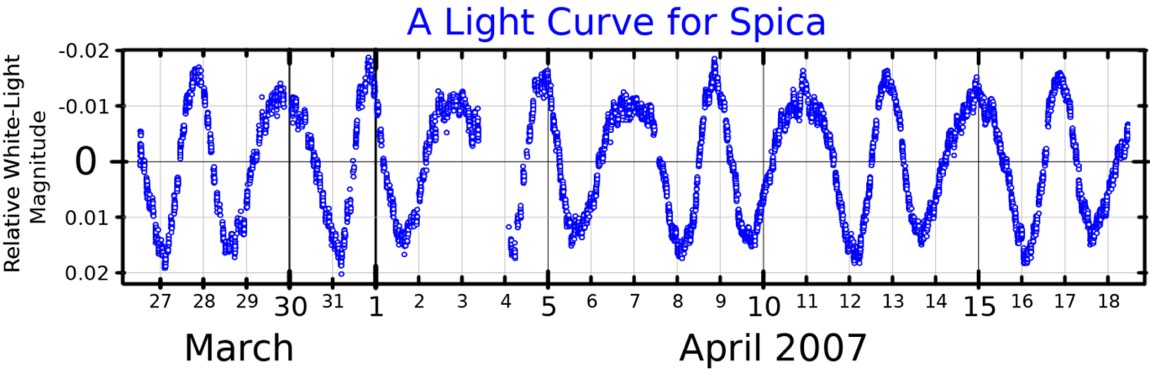
The two inner stars of Spica are so gravitationally entangled that they have stretched each other out of spherical shape entirely. Rather than being round, both stars are distinctly egg-shaped — technically called a rotating ellipsoidal variable — a distortion caused by their mutual tidal pull across a separation so small the orbit could fit comfortably within the inner solar system. As the pair revolves, the amount of distorted stellar surface facing Earth changes continuously, causing the system's apparent brightness to vary by 0.03 magnitudes across the four-day orbital period. This variation is barely perceptible to the human eye but is well documented by instruments. Crucially, this is not an eclipsing binary: neither star passes directly in front of the other from our line of sight. The brightness change comes purely from geometry and distortion. Notably, both stars rotate faster than their orbital period, and the orbit itself is highly elliptical — two characteristics that together suggest Spica's inner pair is a relatively young, dynamically unsettled system that has not yet had time for tidal forces to synchronise and circularise its motion.
05 Measuring the Stars' Own Reflectivity Deeper
In 2016, Spica became the first binary system ever used to directly measure the geometric albedo — the reflectivity — of individual stars. Spica is a polarimetric variable, meaning the polarisation of its light changes over time, a quality also confirmed for the first time in 2016. The dominant cause of this polarimetric signal is the reflection of each star's light off the surface of the other. Because the two stars are so close together and their geometry changes predictably over each four-day orbit, astronomers could disentangle the reflected component and calculate just how much light each star bounces back. Spica A has a geometric albedo of 3.61 percent and Spica B has a geometric albedo of 1.36 percent. Both values are strikingly low — far lower than most planets; Earth's geometric albedo, for comparison, is around 37 percent. Stars are not efficient mirrors, and Spica gave astronomers their first empirical confirmation of exactly how inefficient they really are.
06 A Giant Star Nearing a Crossroads Deeper
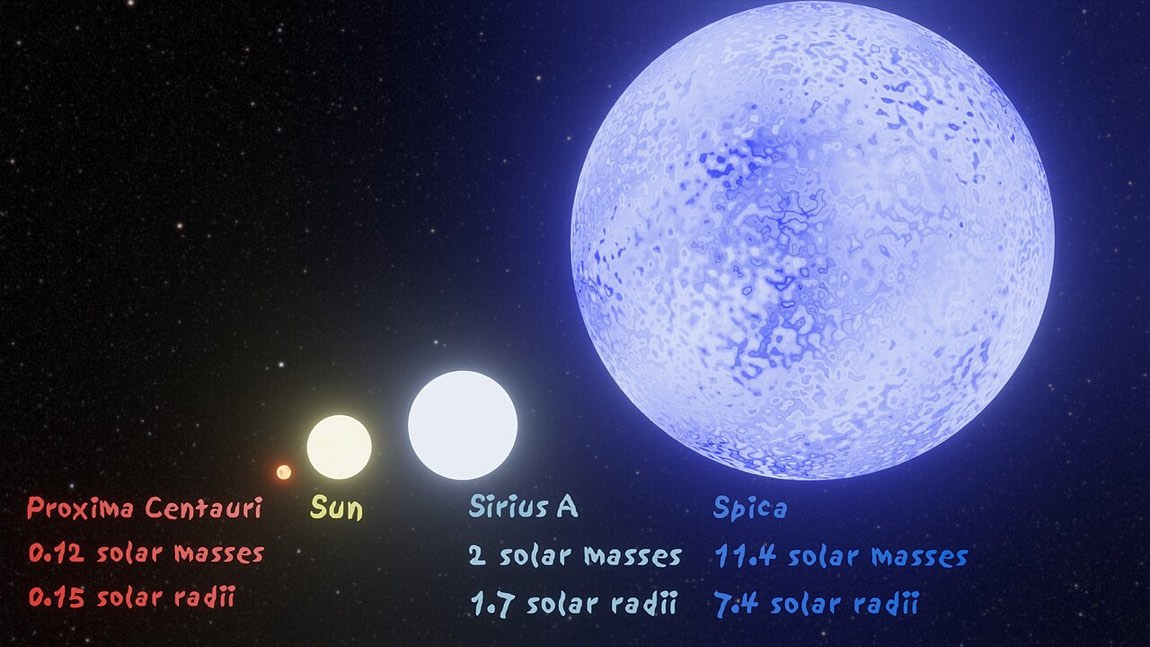
The primary star of Spica carries a spectral classification of B1III-IV, placing it in the transitional zone between a subgiant and a giant — a star that has only recently left the main sequence where it spent most of its life fusing hydrogen in its core. Its mass exceeds 10 times that of the Sun, its radius is about 7 times the Sun's, and its bolometric luminosity — total energy output across all wavelengths — reaches approximately 20,500 times the Sun's output. Despite that staggering energy release, the primary is also classified as a Beta Cephei variable, pulsating with a period of 0.1738 days. The star's surface physically swells and contracts on this schedule, a motion confirmed by radial velocity measurements that show the spectral lines shifting in lockstep. The equatorial rotation velocity is 199 km/s, fast enough that it contributes to the star's overall instability. Most significantly, Spica A is one of the nearest stars to the Sun that has accumulated enough mass to end its life in a Type II supernova explosion — but because it has only recently exited the main sequence, that event remains millions of years in the future.
 ⤢
⤢
07 The Peculiar Spectrum of Spica B Deeper
The secondary star in Spica's inner binary is notable in its own right, though for an unusual and not fully explained reason. It is one of only a handful of stars known to display the Struve–Sahade effect: an anomalous weakening of its spectral absorption lines precisely when the star is moving away from the observer in its orbit. This asymmetry is puzzling because a well-behaved star should show consistent line strengths regardless of its orbital phase. One leading explanation is that the intense stellar wind driven outward by the much more luminous primary scatters the secondary's light preferentially when it is receding, effectively suppressing its spectral signature. The secondary itself is a main-sequence star with a spectral classification of B4–7 V. It is considerably smaller than the primary: roughly 4 times the mass of the Sun and 3.6 times the Sun's radius. Its luminosity is about one-ninth that of the primary. The difficulty of disentangling its spectrum from the primary's, compounded by the Struve–Sahade effect, means individual spectral types for both components remain somewhat uncertain even after decades of study.
08 Directly Measuring an Invisible Orbit Deeper
For decades, everything known about Spica's inner binary came from spectroscopy alone — a powerful but indirect technique. That changed between 1966 and 1970, when the Narrabri Stellar Intensity Interferometer in Australia was used to observe the pair directly and measure their orbital geometry without relying on Doppler shifts. The interferometer determined that the angular diameter of the primary star is (0.90 ± 0.04) × 10⁻³ arcseconds — a vanishingly small angle, comparable to seeing a human hair from about 10 kilometres away. The angular size of the semi-major axis of the pair's mutual orbit was found to be only slightly larger, at (1.54 ± 0.05) × 10⁻³ arcseconds. These measurements converted the spectroscopic orbital parameters into real physical dimensions for the first time. The entire effort underscored just how extreme Spica's inner system is: two massive, distorted suns separated by a gap smaller than their own combined diameters, orbiting at a pace that would take them from one side of their path to the other in less time than it takes Earth to complete one work week.
09 Occultations: Planets Hiding a Giant
Because Spica sits only 2.06 degrees from the ecliptic — the plane of the solar system as seen from Earth — the Moon can pass in front of it regularly, and planets can do so on rarer occasions. The most recent planetary occultation occurred on November 10, 1783, when Venus slid directly across the face of Spica as observed from Earth. The next such event will not happen until September 2, 2197, when Venus once again covers the star. The Sun passes a little more than 2 degrees north of Spica around October 16 each year, and Spica's heliacal rising — its first reappearance in the dawn sky after a period of solar proximity — occurs approximately two weeks after that. There is also a curious eight-year rhythm: Venus returns to the vicinity of Spica near the time of the star's heliacal rising every eight years. In 2009, for instance, Venus passed 3.5 degrees north of Spica on November 3. These repeated planetary encounters with a single bright star made Spica a reliable celestial clock for ancient astronomers across many cultures.
10 How to Find Spica on Any Clear Night
Spica is easy to locate with a simple two-step star-hop remembered by a mnemonic that has guided amateur astronomers for generations. Start at the handle of the Big Dipper, also known as the Plough, and follow the curve of its arc outward until you reach the bright orange star Arcturus. This first hop is the "arc to Arcturus." From there, continue along the same angular direction for roughly the same angular distance, and you will land on Spica — the "spike to Spica." The star culminates at midnight on April 12 in the current astronomical epoch, meaning that on that date it reaches its highest point in the sky at midnight and can be observed from dusk until dawn. Spica is also one of the anchor stars of the Spring Triangle asterism, which it forms together with Arcturus and either Denebola or Regulus depending on the source. Extended further, Spica is part of the larger Great Diamond asterism, which adds the star Cor Caroli to the group.
11 Open Questions Around a Familiar Star Deeper
Despite centuries of observation and Spica's privileged status as one of the nearest massive binary systems to the Sun, significant uncertainties remain. The spectral classification of the individual components — particularly the secondary — is still debated, with published values ranging across multiple subclasses. The Struve–Sahade effect seen in Spica B is not yet fully explained, and whether a stellar wind from the primary is truly responsible remains an open question. The orbital parameters and full three-dimensional path of the newly confirmed third companion, Arista, are completely undetermined as of its 2026 discovery; only its projected separation of 8.9 astronomical units and its estimated mass of 1.4 solar masses are in hand. The system's youth is inferred from the non-synchronised rotation and high orbital ellipticity of the inner pair, but the precise age has not been pinned down. And while Spica A is confidently identified as a future Type II supernova candidate, the timeline — somewhere beyond several million years — carries the inherent uncertainty of stellar evolution modelling for massive, rapidly rotating stars.
 ⤢
⤢