 Photograph · Giuseppe Donatiello · CC0
Star · Deep guide
Mu Cephei
The reddest bright star in northern skies: Herschel's Garnet Star.
What is it?
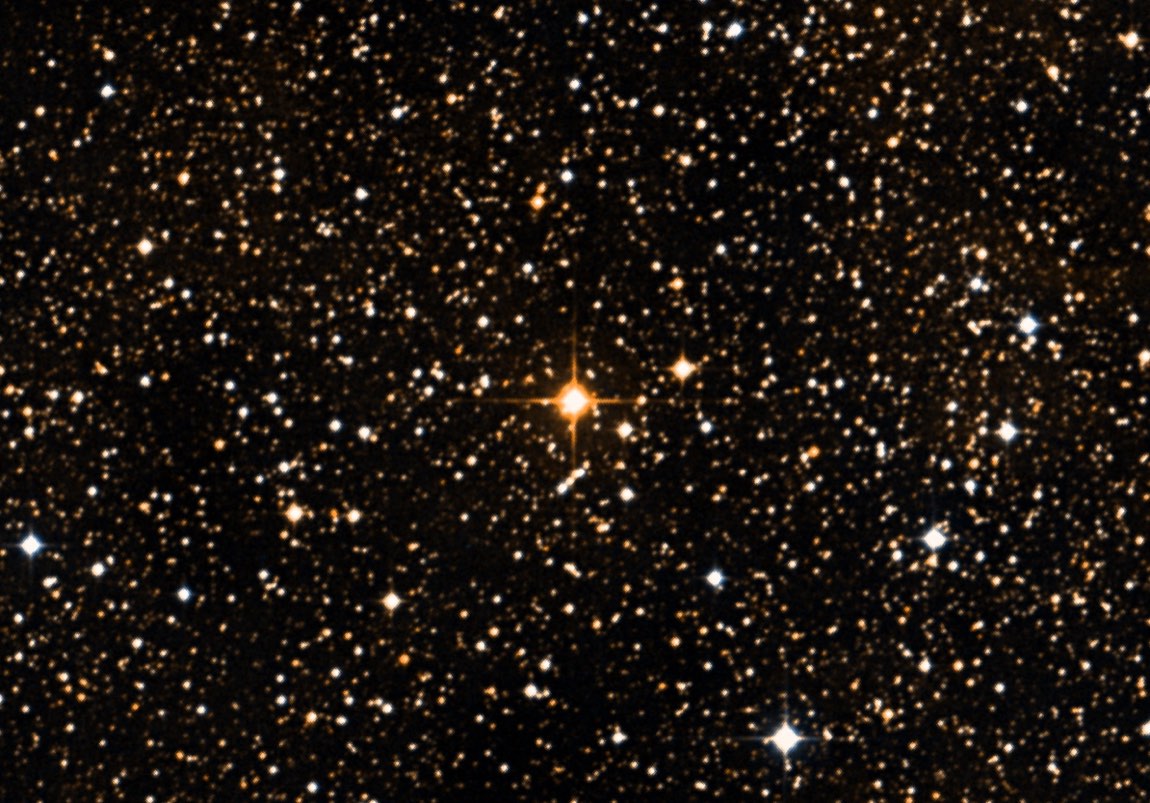
Mu Cephei glows so deeply red that William Herschel likened it to a garnet — point binoculars at Cepheus and it leaps out of the star field like an ember. It is a red supergiant around 2,800 light-years away and over a thousand times the Sun's width, pulsing slowly as it burns through its final fuel reserves.
The deep dive
Researched for the Atlas from Wikipedia — Mu Cephei (6,858 characters read) · updated Sep 20, 2026
01 The Name Written in Garnet Red
The star's famous nickname traces directly to William Herschel, who described its color as "a very fine deep garnet colour, such as the periodical star ο Ceti." That vivid description stuck, and Giuseppe Piazzi formalized it by calling the star Garnet sidus — Latin for Garnet Star — in his catalogue. The name bounced through history informally until 19 September 2024, when the International Astronomical Union's Working Group on Star Names gave it official standing, entering Garnet Star into the IAU Catalog of Star Names. A competing name, Erakis, appeared in Antonín Bečvář's star catalogue but almost certainly arrived through a case of mistaken identity: scholars believe it was borrowed from the Arabic name al-Rāqis, which actually belonged to Mu Draconis, a completely different star. So the name Erakis, however poetic it sounds, was almost certainly an error from the start. Today the Bayer designation Mu Cephei remains in standard use alongside the newly ratified Garnet Star, giving astronomers both a precise technical label and one of the most evocative common names in the entire sky.
02 How Variable — and Who First Noticed
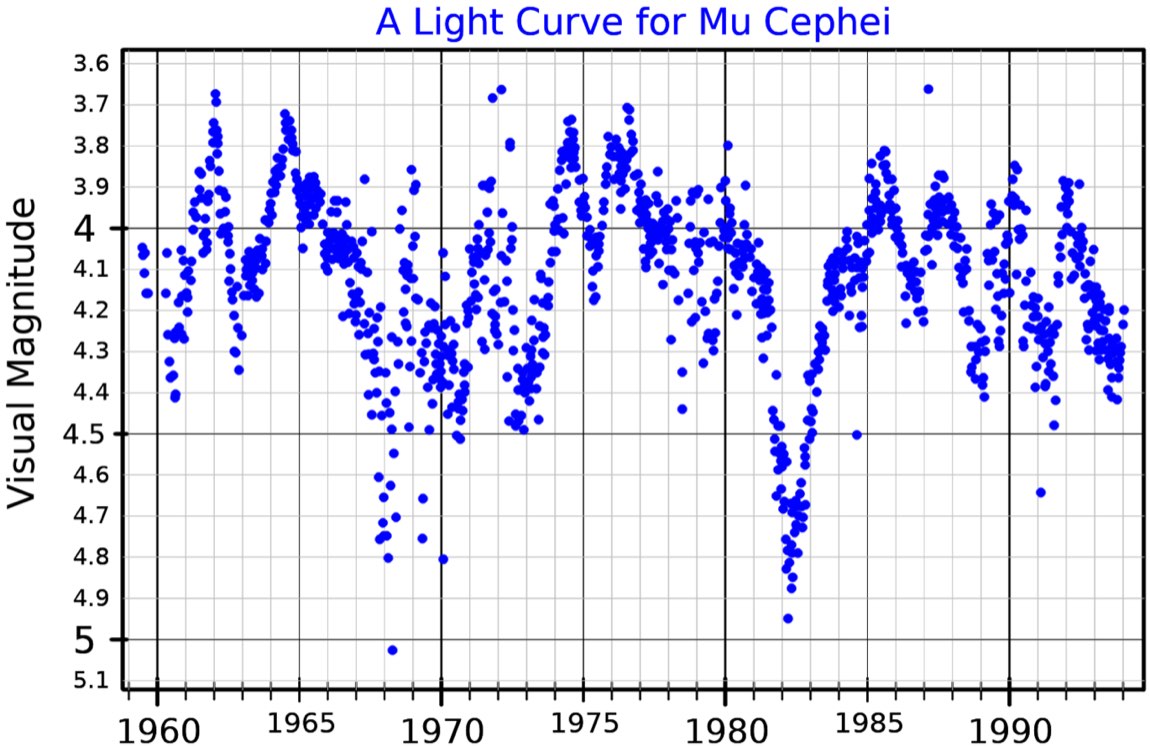
In 1848 the English astronomer John Russell Hind noticed that Mu Cephei's brightness was not constant, and the discovery was quickly confirmed by the German astronomer Friedrich Wilhelm Argelander. The star has been watched almost continuously since 1881, building one of the longest unbroken brightness records for any variable star. Today it is classified as a semiregular variable of type SRc, meaning its changes follow rough cycles but never settle into a perfectly predictable rhythm. Its apparent magnitude wanders erratically between 3.4 and 5.1 — a factor of roughly four in actual brightness — which is large enough to notice with the naked eye over weeks and months. Researchers have identified multiple overlapping periods hiding inside that erratic light curve; they consistently cluster around either about 860 days or about 4,400 days. Mu Cephei was once the prototype of a whole class called "Mu Cephei variables," but that grouping is now considered obsolete, and the star's behavior is understood as part of the broader semiregular category shared by many red supergiants.
03 A Yardstick for Classifying Stars Deeper
Beyond its fame as a spectacular object, Mu Cephei has served a working role at the heart of stellar classification. Since 1943 its spectrum has been one of the so-called "dagger stars" — reference standards whose well-defined spectra anchor the MK classification system used to sort every other star in the sky. In 1943 it was designated the standard star for spectral type M2 Ia, and when the classification system was updated in 1980 it became the standard for the revised type M2− Ia. That minus sign is not a typo; it signals a slightly less extreme luminosity class within the already extreme Ia supergiant category. Using a single real star as the definition of a type means that every astronomer who classifies another red supergiant is, implicitly, comparing it to Mu Cephei's actual light. The angular diameter of the star has also been measured interferometrically, though early measurements were complicated by the fact that the star is surrounded by a cool molecular layer that inflated the apparent size; later work pinned the true stellar angular diameter at 14.11 ± 0.6 milliarcseconds.
04 Why Its Distance Is So Hard to Pin Down Deeper
One of the most frustrating facts about Mu Cephei is that nobody agrees on how far away it is, and the disagreement is not small. The Hipparcos satellite measured a parallax of 0.55 ± 0.20 milliarcseconds, implying roughly 1,800 parsecs, but the uncertainty is nearly as large as the measurement itself. A size-comparison method using Betelgeuse as a reference yields 390 ± 140 parsecs — less than a quarter of the Hipparcos figure. Integrating the star's spectral energy distribution and combining it with luminosity gives 641 parsecs. Averaging the parallaxes of nearby luminous stars with similar dust reddening from the Gaia Data Release 2 catalog gives 940 parsecs. A spectroscopic approach combined with interferometric sizing favors 421 parsecs. These estimates span a factor of roughly four, which is extraordinary for a relatively nearby star. The uncertainty matters enormously because the derived radius, luminosity, and even the star's ultimate fate all depend on knowing the distance — a star at 1,800 parsecs would be dramatically more luminous than the same star at 421 parsecs.
 ⤢
⤢
05 Luminosity and Radius: A Moving Target Deeper
Because the distance to Mu Cephei is so uncertain, estimates of its physical size and energy output span a remarkable range. Bolometric luminosity — summed across all wavelengths by integrating the spectral energy distribution — comes out at 269,000 times the Sun's luminosity in one careful analysis, while a visual and infrared color relation pushes that figure to 340,000 solar luminosities. A 2019 study using a distance of 641 parsecs found a luminosity below 140,000 solar luminosities, and a 2026 paper using 421 parsecs estimated 110,000 solar luminosities. Radius estimates vary just as dramatically: 972 ± 228 solar radii in 2019, 762 solar radii in 2026, and figures as high as 1,420 or even 1,650 solar radii in studies that used larger distances or, it later turned out, accidentally measured the surrounding molecular shell rather than the star itself. The page's headline figure of about 760 solar radii comes from one well-regarded estimate. An effective temperature of 3,750 K — barely more than half the Sun's surface temperature — is a point of reasonable consensus among recent studies, though a 2019 paper found 3,551 ± 136 K.
06 Shells, Rings, and the Star's Own Debris
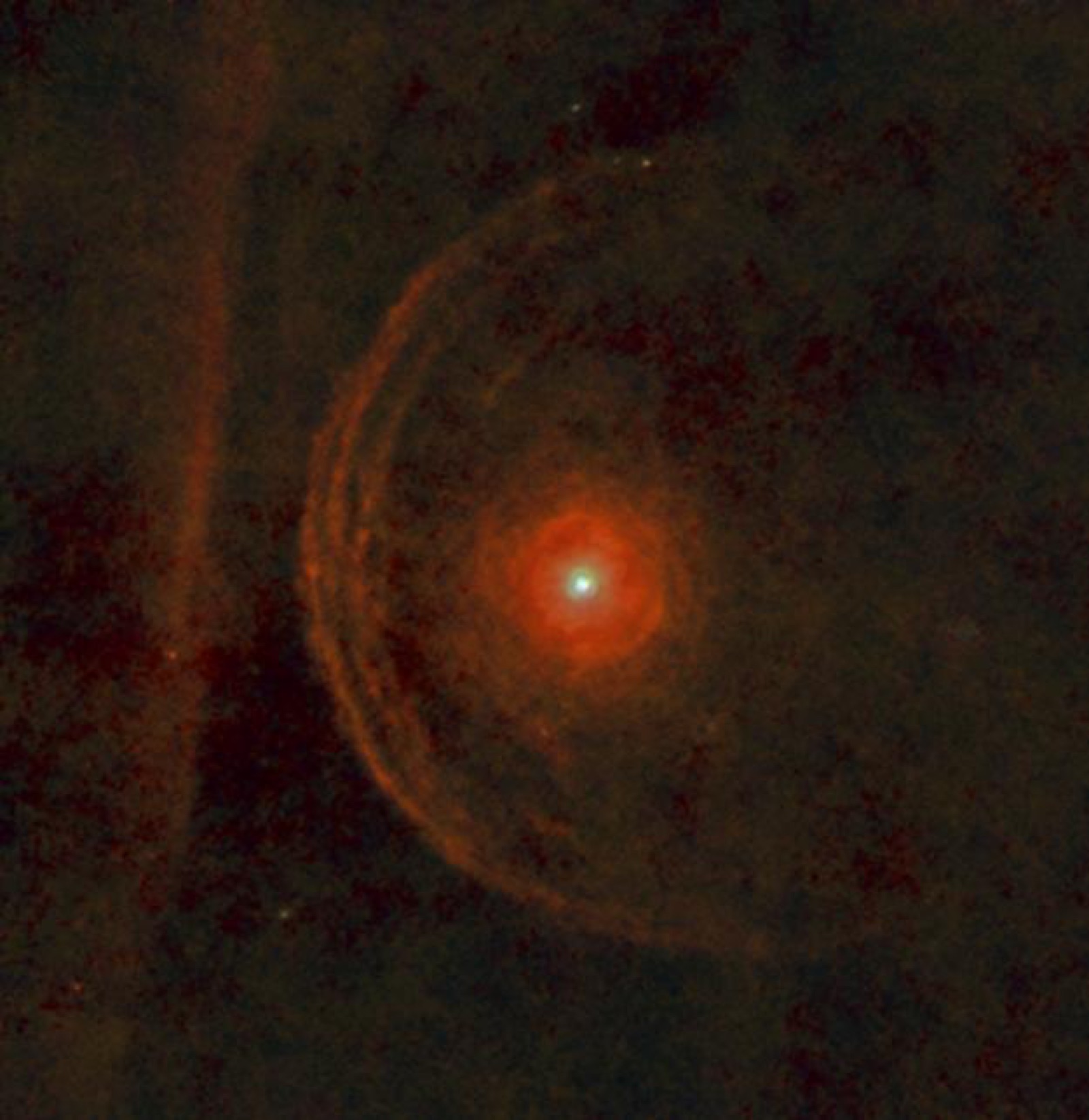
Mu Cephei is not alone in space — it is surrounded by material it has already shed. A spherical shell of ejected gas extends outward to an angular distance of 6 arcseconds from the star and is expanding at 10 kilometers per second. Working backward from that expansion rate, astronomers estimate the shell is between 2,000 and 3,000 years old, meaning it was launched into space around the time Rome was at its height. Closer to the star, the ejected material loses its spherical symmetry and may be shaped more like a torus — a doughnut ring rather than a bubble. Infrared observations add another layer to the picture: a broad ring of dust and water ice appears to surround the star, with its inner edge starting at about twice the stellar radius and extending outward to roughly four times the stellar radius. Together these structures paint the picture of a star actively blowing itself apart, layer by layer, as it burns through its remaining nuclear fuel.
07 A Runaway Star Racing Through the Galaxy
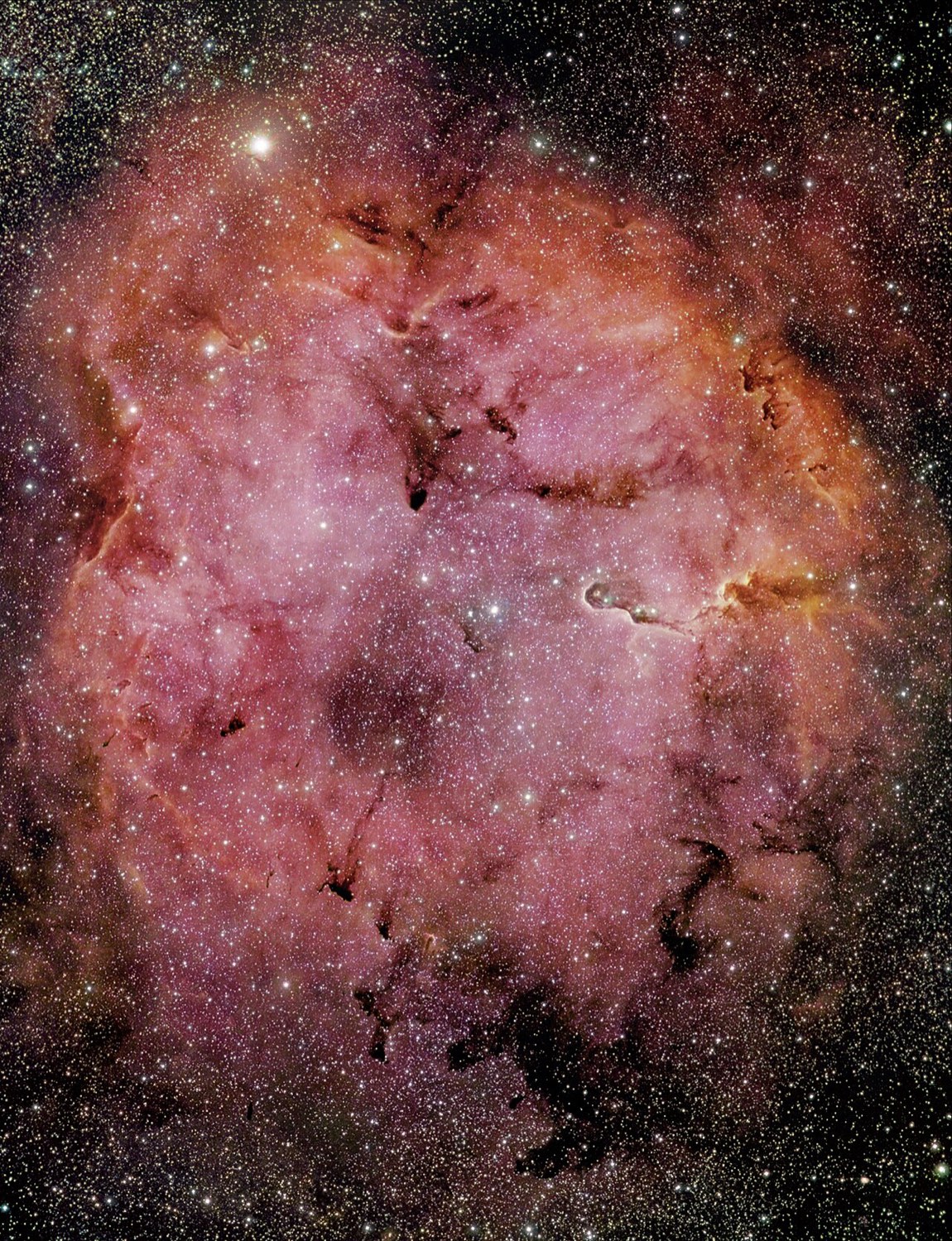
Mu Cephei is not simply orbiting the galaxy in a stately path — it is a runaway star, moving through space with a peculiar velocity of 80.7 ± 17.7 kilometers per second relative to its surroundings. That is fast enough to cross the distance between Earth and the Moon in less than five seconds. Runaway stars are thought to have been ejected from their birth clusters, either by the gravitational slingshot effect of a close encounter with another massive star or because a former binary companion exploded as a supernova, releasing the surviving star like a ball from a sling. Mu Cephei sits at the edge of the IC 1396 nebula, a massive star-forming region in Cepheus, so its origin in a dense stellar nursery is plausible. Its current mass loss rate of about 4.9 × 10⁻⁷ solar masses per year — roughly the mass of a small asteroid evaporating from the star every year — adds to the material it scatters along its path through space. Its initial mass has been estimated from stellar evolutionary models at between 15 and 25 times the mass of the Sun.
08 What Kind of Death Awaits a Star This Massive
Mu Cephei has already moved beyond the hydrogen-burning stage that defines ordinary stars like the Sun. It is now fusing helium into carbon in its core — a sign that it is well into the closing chapters of its life. The eventual endpoint, when iron accumulates in the core and resists further fusion, is a core collapse and supernova explosion that will obliterate the star and leave behind a vast cloud of enriched gas. For a star as massive as Mu Cephei, that remnant is likely to be a black hole rather than a neutron star. However, the path to that explosion is not straightforward. The most massive red supergiants do not simply blow up as red stars; they may first evolve back through hotter phases, becoming blue supergiants, luminous blue variables, or Wolf-Rayet stars. Mu Cephei appears to be massive enough for this to happen. The type of supernova that results depends on how much of its outer envelope the star sheds before collapse: a post-red-supergiant path would produce a Type IIn or Type II-b supernova, while a Wolf-Rayet endpoint would yield a Type Ib or Ic.
 ⤢
⤢
09 Observing the Garnet Star for Yourself
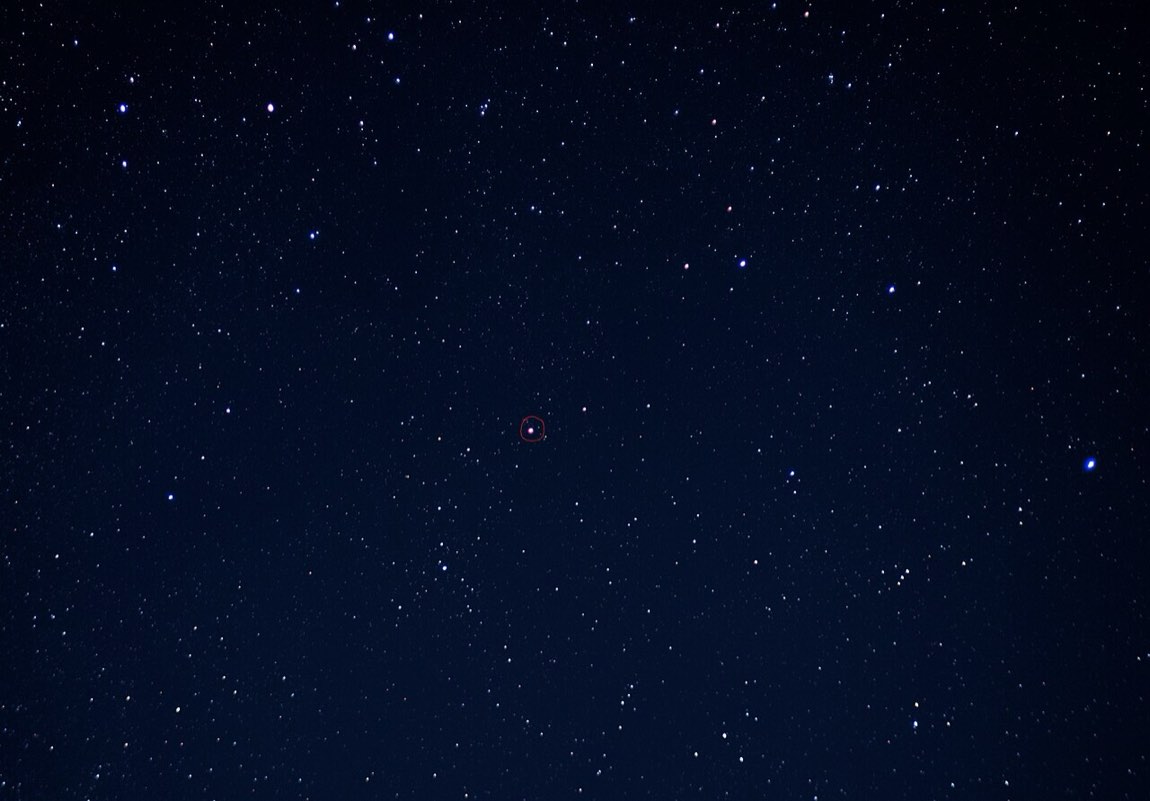
Mu Cephei is genuinely accessible to anyone willing to step outside on a clear night. It is a 4th-magnitude star, meaning it is visible to the naked eye under reasonably dark skies without any optical aid — though binoculars immediately reveal its striking deep-red color in a way the naked eye cannot fully appreciate. The star sits in the northern constellation Cepheus and lies at the edge of the IC 1396 nebula, a region of active star formation that experienced observers can detect with wide-field instruments. Because Cepheus is a circumpolar constellation for mid-to-high northern latitudes, Mu Cephei never sets below the horizon and can in principle be found on any clear night of the year. Its slow brightness variations — drifting between magnitude 3.4 and 5.1 over periods of months to years — are well within the range that amateur variable-star observers can track with simple equipment and contribute to citizen-science databases. The star's color alone has made it a popular target for astrophotographers, who prize its deep garnet hue against the fainter surrounding nebulosity.
10 Comparing Mu Cephei to Betelgeuse Deeper
Astronomers frequently use Betelgeuse as a measuring stick for Mu Cephei, and the comparison is instructive. One early distance estimate for Mu Cephei — 390 ± 140 parsecs — was derived explicitly from a size comparison with Betelgeuse, treating Betelgeuse's properties as a known reference. A 2019 study noted that when Mu Cephei's luminosity is calculated using a distance of 641 parsecs, the resulting luminosity below 140,000 solar luminosities and corresponding radius of 972 ± 228 solar radii are "all consistent with those estimated for Betelgeuse." That equivalence is striking: Betelgeuse is one of the most studied stars in the sky precisely because of its extreme size and its status as a supernova candidate, and Mu Cephei appears to be a near twin in physical terms. The key difference is distance — Betelgeuse is considerably closer and therefore far more thoroughly measured — which is exactly why Mu Cephei's properties remain so contested. Better parallax measurements from future astrometric surveys may finally settle whether these two red giants are truly matched in scale.
11 Open Questions Still Surrounding the Star Deeper
Despite centuries of observation, Mu Cephei leaves several questions genuinely unresolved. The most fundamental is distance: the spread from roughly 390 to 1,800 parsecs across different methods means that even the star's basic physical parameters — radius, luminosity, mass — cannot be stated with confidence. The precise cause of its semiregular variability is not pinned down; the two dominant periods of roughly 860 days and 4,400 days likely reflect different pulsation modes, but the interplay between them is not fully understood. The asymmetric inner structure of the surrounding ejected shell, possibly shaped like a torus, raises questions about what asymmetries exist in the star's mass-loss process and whether magnetic fields or rotation play a role. Whether Mu Cephei will explode directly as a red supergiant or first evolve through hotter phases — and therefore which supernova type it will eventually produce — depends on its true mass, which cannot be known precisely until the distance question is resolved. The star's status as a hypergiant, rather than merely a supergiant, is itself described in the literature as a description rather than a settled classification.
 ⤢
⤢