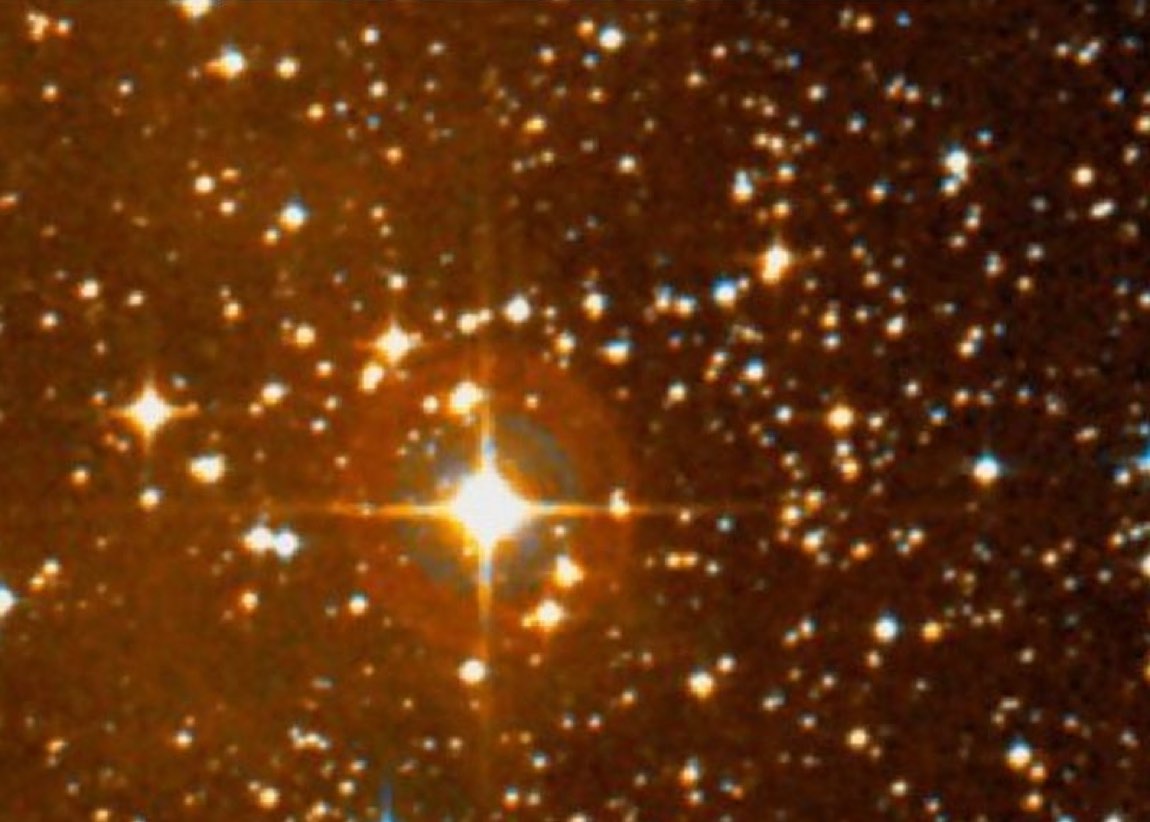
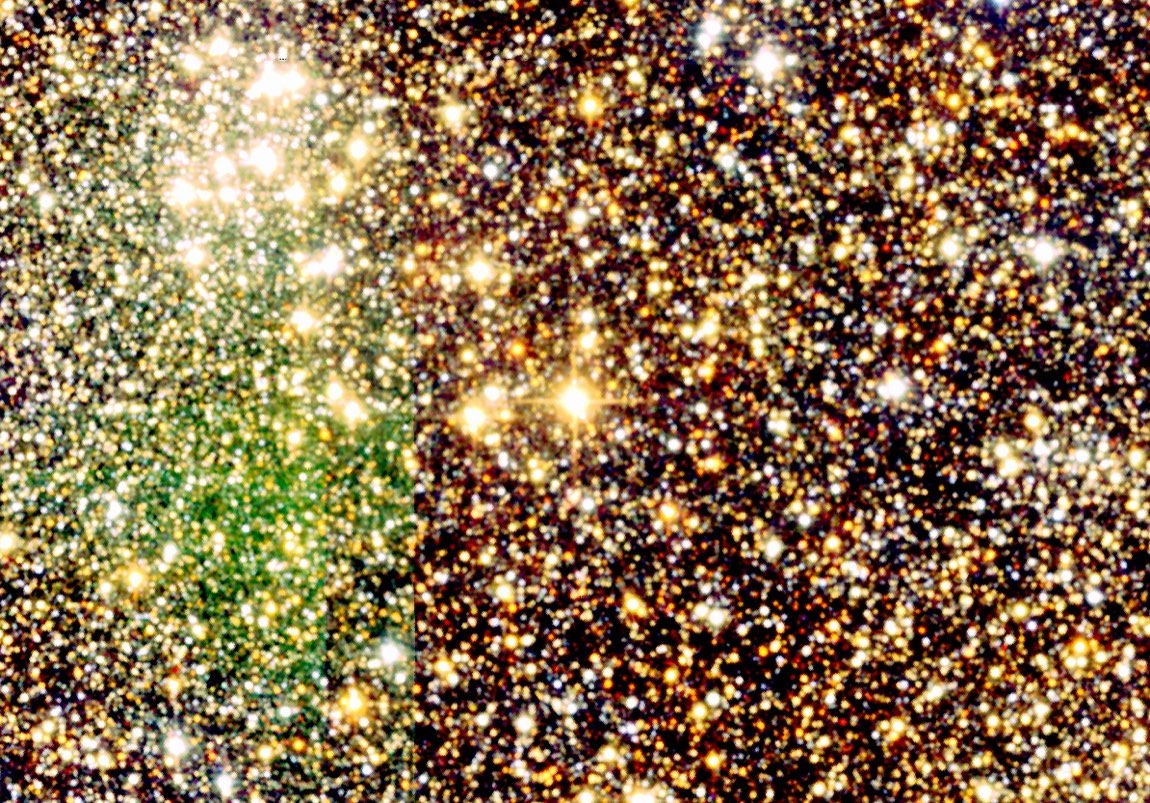
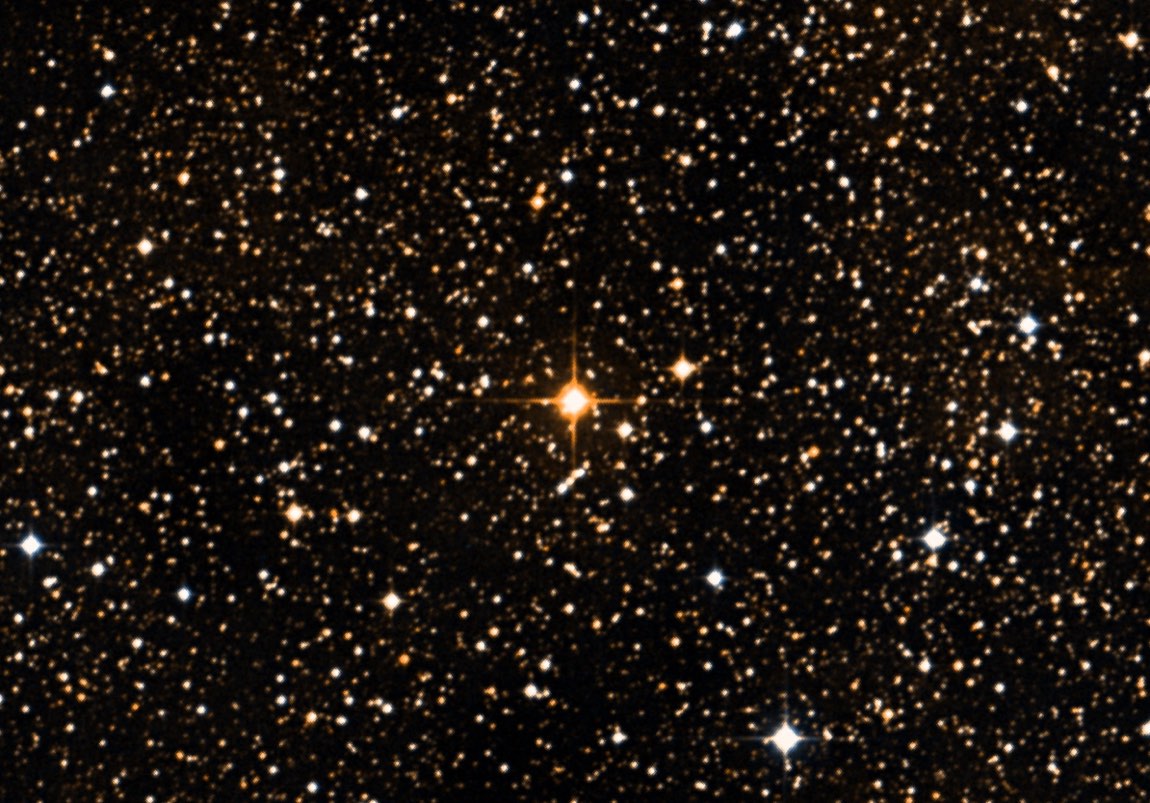
 Photograph · ESO/Digitized Sky Survey 2 · CC BY-SA 3.0
Star · Deep guide
UY Scuti
The internet's favorite 'biggest star', with honest error bars attached.
What is it?
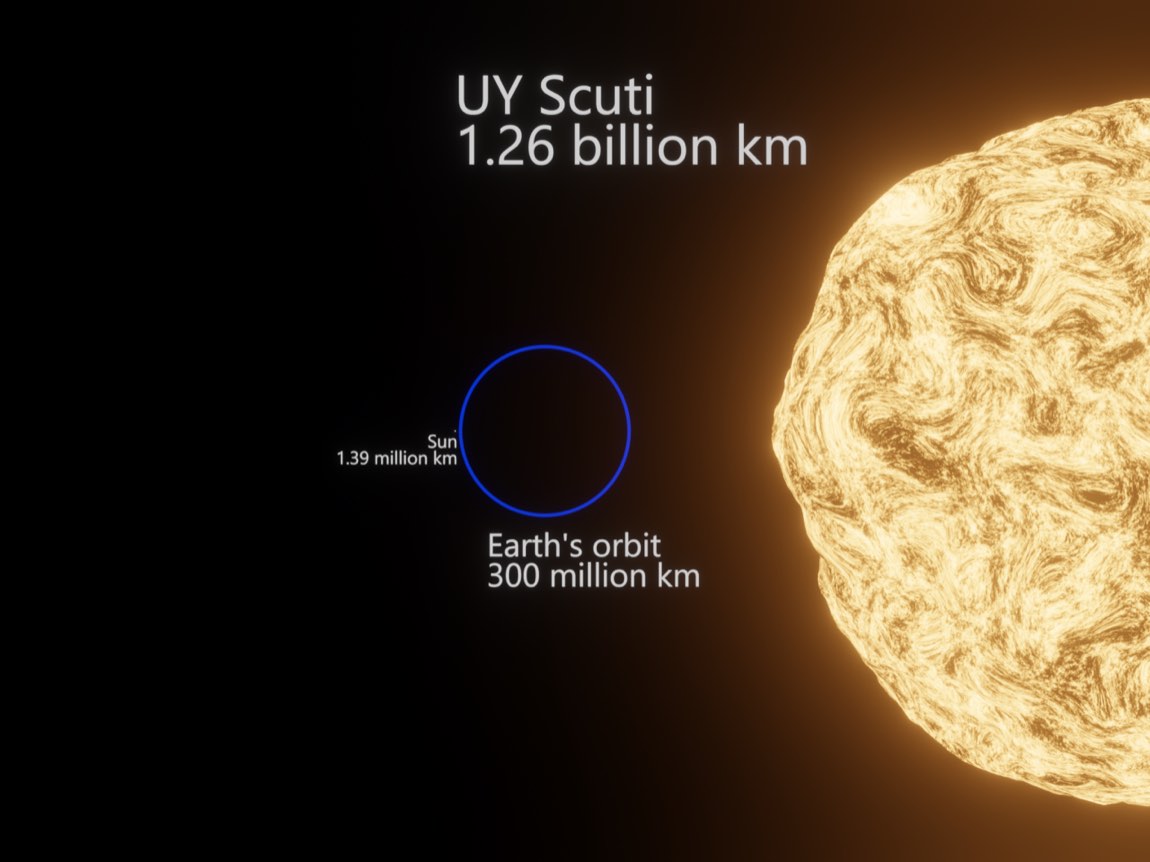
UY Scuti, a red hypergiant roughly 5,900 light-years away in Scutum, became famous as 'the largest known star' with a radius near 1,700 Suns. The honest version: hypergiant sizes carry enormous uncertainties, newer estimates shrink it substantially, and the 'largest star' title changes hands with almost every study. It remains a genuine monster — just not a certified champion.
The deep dive
Researched for the Atlas from Wikipedia — UY Scuti (5,898 characters read) · updated Sep 20, 2026
01 How UY Scuti was first discovered
UY Scuti did not announce itself dramatically — it was quietly logged by German astronomers at the Bonn Observatory in 1860 while they were sweeping the sky for the Bonner Durchmusterung Stellar Catalogue, one of the great 19th-century efforts to inventory the heavens. The star received the catalogue designation BD-12°5055, marking it as the 5,055th star counted between 12° and 13° south of the celestial equator, starting from zero hours of right ascension. Nothing extraordinary was noted at the time. It was only when the same patch of sky was revisited in a second survey that astronomers noticed the star had shifted slightly in brightness between observations — the telltale signature of a variable star. Under the international naming convention for variable stars, it was assigned the designation UY Scuti, identifying it as the 38th confirmed variable in the constellation Scutum. That humble bureaucratic label is now attached to one of the largest known stars in the Milky Way.
02 Where exactly UY Scuti sits in the sky
UY Scuti occupies a visually crowded and scientifically tricky corner of the sky in the constellation Scutum. It sits a few degrees north of Gamma Scuti, a comparatively ordinary A-type star, and lies northeast of the famous Eagle Nebula. It is also in the neighborhood of the Scutum OB3 stellar association, which stretches between 1.33 and 2.23 kiloparsecs away, though UY Scuti is not considered a member of that group. The star's location is particularly problematic for observers and astronomers alike because it falls within the Zone of Avoidance inside the Cygnus rift — a dusty lane of the Milky Way's disc that absorbs and scatters light traveling toward Earth. That obscuring dust is a major reason why, despite UY Scuti being extraordinarily luminous, it appears only as a 9th-magnitude object at its brightest from Earth, far beyond the reach of the naked eye and invisible without a telescope.
03 The mass-loss shaping its surroundings Deeper
UY Scuti is not a static object sitting quietly in space — it is actively shedding itself. The star loses mass at a rate of 5.8×10⁻⁵ solar masses per year, which sounds abstract until you consider that this steady outpouring of material has built up an extensive and complex circumstellar environment of gas and dust encasing the star. This dusty shroud is one reason astronomers describe UY Scuti as dust-enshrouded, and it complicates measurements of the star's true brightness and temperature. The outflowing material also makes UY Scuti a maser source: the gas around it produces natural microwave laser emission from water (H₂O), silicon monoxide (SiO), and hydroxyl (OH) molecules. However, those masers are noted as too weak to qualify UY Scuti as a true OH/IR supergiant — a more extreme category occupied by stars like VY Canis Majoris and IRC +10420. The circumstellar environment has drawn comparisons to another pulsating but cooler supergiant, S Persei, and the star also displays some emission lines in its spectrum, reflecting that turbulent, outflowing atmosphere.
04 Pulsations and the 740-day heartbeat
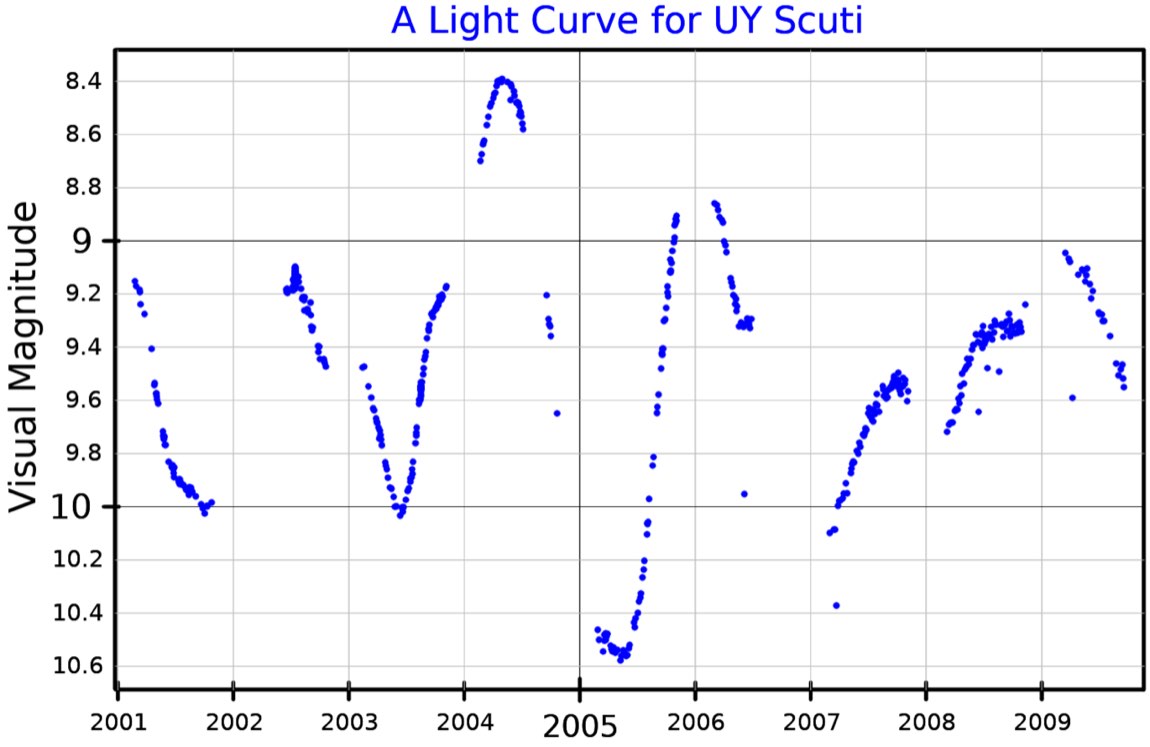
UY Scuti breathes. It is classified as a semiregular variable star, meaning its brightness rises and falls in a pattern that is roughly but not perfectly periodic. Its pulsation period is approximately 740 days — just over two Earth years — during which the star swells and contracts, causing its brightness to swing between a maximum of magnitude 8.29 and a minimum of magnitude 10.56. Astronomers debate exactly what kind of pulsation this represents. Based on the older, larger radius estimate of 1,708 solar radii, the 740-day cycle would be an overtone of the star's fundamental pulsation period rather than the primary mode. Alternatively, the same 740-day period could represent a fundamental mode corresponding to a smaller physical radius. The ambiguity reflects how tightly the interpretation of a variable star's pulsation is tied to knowing its true size — and UY Scuti's size has itself been a moving target as distance estimates have been revised over the decades.
05 The 2012 interferometry study that changed things Deeper
The measurement that propelled UY Scuti to internet fame came from a focused observing campaign in mid-2012, when astronomers used AMBER interferometry on the Very Large Telescope (VLT) in the Atacama Desert in Chile. The team targeted three red supergiants near the Galactic Center region — UY Scuti, AH Scorpii, and KW Sagittarii — and found that all three are more than 1,000 times larger than the Sun and more than 100,000 times more luminous. The stellar radii were calculated using the Rosseland radius, defined as the point where the optical depth equals 2/3. For UY Scuti specifically, the team measured an angular diameter of 5.48 ± 0.10 milliarcseconds and adopted a distance of 2.9 ± 0.317 kiloparsecs — a distance originally derived in 1970 from spectral modeling. The result was a radius of 1,708 ± 192 solar radii, a luminosity of 340,000 solar luminosities, and an effective temperature of 3,365 ± 134 K, implying an initial mass of 25 solar masses, possibly up to 40 solar masses for a non-rotating model. UY Scuti emerged from the study as the largest, most luminous, and coolest of the three.
06 Why its size is still hotly debated Deeper
The 2012 radius of 1,708 solar radii is not the settled answer — it is one point in an ongoing scientific argument. The measurement depended critically on a distance of 2.9 kiloparsecs that itself dated back to 1970 spectral modeling. When the Gaia spacecraft published its Data Release 2 parallax measurements, the implied distance shrank dramatically to approximately 1.5 kiloparsecs (about 4,900 light-years), which would reduce the radius to around 755 solar radii and the luminosity to roughly 86,300–87,100 solar luminosities. But astronomers caution that the Gaia parallax for UY Scuti may be unreliable because the star has a very high level of astrometric noise — likely caused by the dusty, variable nature of the star itself confusing the satellite's precise position measurements. A 2021 reanalysis by Bailer-Jones and colleagues, incorporating Gaia EDR3 data alongside color and apparent brightness, settled on a distance of 1,800 parsecs (5,900 light-years). A 2023 photometric study using Gaia DR3 then produced a radius of 909 solar radii and a luminosity of 124,000 solar luminosities at an effective temperature of 3,550 K. Three different answers within a decade illustrate how fragile size claims for distant, dusty, variable stars can be.
 ⤢
⤢
07 Rivals for the title of largest known star
UY Scuti is often described in popular media as definitively the largest known star, but astronomers are more careful. Even before the Gaia revisions, the scientific literature already noted that potentially larger radius estimates had been published for other supergiant stars, including VX Sagittarii, NML Cygni, MY Cephei, and Stephenson 2 DFK 1. Frequent alternative candidates put forward in the debate include VY Canis Majoris and, from well outside the Milky Way, the extragalactic star WOH G64 A, which resides in the Large Magellanic Cloud. The difficulty is that every competing candidate faces the same measurement challenges: poorly constrained distances, obscuring dust, and the choice of which physical radius definition to use. The Rosseland radius used in the 2012 UY Scuti study is one technically meaningful definition, but different groups apply different conventions, making direct comparisons imprecise. The honest scientific position is that UY Scuti is one of the largest known stars, not necessarily the largest — and that ranking may shift again with future observations.
08 Its uncertain mass and missing companion Deeper
Knowing a star's mass precisely usually requires a companion star whose orbit betrays the gravitational tug of its partner, but UY Scuti has no known companion. Without orbital dynamics to anchor a measurement, its mass is genuinely uncertain and must be estimated from theoretical stellar evolution models. On that basis, astronomers expect its current mass to lie somewhere between 7 and 10 solar masses — a range consistent with a star that has already shed a substantial portion of its original material through its strong stellar wind. The 2012 interferometry study, however, derived an initial mass — the mass the star had when it was born — of 25 solar masses, possibly reaching up to 40 solar masses for a non-rotating stellar model. The large gap between the inferred birth mass and the present-day theoretical mass is itself informative: it reflects the enormous quantity of gas UY Scuti has blown off into its circumstellar environment over its lifetime. The star's location deep within the Milky Way disc also suggests it is metal-rich, which influences the strength and character of its stellar wind.
09 Helium fusion and the path to catastrophe
UY Scuti is not in the calm, stable phase of hydrogen burning that defines a main-sequence star like the Sun. Based on current stellar evolution models, it has already begun fusing helium in its core, while hydrogen continues to burn in a surrounding shell. This layered, multi-fuel burning is characteristic of the late evolutionary stages of a massive star, and it will not end quietly. As the star continues to process progressively heavier elements, it will eventually build up an iron core. Iron is the endpoint of stellar fusion: fusing iron consumes energy rather than releasing it, so when the iron core becomes massive enough, the outward pressure of radiation can no longer counteract gravity. The core collapses catastrophically, triggering a core-collapse supernova. The path UY Scuti is expected to take before that final explosion involves first evolving to hotter temperatures, possibly passing through stages as a yellow hypergiant, a luminous blue variable, or a Wolf-Rayet star, each phase characterized by increasingly powerful stellar winds that strip away its outer layers and expose the core.
10 What kind of supernova it will likely produce Deeper
The specific type of supernova UY Scuti eventually produces depends on how much of its outer envelope survives until the moment of core collapse — and that is shaped by its entire mass-loss history. Models suggest UY Scuti is expected to explode as a Type IIb, Type IIn, or Type Ib/Ic supernova. A Type IIb explosion would indicate that most but not all of the hydrogen envelope has been stripped away before detonation. A Type IIn would imply that material ejected by the star in prior outbursts is still surrounding it, causing the supernova's shock wave to collide with that circumstellar material and produce distinctive narrow emission lines. A Type Ib or Ic supernova would mean the hydrogen envelope — or even the helium layer — was entirely removed before the collapse, leaving the bare core to explode. All three scenarios are consistent with the stellar wind activity and mass-loss already observed. Regardless of which path it takes, the strong stellar wind expected to eject the outer layers is the physical mechanism connecting UY Scuti's current dusty, pulsating state to its ultimate violent end.
11 Why the Zone of Avoidance hides it from us
One of the persistent frustrations of studying UY Scuti is that it happens to sit in one of the worst possible positions for an Earth-based observer. The star lies within what astronomers call the Zone of Avoidance, a band across the sky where the dense dust and gas of the Milky Way's disc absorbs and scatters light from objects behind it. This interstellar dust is part of the Cygnus rift, a prominent dark lane visible even to the naked eye on a clear night as a dark division within the Milky Way's glow. For UY Scuti, the practical consequence is severe: a star of its extraordinary intrinsic luminosity — hundreds of thousands of times brighter than the Sun — appears to Earth-bound observers as a faint 9th-magnitude object at its peak brightness, completely invisible without optical aid. The same dust that dims it for human eyes also distorts the infrared and optical measurements that astronomers rely on to determine its temperature, luminosity, and distance. Every physical parameter astronomers have published for UY Scuti carries the fingerprint of that obscuring veil.
 ⤢
⤢