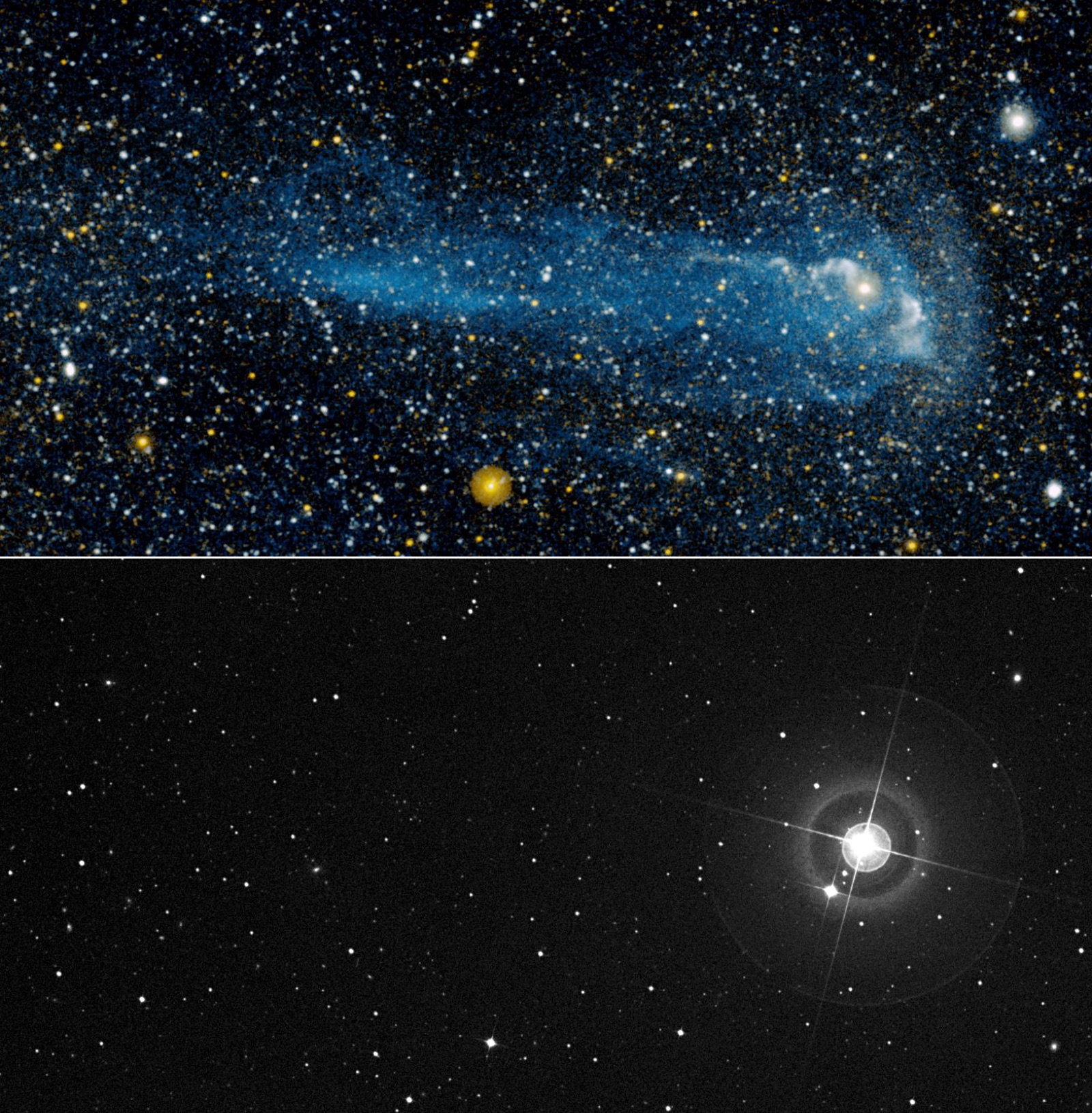
 Photograph · NASA/JPL-Caltech/POSS-II/DSS
Star · Deep guide
Mira
The first star humanity caught changing, 'The Wonderful' also trails a 13-light-year tail.
What is it?
Mira, about 300 light-years away in Cetus, stunned astronomers in 1596 by appearing, fading, and returning — the first periodic variable star ever recognized, hence its name, 'the Wonderful'. Every 332 days it swells and shrinks, swinging from easy naked-eye visibility to telescope-only. Racing through space, it sheds material into a comet-like tail 13 light-years long, discovered by the GALEX ultraviolet telescope.
The deep dive
Researched for the Atlas from Wikipedia — Mira (11,045 characters read) · updated Sep 20, 2026
01 The Name That Means Wonderful
The word Mira is Latin for 'wonderful' or 'astonishing,' and the name was bestowed by the Polish astronomer Johannes Hevelius, who described his observations in a 1662 work titled Historiola Mirae Stellae — roughly, 'A Short History of the Wonderful Star.' Hevelius chose the name because the star behaved like nothing else he knew: it blazed into naked-eye visibility, then vanished entirely, over and over. Before that name took hold, the star carried only the dry Bayer designation Omicron Ceti, meaning it was the fifteenth-brightest star in the constellation Cetus, the sea monster. In 2016, the International Astronomical Union's Working Group on Star Names formally ratified 'Mira' in its very first bulletin, cementing a name that had already been in informal use for more than three and a half centuries. The IAU process matters because it standardizes names across languages and space missions, ensuring that astronomers worldwide are unambiguously talking about the same object.
02 Who First Saw It Fade and Return
The certain discovery of Mira's variability begins on August 3, 1596, when astronomer David Fabricius needed a nearby reference star to track what he believed was the planet Mercury — later identified as Jupiter. He picked a faint third-magnitude star that had no name, and within weeks it had brightened by a full magnitude. By October it had vanished from view entirely. Fabricius concluded it was a nova, a one-time stellar explosion, but the star reappeared on February 16, 1609, proving that interpretation wrong. In 1638, Johannes Holwarda was the first to pin down a repeating period of approximately eleven months, and he is often credited as the true discoverer of Mira's variability. Shortly after, Ismail Bouillaud refined the period to 333 days — less than one day off the modern accepted value of 332 days, a remarkable feat of early measurement. Whether ancient Chinese, Babylonian, or Greek observers had noticed Mira earlier remains circumstantial, though three suggestive records from Chinese and Korean archives date to 1596, 1070, and possibly 134 BC.
03 A Star That Breathes: the Pulsation Cycle
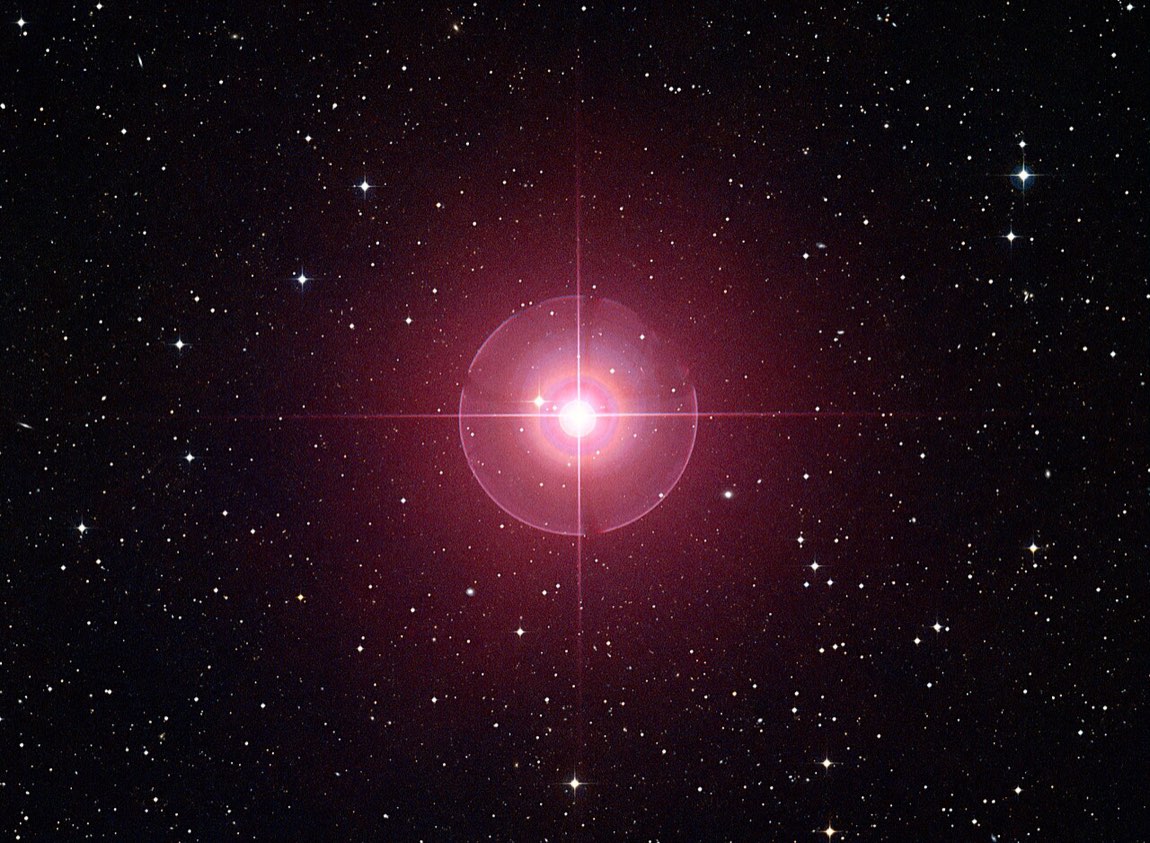
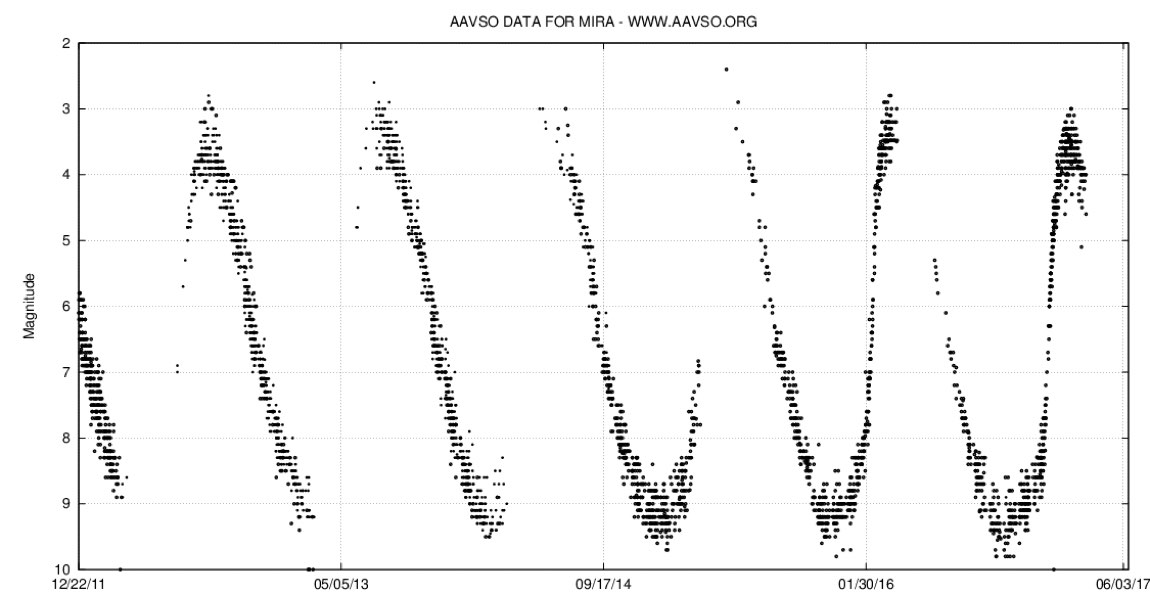
Mira A belongs to a class of pulsating variable stars — the Mira variables — that includes between 6,000 and 7,000 known members. All of them are red giants whose outer layers rhythmically swell and shrink, driving enormous swings in brightness over periods ranging from about 80 to more than 1,000 days. Mira itself averages a peak brightness around magnitude 3.5, placing it among the more conspicuous stars in Cetus, but individual cycles vary dramatically: documented maxima range from magnitude 2.0 to 4.9, a spread of almost 15 times in brightness. Minima range from 8.6 to 10.1. Taking the most extreme recorded maximum against the most extreme recorded minimum — events that did not even fall on the same cycle — the total swing in brightness is a factor of 1,700. The rise to maximum takes roughly 100 days, while the fade back to minimum takes about twice as long. Because most of Mira's energy pours out in the infrared rather than visible light, its infrared variability is a comparatively modest two magnitudes, even as it dazzles and disappears at visual wavelengths.
 ⤢
⤢
04 Size and Temperature Through the Pulse Deeper
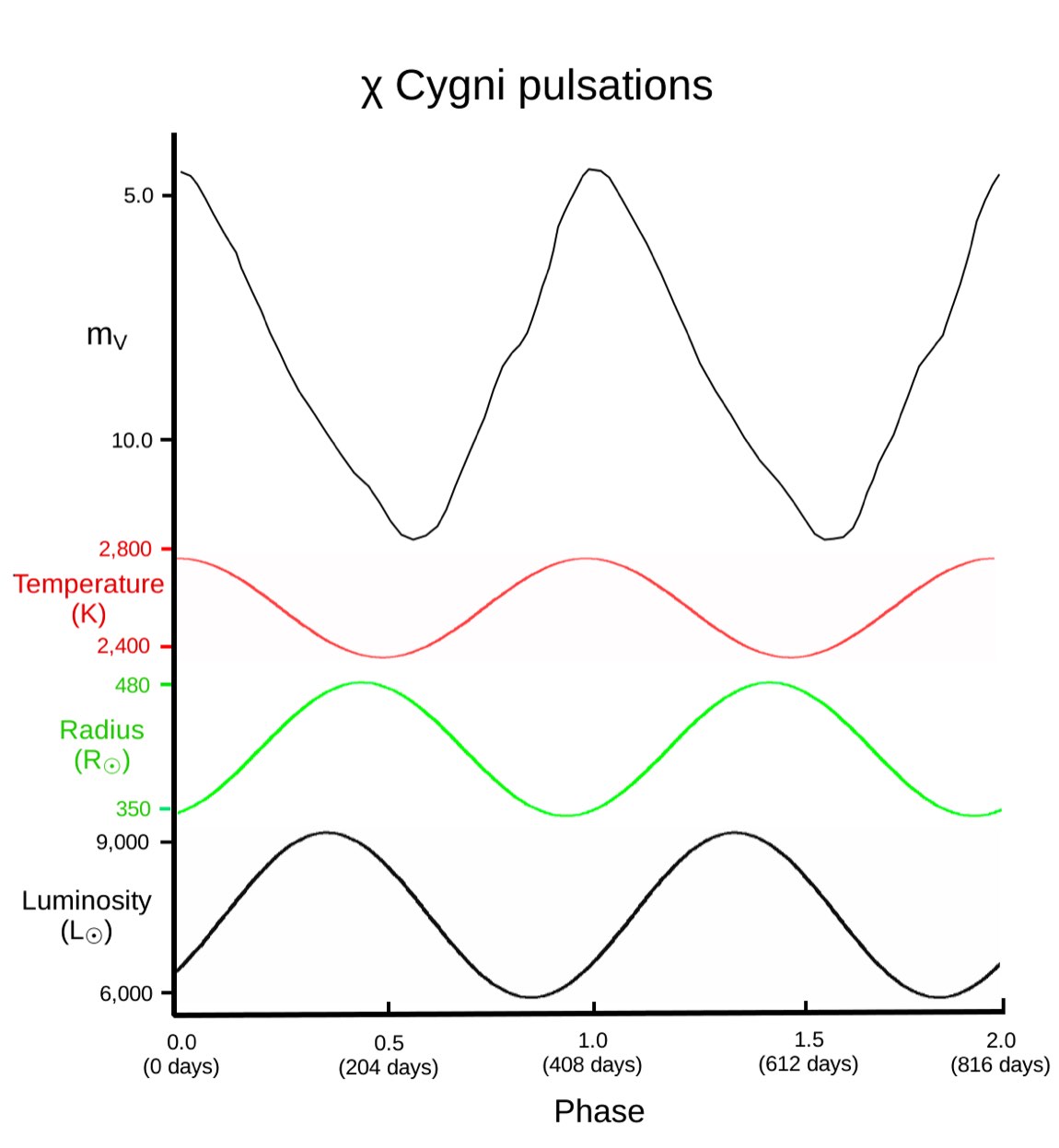
Mira A's pulsations are not just changes in brightness — they are genuine physical expansions and contractions of an enormous body. Infrared measurements by the Very Large Telescope Interferometer tracked the star's radius across multiple phases of its cycle: at phase 0.13, just after maximum light, the radius measured 332 ± 38 solar radii; by phase 0.40, approaching minimum, it had swollen to 402 ± 46 solar radii. For context, 400 solar radii placed end-to-end across the Earth's orbit would stretch nearly twice the distance from the Sun to Earth. The photosphere is smallest just before visual maximum and reaches its largest extent slightly before the coolest temperature occurs. Temperature measurements tell a complementary story: at phase 0.13 the surface runs at 3,192 ± 200 K, dropping to 2,918 ± 183 K by phase 0.26, roughly halfway to minimum. Luminosity follows, calculated at 9,360 ± 3,140 solar luminosities near maximum and 8,400 ± 2,820 near the midpoint. Crucially, pulsations inflate the photosphere by around 50% compared to what a non-pulsating twin would show; without pulsations, models suggest Mira would have a radius of only about 240 solar radii.
05 The 13-Light-Year Tail No One Knew Existed
One of Mira's most dramatic discoveries came in the ultraviolet, a wavelength invisible to the naked eye. NASA's Galaxy Evolution Explorer space telescope revealed that Mira A is shedding a comet-like tail of gas and dust stretching 13 light-years — a structure so vast it would take light itself more than thirteen years to cross from tip to tip. The tail formed over tens of thousands of years and has been actively shed over at least the past 30,000 years. The driving mechanism is a bow wave: Mira races through interstellar space at 130 kilometres per second (290,000 miles per hour), and that speed compresses the surrounding plasma into a hot shock front at the leading edge. Material stripped from this bow wave streams away behind the star. The tail is chemically rich, carrying carbon, oxygen, and other elements that can seed future star and planet formation. Scientists view Mira's tail as a rare real-time window onto how Sun-like stars die and how the raw ingredients for new planetary systems — and potentially life — are spread through the galaxy.
06 The White Dwarf Companion and Its Stolen Gas
Mira is not a single star but a binary system. Its companion, Mira B, is a white dwarf currently separated from the red giant by approximately 70 astronomical units — about twice the distance from the Sun to Neptune, multiplied by thirty-five. The two stars form what astronomers call a symbiotic system: Mira A loses mass through its stellar wind, and Mira B greedily accretes that material. Chandra X-ray Observatory observations confirmed a direct bridge of matter flowing from the red giant to the white dwarf. Hubble Space Telescope ultraviolet images, resolved in 1995 and announced in 1997, show a spiral of gas rising off Mira A in the direction of its companion. Mira B's orbital period around the primary is approximately 497.9 years. In 2007, observations further revealed a protoplanetary disc around Mira B built from accreted wind material, raising the intriguing possibility that new planets could eventually form around a white dwarf inside this aged binary. This system is the closest symbiotic pair to the Sun, making it uniquely valuable for studying mass-transfer dynamics.
 ⤢
⤢
07 Asymmetry: Mira Is Not a Perfect Sphere Deeper
Most people picture stars as perfect spheres of glowing gas, and that image is reasonable for stable main-sequence stars. Mira A, however, departs noticeably from that ideal. Observations have shown that its overall shape changes over time, displaying pronounced departures from spherical symmetry. The cause appears to be bright surface spots that evolve in shape on timescales of 3 to 14 months. These hot regions likely arise from convective cells — enormous bubbles of rising hot gas, analogous to but far larger than anything on the Sun — that push outward and distort the star's limb. Hubble Space Telescope ultraviolet observations have also detected a plume-like feature extending from Mira A toward Mira B, probably tracing outflowing gas caught in the gravitational pull of the companion. The combined asymmetry, bright spots, and plume mean that Mira's appearance shifts measurably over months, a behavior unique among well-studied variable stars. Early interferometry by Francis G. Pease at Mount Wilson Observatory in 1925 gave the star a diameter of 250 to 260 million miles (402 to 418 million kilometers, or approximately 290 to 300 solar radii), briefly making it the second-largest star known, comparable to historical estimates of Betelgeuse.
08 Thermal Pulses and Mira's Deep Interior Deeper
Mira A occupies a specific and short-lived phase of stellar evolution: the thermally pulsing asymptotic giant branch, or TP-AGB. In this stage, nuclear burning alternates between two shells — one burning hydrogen, one helium — in an unstable, recurring cycle. Each thermal pulse itself lasts a decade or more, and roughly 10,000 years separate successive pulses. With every pulse cycle, Mira's luminosity increases and the pulses grow stronger, creating growing dynamic instability. This instability is what produces the dramatic changes in both luminosity and physical size observed over shorter, irregular timescales on top of the regular pulsation period. The star is estimated to be approximately six billion years old, meaning it formed around the same time as our own Sun. Within the next few million years — a blink on cosmic timescales — Mira will shed its outer layers entirely, producing a planetary nebula, and the core that remains will cool into a white dwarf, much like its current companion. Mira's fate thus offers a preview of what will eventually happen to our own Sun.
09 How to See Mira with Your Own Eyes
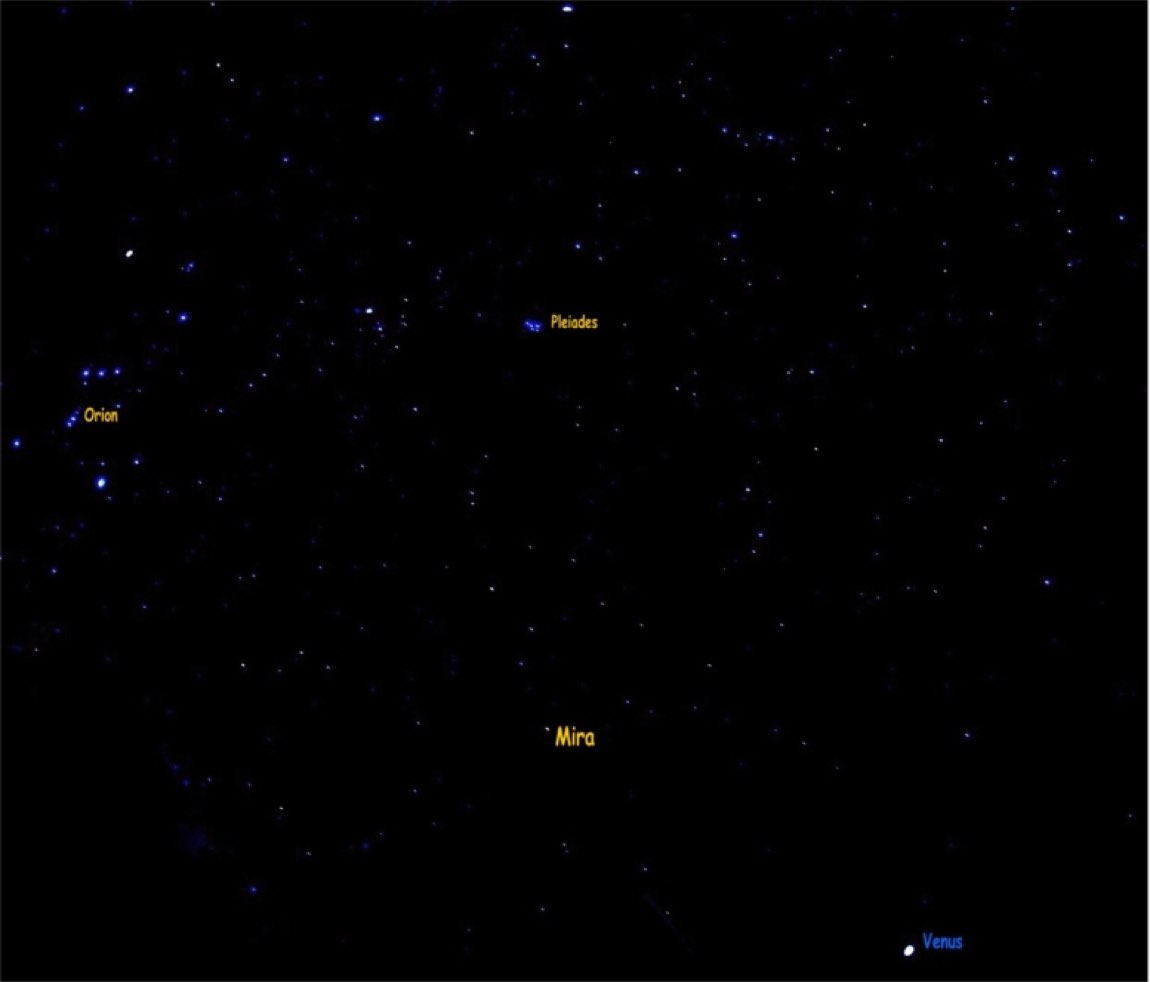
Mira is one of the few variable stars whose brightness changes are easily tracked without any equipment. Near maximum, it reaches an average visual magnitude of about 3.5, bright enough to stand out in a modest suburban sky, and exceptional maxima have hit magnitude 2.0, rivaling the brightest stars in the sky. At minimum, however, it fades between magnitude 8.6 and 10.1, well beyond naked-eye reach and requiring at least binoculars. The star lies in the constellation Cetus, the sea monster, and from northern temperate latitudes it is generally unobservable between late March and June because it sits too close to the Sun. This seasonal gap means that several consecutive years can sometimes pass without a naked-eye appearance. The deep red color of Mira at minimum — a result of its cool surface temperature of 1,600 to 2,200 degrees Celsius — pales to a lighter orange as the star brightens toward maximum. Tracking Mira over months and recording its magnitude relative to nearby comparison stars is a classic exercise for amateur variable-star observers, and historical records built in this way stretch back centuries, forming a valuable scientific dataset.
 ⤢
⤢
10 Mira's Atmosphere: Thin as a Whisper Deeper
Mira's outer layers are extraordinarily diffuse. The article's description is vivid: the gaseous material of its extended atmosphere is as much as one-thousandth as thin as the air at Earth's surface. To put that in perspective, Earth's atmosphere at sea level contains roughly 2.7 × 10¹⁹ molecules per cubic centimeter; Mira's outermost gas is so rarefied that it approaches the density of the best vacuums achievable in laboratories on Earth. Despite this near-emptiness, the sheer volume of the star means that significant mass is flowing outward all the time, eventually escaping into the interstellar medium and forming the 13-light-year tail detected by GALEX. Mira is described as being among the coolest known bright red giants, with surface temperatures ranging from 3,000 to 4,000 degrees Fahrenheit (1,600 to 2,200 degrees Celsius). These temperatures are low enough that molecules — including water, carbon monoxide, and titanium oxide — can form in the atmosphere, and it is the opacity of titanium oxide in particular that strongly affects how much visible light escapes, amplifying the visual variability far beyond what the underlying luminosity changes alone would produce.
11 An Unsettled Distance: How Far Is Mira? Deeper
Pinning down Mira's distance turned out to be harder than expected. Pre-Hipparcos estimates clustered around 220 light-years, but data from the revised 2007 reduction of the Hipparcos satellite's measurements shifted the figure to 299 light-years, with a margin of error of 11 percent — placing the true distance somewhere between roughly 265 and 333 light-years. The figure cited most often for the system is 300 light-years (92 parsecs). This uncertainty matters more than it might seem for a well-studied star, because distance errors propagate directly into estimates of luminosity, radius, and mass-loss rate. At 300 light-years, Mira is close enough to be resolved by interferometry and to have its companion separated by the Hubble Space Telescope, but far enough that early ground-based parallax measurements were unreliable. The distance also controls how remarkable the 13-light-year tail appears: at any plausible distance within the error range, the tail is an enormous fraction of a light-year long, confirming that Mira has been shedding mass prolifically for tens of thousands of years.
12 Open Questions Mira Still Has Not Answered Deeper
Despite four centuries of observation, Mira still poses genuine scientific puzzles. Its period is known to vary slightly, and the star may be slowly changing its average cycle length over time — Bouillaud's 1660s estimate of 333 days fits within the acknowledged variability, but whether there is a long-term trend remains unresolved. The nature of Mira B was itself debated as recently as 2010: a 2007 study of the protoplanetary disc around the companion suggested it might be a main-sequence star of about 0.7 solar masses and spectral type K, rather than a white dwarf, but further research in 2010 concluded it is indeed a white dwarf. How the mass-transfer bridge between the two stars evolves over the remaining lifetime of the system, and whether the protoplanetary disc around Mira B will genuinely produce new planets, remain open. The exact shape and future morphology of the eventual planetary nebula is also uncertain, complicated by Mira's high space velocity of 130 kilometres per second and the asymmetric interaction of its stellar wind with the interstellar medium. Mira's story is far from finished.
 ⤢
⤢