- Surface temperature
- 3,790 K
- Radius
- 0.18 × the Sun
- Luminosity
- 0.006 × the Sun
- Spectral type
- M2V
Star · Deep guide
Lalande 21185
The brightest red dwarf of northern skies hosts a planetary system.
What is it?
Lalande 21185, 8.3 light-years away in Ursa Major, is the closest red dwarf visible with mere binoculars and the sixth-closest stellar system. Radial-velocity work has confirmed planets around it, including a super-Earth on a warm orbit — one more datapoint that the galaxy's most common stars routinely make planets.
The deep dive
Researched for the Atlas from Wikipedia — Lalande 21185 (7,967 characters read) · updated Sep 20, 2026
01 A Catalog Entry That Stuck Around
Most stars in Jérôme Lalande's 1801 catalog Histoire céleste française have long been superseded by sleeker designations, yet Lalande 21185 is one of a tiny handful still commonly called by its Lalande number more than two centuries later. The catalog sequence numbers themselves were not part of Lalande's original publication — Francis Baily added them in the 1847 edition. So the name we use today is really a Victorian-era retrofit applied to an Enlightenment-era observation. The star also carries the designations BD+36 2147, Gliese 411, and HD 95735, which means professional astronomers have four common ways to refer to the same object depending on which catalog tradition they work in. That proliferation of names is itself a badge of scientific attention: a star gets many names only when many researchers, in many eras and contexts, have found it worth studying.
02 Argelander Spots Something Moving Fast
In May 1857, Friedrich Wilhelm Argelander noticed that Lalande 21185 was sliding across the sky at a unusually high rate — what astronomers call a large proper motion. The discovery earned the star the informal nickname "Argelander's second star," a nod to Groombridge 1830, whose high proper motion Argelander had found fifteen years earlier in 1842. The significance of a large proper motion was well understood even then: stars that appear to drift quickly relative to background stars tend to be close to us, because nearby objects show more angular displacement for the same physical velocity. That reasoning led Argelander to request a formal parallax measurement. Friedrich August Theodor Winnecke answered the call, carrying out observations between 1857 and 1858 and arriving at a parallax of 0.511 arc seconds. The result placed Lalande 21185 as the second-closest known star to the Sun at the time, behind only the Alpha Centauri system — a ranking it held until dim red dwarfs Wolf 359 and Barnard's Star were photographically discovered in the early twentieth century.
03 What Kind of Star Is This, Really?
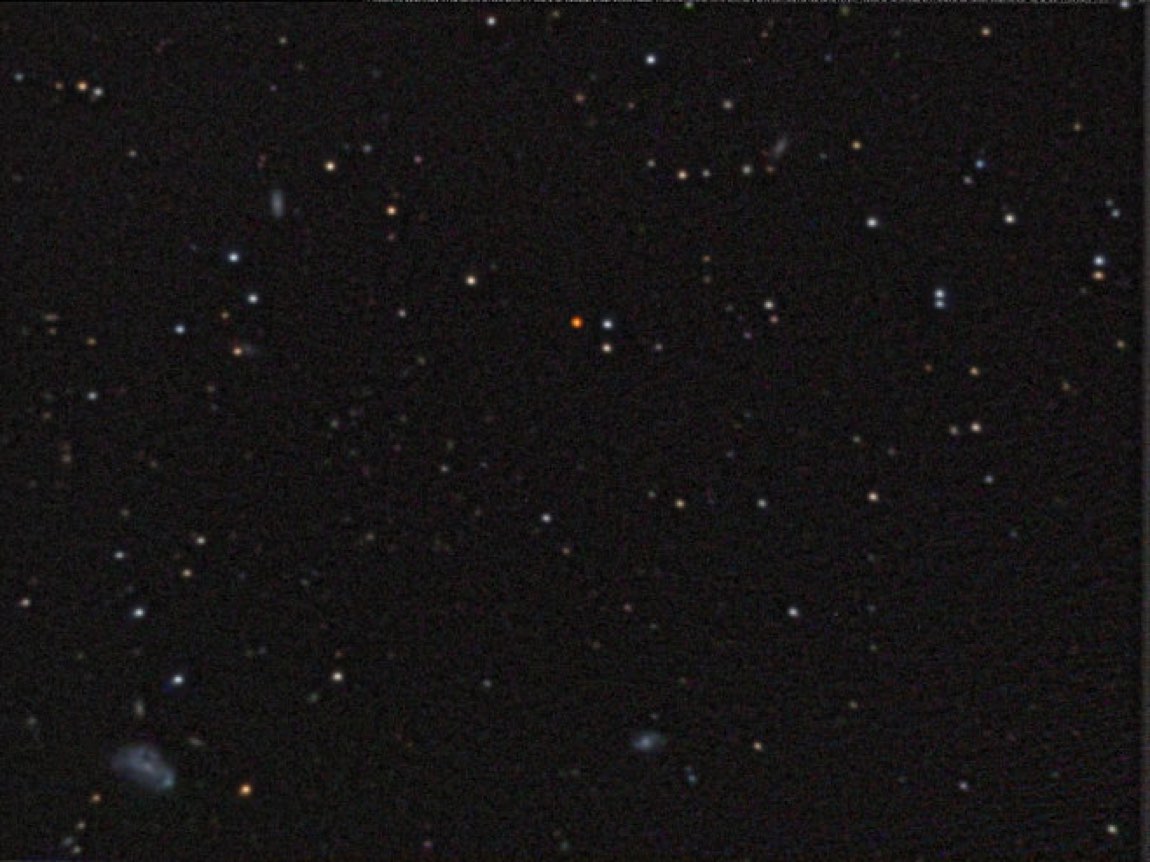
Lalande 21185 is a thoroughly typical type-M main-sequence star — a red dwarf — with about 39% of both the mass and radius of the Sun. Its surface temperature is 3,550 K, far cooler than the Sun's roughly 5,778 K, which is why it glows a deep red-orange rather than yellow-white. With only 2.2% of the Sun's luminosity, most of that energy pours out in the infrared rather than visible light, which is part of why the star reaches only apparent magnitude 7.5 — just beyond naked-eye visibility despite being one of our nearest neighbors. Its absolute magnitude is 10.48, making it intrinsically one of the faintest objects you could call a true star. The surface gravity is striking: approximately 65 times Earth's surface gravity, expressed as log g = 4.8 in cgs units. That is more than twice the Sun's own surface gravity, a consequence of packing 39% of the Sun's mass into just 39% of its radius, which produces a much denser, more compact body.
04 Iron-Poor but Not Unusual Deeper
Astronomers estimate a star's metallicity — the proportion of elements heavier than hydrogen and helium — by comparing its iron-to-hydrogen ratio with the Sun's. For Lalande 21185, the logarithm of that ratio is −0.20, which translates to an iron abundance of about 63% of the solar value (since 10 raised to the power −0.20 equals roughly 0.63). That places the star modestly below solar metallicity but well within the normal range for nearby red dwarfs. Metallicity matters for planet formation: iron-poor stars generally have less raw material for building rocky worlds, though Lalande 21185 has still managed to host at least two confirmed planets. It is worth noting that metallicity estimates for M dwarfs carry real uncertainties because their cool, complex spectra make precise abundance measurements harder than for Sun-like stars, so the −0.20 figure should be treated as a well-informed approximation rather than a precise chemical inventory.
05 Variability, Flares, and a Quieter Reality Deeper
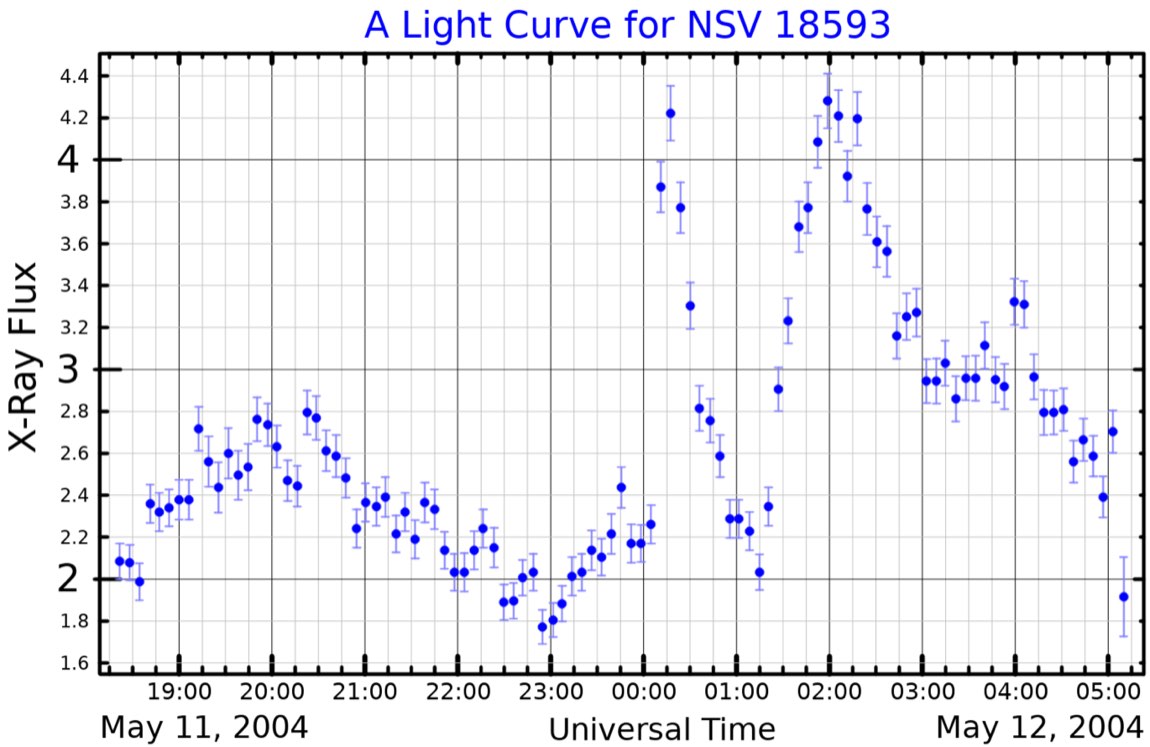
Lalande 21185 is listed in the General Catalogue of Variable Stars as a BY Draconis type variable star, carrying the designation NSV 18593. BY Draconis variables are cool stars whose brightness fluctuates because of starspots — dark, magnetically active regions rotating in and out of view, analogous to sunspots but often far more extensive. Several major catalogs, including SIMBAD, also classify the star as a flare star, which would imply sudden, violent releases of magnetic energy. However, the article notes that this flare-star classification is not supported by the primary reference those catalogs all draw on; the observations in that reference suggest Lalande 21185 is actually rather quiet compared to other BY Draconis variables. The star does emit X-rays, and X-ray flares have been observed, so it is not entirely placid — but calling it an active flare star appears to be an overclaim that has propagated through databases by inheritance rather than by independent verification.
06 A Planetary System Built From Radial Velocity
Both confirmed planets around Lalande 21185 were detected using the radial velocity method, which watches for the tiny Doppler wobble a planet induces in its host star's light. The inner planet, Gliese 411 b, was initially reported in 2017 using the HIRES spectrograph at the Keck Observatory on Mauna Kea, with a suggested orbital period of 9.8693 ± 0.0016 days and a minimum mass of at least 3.8 Earth masses. Subsequent work with the SOPHIE échelle spectrograph revised the picture considerably: the original 9.9-day signal became undetectable, and analysis of both datasets pointed instead to a period of either 12.95 or 1.08 days, with 12.95 days considered far more likely because ultra-short one-day-period planets appear to be genuinely rare. At 12.95 days the minimum mass settles to 2.99 Earth masses. The CARMENES project — the Calar Alto high-Resolution search for M dwarfs with Exoearths with Near-infrared and optical Echelle Spectrographs — confirmed this planet in 2020, cementing Lalande 21185 as the third closest confirmed planetary system to the Solar System.
07 The Outer Planet and a Candidate in Between Deeper
A second planet, much more massive than the inner one, was first hinted at in SOPHIE data but required a longer observational baseline before the signal could be trusted. Confirmation arrived in 2021: Gliese 411 c has a minimum mass initially reported as 18.0 with an asymmetric uncertainty of +2.9 and −2.6 Earth masses, a figure later revised to 14.2 ± 1.8 Earth masses. At roughly 14 to 18 Earth masses it sits in the Neptune-to-sub-Saturn range — substantially larger than any rocky planet in our own Solar System. A third body, designated Gliese 411 d, is suspected to orbit between planets b and c with a period of 215 days, though it remains a candidate rather than a confirmed planet. The habitable zone of this star falls at 0.11 to 0.24 AU from the star, and none of the known planets sits within it; planet b, the innermost, has an equilibrium temperature of 370.1 K — roughly 97 degrees Celsius — placing it firmly in the too-hot category.
08 Decades of False Starts: Ghost Planets
The planetary history of Lalande 21185 is littered with claims that did not survive scrutiny. In 1945, Dutch astronomer Peter van de Kamp suggested an unseen companion of 0.06 solar masses — about 60 Jupiter masses. By 1951 he and student Sarah Lippincott had refined this using photographic plates from Swarthmore College's Sproul Observatory 24-inch refractor into a claimed planetary system. In 1960 Lippincott revised the claim again, this time to a single planet of 0.01 solar masses (10 Jupiter masses) with an 8-year period, eccentricity of 0.3, and a semi-major axis of 0.083 AU. The credibility of all these results collapsed in 1973 and 1974 when the Sproul plates were shown to be flawed, with George Gatewood of the Allegheny Observatory providing independent astrometric measurements that contradicted them. Notably, the same flawed Sproul plates underpinned van de Kamp's famous — and ultimately erroneous — claim of planets around Barnard's Star.
09 Gatewood's 1996 Announcement and Its Aftermath Deeper
Even after the Sproul plate debacle, Lalande 21185 generated another high-profile planetary claim. In 1996, George Gatewood announced at an American Astronomical Society meeting — and to the popular press — the astrometric detection of multiple planets. His analysis of the star's positional drift over many years suggested the gravitational tug of companions that would typically appear more than 0.8 arcseconds from the star. The announcement received widespread coverage, but follow-up searches using coronagraphs and multifilter techniques designed to suppress scattered starlight found no positive identification of any such companions. Curiously, a paper by Gatewood published only a few years before his 1996 announcement also failed to identify them. His claim remains unconfirmed and is now regarded as doubtful. The episode illustrates how extraordinarily sensitive astrometric planet detection is to systematic errors: tiny calibration drifts in the instrument or the reference frame can mimic the signature of a companion.
10 Early Radial Velocity Surveys and Their Limits Deeper
Before the 1980s, measuring the radial velocity of red dwarfs was neither accurate nor consistent enough to detect planets. Recognising this, planet-hunter Geoff Marcy selected Lalande 21185 along with eleven other bright red dwarfs for a high-precision radial velocity campaign aimed at setting meaningful detection limits. No companion was found. Critically, the equipment used in those early surveys would have been sensitive enough to detect any planet exceeding 0.7 Jupiter masses in an orbit of five days or fewer, or any body exceeding 10 Jupiter masses at roughly Jupiter's orbital distance from the star. The fact that nothing showed up in those regimes set real, quantitative upper limits on what could be hiding in the system — a valuable result even though it was a non-detection. Contemporary surveys of the era confirmed this null result, gradually narrowing the space in which unknown massive companions could lurk.
11 A Closest-Approach Date Far in the Future
Lalande 21185 is not standing still relative to the Sun: its high proper motion, the very feature that first flagged it as a nearby star in the nineteenth century, means it is drawing closer. In approximately 19,900 years it will reach its closest point to the Solar System, at about 4.65 light-years (1.43 parsecs) — just over half its current distance of 8.304 light-years (2.546 parsecs). At that closest approach it will be nearer than Alpha Centauri is today. For context, 19,900 years is roughly four times the span of recorded human history, so this is not an event any civilization plausibly plans around. Nevertheless, predicting it with confidence is itself a demonstration of how well we now understand the star's three-dimensional motion through the galaxy — a precision that rests directly on the parallax tradition Argelander and Winnecke started in the 1850s.
12 How to Find It in the Night Sky
Lalande 21185 sits in the southern part of the constellation Ursa Major, the Great Bear, whose most recognizable feature is the Big Dipper asterism. Despite being the brightest red dwarf visible from the northern hemisphere, the star reaches only magnitude 7.5 in visible light — about two and a half times fainter than the generally accepted naked-eye limit of magnitude 6. That means no amount of dark adaptation or exceptionally dark skies will make it visible to the unaided eye. A small telescope or even a pair of binoculars, however, is sufficient to pick it up. Its dimness in visible light is directly tied to its nature: with only 2.2% of the Sun's luminosity and most of that energy radiated in the infrared, the star simply does not put much optical light into the sky despite its cosmic proximity. Being the brightest northern-hemisphere red dwarf is, in this context, a rather modest distinction.
13 Where It Stands Among the Sun's Neighbors
At 8.304 light-years, Lalande 21185 is the sixth-closest known star system to the Sun, by the ranking given in the article. The five systems closer are the Alpha Centauri triple system, Barnard's Star, Wolf 359, and the brown dwarfs Luhman 16 and WISE 0855−0714 — the latter two not even true stars, unable to sustain hydrogen fusion. That neighborhood context matters scientifically: nearby stars are the only ones for which current technology can attempt direct imaging searches for planets, precise astrometric wobble measurements, and detailed atmospheric characterization if a planet transits its host. Lalande 21185's combination of proximity and a known planetary system makes it an ongoing target for surveys. The fact that it hosts at least two confirmed planets establishes it as the third closest confirmed planetary system to the Solar System, after whichever systems among the closer five have confirmed planets.
 ⤢
⤢