- Surface temperature
- 12,650 K
- Radius
- 6.75 × the Sun
- Luminosity
- 1,052 × the Sun
- Spectral type
- B3Vp
Star · Deep guide
Achernar
The flattest star known, spun into a cosmic lentil.
What is it?
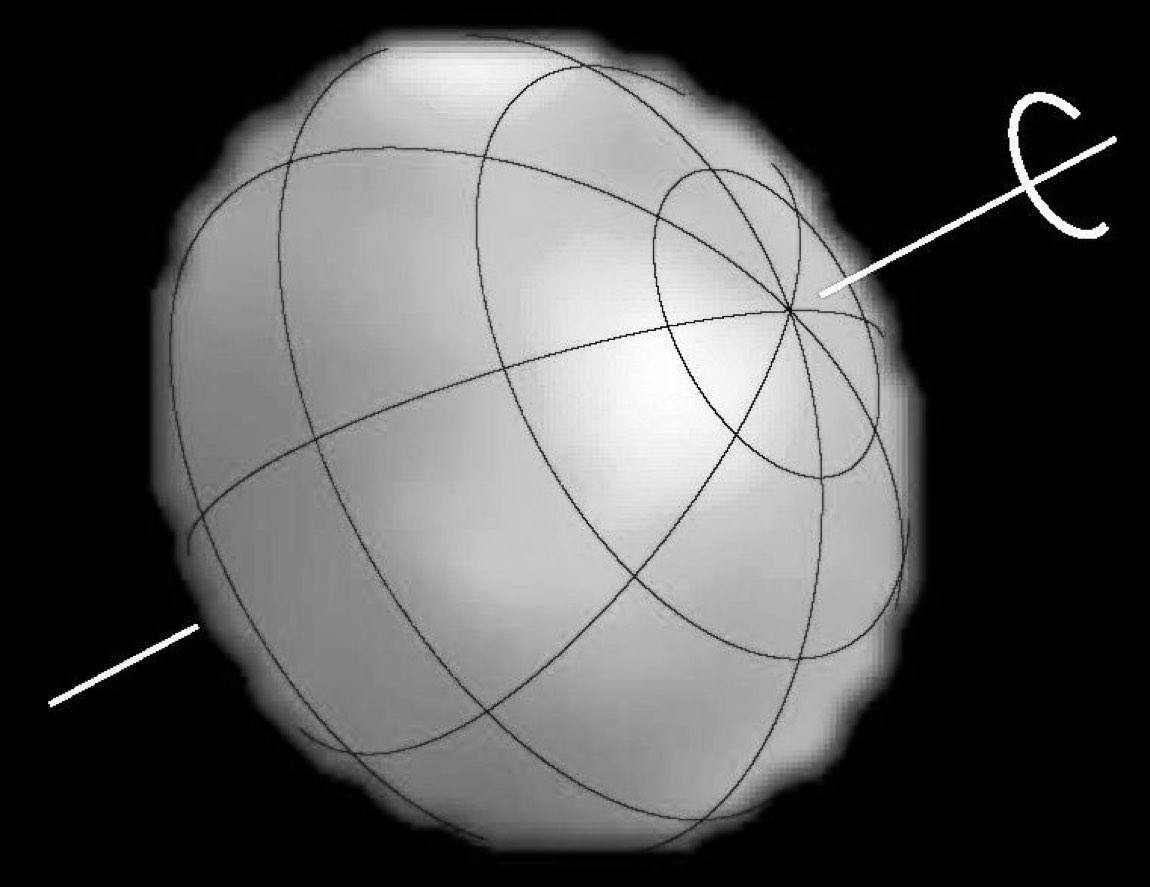
Achernar marks the End of the River Eridanus, 139 light-years away — and it is the least spherical star ever measured. Rotating near breakup speed, its equator bulges to roughly 35% wider than its poles. Interferometry revealed the squashed shape directly, along with a disk of gas flung from its racing equator.
The deep dive
Researched for the Atlas from Wikipedia — Achernar (7,168 characters read) · updated Sep 20, 2026
01 The hottest of the ten brightest stars
Among the ten brightest stars visible in the night sky by apparent magnitude, Achernar stands apart in one striking way: it is the hottest and the bluest of them all. That distinction comes from its spectral type, B6 Vep, which places it firmly in the hot blue-white category of B-type stars. Its average surface temperature runs around 15,000 K — more than twice the Sun's surface temperature of roughly 5,800 K. But that average masks a remarkable range. Because Achernar spins so fast that it bulges at the equator and flattens at the poles, the poles receive far more radiation per unit area than the equator does, driving polar temperatures up to 17,124 K while the equatorial belt cools to just 12,673 K. That difference of more than 4,400 K between top and bottom on a single star is a direct consequence of its extreme rotation, and it makes Achernar a living laboratory for understanding how spin shapes stars from the inside out.
02 A star spinning itself out of round
As of 2015, Achernar held the title of the least spherical star known in the Milky Way. Its rotation is so rapid that centrifugal force has pushed the equatorial diameter to 35% greater than the polar diameter — an extreme oblateness that astronomers compare directly to the dwarf planet Haumea, as well as to the well-studied stars Altair and Regulus. To put that distortion in everyday terms, if you scaled Achernar down to the size of a basketball, the equator would bulge out nearly an inch and a half beyond where the poles sit. The polar axis of this lopsided star is tilted about 60.6 degrees relative to our line of sight from Earth. That oblate shape is not merely a visual curiosity: because Achernar is also a binary system, the gravitational field of such a distorted primary is not a simple sphere, meaning the companion star's orbit is expected to deviate measurably from a perfect Keplerian ellipse — a detail that makes the system valuable for testing gravitational theory.
03 Polar winds and a shifting disk of gas Deeper
Achernar's extreme temperature gradient between pole and equator does more than paint the star in uneven colors — it drives vigorous mass loss. The hot polar regions generate a fast polar wind that actively ejects material from the star, building up a polar envelope of hot gas and plasma. Surrounding the star entirely is an extended envelope detectable through its excess infrared emission and through the polarization it imparts on starlight passing through it. Inside this broader envelope sits a circumstellar disk of ionized gas, a classic feature of the Be-star class to which Achernar belongs. That disk, however, is not a permanent fixture: it is unstable and periodically collapses back into the star before reforming. Astronomers tracking its polarization — a proxy for the disk's density and extent — recorded a maximum in September 2014, after which polarization began decreasing, signaling the disk was thinning or collapsing again. The disk also appears to vary in size and shape over time, adding to the picture of a star in a constant, restless state of atmospheric flux.
04 Why Achernar's brightness is never quite steady Deeper
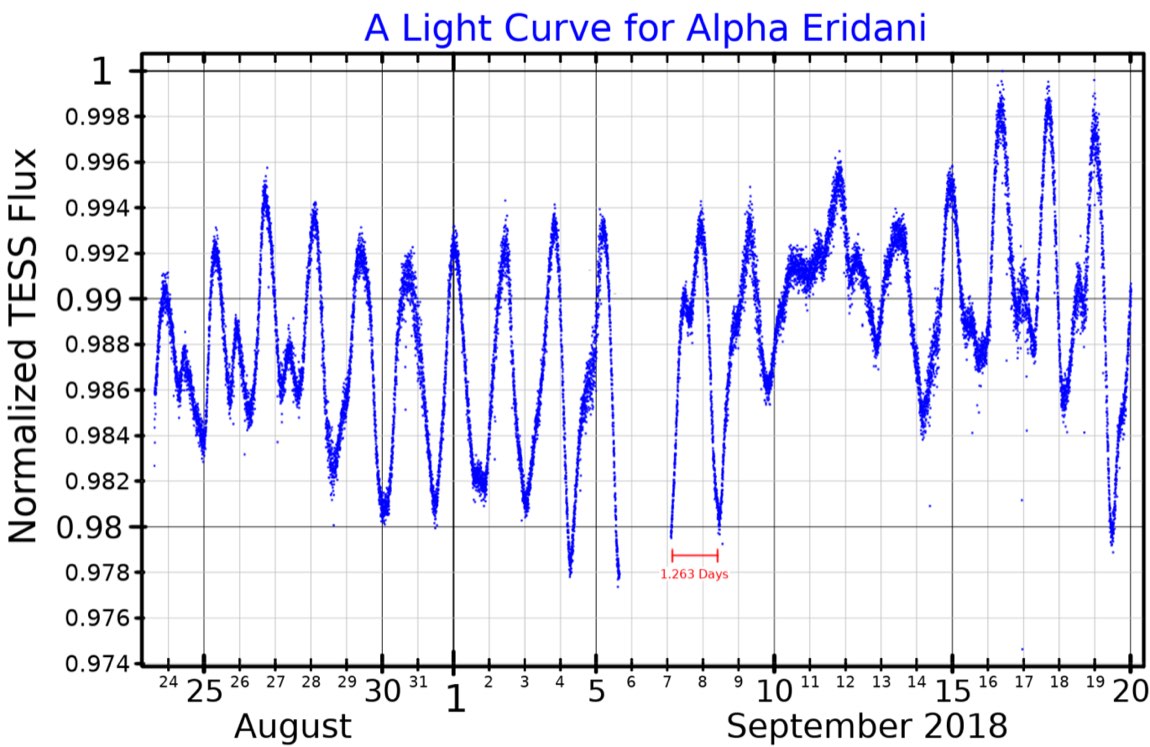
Achernar is catalogued as a variable star, but pinning down exactly how and why it varies has proven elusive. Its brightness changes by a maximum of 0.06 magnitudes, or about 6% — subtle but measurable. The General Catalogue of Variable Stars assigns it a period of 1.263 days, yet multiple periodicities have been identified, ranging from roughly 17 hours to about 35 hours. The longer periods in that range closely match the star's rotation period, though even that exact period seems to shift as the rotational velocity of the upper atmosphere changes — an indication that the atmosphere itself is not rotating as a rigid body. The shortest detected periods may simply be harmonics of the longer ones rather than independent oscillations. The variability type is listed only as a Be star, and the root causes of the brightness changes remain genuinely unknown. The star itself appears to pulsate, and the surrounding disk changes independently in size and shape, so observers are likely seeing several overlapping signals rather than one clean, explainable cycle.
05 A companion found by infrared and adaptive optics
Achernar's companion was not found by splitting the star visually with a conventional telescope — it was revealed through infrared observations using an adaptive optics system mounted on the Very Large Telescope. That technology corrects in real time for the blurring caused by Earth's atmosphere, allowing astronomers to resolve detail close to a bright star that would otherwise be washed out. The companion, designated Alpha Eridani B and informally called Achernar B, falls in the stellar classification range A0V to A3V, making it a white main-sequence star with a mass estimated at roughly twice that of the Sun. It orbits the primary at a separation of 7.35 AU — approximately the distance from the Sun to Jupiter — and completes one orbit every 7 years. Because the primary is so oblate rather than spherical, the gravitational field it presents to the companion is asymmetric, and astronomers expect the companion's orbital path to show detectable departures from the simple ellipse that a spherical star would produce.
06 A possible stellar sibling a light-year away Deeper
About half a degree north of Achernar on the sky sits a red dwarf catalogued as 2MASS J01375879−5645447. At first glance it might simply be a coincidental line-of-sight neighbor, but several independent measurements suggest otherwise. The red dwarf appears to lie at the same distance as Achernar and shares the same common proper motion — meaning both stars are drifting through the galaxy in the same direction at the same rate, as co-travelers rather than strangers passing in the night. They also appear to be roughly the same age. Their projected separation, however, is slightly over one light-year, which is large enough that the two are almost certainly not gravitationally bound to each other. Instead, researchers propose that both stars were born together as members of the Tucana-Horologium association — a loose grouping of young stars spread across that part of the southern sky — and have simply been drifting apart ever since, retaining their common motion as a shared fossil of their birth environment.
07 Hidden from the ancient world by Earth's wobble
Precession — the slow wobble of Earth's rotational axis over roughly 26,000 years — has dramatically changed which stars ancient civilizations could see. For Achernar, precession pushed it deep into the southern sky in antiquity. Around 3400 BCE it lay only 7.5 degrees from the south celestial pole, at a declination of −82° 40′, making it invisible to virtually every ancient civilization we know of. By around 1500 BCE it had migrated to declination −76°, still well beyond the reach of Egyptian astronomers. Even in 100 CE, its declination was approximately −67°, placing it permanently below the horizon for Ptolemy observing from Alexandria — though it was just visible from Syene, farther south. The consequence is remarkable: Achernar is the only first-magnitude star in the entire sky that is absent from Ptolemy's Almagest. It entered European star charts only with Johann Bayer's Uranometria, based on observations attributed to the Dutch navigator Pieter Dirkszoon Keyser during the first Dutch voyage to the East Indies.
08 Where Achernar is heading over millennia
Achernar's journey across the celestial sphere is not finished. Precession continues to carry it northward, and over the next few thousand years the star will gradually become accessible to more of humanity. Projections indicate that it will reach its maximum northern declination sometime between the 8th and 11th millennia CE — a span of several thousand years from now. At that point it will be visible as far north as Germany and southern England, latitudes where it cannot be seen at all today. Currently the star never rises above the horizon north of about 33° N latitude, roughly the latitude of Dallas, Texas. From the Southern Hemisphere it is best seen in November, and it is circumpolar — never setting — south of about 33° S, roughly the latitude of Santiago, Chile. From that latitude it barely clears one degree above the horizon at its lowest point in the sky, skimming just above the southern horizon like a bright blue ember.
09 Names across cultures and centuries
The name Achernar derives from the Arabic آخر النهر (ākhir an-nahr), meaning "The End of the River" — a fitting label for the star that marks the southern terminus of Eridanus, the celestial river. Interestingly, historians believe this Arabic name was originally applied to Theta Eridani, a different star in the same constellation, which later became known as Acamar, sharing the same etymological root. The IAU's Working Group on Star Names formally approved the spelling Achernar for the component Alpha Eridani A on 30 June 2016. In the Chinese sky system, Achernar belongs to the asterism 水委 (Shuǐ Wěi), meaning "Crooked Running Water," which includes ζ Phoenicis and η Phoenicis; Achernar itself is 水委一, the First Star of Crooked Running Water. Indigenous Australian traditions add further layers: the Boorong people of northwestern Victoria called it Yerrerdetkurrk, while the Wardaman people knew it as Gawalyan, their word for the echidna. The U.S. Navy honored the star by naming an attack cargo ship, USS Achernar (AKA-53), after it.
10 Mass, luminosity, and a star past its prime Deeper
Achernar carries a mass of roughly six to seven times that of the Sun, which places it comfortably in the regime of massive hot stars that live fast and die relatively young on cosmic timescales. Its radius has expanded to an average of eight times the Sun's radius, and it pours out energy at roughly 3,000 times the Sun's luminosity — enough that, if placed where the Sun is, it would flood the inner solar system with intense ultraviolet radiation. Its stellar classification of B6 Vep superficially resembles a typical main-sequence star, but astronomers believe Achernar has already exhausted the hydrogen fuel in its core and has begun evolving away from the main sequence. That makes it a star caught at a transitional moment — no longer burning hydrogen in its center but not yet dramatically transformed into a giant. This evolutionary status, combined with its rapid rotation and Be-star characteristics, makes it a particularly useful object for probing the physics of massive stars at a turning point in their lives.
11 How and where to observe Achernar
Finding Achernar requires being in the right place on Earth. The star never rises above the horizon north of latitude 33° N — a line running roughly through Dallas, Texas, and the Mediterranean coast of North Africa — so observers in Europe, most of the United States, and northern Asia are permanently shut out. Southern Hemisphere observers have the best access: from latitudes south of about 33° S, Achernar is circumpolar, meaning it never sets and can be found on any clear night of the year. It is brightest and highest in the sky, easiest to identify, in November. For observers near the south coast of South Africa — between Cape Town and Port Elizabeth — the star sits just one degree above the horizon at its lowest point, so patience and a clear southern horizon are needed. Despite its extreme southern position, Achernar is hard to miss once it clears the horizon: it shines as the ninth-brightest star in the night sky, a piercing blue-white point that stands out even against the rich starfields of that part of the southern Milky Way.
 ⤢
⤢