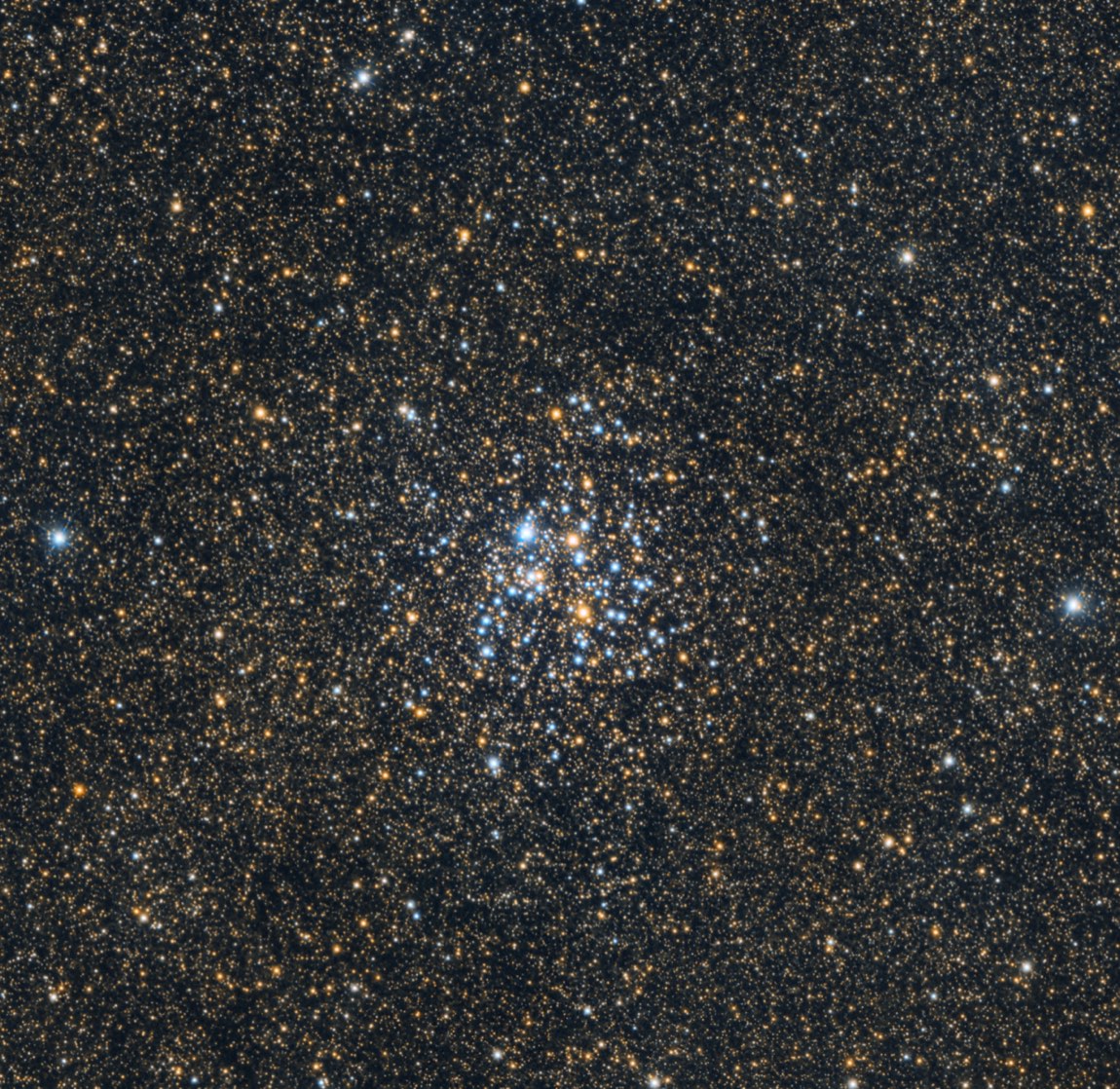
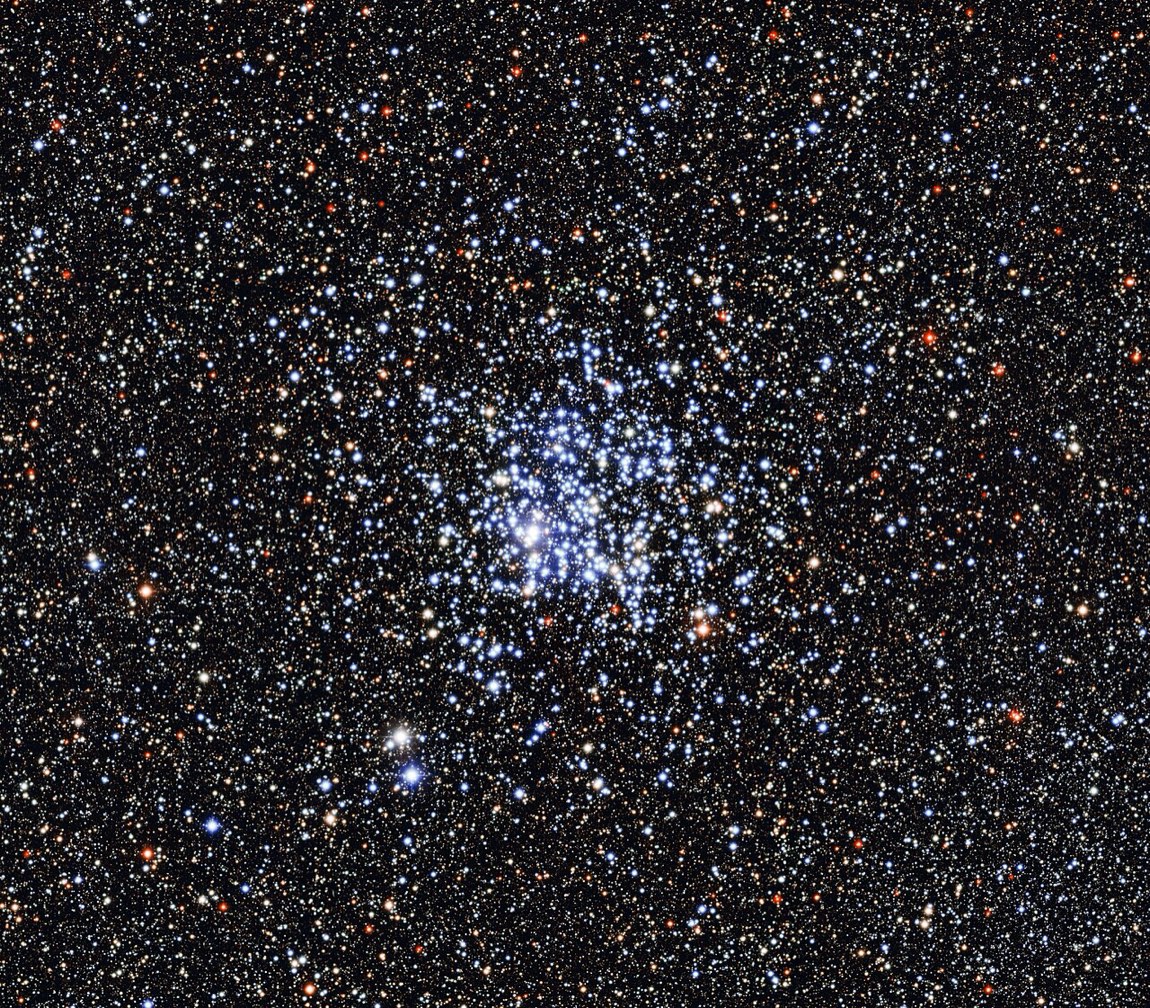
 Photograph · ESO · CC BY 4.0
Star Cluster · Deep guide
The Wild Duck Cluster (Messier 11)
Also called: M11 · Messier 11 · NGC 6705
One of the richest open clusters known, its bright stars arranged like a flock of flying ducks.
What is it?
The Wild Duck Cluster is an open cluster in the small constellation Scutum, discovered by Gottfried Kirch in 1681. Its name comes from a triangle of brighter stars that resembles ducks in flight. It is among the richest, most compact and most massive open clusters known, with about 870 members brighter than magnitude 16.5. The cluster is roughly 316 million years old and lies about 6,100 light-years away, just east of the bright Scutum Star Cloud.
The deep dive
Researched for the Atlas from Wikipedia — Wild Duck Cluster (1,646 characters read) · updated Nov 15, 2026
01 Discovered by a comet hunter in 1681
The Wild Duck Cluster was first recorded by German astronomer Gottfried Kirch in 1681, making it one of the earlier deep-sky objects to enter the European astronomical record. Kirch is better remembered today as a comet hunter, yet his careful sky surveys turned up this glittering swarm as well. The cluster sat largely as a footnote until 1764, when Charles Messier added it to his famous catalogue of diffuse objects — the same list that immortalized nebulae, galaxies, and clusters under the "M" designations still used every night at telescopes worldwide. Messier's goal was practical: he wanted to flag objects that could be mistaken for comets. The Wild Duck Cluster, appearing as a soft glow to the unaided eye and resolving into stars through a small telescope, was exactly the kind of impostor he wished to flag. Today it carries both a Messier number (M11) and an NGC number (6705), two independent cataloguing traditions that converged on the same spectacular object.
02 Why astronomers call it "rich and compact"
Open clusters vary enormously in how tightly packed and how populous they are, and the Wild Duck Cluster sits near the extreme end of both scales. It is described as one of the richest and most compact open clusters known — a distinction earned by sheer star count and density together. The cluster contains 870 confirmed members down to at least visual magnitude 16.5, while its brightest member shines at magnitude 8, just below naked-eye visibility. The core radius is only 1.23 parsecs, equivalent to about 4.0 light-years — roughly the distance from our Sun to the nearest star system, Proxima Centauri. Stars are therefore packed into that core at a density that would be astonishing by the standards of our own Sun's neighbourhood. The tidal radius, which marks the outer boundary where the galaxy's gravity begins to strip stars away, extends to 29 parsecs (95 light-years), giving the cluster a large gravitational catchment even as its heart remains extraordinarily concentrated.
03 An unusually massive open cluster Deeper
Mass estimates for the Wild Duck Cluster span a wide but impressive range: between 3,700 and 11,000 solar masses, depending on which method astronomers apply. That spread reflects genuine uncertainty — different techniques, such as counting luminous stars and extrapolating a stellar mass function versus dynamical modelling of star motions, can yield substantially different answers for the same object. Even the lower bound of 3,700 solar masses makes M11 one of the most massive open clusters in the Milky Way. For context, many familiar open clusters like the Pleiades contain only a few hundred solar masses. The cluster's integrated absolute magnitude of –6.5 reinforces this picture: negative absolute magnitudes in the range of –6 or brighter represent genuinely luminous, populous systems. The combination of high mass, compactness, and relatively young age of about 316 million years raises questions about how such a dense system has survived gravitational disruption this long, and it makes M11 a valuable laboratory for studying cluster dynamics and stellar evolution simultaneously.
04 Metal-rich stars and what that tells us Deeper
The stars of the Wild Duck Cluster are measurably metal-rich, with an iron abundance of [Fe/H] = 0.17 ± 0.04. In astronomical shorthand, this means their iron content is roughly 48 percent higher than the Sun's on a logarithmic scale — a significant enrichment. Metal-rich open clusters tend to form in the inner, chemically evolved regions of the galactic disk, where successive generations of supernovae have seeded the interstellar medium with heavy elements over billions of years. The cluster's position 6.8 kiloparsecs (22,000 light-years) from the Galactic Center and close to the galactic plane is consistent with this origin. Interestingly, M11 also shows an enhancement of alpha-process elements — oxygen, magnesium, silicon, and similar nuclei built up during massive-star burning and supernova explosions — beyond what its iron abundance alone would predict. This unusual chemical fingerprint is a clue that the molecular cloud from which the cluster was born may have been recently enriched by a nearby Type II supernova, essentially gifting the newborn stars with a fresh injection of freshly forged nuclei.
05 A supernova's chemical gift to the cluster
One of the more intriguing puzzles about the Wild Duck Cluster is a mismatch in its chemistry. At 316 million years old, it is relatively young by stellar standards, yet its alpha-element enhancement looks more like the signature left by a dramatic, rapid event rather than slow galactic chemical evolution. The leading explanation is that a Type II supernova — the violent death of a massive star — exploded near the molecular cloud that would become M11, shortly before or during the cluster's formation. Type II supernovae are prodigious factories of alpha-process elements, synthesising them in the last moments of a massive star's life and then blasting them outward at thousands of kilometres per second. If such an explosion seeded the birth cloud, the infant stars would have inherited an alpha-element-enriched composition from the start. This scenario is not unique to M11 — similar arguments are made for the solar system's own early history — but the Wild Duck Cluster provides a relatively nearby and well-studied case where the chemical evidence is unusually clear.
06 Variable stars hidden in the swarm Deeper
Even within a dense cluster, careful photometric monitoring can track the brightness changes of individual stars over time. At least nine variable star members of the Wild Duck Cluster have been identified with high probability, with a further 29 candidates considered lower-probability members. Among the high-confidence variables, the cluster contains at least two eclipsing binary star systems — pairs of stars whose orbital plane happens to be aligned with our line of sight, so that each star periodically passes in front of the other and dims the combined light we observe. Eclipsing binaries are scientifically valuable because, combined with spectroscopic observations, they can yield precise measurements of stellar masses and radii. In a cluster of known age and chemical composition like M11, they serve as powerful calibration tools for stellar evolution models. The total tally of variable stars in M11 may yet grow as deeper, more systematic surveys are applied to this densely populated field.
07 Its position in the galaxy's architecture
The Wild Duck Cluster sits 6.8 kiloparsecs — about 22,000 light-years — from the Galactic Center, placing it well inside the main disk of the Milky Way. It lies close to the galactic plane, the flattened midplane where gas, dust, and young star-forming regions concentrate. This location carries consequences: interstellar dust along the line of sight dims and reddens the cluster's light, a quantity astronomers express as visual extinction. M11's visual extinction is 1.3 magnitudes, meaning it appears roughly three times fainter than it would in a dust-free sky. The cluster is also described as not far from its birthplace — suggesting that in its 316 million years of existence it has not migrated dramatically from where it formed. Open clusters in the disk are subject to gravitational disturbances from giant molecular clouds and spiral arm passages, so long-term survival near the birth site hints that M11 has experienced a relatively undisturbed dynamical history, or that its high mass has helped it resist dispersal.
08 How the "wild ducks" got their name
The popular name Wild Duck Cluster has nothing to do with any duck-shaped nebulosity or historical myth — it is purely a visual impression created by the arrangement of the cluster's brighter stars. Those stars form a triangular pattern that some observers have likened to a flock of ducks in flight, wings angled as they cut across the sky. The analogy depends on the viewing angle and the observer's imagination, since from other orientations the same stars might suggest a single swimming duck rather than a flock. This kind of informal naming is common in amateur astronomy, where distinctive patterns within clusters or nebulae get attached to vivid mental images as an aid to recognition and memory. The official designations — Messier 11 and NGC 6705 — are strictly positional and sequential, carrying no imagery at all. Yet it is the duck analogy that has stuck in popular astronomy writing for generations, ensuring that this otherwise catalogue-numbered cluster has a memorable identity in the public imagination.
09 Finding M11 in Scutum's star cloud
The Wild Duck Cluster resides in the small southern constellation Scutum, the Shield, which despite its modest size contains one of the richest star fields visible from Earth: the Scutum Star Cloud. M11 is located just to the east of the midpoint of this star cloud, meaning observers who sweep that region of the Milky Way will encounter a spectacularly dense backdrop even before they home in on the cluster itself. Scutum is best placed for northern-hemisphere observers during summer evenings, when it rides relatively high in the southern sky. Under dark skies, the Scutum Star Cloud is visible to the unaided eye as a bright condensation in the Milky Way band, and M11 appears as a slightly brighter knot within it. Through binoculars the cluster begins to resolve at its edges, and a small telescope reveals the dense, sparkling core that has made it a showpiece object for generations of amateur astronomers. Its apparent magnitude and position make it one of the most rewarding open clusters in the summer sky.
10 Why M11 has been so extensively studied Deeper
The Wild Duck Cluster's combination of properties has made it a recurring target in stellar astrophysics research. Its richness — nearly 900 confirmed members — provides large statistical samples for studying stellar populations at a single, well-defined age and chemical composition. Its compactness means that even modest fields of view capture a large fraction of the cluster membership. Its metal-rich, alpha-enhanced chemistry sits outside the mainstream of open cluster compositions, making it a useful test case for galactic chemical evolution models. Its mass, sitting at the high end of the open cluster distribution, raises questions about formation efficiency in molecular clouds and about the timescales over which such systems eventually dissolve into the field star population. The presence of multiple variable stars and eclipsing binaries adds further layers of information accessible to photometric monitoring programs. Together these attributes explain why M11 is described in the literature as having been extensively studied — it rewards investigation at multiple wavelengths and with multiple methods, consistently returning new information about stellar and galactic physics.
 ⤢