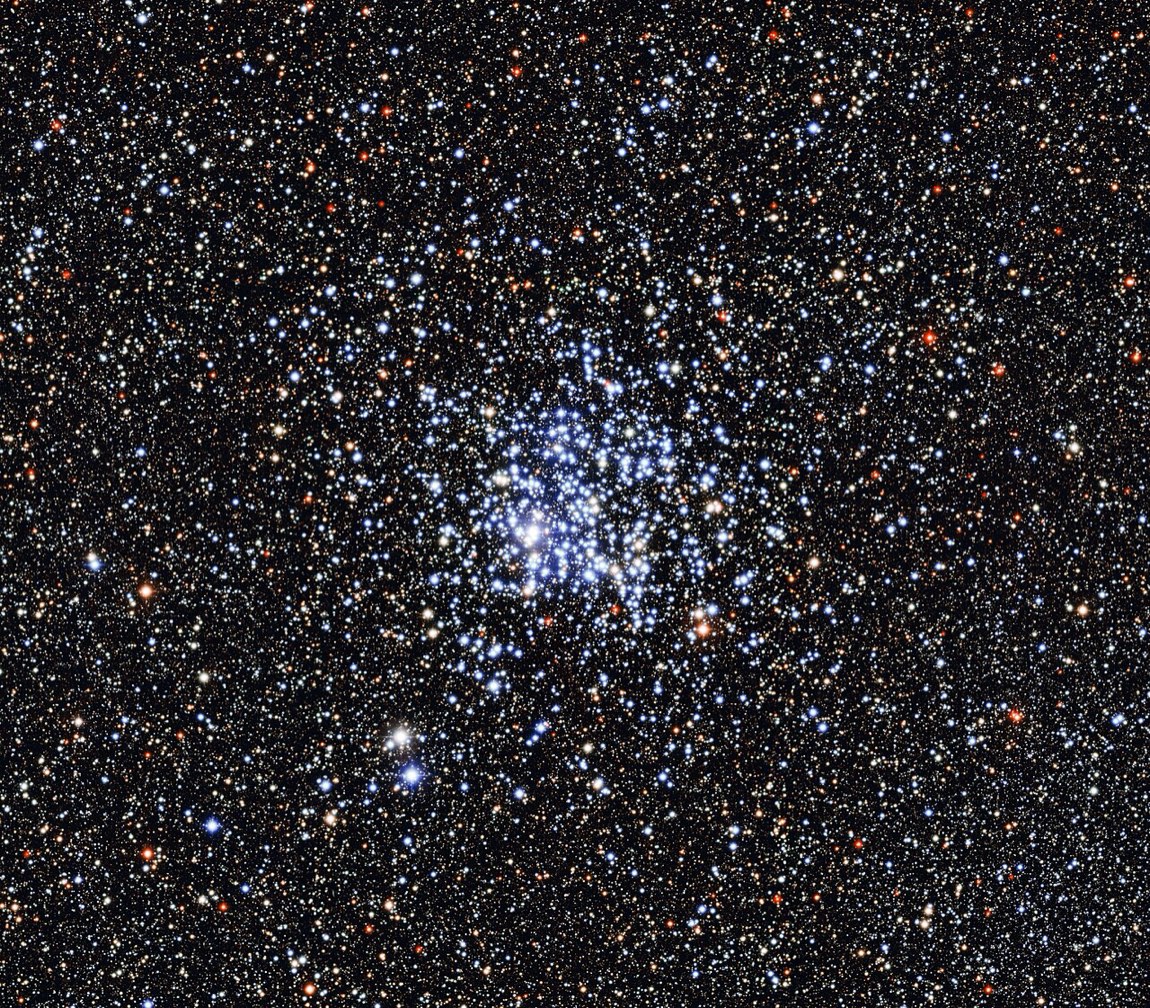
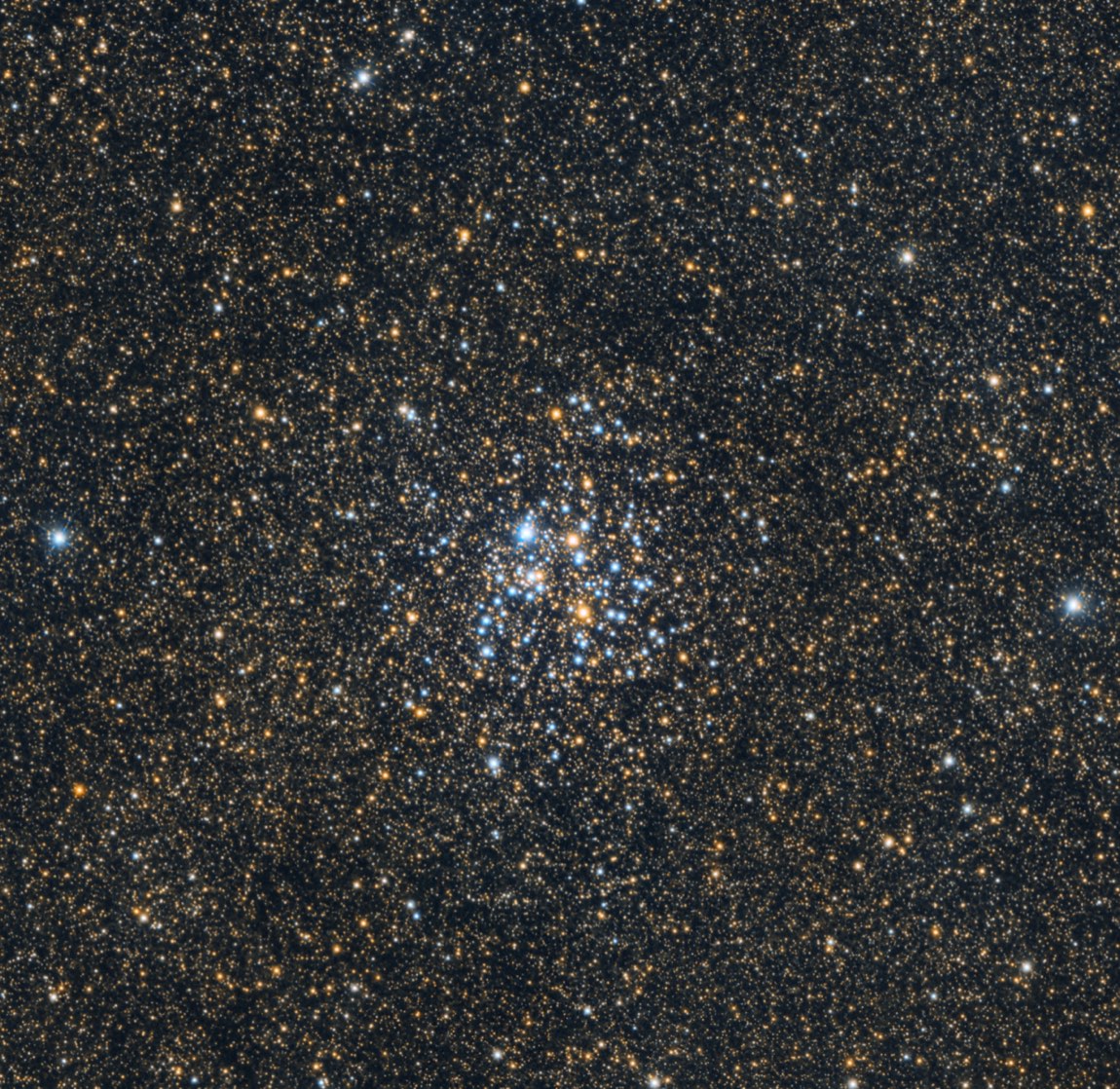
 Photograph · Chuck Ayoub · CC0
Star Cluster · Deep guide
Messier 26
Also called: M26 · NGC 6694
A faint cluster in Scutum with a puzzling empty patch near its centre.
What is it?
Messier 26 is an open cluster in Scutum, discovered by Charles Messier in 1764. At 8th magnitude it is a challenge for binoculars, and a telescope shows around 25 stars. It lies about 5,160 light-years away, spans about 22 light-years and is roughly 85 million years old. Its most curious feature is a region of low star density near the centre. One idea was a foreground dust cloud, but that was later argued to be impossible, and as of 2015 there was no clear explanation.
The deep dive
Researched for the Atlas from Wikipedia — Messier 26 (1,235 characters read) · updated Nov 15, 2026
01 Discovered by the man who wanted to ignore it
Charles Messier catalogued M26 in 1764, but his motivation was famously backwards: he was a comet hunter, and his famous list existed primarily so that fuzzy, comet-like objects would not fool him or his colleagues into false discoveries. M26 was one of those distractions worth cataloguing and setting aside. Despite that dismissive origin, the cluster earned a permanent place in one of astronomy's most beloved reference lists. It sits in the small but rich southern constellation of Scutum, a patch of sky dense with star fields along the plane of the Milky Way. Scutum's crowded background makes pinpointing M26 genuinely tricky, even though the cluster itself shines at 8th magnitude — just beyond the threshold of naked-eye visibility under good conditions.
02 A sparse but real gap at the heart of the cluster Deeper
The most scientifically intriguing feature of M26 is a region of noticeably lower star density near its nucleus — essentially a thinning of stars right where you would expect the greatest concentration. The first instinct was to blame the view rather than the cluster itself: perhaps an obscuring cloud of interstellar dust and gas sat between Earth and M26, blocking out background and member stars alike and creating a false impression of emptiness. That hypothesis was tested and rejected. Astronomer James Cuffey published a paper arguing that an intervening cloud cannot account for what is observed, and that the region really is a genuine shell of low stellar space density within the cluster. The gap is a structural reality, not an optical illusion. As of 2015, Michael Merrifield of the University of Nottingham stated publicly that no clear explanation for the phenomenon yet exists, leaving the central void of M26 an open and active puzzle in stellar cluster research.
03 How big M26 really is in space
Spread across 14 arcminutes of sky — roughly half the apparent diameter of the full Moon — M26 translates to a physical span of 22 light-years from edge to edge. To put that in perspective, the distance from our Sun to its nearest stellar neighbor, Proxima Centauri, is about 4.2 light-years, so M26's diameter equals roughly five such journeys laid end to end. Beyond the visible boundary, the cluster's gravitational reach extends even further: its tidal radius, the zone within which the cluster's own gravity can hold onto stars against the pulling force of the Milky Way's overall gravitational field, stretches to 25 light-years. Stars wandering beyond that boundary are gradually stripped away by the galaxy itself over millions of years.
04 An 85-million-year-old stellar family
The calculated age of M26 is 85.3 million years — young by cosmic standards, but old enough to place its formation back in the Cretaceous period on Earth, when non-avian dinosaurs were still tens of millions of years from extinction. Open clusters like M26 are born in a single burst from the same giant molecular cloud, meaning all its member stars share roughly the same birthday, chemical makeup, and starting conditions. That shared origin is precisely what makes clusters scientifically valuable: astronomers can study stars of different masses that formed together, using them to test models of stellar evolution without the complicating variable of different ages. At 85.3 million years, M26 is old enough to have shed its most massive, short-lived stars yet young enough that many moderately massive members are still on or near the main sequence.
05 The brightest stars and what a telescope reveals
The most luminous individual star visible in M26 shines at magnitude 11 — far too faint to see with the naked eye but reachable with a modest telescope. Through an eyepiece fitted to a 150–200 mm (6–8 inch) aperture instrument, observers can resolve around 25 individual cluster members. That aperture range covers many mid-sized amateur telescopes, the kind commonly owned by serious backyard observers. Smaller instruments, including standard binoculars, struggle considerably: the article notes that even an 8th-magnitude cluster presents a genuine challenge in ideal skies with typical binoculars, and a minimum aperture of 3 inches (76 mm) is suggested for any meaningful view. The cluster's location in star-rich Scutum adds to the difficulty, since bright Milky Way background stars compete for the eye's attention.
06 Finding M26 in the sky: a star-hopping guide
M26 lives in Scutum, one of the smallest constellations but one of the most rewarding for deep-sky observers because it straddles a brilliant stretch of the Milky Way. The most reliable landmark nearby is Messier 11, the famous Wild Duck Cluster, which is a considerably easier target. M26 sits south-southwest of M11, giving observers a natural two-step approach: locate the brighter, more conspicuous M11 first, then nudge the telescope a short distance in that direction to sweep up M26. The cluster spans 14 arcminutes, so a moderate field of view will comfortably frame it. Clear, dark skies well away from city light pollution are important, since the 8th-magnitude glow of the cluster competes with the dense stellar background of the inner galaxy rather than standing out against a truly dark field.
07 A hidden binary inside the cluster Deeper
Buried within M26's membership is at least one confirmed spectroscopic binary system — a pair of stars orbiting each other so closely that no telescope can separate them visually. Their dual nature is revealed only through spectroscopy, the technique of splitting starlight into its component wavelengths. As the two stars orbit their common center of mass, one periodically moves toward Earth and one away; this motion stretches and compresses the wavelengths of their light in a measurable, rhythmic pattern known as a Doppler shift. Detecting even a single spectroscopic binary inside a cluster of this size is scientifically useful, because binary stars provide some of the most direct measurements of stellar mass available to astronomers. The article notes one known such system in M26, though deeper spectroscopic surveys could potentially reveal more.
08 What tidal radius tells us about the cluster's fate Deeper
The distinction between M26's linear diameter of 22 light-years and its tidal radius of 25 light-years carries real physical meaning. The tidal radius marks the gravitational boundary beyond which the Milky Way's tidal forces overcome the cluster's own self-gravity. Any star that drifts or gets nudged past that 25-light-year limit will slowly be captured by the broader galactic gravitational field and drift away permanently, joining the general stellar population of the galaxy. Over tens or hundreds of millions of years, this process — called tidal stripping — erodes open clusters, and most eventually dissolve entirely into the galaxy. At 85.3 million years old, M26 has already been subject to this erosion for a substantial time, though it retains enough members to remain a recognizable cluster today.
09 Why open clusters eventually disappear
M26 belongs to the class of object known as an open cluster, which distinguishes it from the denser, far older globular clusters that orbit the outer halo of the Milky Way. Open clusters form along the galactic disk, in the same spiral arms where gas and dust are plentiful enough to birth new stars. Because they form in this busy, gravitationally complex environment, they are perpetually tugged at by passing giant molecular clouds, density waves in the spiral arms, and the overall tidal pull of the galaxy. Globular clusters survive billions of years because their huge numbers of stars — sometimes hundreds of thousands — generate enough collective gravity to resist disruption. Open clusters like M26, with far fewer members, are loosely bound and gradually come apart. M26, at 85.3 million years, is a relatively young example still in its bound phase.
10 M26 and NGC 6694: the same object, two names
M26 carries a second official designation, NGC 6694, from the New General Catalogue compiled by J.L.E. Dreyer in 1888 using observations gathered by William and John Herschel and others. It is common for deep-sky objects to appear in multiple historical catalogues under different identifiers, since 18th and 19th century astronomers often worked independently and re-discovered objects already listed elsewhere. Messier's catalogue number takes cultural priority for most enthusiasts because of its historical fame and because Messier objects form a popular observing checklist for amateur astronomers. The NGC designation, however, is the one more typically used in professional research databases and journal papers, where the broader NGC provides a systematic framework covering far more objects than Messier's 110-entry list.
 ⤢