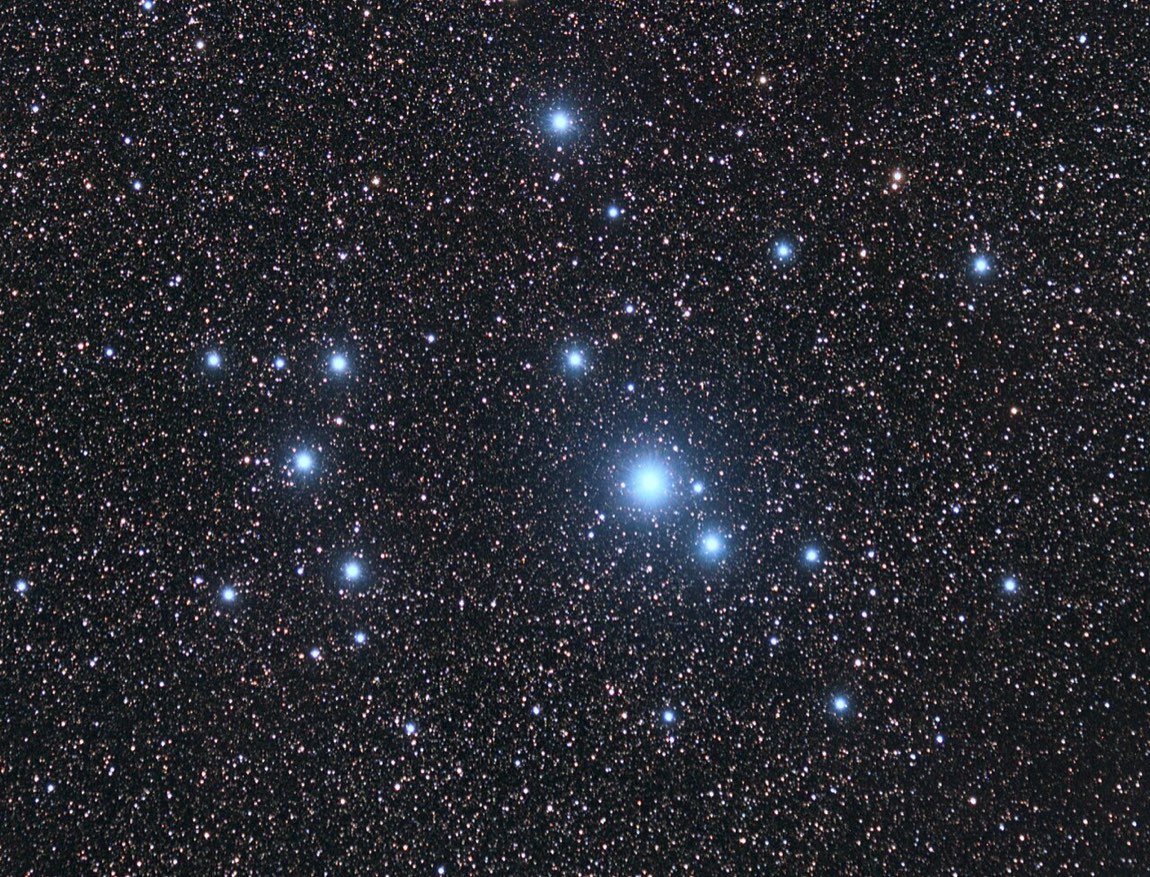
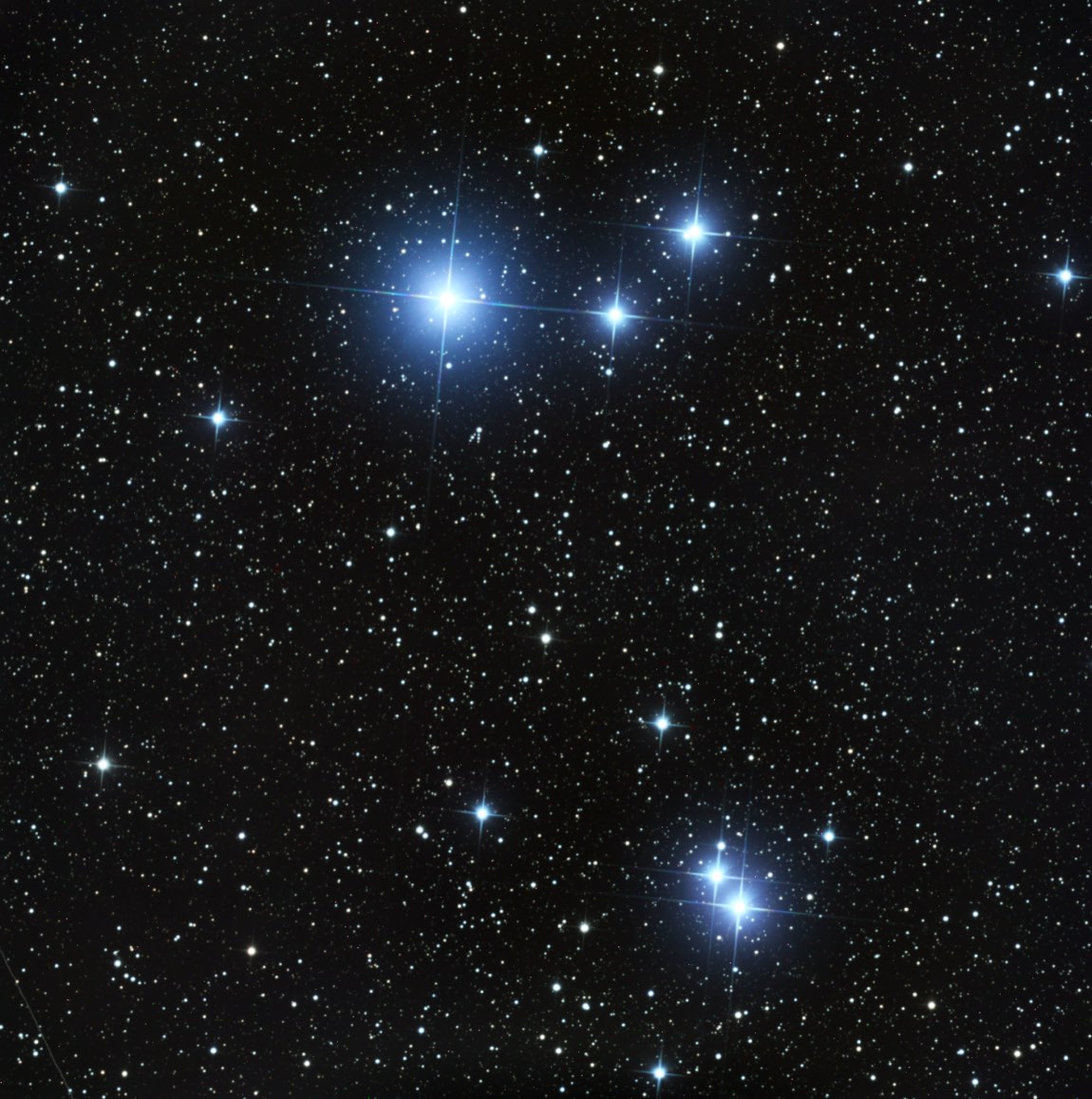
 Photograph · YayLol123 · CC BY-SA 4.0
Star Cluster · Deep guide
Omicron Velorum Cluster (IC 2391)
Also called: Caldwell 85 · IC 2391 · Omicron Velorum Cluster
A nearby naked-eye sprinkle of hot blue stars in Vela, known for over a thousand years.
What is it?
IC 2391, the Omicron Velorum Cluster, is a nearby open cluster of hot, young blue stars in Vela, visible to the naked eye. The Persian astronomer al-Sufi described it as a nebulous star in the 10th century, and Lacaille later catalogued it. About 30 stars spread across 50 arcminutes, some in binary systems. It is roughly 50 million years old, similar to IC 2602 in neighbouring Carina.
The deep dive
Researched for the Atlas from Wikipedia — IC 2391 (1,230 characters read) · updated Nov 15, 2026
01 A cluster old enough to surprise you
At roughly 50 million years old, IC 2391 sounds ancient by human standards, but in stellar terms it is an infant. The Sun, by comparison, is about 4.6 billion years old — meaning IC 2391 formed when the dinosaurs had already been extinct for some 15 million years, yet its stars are still essentially newborns. Astronomers pinned down this age not by counting rings or reading fossils, but through a technique called the lithium depletion boundary. Young stars burn through their surface lithium quickly once they reach certain temperatures; by finding the exact point in a cluster where lithium disappears, researchers can set a precise age clock. For IC 2391, that clock reads about 50 million years. The cluster shares a strikingly similar age and formation era with IC 2602, the nearby open cluster in the neighbouring constellation Carina, suggesting both groups may trace back to the same broad epoch of star-forming activity in this corner of the Milky Way.
02 How astronomers first recorded it
The story of IC 2391's recorded history stretches back over a thousand years. Around 964 CE, the Persian astronomer Abd al-Rahman al-Sufi noted it in his landmark sky survey, describing it simply as a "nebulous star" — a sensible description for something that looks to the naked eye like a slightly smeared, softly glowing point. Al-Sufi's work was one of the most systematic observational catalogues of the medieval Islamic world, and IC 2391 earned its place in it. Centuries later, the French astronomer Abbé de Lacaille rediscovered the cluster during his southern-hemisphere survey and catalogued it under his own system as Lac II 5. The cluster also carries the Caldwell designation C85, part of Patrick Caldwell-Moore's modern catalogue of non-Messier objects worth observing. The designation IC 2391 itself comes from the Index Catalogue, the late-19th-century supplement to the New General Catalogue. Few objects can claim a paper trail that runs continuously from medieval Persia to Victorian England to the present day.
03 Seeing it with nothing but your eyes
With a total visual magnitude of 2.5 spread across about 50 arcminutes of sky, IC 2391 is one of the finest naked-eye open clusters in the southern sky. A magnitude of 2.5 is comparable to some of the more prominent individual stars visible on any clear night, which makes this a genuinely impressive cluster to simply look up at. The 50-arcminute spread is worth appreciating: for reference, the full Moon spans about 30 arcminutes, so the cluster covers more sky than the Moon does, giving it a loose, scattered character when viewed through binoculars. Its home constellation is Vela, the Sail, which sits low in the sky for most northern-hemisphere observers but rides high and prominently for those in the Southern Hemisphere. The cluster is centered around the bright star Omicron Velorum, which lends the cluster one of its popular names. For backyard astronomers in Australia, South Africa, or South America, IC 2391 is a showpiece object even without a telescope.
04 Hot, blue, and built for youth Deeper
The roughly 30 stars that make up IC 2391 are described as hot, young, and blueish — a colour palette that tells a direct physical story. Blue or blue-white stars are massive and burn their nuclear fuel at a ferocious rate, which is precisely why they remain blue: they haven't had time to evolve off the main sequence into cooler, redder giant phases. At 50 million years of age, the cluster is young enough that its most massive members are still living fast. Among the member stars, some are binaries — two stars gravitationally bound and orbiting each other — while at least one system is a quadruple, meaning four stars sharing a mutual gravitational embrace. Such multiple-star systems are not unusual in young clusters, where the dense, turbulent conditions of formation can easily leave several stars locked together. The cluster sits about 490 light-years from Earth, while its near-twin IC 2602 in Carina averages about 485 light-years — a difference of only 5 light-years, reinforcing the idea that these two clusters formed in the same broad region of the galaxy.
05 The Argus Association: a larger family Deeper
IC 2391 does not exist in isolation. It appears to be linked — by age, by direction in the sky, and by motion through space — to a broader stellar grouping called the Argus Association. This association sits closer to Earth than IC 2391 itself and is thought, under at least one motion model, to have originated in the same nebular cloud as the cluster. The Argus Association and IC 2391 formed at roughly the same time and drift in a similar direction, both concentrated toward the constellation Vela and embedded within the local galactic arm, the same spiral arm that contains our Solar System. Stellar associations like Argus are looser and more extended than open clusters; they share a common birthplace but are not tightly bound by gravity the way a cluster is. The connection between IC 2391 and the Argus Association is described as a "supposed" one, reflecting that the linkage is supported by one motion model but remains a subject of ongoing study rather than settled fact. Identifying the full membership of such associations is notoriously difficult because stars spread out and their individual proper motions blur the original family ties over millions of years.
06 A neighbour cluster almost identical in age
One of the more striking facts about IC 2391 is how closely it mirrors IC 2602, the Southern Pleiades, in the neighbouring constellation Carina. The two clusters share a similar formation era, a similar lithium depletion boundary age of about 50 million years, and nearly the same distance from Earth — IC 2391 at about 490 light-years, IC 2602 at about 485 light-years. That is a gap of only 5 light-years between two clusters sitting hundreds of light-years away, which is remarkably close in cosmic terms. This parallel strongly suggests the two clusters were born from related or even connected regions of the same giant molecular cloud complex, though they have since become distinct, separately identifiable groups. Having two young, well-studied clusters at nearly the same distance and age is scientifically valuable: astronomers can cross-check age-dating techniques, compare how stellar evolution proceeds under similar initial conditions, and use one cluster as a check on conclusions drawn from the other. This kind of natural control experiment is rare and makes both IC 2391 and IC 2602 unusually well-calibrated benchmarks in stellar astrophysics.
07 What the lithium boundary actually measures Deeper
The lithium depletion boundary is a subtle but powerful dating tool, and IC 2391 is one of the clusters where it has been applied. Here is the underlying physics: in young, low-mass stars — the dim, cool red and orange dwarfs — lithium in the outer layers is mixed down into hotter interior zones and destroyed by nuclear reactions. This process runs at a predictable rate that depends on the star's mass and temperature. As a cluster ages, progressively lower-mass stars reach the internal temperatures needed to burn their lithium, so at any given age there is a sharp boundary in the cluster's colour-magnitude diagram below which stars have lost their lithium and above which they have not. By measuring exactly where this boundary sits, astronomers can read off the cluster's age with an accuracy that complements other methods like isochrone fitting. For IC 2391, all these lines of evidence converge on roughly 50 million years. Because the physics of lithium burning is well understood from first principles, the lithium depletion boundary is considered one of the more robust and model-independent age indicators available to stellar astronomers, making IC 2391's age one of the better-established values among young open clusters.
08 Its place in the local galactic arm Deeper
IC 2391, the Argus Association, and the related cluster IC 2602 all reside within what is described as the local galactic arm — the same curved ribbon of gas, dust, and young stars that the Sun calls home. At roughly 490 light-years away, IC 2391 is well within the solar neighbourhood on a galactic scale; the Milky Way's disk stretches roughly 100,000 light-years across, so this cluster is practically on our doorstep. The concentration of these young clusters and associations toward the direction of Vela and neighbouring Carina is not coincidental. That part of the southern sky contains some of the most active star-forming real estate in the local arm, including the vast Vela Molecular Ridge and the remnants of past supernova explosions that have stirred and compressed gas over millions of years. IC 2391 and its relatives are a snapshot of that activity — stars born out of that turbulent interstellar environment, now drifting apart as the gas that made them has long since dispersed. Mapping these groups and tracing their motions backward helps astronomers reconstruct the recent star-formation history of our small corner of the galaxy.
09 Open questions still surrounding the cluster Deeper
Despite IC 2391 being one of the sky's brightest and most accessible open clusters, several questions about it remain genuinely open. The connection between IC 2391 and the Argus Association, for instance, is described as "supposed" and rests on one motion model — meaning the picture could change as more precise stellar velocity measurements, particularly from missions like the European Space Agency's Gaia satellite, refine the proper motions and distances of candidate members. Establishing exactly who belongs to the Argus Association, and confirming or refuting its shared origin with IC 2391, is an active area of research. The full census of cluster members is also incomplete: the article notes about 30 stars, but the true membership of open clusters is always uncertain at the faint, low-mass end, where dim red dwarfs can be hard to distinguish from background field stars at the same apparent position. The nature and dynamics of the multiple-star systems within IC 2391 — including the one quadruple system — also invite follow-up study, since multiple systems record clues about how stars form and interact in crowded young environments.