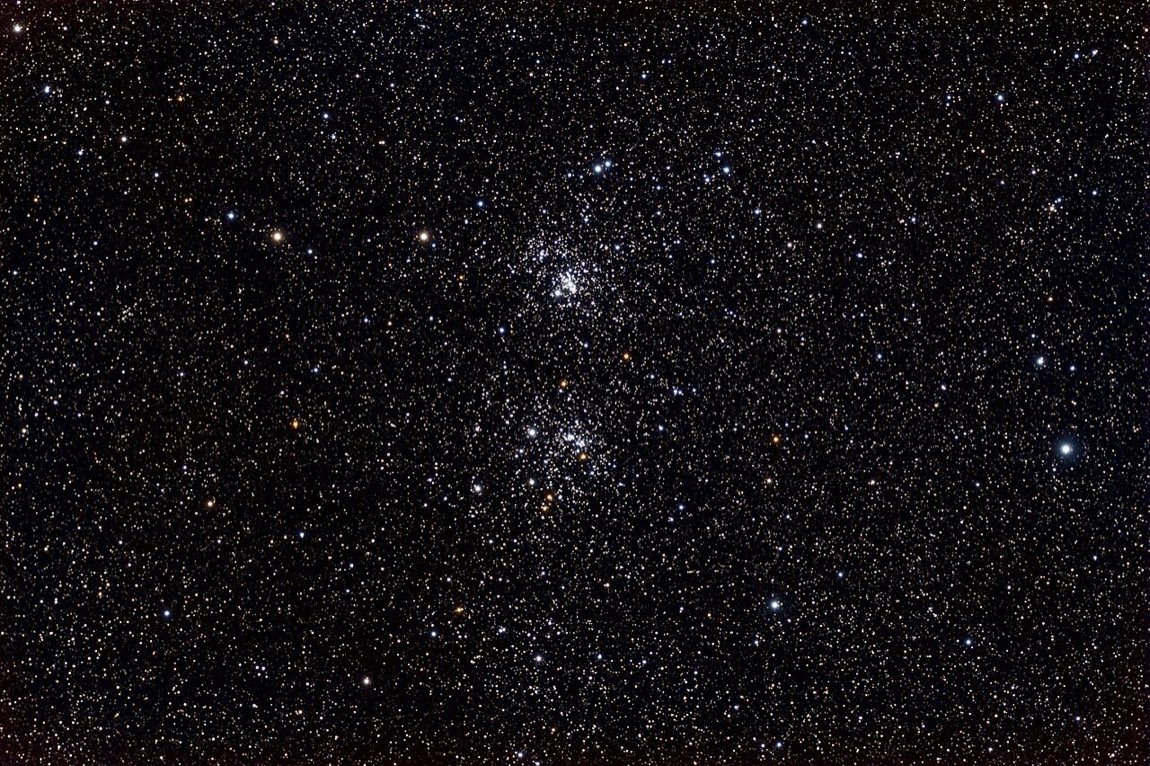
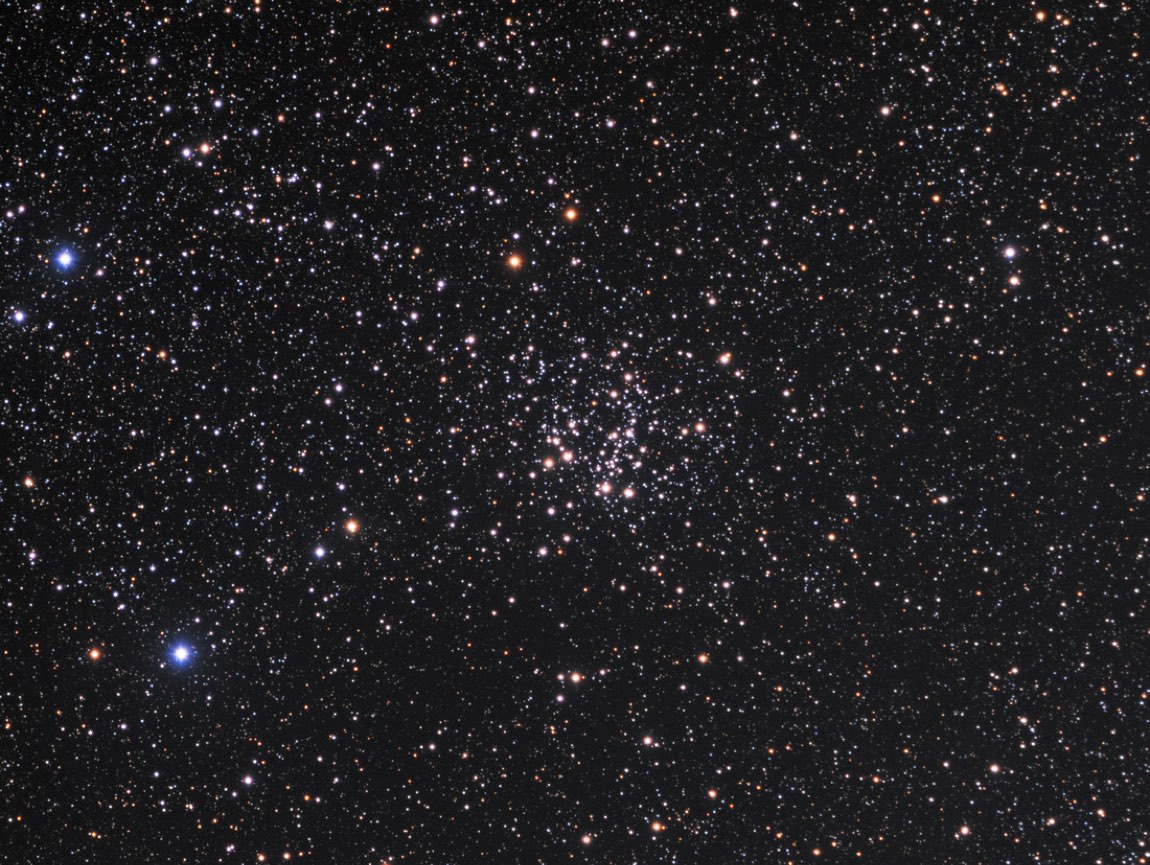
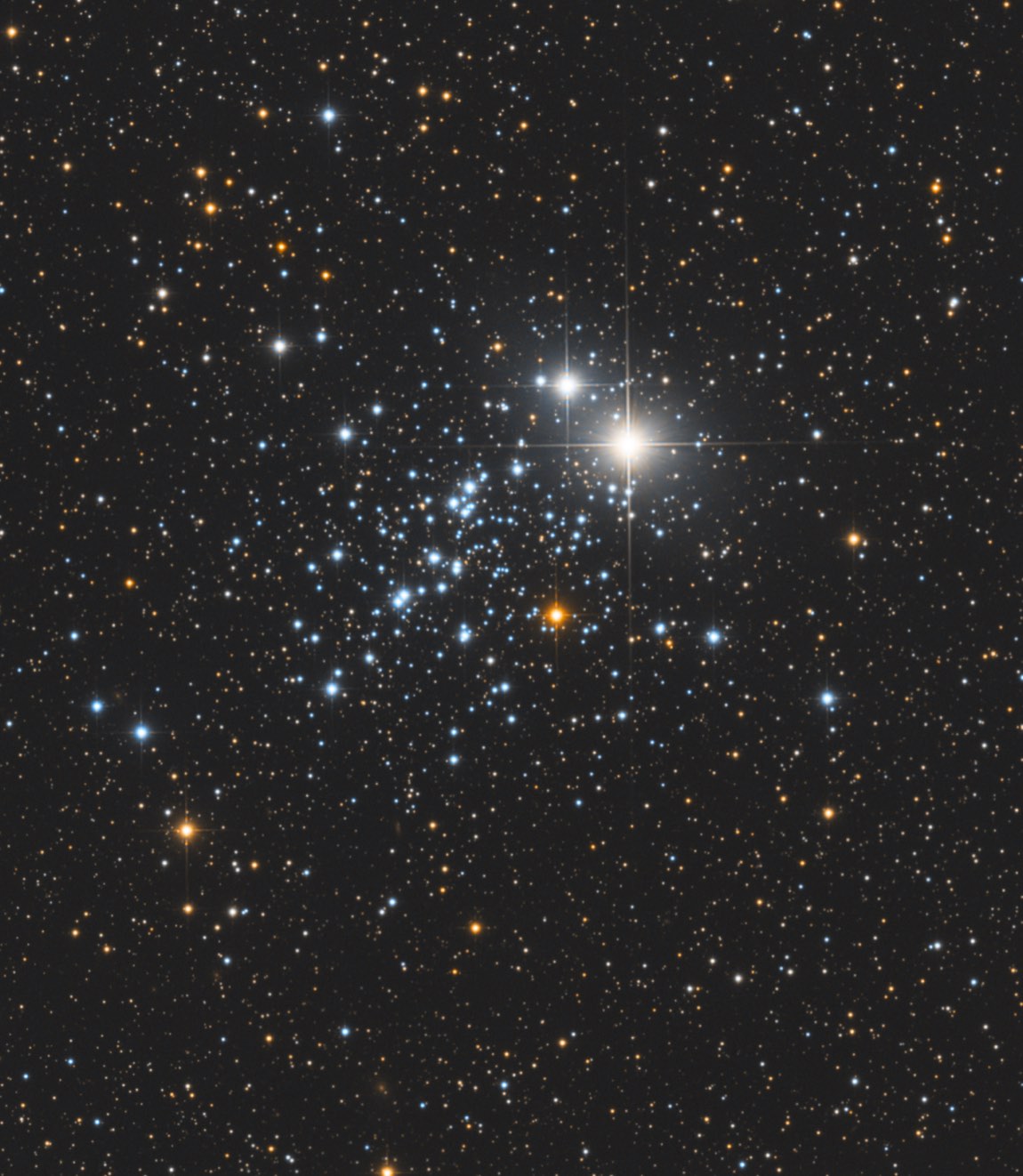
 Photograph · Chuck Ayoub · CC0
Star Cluster · Deep guide
The Owl Cluster (NGC 457)
Also called: Caldwell 13 · C13 · NGC 457 · E.T. Cluster · Dragonfly Cluster · Kachina Doll Cluster · Phi Cassiopeiae Cluster
Two bright 'eyes' make this Cassiopeia cluster look like an owl, or the movie alien E.T.
What is it?
NGC 457 is an open star cluster in Cassiopeia with a crowd of nicknames: the Owl, E.T., Dragonfly and Kachina Doll Cluster. Two bright stars, Phi Cassiopeiae and HD 7902, play the part of the eyes. If Phi Cassiopeiae truly belongs to the cluster, it would rank among the most luminous stars known, outshining Rigel, but its membership is not yet settled. The cluster is about 21 million years old. William Herschel discovered it on 18 August 1780, and it is easy to see in a small telescope even from light-polluted places.
The deep dive
Researched for the Atlas from Wikipedia — NGC 457 (2,587 characters read) · updated Nov 15, 2026
01 William Herschel and the Night of Discovery
NGC 457 entered the astronomical record on August 18, 1780, when German-British astronomer William Herschel swept it up with a 6.2-inch reflector telescope. He catalogued it as VII 42, a designation that placed it in his personal classification system for nebulous objects and star clusters. It is worth pausing on the instrument: a 6.2-inch reflector was a serious piece of hardware for its era, yet today amateur astronomers routinely spot this same cluster with far smaller telescopes under compromised, light-polluted skies. That contrast speaks both to how visually generous NGC 457 is and to how dramatically telescope technology has advanced in the two and a half centuries since Herschel first noted its presence. The cluster later received the catalog designations NGC 457 in the New General Catalogue and Caldwell 13 in Patrick Caldwell-Moore's popular observing list, giving it at least two widely used identities beyond Herschel's original notation.
02 A Cluster With Too Many Nicknames
Few open clusters collect popular names the way NGC 457 does. It goes by the Owl Cluster, the E.T. Cluster, the Dragonfly Cluster, the Kachina Doll Cluster, and the Phi Cassiopeiae Cluster — five unofficial names layered on top of its formal designations. The E.T. nickname, referencing the famous movie character, and the Owl nickname both hinge on the same visual trick: two relatively bright stars at the cluster's southeastern end read unmistakably as a pair of glowing eyes staring back at the observer. Those stars are Phi Cassiopeiae, shining at magnitude 5 with a spectral type of F0, and HD 7902 at magnitude 7. The Kachina Doll and Dragonfly names reflect the same underlying shape interpreted through different cultural lenses, while the Phi Cassiopeiae Cluster name simply anchors the grouping to its most prominent star. The abundance of nicknames is itself a clue to how distinctive and memorable the cluster's silhouette is.
03 The Shape That Sparked the Imagination
What makes NGC 457 so visually arresting is a roughly T-shaped arrangement of stars that the human eye almost involuntarily assembles into a figure. Author Stephen James O'Meara, writing in Deep-Sky Companions: The Caldwell Objects in 2002, described seeing in photographs a stick figure of a man ready to offer a hug: the two bright eye-stars at the southeastern end, two chains of stars extending outward like wide-open arms along the northeastern and southwestern sides, and two isolated suns at the northwestern end serving as the figure's feet. Through a 4-inch telescope at 23x magnification, O'Meara found the impression shifted from welcoming to eerie — the bright eyes seeming to pierce the dark like a specter emerging from dusty corridors of space, the fainter surrounding stars resembling tattered clothes on skeletal limbs. That shift between photographic warmth and eyepiece menace illustrates how much aperture, magnification, and observing mode can reshape the emotional character of the same object.
04 The Dark Web Behind the Stars Deeper
O'Meara's vivid 2002 description draws attention to something physically real lurking behind NGC 457's theatrical appearance: a network of dark material that permeates the Cassiopeia section of the Milky Way. This interstellar dust and gas is not unique to the cluster's immediate neighborhood, but it is visually prominent when observing in this direction. The dusty background contributes to what O'Meara calls cobwebbed corridors of space, and it explains why the combined glow of a hundred or more faint stars in the cluster appears to shimmer near or beyond the limit of resolution, like smoke rising from countless dying embers. At a distance of over 7,900 light-years from the Sun, any intervening interstellar material along the line of sight has ample opportunity to scatter and redden starlight. This context is a reminder that an open cluster is never truly isolated — it sits embedded within the broader structure of the galactic disk, and that structure shapes how we perceive it.
05 150 Stars, But Only 60 Confirmed Members Deeper
NGC 457 presents a rich stellar field containing roughly 150 stars with apparent magnitudes ranging from 9 to 13, faint enough to require optical aid but well within reach of modest amateur equipment. However, apparent proximity on the sky does not equal physical association, and careful analysis has whittled the confirmed membership list down to about 60 stars identified as true members of the cluster. The remaining stars are foreground or background objects that happen to share the same patch of sky. This distinction matters enormously when trying to characterize the cluster's physical properties, such as its true diameter, total luminosity, and stellar population. The gap between 150 apparent stars and 60 confirmed members is a common challenge in open-cluster research, where separating genuine members from line-of-sight coincidences requires measuring proper motions, radial velocities, or parallaxes — none of which can be inferred from a simple brightness measurement.
06 Phi Cassiopeiae: Member or Impostor? Deeper
The most consequential unresolved question about NGC 457 concerns its most visually prominent star. Phi Cassiopeiae shines at magnitude 5 with a spectral type of F0, and it serves as one of the cluster's famous "eyes." But whether Phi Cassiopeiae is actually a physical member of the cluster remains unclear. The stakes of that uncertainty are remarkably high: if Phi Cassiopeiae truly belongs to NGC 457 at a distance of over 7,900 light-years, then its intrinsic luminosity would make it one of the brightest stars known, surpassing even Rigel. For scale, the article notes that the Sun placed at that same distance would fade to a magnitude of just 17.3 — far below naked-eye visibility and challenging even for moderate telescopes. That comparison underscores just how extraordinarily luminous Phi Cassiopeiae would have to be to appear at magnitude 5 from more than 7,900 light-years away. If instead it is a closer foreground star, its true luminosity would be far more ordinary.
07 The Red Supergiant Watching From Within Deeper
Beyond the debated brilliance of Phi Cassiopeiae, the next most notable star in NGC 457 is V466 Cassiopeiae, described in the article as a red supergiant variable star. Red supergiants are among the most massive and physically largest stars in the universe, typically representing a late evolutionary stage of stars many times the mass of the Sun. Variable red supergiants are known for irregular or semi-regular brightness fluctuations driven by pulsations in their outer layers. At the cluster's estimated age of 21 million years, it is not surprising to find a red supergiant present: massive stars evolve rapidly, and 21 million years is enough time for the heaviest members of a stellar cohort to have already burned through their core hydrogen and swollen into supergiant territory. V466 Cassiopeiae thus offers a snapshot of the most advanced stage of stellar evolution currently playing out inside this young cluster.
08 How Young Is 21 Million Years, Really?
NGC 457 carries an estimated age of 21 million years, a number that sounds large but is extraordinarily young by cosmic standards. The Sun, for comparison, is roughly 4.6 billion years old — more than 200 times older. The Milky Way galaxy itself is around 13 billion years old. At 21 million years, NGC 457 is a stellar infant: its member stars have barely settled into steady hydrogen-burning, and the most massive among them are already racing toward the ends of their lives as supergiants. Open clusters like NGC 457 are fragile gravitational families that the tidal forces of the galaxy gradually pull apart over hundreds of millions of years. Given how young this cluster is, it still retains much of its original stellar population, making it a valuable natural laboratory for studying how stars of different masses evolve in lockstep from a common birthplace and a common age.
09 Finding NGC 457 in Cassiopeia's W
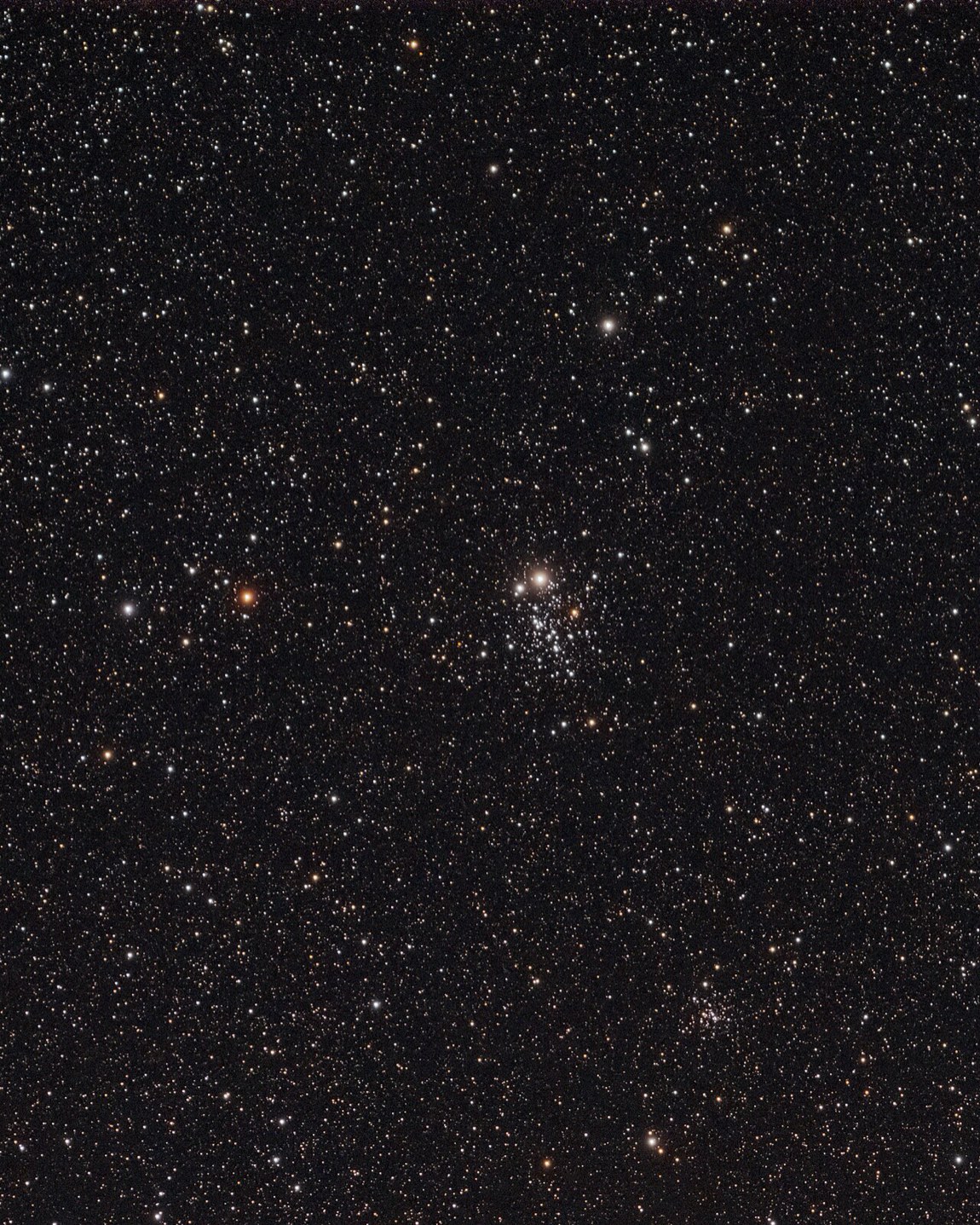
NGC 457 resides in Cassiopeia, one of the most recognizable constellations in the northern sky, identifiable by its distinctive W or M shape depending on the season and viewing angle. The cluster sits more than 7,900 light-years away but is bright and concentrated enough to qualify as an easy target for amateur astronomers. The article specifically notes it can be seen even with small telescopes in light-polluted skies — high praise that places it firmly in the category of showpiece objects for outreach events and casual backyard observing. The bright eye-stars, Phi Cassiopeiae at magnitude 5 and HD 7902 at magnitude 7, are visible enough to serve as reliable anchor points when scanning the field. The surrounding Cassiopeia Milky Way is itself rich with star fields and dark lanes, so observers who linger in the area after finding the cluster are rewarded with an unusually textured swath of the galaxy's disk.
10 Open Clusters and Why They Drift Apart
NGC 457 belongs to the class of objects called open clusters — loose gravitational groupings of stars born from the same giant molecular cloud at roughly the same time. Unlike the densely packed globular clusters that orbit in the galactic halo, open clusters sit within the disk of the Milky Way and are subject to its ongoing gravitational disturbances. Giant molecular clouds, passing spiral arms, and the galaxy's overall tidal field all tug at the cluster's stars over time, gradually dispersing them into the general stellar population. The roughly 60 confirmed member stars of NGC 457 are still close enough and young enough to be recognizable as a family, but over the next hundreds of millions of years the cluster will likely dissolve entirely. Studies of open clusters at different ages effectively let astronomers watch this dissolution process at different stages, using NGC 457's youth as one data point in that longer story.
11 What Magnitude 9–13 Stars Tell Observers Deeper
The article states that the rich star field of NGC 457 contains about 150 stars in the magnitude range of 9 to 13. This range has practical significance for observers. Magnitude 9 stars are just beyond the naked eye's reach under ideal conditions but are easily captured with binoculars or any small telescope. Magnitude 13 stars require a telescope of moderate aperture and reasonably dark skies to resolve individually. The spread of roughly four magnitudes within the cluster means that different optical instruments reveal different layers of the population: binoculars show the brighter framework, a small telescope reveals more of the mid-range stars, and a larger instrument begins to resolve the fainter tail of the distribution. This layered visibility is part of why NGC 457 remains rewarding across a wide range of equipment. The brightest confirmed eye-stars at magnitude 5 and 7 sit well above this range, further broadening the total dynamic range a visitor to the cluster encounters.
 ⤢