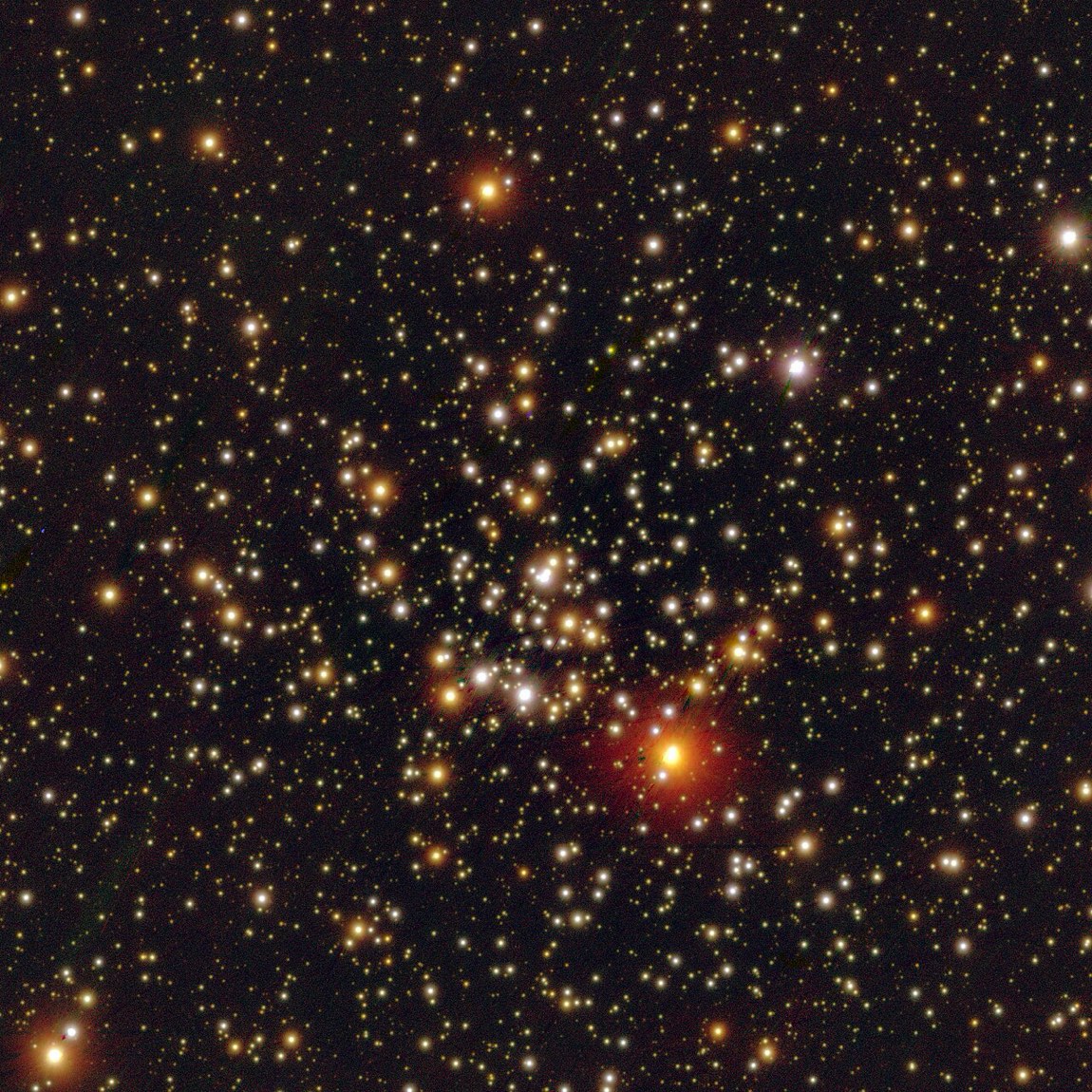
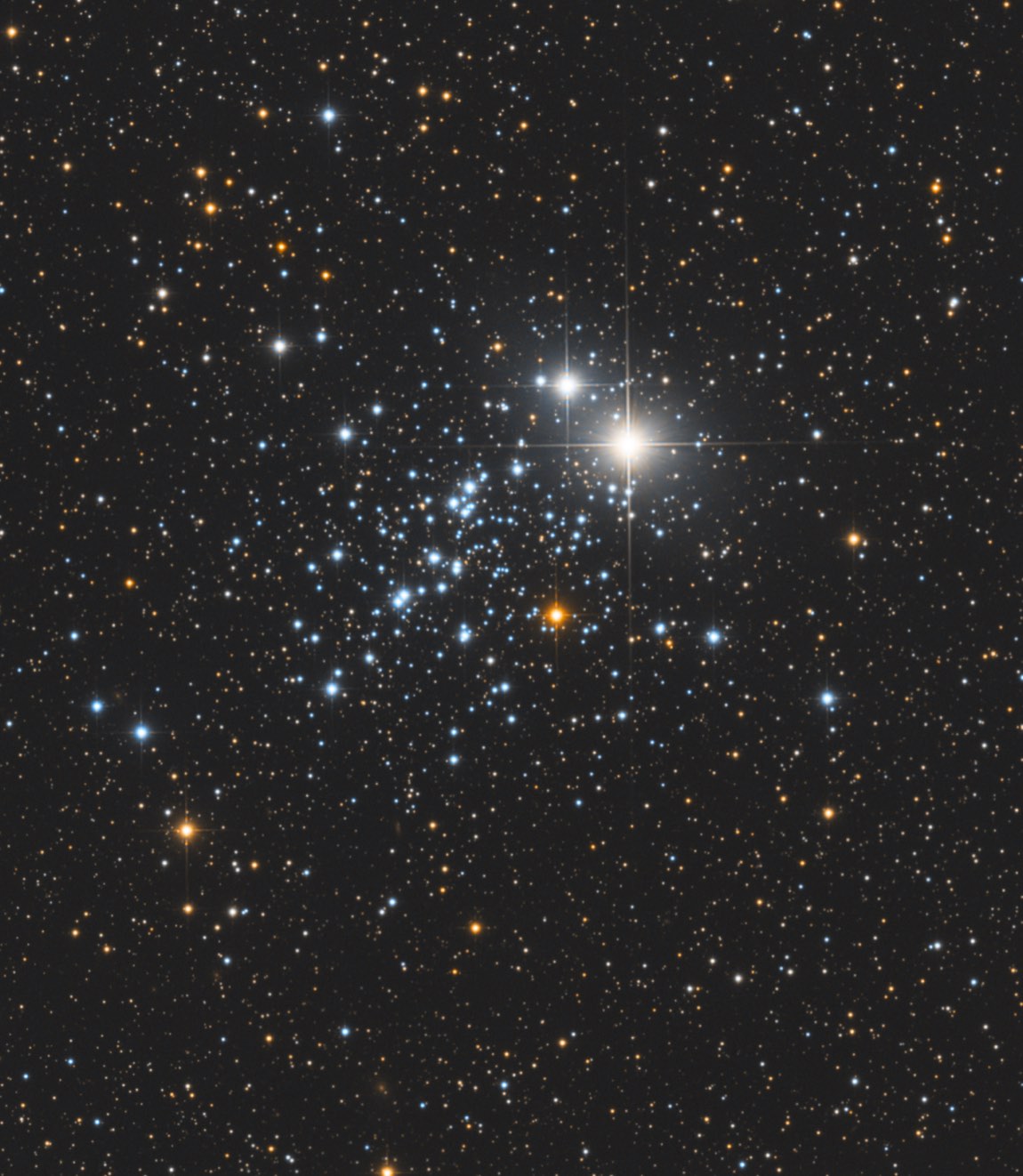
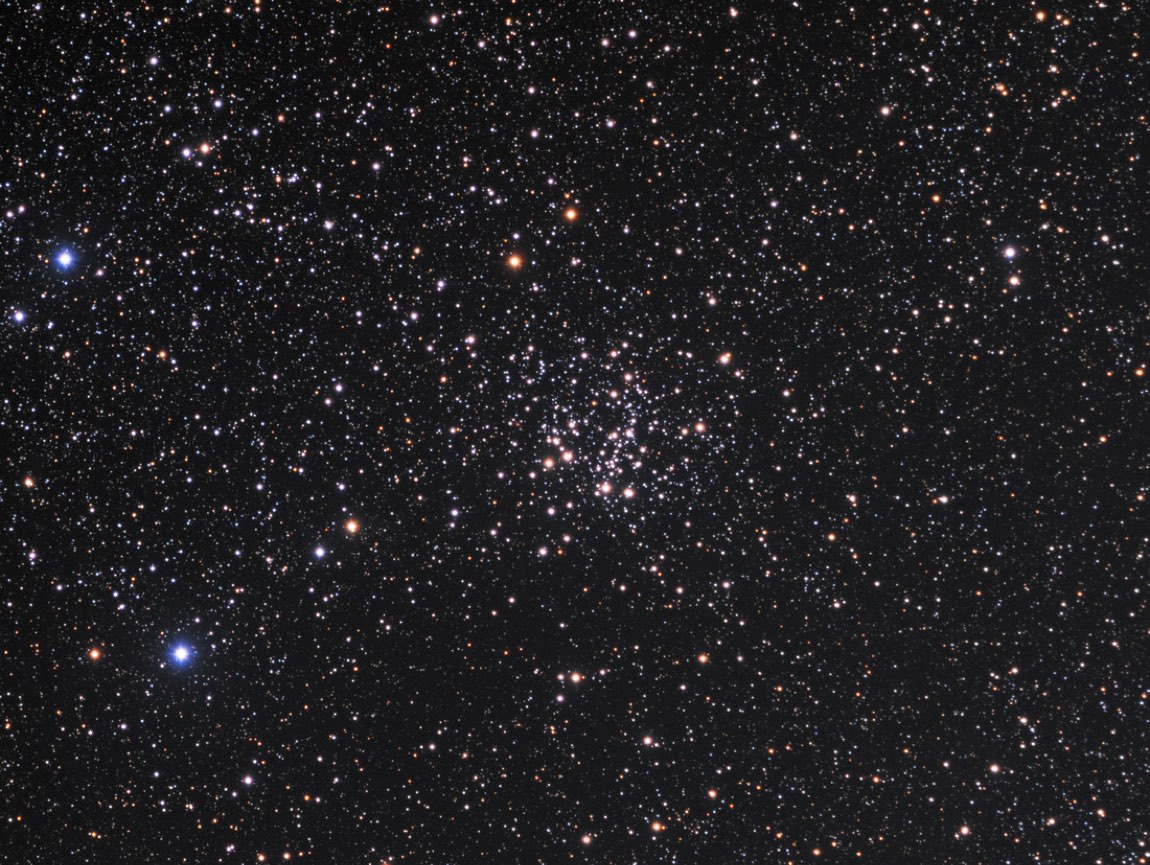
 Photograph · Hewholooks · CC BY-SA 3.0
Star Cluster · Deep guide
NGC 663
Also called: Caldwell 10 · C10 · Collinder 20 · Lawnmower Cluster
A young Cassiopeia cluster unusually rich in Be stars, hot stars that shine with bright hydrogen emission.
What is it?
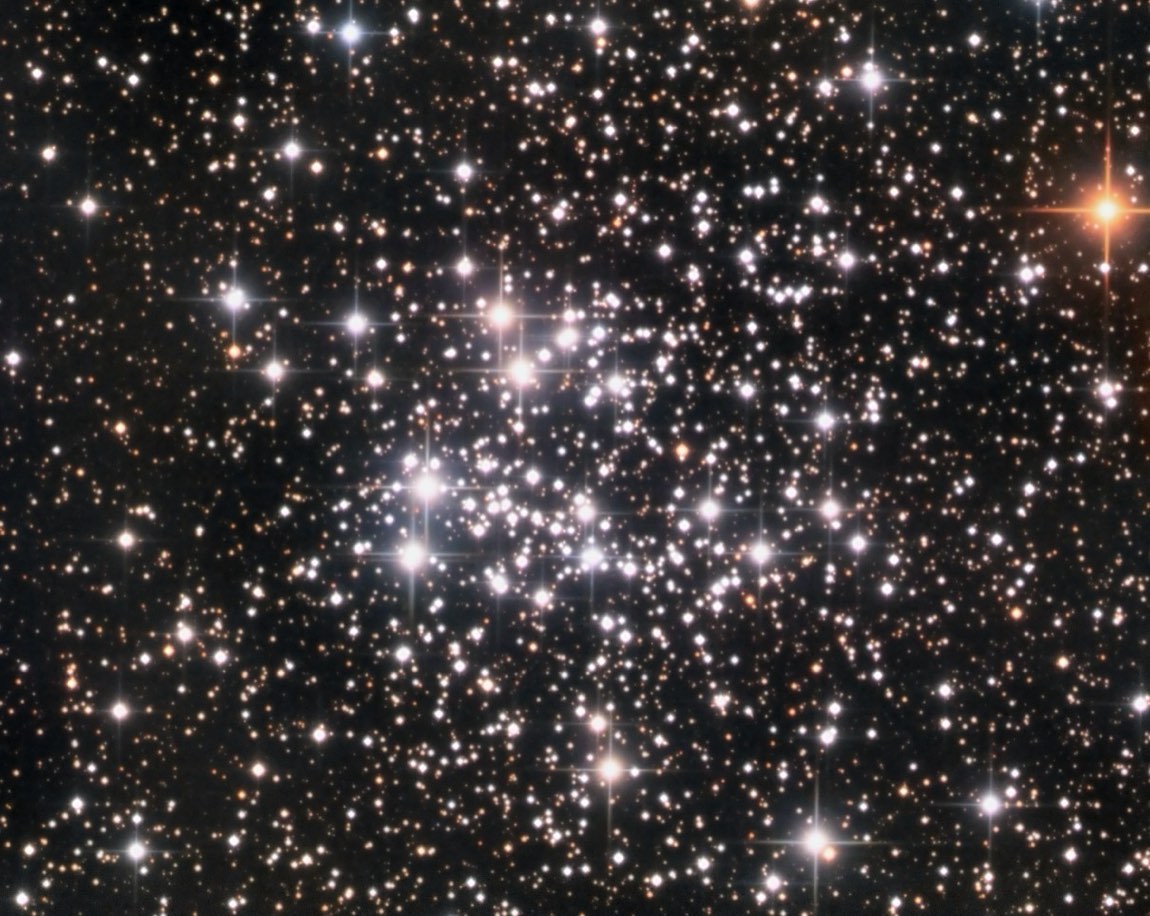
NGC 663 is a young open cluster in Cassiopeia with an estimated 400 stars, covering about a quarter of a degree of sky. Binoculars show its brightest members, and some observers report glimpsing it with the naked eye. It is only about 20–25 million years old, and it is notable for holding around two dozen Be stars, hot blue stars whose spectra show bright hydrogen emission lines. At least five blue stragglers, stars that look younger than their neighbours, have also been found in it.
The deep dive
Researched for the Atlas from Wikipedia — NGC 663 (2,100 characters read) · updated Nov 15, 2026
01 A Cluster Born in the Perseus Arm
NGC 663 is not an isolated island of stars — it belongs to a much larger family. Astronomers classify it as part of Cassiopeia OB8, a stellar association sprawling through the Perseus Arm of the Milky Way. Stellar associations are loose, gravity-unbound groupings of young stars that formed from the same giant molecular cloud around the same time. Sharing that common cradle with NGC 663 are the open clusters M103, NGC 654, and NGC 659, plus a scattering of supergiant stars drifting between them. The fact that all these clusters have similar ages and distances is the key evidence tying them together into a single family. The Perseus Arm is one of the Milky Way's prominent spiral arms, and studying clusters like NGC 663 helps astronomers map its structure and understand how star formation propagates along these galactic highways. Among all known clusters in Cassiopeia OB8, NGC 663 is considered the most massive — and may even be the most massive cluster in the entire Perseus Arm, a distinction that makes it a benchmark for studying star formation at large scales.
02 An Extraordinary Census of Be Stars
What sets NGC 663 apart from most open clusters is its unusually rich population of Be stars — spectral class B stars that display prominent emission lines of hydrogen in their spectra. About 24 Be stars have been discovered in the cluster, a strikingly high count. The "e" in Be simply signals that the star's light carries the fingerprint of glowing hydrogen gas, typically forming a disk of hot material flung outward from the star's equator by rapid rotation. Most of the Be stars in NGC 663 fall between spectral classes B0 and B3, meaning they are massive, luminous, and hot — surface temperatures typically running into the tens of thousands of degrees. The abundance of Be stars here makes the cluster a natural laboratory for studying why some B-type stars develop these equatorial disks while others do not. Because the cluster is young and all its Be stars share roughly the same age and birth environment, researchers can compare them far more cleanly than they could across the general field of unrelated stars spread throughout the galaxy.
03 Stars Nearing the End of Their Short Lives
With an estimated age of only 20 to 25 million years, NGC 663 is in a transitional phase that makes it especially interesting to stellar evolutionists. Stars burn through their hydrogen fuel at a rate that depends steeply on their mass — the more massive the star, the shorter its life. At the cluster's current age, stars of spectral class B2 or higher mass are reaching the end of their main-sequence lifespans, the long stable period during which a star fuses hydrogen in its core. This means NGC 663 is essentially caught at the moment when its most massive survivors are about to depart the main sequence and swell into giants or supergiants. For comparison, our own Sun, a far less massive star, will spend roughly 10 billion years on the main sequence — about 400 times longer than these massive B-type stars. Watching a cluster at this precise evolutionary stage lets astronomers calibrate models of stellar aging and test predictions about which stars should still be burning steadily and which should already be transforming.
04 Red Supergiants on the Cluster's Edge Deeper
NGC 663 hosts two red supergiant stars, and their location is telling: both sit on the periphery of the cluster rather than near its center. Red supergiants are among the largest and most luminous stars known, representing a late evolutionary stage that the cluster's most massive members are beginning to approach given its age of 20 to 25 million years. Their placement at the outskirts could reflect dynamical processes — massive stars can receive gravitational kicks or simply form in looser outer regions of a cluster's natal cloud. It may also be that these stars have drifted outward over the cluster's lifetime. Because the cluster is considered the most massive in Cassiopeia OB8, finding evolved massive stars like red supergiants within it is consistent with expectations: more massive clusters statistically produce more high-mass stars, and high-mass stars are the ones that evolve fastest into supergiants. These two stars serve as prominent signposts of the cluster's evolutionary state and are natural targets for detailed spectroscopic study.
05 Blue Stragglers: Stars Built from Collisions Deeper
Among the notable residents of NGC 663 are at least five blue straggler stars. Blue stragglers appear anomalously young and hot for a cluster of a given age — they sit in a region of the color-magnitude diagram where, by rights, they should have already evolved off the main sequence. The explanation the article gives is direct: these are stars that formed through the merger of two other stars. When two stars in a binary system spiral inward and merge, the collision creates a single more massive object that effectively resets or extends its hydrogen-burning clock, appearing bluer and brighter than its true age would suggest. Finding at least five such objects in NGC 663 indicates that stellar mergers are not vanishingly rare events, even in a cluster this young. For astronomers, blue stragglers are valuable probes of binary star dynamics and the internal gravitational life of clusters, since their existence implies a history of close stellar encounters and mass transfer or outright mergers taking place over the cluster's 20-to-25-million-year lifetime.
06 A Binary Star Harboring an X-ray Pulsar Deeper
One of the most exotic candidate members of NGC 663 is a star catalogued as LS I +61° 235. It is classified as a Be star — placing it among the cluster's already notable Be star population — but it carries an additional remarkable feature: an X-ray binary component. This means the Be star is in an orbital relationship with a compact object, most likely a neutron star or black hole, which pulls material from the Be star's disk and heats it so intensely that the infalling gas radiates in X-rays. The system has a measured period of about three years, meaning the compact object completes one orbit around the Be star roughly every three years. Be X-ray binaries are important because they let astronomers study accretion physics and the lifecycle of massive stars that have already undergone supernova explosions to produce compact remnants. The qualifier "candidate member" reflects remaining uncertainty about whether LS I +61° 235 is physically part of NGC 663 or simply a chance alignment along the same line of sight.
07 Eclipsing Binaries with Fast Orbits Deeper
Beyond the exotic X-ray binary, NGC 663 contains at least two star systems identified as likely eclipsing binaries — pairs in which one star periodically passes in front of the other as seen from Earth, causing a predictable dip in the combined brightness. What makes these systems particularly notable is how short their orbital periods are: 0.6 days and 1.03 days respectively. For context, 0.6 days is just under 15 hours — the two stars in that system complete a full mutual orbit faster than most people work a weekend shift. Such tight orbits imply that the stars are separated by very small distances, likely only a few stellar radii apart. Systems this close are of great interest because tidal forces between the stars are strong, potentially distorting their shapes, synchronizing their rotations, and driving mass transfer. Over time, close binaries like these may be the progenitors of stellar mergers, linking them conceptually to the blue straggler population also found in this cluster.
08 A Foreground Cloud That Shapes the View
Looking toward NGC 663, astronomers have noted the presence of a molecular cloud along the same line of sight. Crucially, the cloud is not physically associated with the cluster — the two objects simply happen to lie in the same direction from our vantage point. The cluster sits at a distance of about 2,700 parsecs from Earth, while the molecular cloud is only about 300 parsecs away, putting it roughly nine times closer to us than the cluster itself. Even so, the cloud has a real observational effect: its dense gas and dust absorbs and scatters the light of background stars, effectively blocking them from view in images and observations of the cluster. This means that any census of stars in that region of sky must account for this foreground obstacle. For researchers studying the cluster's true stellar population and luminosity function, disentangling cluster members from background stars is complicated by this natural screen sitting between us and NGC 663.
09 How the Gaia Satellite Refined Its Distance
The distance to NGC 663 has been pinned down using parallax measurements from the European Space Agency's Gaia spacecraft. Parallax is the slight apparent shift in a star's position measured as Earth orbits the Sun — the larger the shift, the closer the star. Gaia has measured the parallaxes of an enormous number of stars with unprecedented precision, and those measurements place NGC 663 at approximately 2,700 parsecs from Earth. One parsec equals about 3.26 light-years, putting the cluster at roughly 8,800 light-years away — a figure that the article cites directly. Before missions like Gaia, distances to open clusters relied more heavily on photometric methods, which compare the apparent brightness of stars to their expected intrinsic brightness and are subject to larger uncertainties. The Gaia-based parallax value represents a more direct geometric measurement and underpins the age estimate of 20 to 25 million years, since knowing the true distance is essential for placing stars correctly on the color-magnitude diagrams used to determine cluster age.
10 Observing NGC 663 from Your Backyard
NGC 663 sits in Cassiopeia, one of the most recognizable constellations in the northern sky, making it accessible to observers across the Northern Hemisphere for much of the year. With a listed visual magnitude of 7.1 — just below the conventional naked-eye limit of around 6 — the cluster is reportedly detectable without optical aid under good dark-sky conditions, though a telescope is recommended for the best view. Binoculars are sufficient to pick out the cluster's brightest member stars. It spans about a quarter of a degree across the sky, which is roughly half the apparent width of a full Moon, making it a compact but rich target. Several observers have reported visual magnitude estimates higher than the listed 7.1, suggesting the cluster may appear slightly brighter than catalogs indicate under ideal conditions — a reminder that published magnitudes are averages and that individual observing circumstances vary. It is also listed in the Caldwell catalogue as Caldwell 10, giving amateur astronomers an easy cross-reference when planning observing sessions.
11 Open Questions About the Cluster's Be Stars Deeper
Despite the wealth of data on NGC 663, significant questions about its Be star population remain open. The fundamental puzzle in Be star research is understanding why rapid rotation — a defining characteristic of these stars — causes some B-type stars to develop equatorial decretion disks while others of similar mass and age do not. Having roughly 24 Be stars in a single cluster of known age and composition provides a controlled sample that can help test competing theories, but the data so far have not settled the debate. It is unclear, for instance, whether the Be phenomenon is linked primarily to initial rotation rates set at birth, to binary star interactions that spun the stars up over time, or to some combination of factors. The concentration of Be stars between spectral classes B0 and B3 in NGC 663 offers a narrowed mass range to study, but distinguishing between formation scenarios requires detailed spectroscopic monitoring of individual stars over extended periods — work that is ongoing.
 ⤢