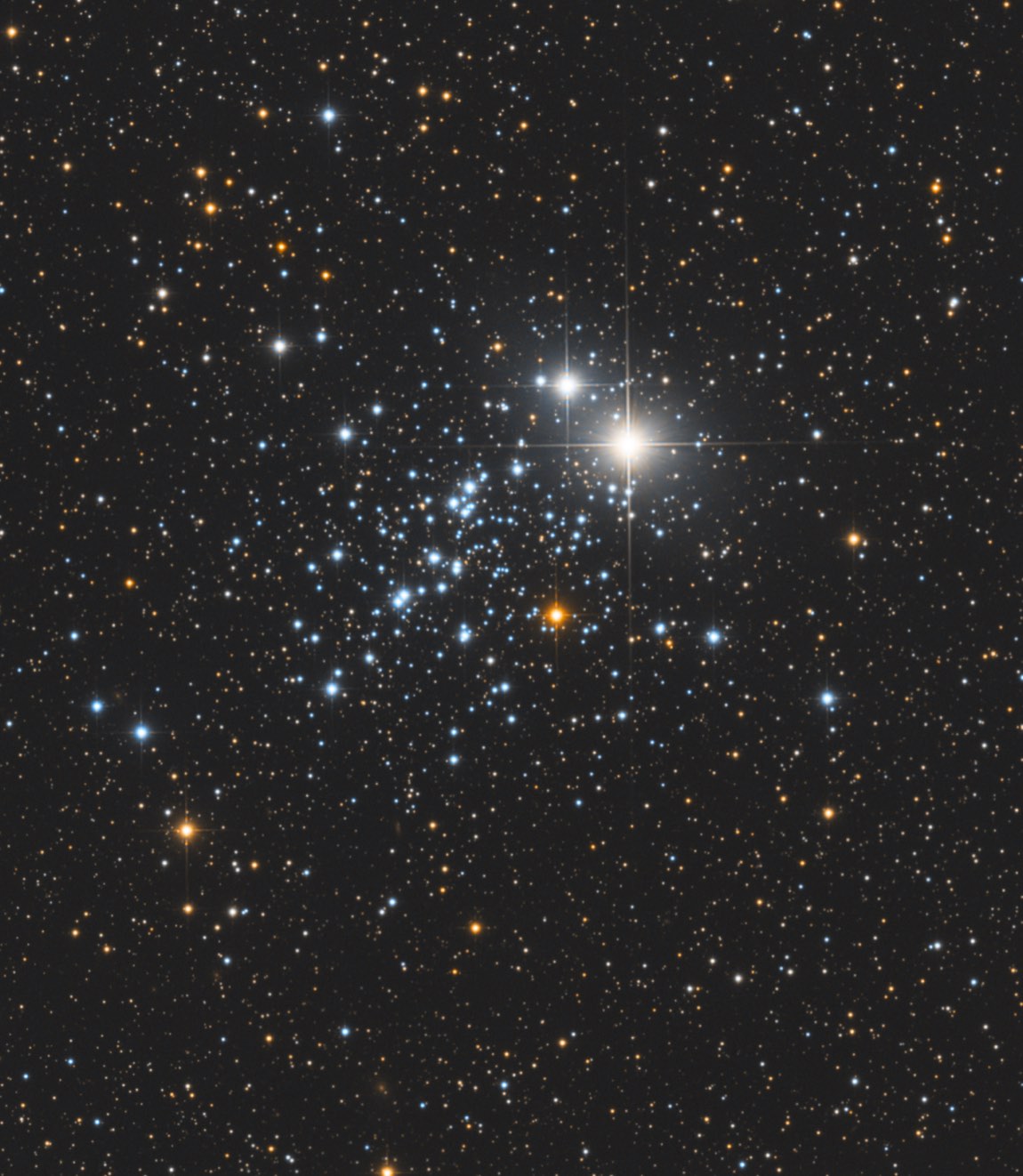
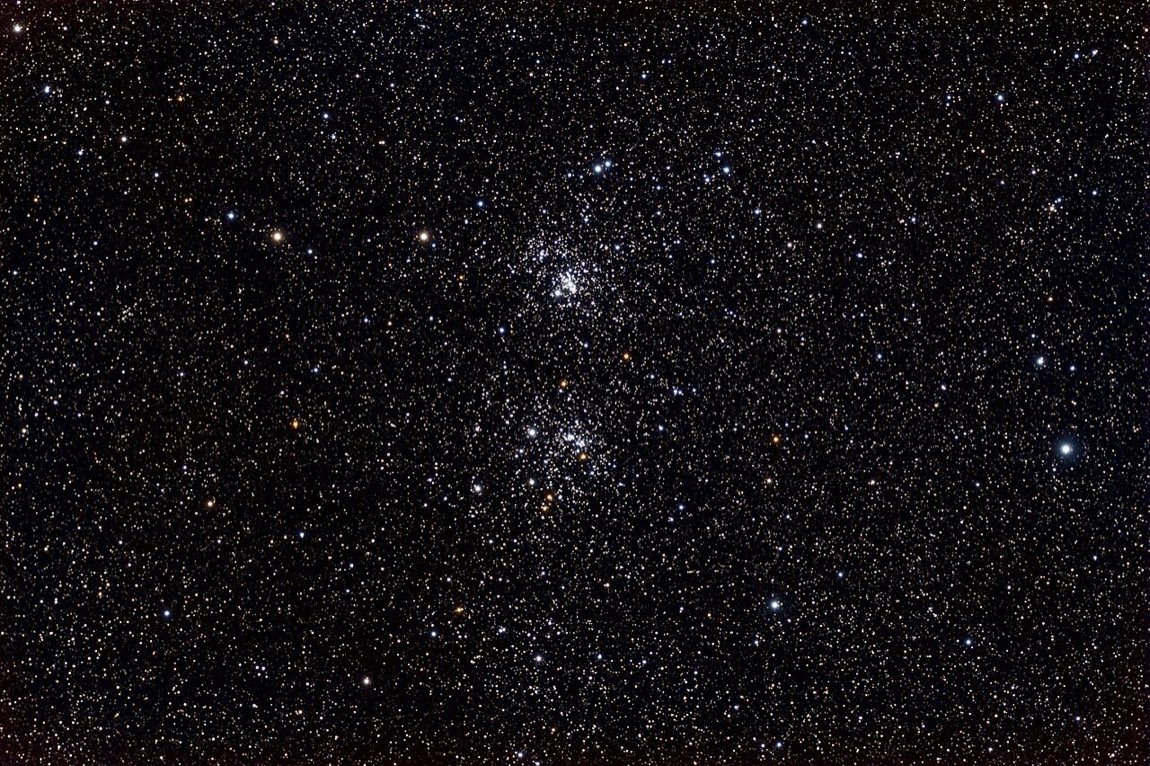
 Photograph · Genuson · CC BY-SA 3.0
Star Cluster · Deep guide
The Double Cluster
Also called: Caldwell 14 · C14 · NGC 869 · NGC 884 · h Persei · Chi Persei · h and χ Persei
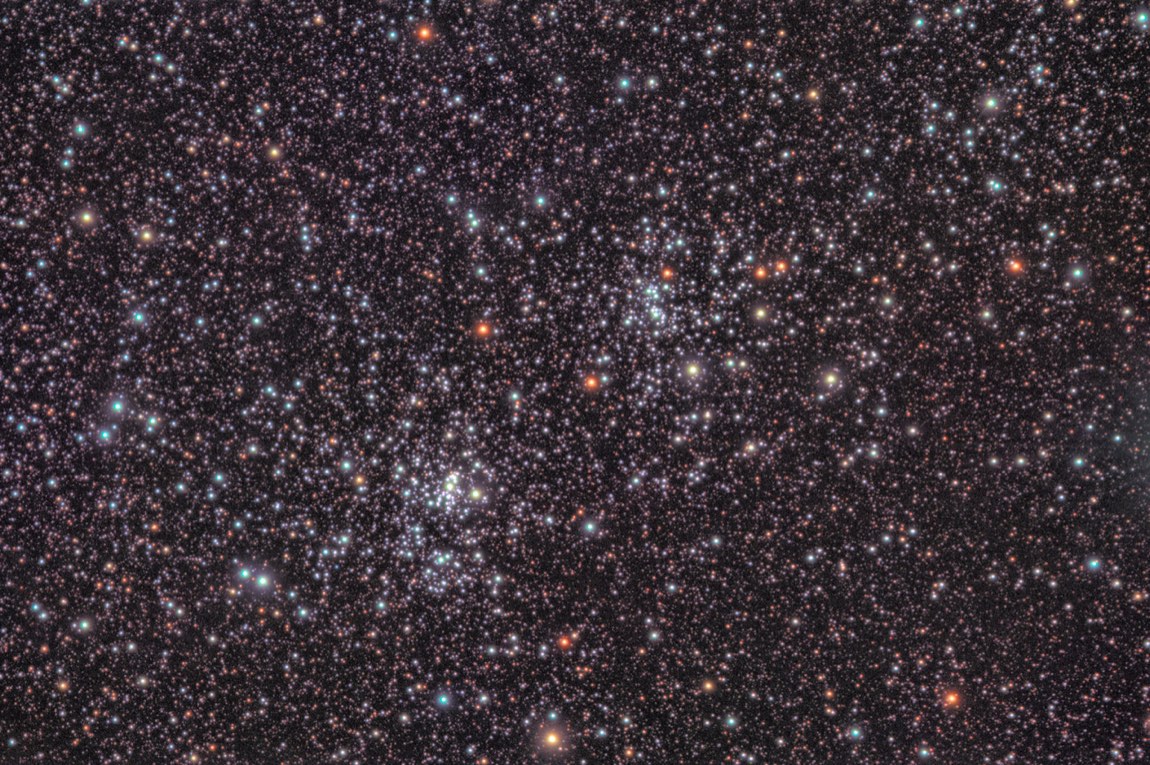
Two young star clusters side by side in Perseus, each bright enough to see without a telescope.
What is it?
The Double Cluster is a pair of open star clusters, NGC 869 and NGC 884, sitting close together in the sky in Perseus. Both are visible to the naked eye and lie about 7,500 light-years away in the Perseus Arm of the Milky Way. They are young, about 14 million years old, and each holds more than 300 blue-white supergiant stars. Together they form the core of a larger group of hot young stars called the Perseus OB1 association, with a combined mass of at least 20,000 Suns.
The deep dive
Researched for the Atlas from Wikipedia — Double Cluster (3,645 characters read) · updated Nov 15, 2026
01 Two Clusters or One Giant Family
NGC 869 and NGC 884 are not merely a chance alignment along the same line of sight — they are genuinely close to each other in space and belong to the same vast stellar family. Both clusters sit at roughly 7,500 light-years away in the Perseus Arm of the Milky Way, and together they form the dense core of a much larger grouping called the Perseus OB1 association, a loose congregation of young, hot, massive stars spread across a wide region of the arm. The two clusters themselves carry masses of 4,700 and 3,700 solar masses respectively, but that is only part of the story. Each is wrapped in an extensive halo of stars, and when astronomers account for the full complex — clusters plus halos — the total mass climbs to at least 20,000 solar masses. That figure is roughly equivalent to 20,000 copies of our own Sun packed into a single gravitationally related system, making the Double Cluster far more substantial than it appears at first glance.
02 Extraordinarily Young Stars in Deep Space
At just 14 million years old, both NGC 869 and NGC 884 are genuinely newborns on the cosmic timescale. To put that in perspective, the Pleiades — often held up as a cluster of young stars — are estimated to be somewhere between 75 million and 150 million years old, making them between five and ten times older than the Double Cluster. The Sun itself is about 4.6 billion years old, more than 300 times the age of these clusters. This extreme youth has profound consequences for what kinds of stars inhabit them. When a cluster is only 14 million years old, the most massive, shortest-lived stars have not yet exhausted themselves and exploded as supernovae. The result is a population heavily weighted toward luminous blue-white supergiants — more than 300 of them in each cluster — along with a smattering of red supergiants in NGC 884 that have already evolved off the main sequence despite the cluster's tender age. The hottest main-sequence stars still burning steadily are classified as spectral type B0, among the most energetic category of non-supergiant stars known.
03 The Red Giants Hiding Among Blue Stars Deeper
NGC 884 harbors a striking contrast within its blue-dominated stellar population: five prominent red supergiant stars that glow at around 8th magnitude and are individually named. They are RS Persei, AD Persei, FZ Persei, V403 Persei, and V439 Persei. Each of these is a variable star, meaning its brightness fluctuates over time rather than holding steady. Red supergiants are stars that began life as very massive blue stars, burned through their hydrogen fuel rapidly, and swelled into enormous, cool, ruddy giants — all within the same 14-million-year window that defines the cluster's age. Their coexistence alongside hundreds of blue-white supergiants creates one of the most visually and scientifically dramatic mixed populations in any nearby open cluster. Through a telescope, the color contrast between the dominant blue-white stellar field of NGC 884 and these five red supergiants scattered among them is immediately apparent, giving the cluster a jewel-box quality that observers frequently describe as breathtaking.
04 Both Clusters Are Heading Toward Us Deeper
The Double Cluster is not standing still relative to Earth. Both NGC 869 and NGC 884 are blueshifted, meaning the light from their stars is compressed toward shorter, bluer wavelengths by the Doppler effect — a signature that the source is approaching rather than receding. NGC 869 is closing the gap at 39 km/s, which works out to roughly 24 miles per second, and NGC 884 is moving toward us at the nearly identical speed of 38 km/s. These are radial velocities — the components of motion directly along our line of sight — and their similarity is further evidence that the two clusters share a common origin and move through the galaxy together as a coherent group. At these speeds, the clusters are racing toward us faster than any spacecraft humanity has ever launched, yet their distance of 7,500 light-years is so immense that any perceptible change in apparent position or brightness will not register on any human timescale.
05 From Hipparchus to Herschel: 2,000 Years of Discovery
The story of the Double Cluster's recognition spans more than two millennia. Greek astronomer Hipparchus cataloged the patch of light in Perseus as early as 130 BCE, treating it as a single nebulous smudge. Centuries later, Islamic astronomers incorporated it into their star lore — Bedouin Arabs saw it as the tail of the smaller of two fish they traced in that region of sky, and the object appeared in illustrations within Abd al-Rahman al-Sufi's influential Book of Fixed Stars. Despite this long history of observation, no one could resolve its true nature without a telescope. Even Johann Bayer, who assigned the designations h Persei and χ Persei in his landmark 1603 star atlas Uranometria, may not have clearly distinguished two separate nebulous patches — though the clusters are described as Nebulosa Duplex in Julius Schiller's Coelum Stellatum Christianum, assembled with Bayer's assistance. It was not until the early 19th century that William Herschel became the first to definitively recognize the object as two distinct clusters, a realization that required the resolving power of a substantial telescope trained on a region the naked eye had blurred into one.
06 Why It Was Left Out of Messier's Catalog
Charles Messier compiled his famous catalog of nebulae and star clusters in the 18th century specifically to help comet hunters avoid confusing fuzzy, non-moving objects with actual comets. The Double Cluster, despite being one of the most spectacular deep-sky objects visible from the Northern Hemisphere, never made the list. The catalog's absence is notable rather than surprising: Messier's observations were conducted from Paris, and the Double Cluster, while circumpolar from many northern latitudes, may simply not have crossed his working list of objects worth flagging. The object did eventually earn a place in the Caldwell catalogue — a modern supplement to Messier compiled by Patrick Caldwell-Moore to cover showpiece objects Messier omitted — where it is listed as Caldwell 14. The NGC designations, 869 and 884, come from the New General Catalogue assembled in the 19th century. Its omission from Messier's list is now a minor footnote; among visual observers, the Double Cluster is considered one of the finest targets in the entire sky.
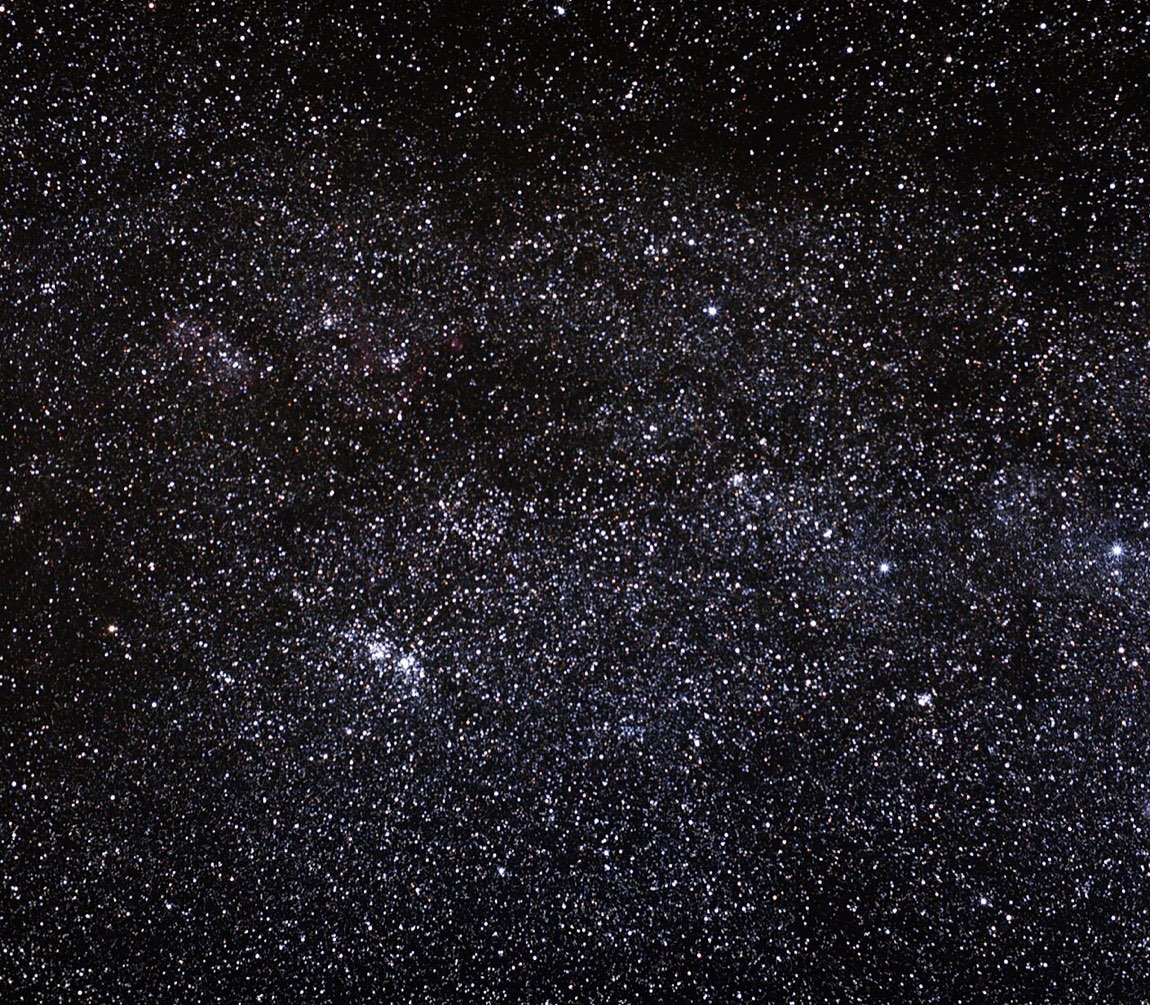 ⤢
07 Finding It in the Northern Sky
For observers at most northern temperate latitudes, the Double Cluster is a year-round fixture — it is circumpolar, meaning it never dips below the horizon. It sits in Perseus, close to the boundary with Cassiopeia, whose distinctive W-shape provides a convenient signpost. The clusters are bright enough to detect with the naked eye as a slightly elongated brightening in the Milky Way, but separating them into two distinct objects requires binoculars or a small telescope. Once optical aid is employed, they reveal themselves as genuinely awe-inspiring: two rich fields of brilliant stars side by side, each spanning roughly half a degree across. For observers in the Southern Hemisphere, however, the Double Cluster is effectively inaccessible — its northern declination places it permanently below the horizon from locations south of approximately 30 degrees south latitude, which excludes New Zealand, most of Australia, and South Africa entirely. Those at mid-southern latitudes will never see this showpiece object from their home skies.
08 The Perseid Connection: A Shower's False Radiant
Every year around August 12 or 13, Earth passes through a stream of debris shed by a periodic comet, producing the Perseid meteor shower — one of the most reliable and watched meteor displays of the year. The shower takes its name from the fact that its radiant, the point in the sky from which meteors appear to stream outward, lies in the constellation Perseus. The Double Cluster sits approximately at that radiant point. This means that during the Perseid peak, the clusters form a kind of visual anchor for the entire meteor display, with shooting stars appearing to spray outward from the same patch of sky where NGC 869 and NGC 884 reside. The association is entirely geometric — the meteors are solar-system debris burning up in Earth's atmosphere, vastly closer than the clusters' 7,500-light-year distance — but it creates a memorable observing coincidence. A wide-field view during the Perseid peak can capture both the deep-sky clusters and the meteors diverging from that same region.
09 Perseus, Medusa, and a Jeweled Sword Handle
The constellation Perseus commemorates one of Greek mythology's most celebrated heroes, a son of Zeus who accomplished a series of extraordinary feats. Among them, Perseus beheaded the Gorgon Medusa — whose gaze could turn mortals to stone — and later rescued Princess Andromeda, who had been chained to a rock as a sacrifice to the sea monster Cetus. In gratitude, the gods placed Perseus among the stars, depicted holding the severed head of Medusa in one hand and his jeweled sword in the other. Within this celestial portrait, the Double Cluster represents the jeweled handle of that sword — a mythological designation that feels apt, given how the two glittering star clusters shimmer side by side like gems set in a hilt. Neighboring Andromeda also has her own constellation nearby, as does Cetus, so the full cast of Perseus's myth is literally written across adjacent regions of the night sky, making the area around Perseus one of the richest storytelling regions in the entire celestial sphere.
10 Open Questions About the Halo's True Extent Deeper
The clusters' official masses of 4,700 and 3,700 solar masses account for the stars astronomers can confidently assign to each cluster's core, but the broader picture is less certain. Both clusters are described as being surrounded by a very extensive halo of stars, and the total mass of the entire Double Cluster complex — cores plus halos — is given as at least 20,000 solar masses. That phrase 'at least' is significant: it acknowledges that the full census of halo members is incomplete, and the true total could be considerably higher. Disentangling halo stars from unrelated Perseus OB1 association members, and from still more distant background stars projected onto the same region, is an ongoing challenge. Because the clusters are only 14 million years old, they have not had enough time for gravitational interactions to eject large numbers of stars, so their halos likely represent genuine extended membership rather than escaped debris — but precisely tracing where each cluster ends and the broader association begins remains an active area of research.
11 What Bayer Actually Drew — and Didn't Deeper
Johann Bayer's 1603 star atlas Uranometria assigned the designations h Persei and χ Persei to the two clusters, and those Greek-letter labels have been in use ever since. But what exactly Bayer understood himself to be charting is genuinely ambiguous. One persistent claim holds that Bayer did not resolve the pair into two separate patches of nebulosity at all — that χ refers to the Double Cluster as a whole and h to a nearby star rather than a cluster. Examining Bayer's own Uranometria chart for Perseus lends some credence to this view: neither object is depicted as nebulous there. However, his chart for the adjacent constellation Cassiopeia does show them as nebulous features, and the description Nebulosa Duplex — 'double nebula' — appears in Schiller's Coelum Stellatum Christianum, which was assembled with direct input from Bayer. Whether Bayer consciously recognized two distinct nebulous clusters or inadvertently labeled a single fuzzy patch and a star remains a minor but unresolved question in the history of observational astronomy.
 ⤢