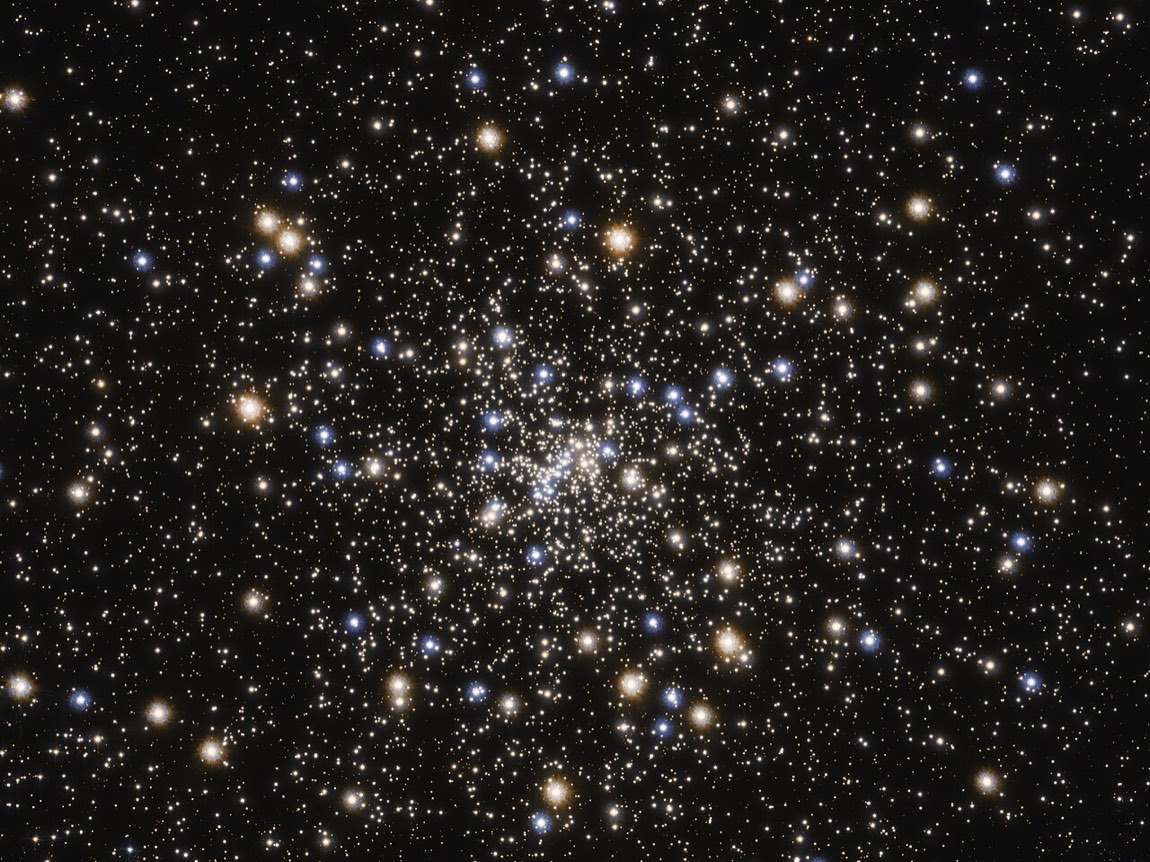
 Photograph · NASA/ESA and the Hubble Heritage Team (AURA/STScI) · Public domain
Star Cluster · Deep guide
NGC 6397
Also called: Caldwell 86 · NGC 6397
One of the two closest globular clusters to Earth, used to estimate the Milky Way's age.
What is it?
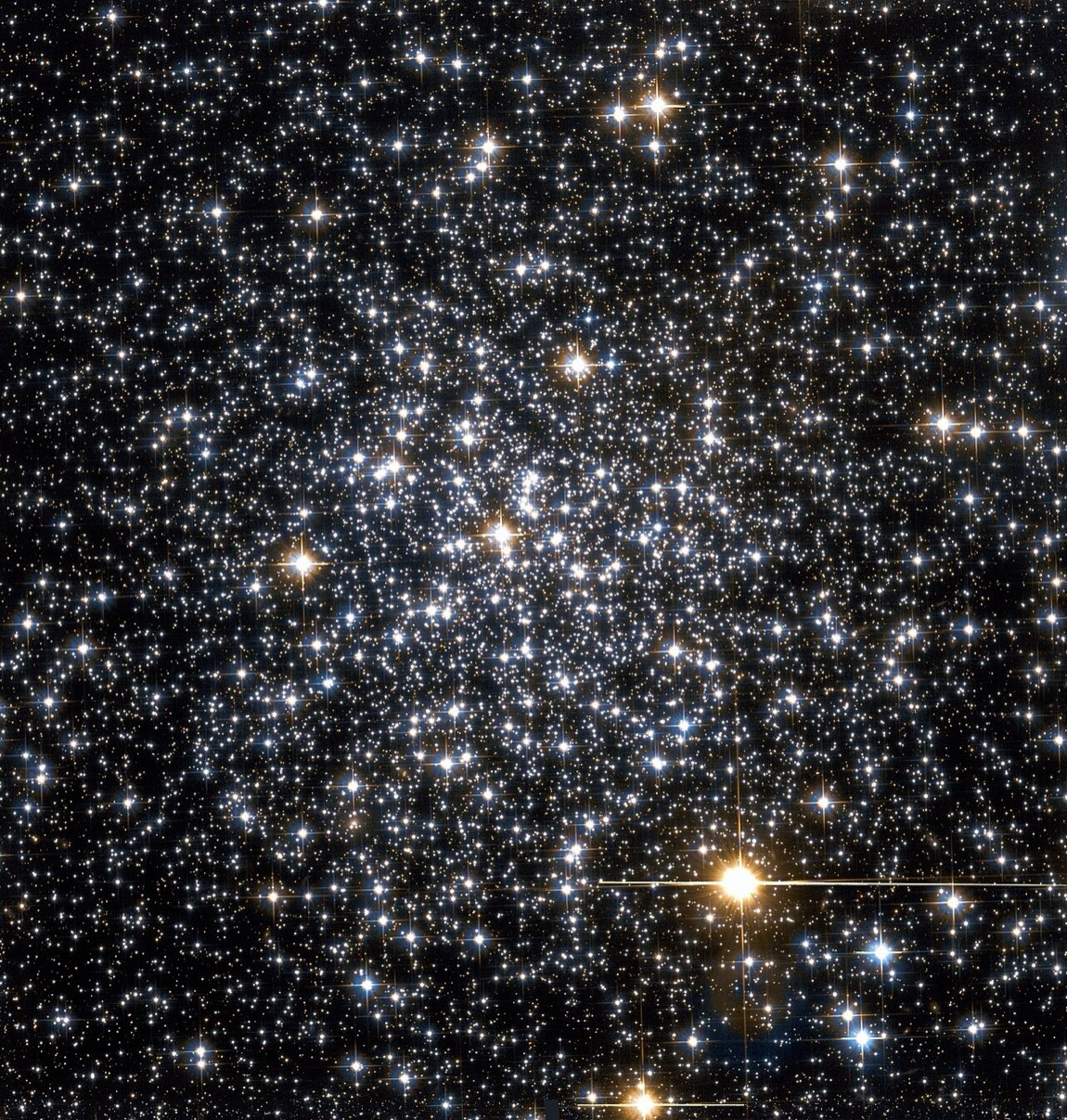
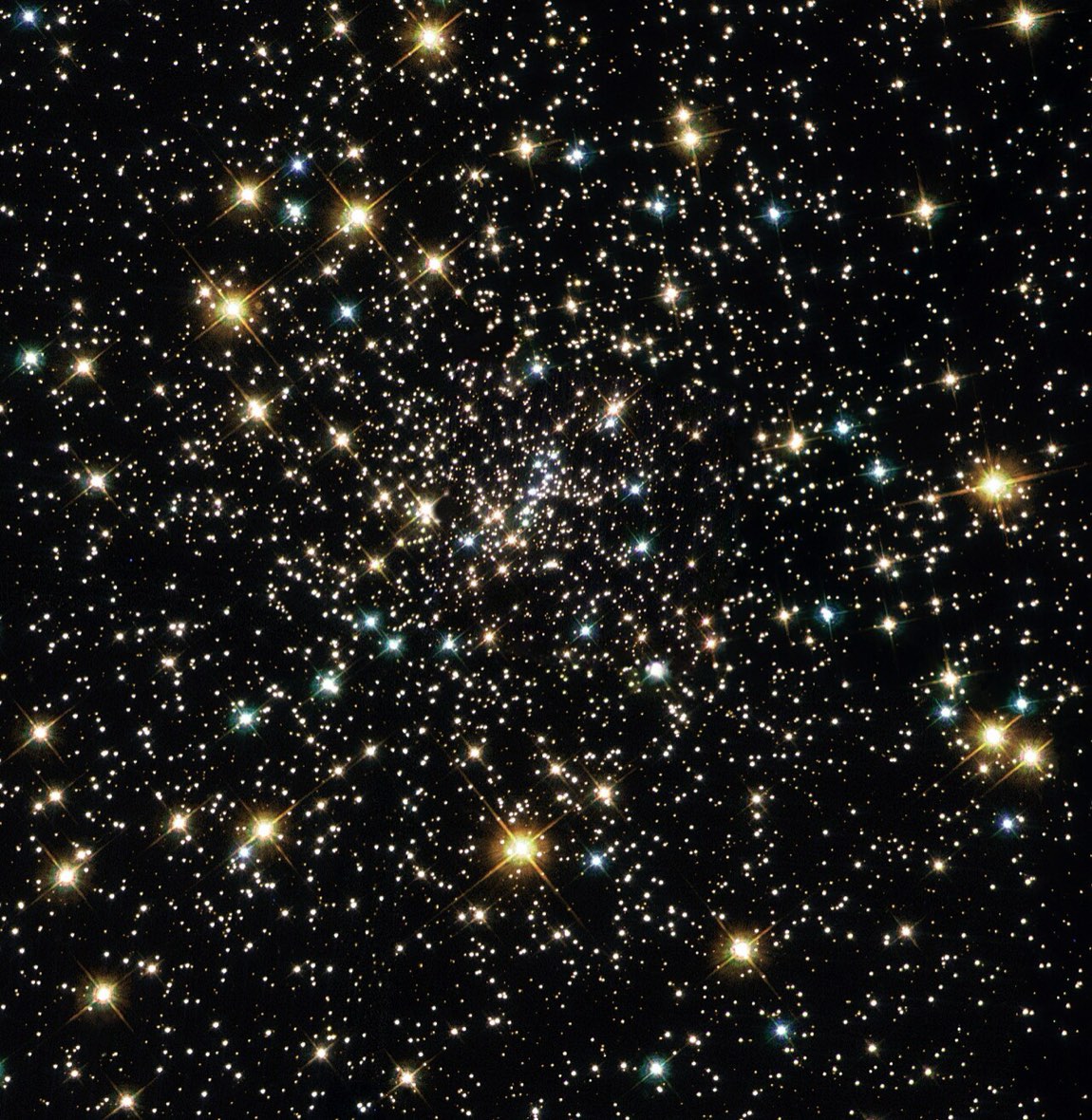
NGC 6397 is a globular cluster in Ara, discovered by Lacaille in 1752. At about 7,800 light-years it is one of the two nearest globulars to Earth, the other being Messier 4. It holds around 400,000 stars and can be seen with the naked eye under good skies. Its core has collapsed into a very dense knot. In 2004 astronomers measured beryllium in two of its stars with ESO's Very Large Telescope to help estimate the age of the Milky Way.
The deep dive
Researched for the Atlas from Wikipedia — NGC 6397 (3,182 characters read) · updated Nov 15, 2026
01 Discovered by Lacaille in the Southern Sky
NGC 6397 was discovered in 1752 by French astronomer Nicolas-Louis de Lacaille, making it one of the earlier deep-sky objects to be catalogued in the southern hemisphere. The cluster sits in the constellation Ara — the Altar — a compact southern constellation not visible from most of Europe or North America. Lacaille was conducting a systematic survey of the southern sky from the Cape of Good Hope when he recorded it. The cluster also carries the designation Caldwell 86, part of a modern catalogue assembled to complement Messier's famous list with notable objects Messier himself never catalogued. Despite being discovered more than 270 years ago, NGC 6397 continues to be one of the most scientifically productive globular clusters in the sky, serving as a natural laboratory for questions ranging from stellar physics to the age of the entire Milky Way.
02 One of Our Two Closest Globular Neighbors
At roughly 7,800 light-years from Earth, NGC 6397 holds the distinction of being one of the two nearest globular clusters to our planet, sharing that honor with Messier 4. To put that distance in perspective, 7,800 light-years is still about 75 quadrillion kilometers — yet in the context of a galaxy that stretches roughly 100,000 light-years across, NGC 6397 is practically on our cosmic doorstep. That relative closeness is scientifically invaluable: the nearer a cluster, the brighter its individual stars appear, and the easier it becomes to study faint, low-mass objects that would be invisible in more distant clusters. It is this proximity that has allowed astronomers to push the boundaries of stellar physics using NGC 6397 — detecting the faintest stars capable of nuclear fusion, and tracking the subtle motions of stars near the cluster's core with enough precision to argue about what hidden mass lies there.
03 Seeing It with Your Own Eyes
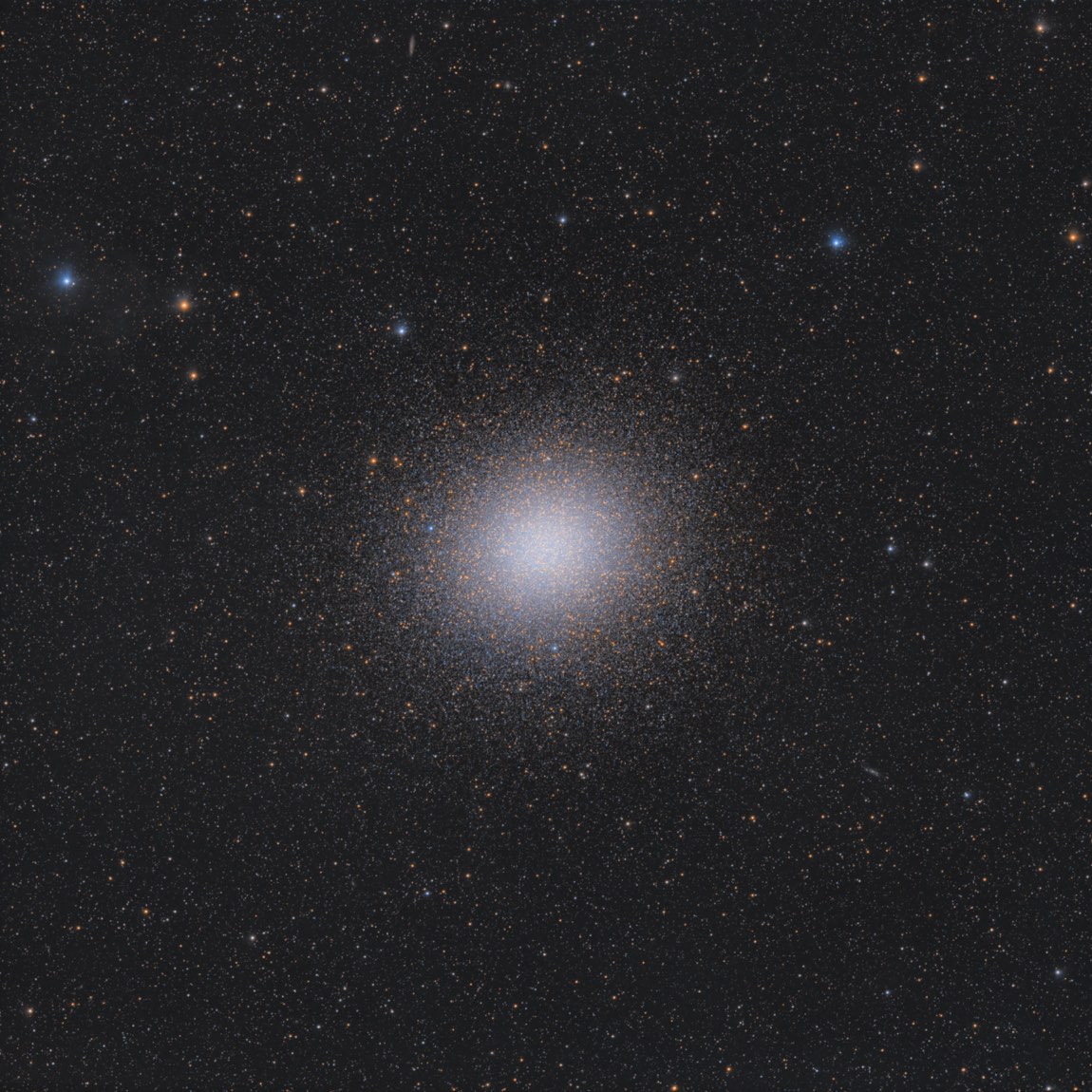
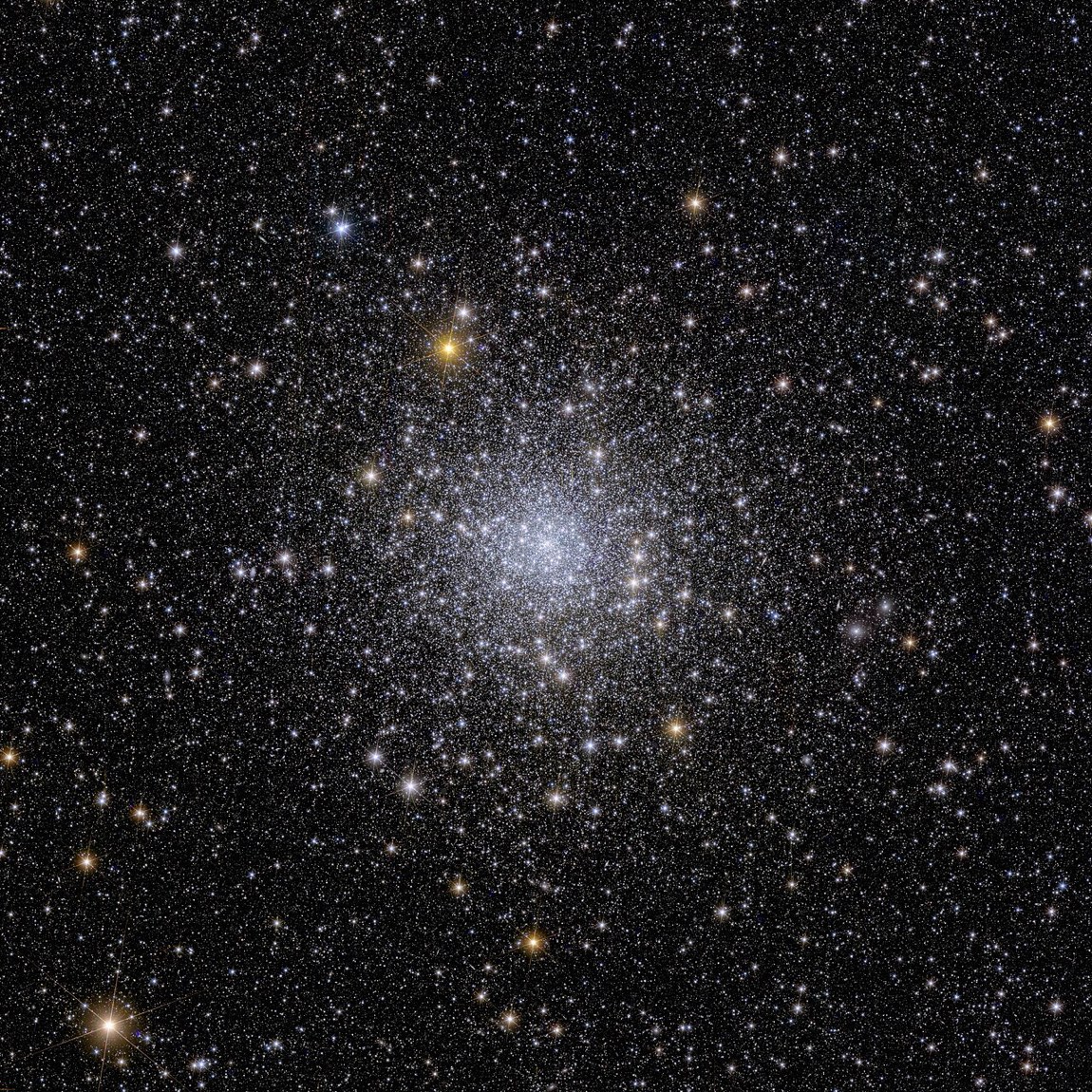
With around 400,000 stars packed into a single gravitationally bound system, NGC 6397 is bright enough to be visible to the naked eye under good observing conditions — a remarkable feat for an object thousands of light-years away. For observers in the southern hemisphere or low northern latitudes who can see the constellation Ara, the cluster appears as a soft, slightly fuzzy star. Through binoculars it resolves into a misty glow, and even a modest telescope begins to separate individual stars at its edges. Its apparent magnitude makes it one of the more accessible globular clusters in the sky, and its proximity means that the outer halo of stars can be spread across a noticeable area of sky in longer-exposure photographs. Southern hemisphere observers in particular have an advantage, as Ara rises high enough above the horizon to give a clear, steady view.
04 Core Collapse: When a Cluster Implodes Deeper
NGC 6397 belongs to a select group of at least 20 Milky Way globular clusters that have undergone what astronomers call core collapse. In a normal globular cluster, stars are distributed in a gradual gradient from a loose halo down to a denser center. In a core-collapsed cluster, gravitational interactions between stars have caused the innermost region to contract into an extraordinarily dense stellar agglomeration — a runaway process driven by energy exchange between stars. Heavier objects sink toward the center while lighter ones are flung outward, a process known as mass segregation. The result is a core so dense that the rate of close encounters between stars accelerates dramatically. This violent dynamical history has profound consequences: it shapes which exotic objects — white dwarfs, neutron stars, black holes — survive at the center, and it sets the stage for the ongoing scientific debate about what exactly lurks at NGC 6397's heart.
05 Weighing the Milky Way's Age in Beryllium Deeper
In 2004, an innovative study used NGC 6397 as a cosmic clock to estimate the age of the Milky Way Galaxy itself. Astronomers used the UV-Visual Echelle Spectrograph on the Very Large Telescope at Cerro Paranal to measure the beryllium content of two stars within the cluster. Beryllium accumulates in stellar atmospheres over time through cosmic-ray spallation, so its abundance acts as a timer. By measuring how much beryllium the stars had accumulated, the team could calculate the time gap between the formation of the very first generation of stars in the entire Galaxy and the formation of the first stars in NGC 6397. Adding that interval to the already-estimated age of the cluster's own stars, they arrived at an age for the Milky Way of about 13.6 billion years — nearly as old as the universe itself. The researchers were careful to note that this estimate assumes NGC 6397 is not older than the Galaxy it orbits.
 ⤢
06 Finding the Faintest Stars That Can Burn Deeper
In 2006, a Hubble Space Telescope study of NGC 6397 produced a landmark result in stellar physics: a sharp, observable lower limit to how faint — and therefore how low in mass — a star in the cluster could be. Below this brightness threshold, no cluster members were found. The authors interpreted this cutoff as evidence of a minimum mass required for a stellar core to sustain nuclear fusion: approximately 0.083 times the mass of the Sun. Objects below this threshold cannot ignite hydrogen fusion and are instead classified as brown dwarfs. The fact that this boundary showed up so cleanly in the data, as a clear edge rather than a gradual fade, made NGC 6397's proximity essential — only the cluster's relative closeness to Earth allowed Hubble to detect such dim objects at all. This measurement gave observational grounding to theoretical predictions about the hydrogen-burning limit and refined our understanding of where stars end and substellar objects begin.
07 The Mystery of What Hides in the Core Deeper
In February 2021, astronomers analyzing star motions near the core of NGC 6397 — using data from both the Hubble Space Telescope and the European Space Agency's Gaia spacecraft — reported a surprisingly dense concentration of compact objects: white dwarfs, neutron stars, and potentially black holes. The research group suggested that black holes might dominate the mass of this central concentration, provided they had not been ejected by the cluster's violent dynamical history. A second group of scientists quickly challenged this interpretation, arguing that because NGC 6397 has undergone core collapse, its high rate of dynamical interactions should have expelled nearly all of its original black holes. They offered computer simulations showing that a dense population of white dwarfs alone could account for the observed stellar motions. The debate was not simply adversarial: by 2022, members of both groups published a joint paper showing that the data agreed remarkably well with simulations featuring hundreds of massive white dwarfs and essentially no black holes — a tidy resolution to a genuinely contested question.
08 A Window onto Galaxies Far Beyond
One unexpected benefit of studying NGC 6397 has nothing to do with the cluster itself. Because NGC 6397 is relatively nearby and its stars — though numerous — do not completely block the background sky, Hubble Space Telescope images of the cluster have revealed a rich backdrop of distant globular clusters belonging to far more remote galaxies. These background objects, sitting far behind NGC 6397, would be nearly impossible to identify without the deep, high-resolution imaging that Hubble performed while studying the cluster in the foreground. This kind of serendipitous science is common in astronomy: pointing a powerful telescope at one target often uncovers unexpected treasures in the same field of view, turning a focused study of a nearby object into a broader survey of the distant universe.
09 How Two Spacecraft Cracked One Problem
The 2021 and 2022 investigations into the core of NGC 6397 stand as a good illustration of how modern astronomy combines instruments to answer questions neither could resolve alone. The Hubble Space Telescope provided deep imaging with high spatial resolution — essential for distinguishing individual stars in the crowded core of a globular cluster. The European Space Agency's Gaia spacecraft contributed precise measurements of stellar positions and motions across the sky over time. Together, their data allowed researchers to map how stars move near the cluster's center, and from those motions to infer the distribution of hidden mass. The fact that two independent research groups, using the same combined dataset, initially reached different conclusions — before eventually converging on a shared answer — illustrates the self-correcting nature of the scientific process, and shows how much interpretive work underlies any single reported discovery.
 ⤢