Star Cluster · Deep guide
NGC 5286
Also called: Caldwell 84 · NGC 5286
An ancient halo globular cluster that may be linked to a shredded dwarf galaxy.
What is it?
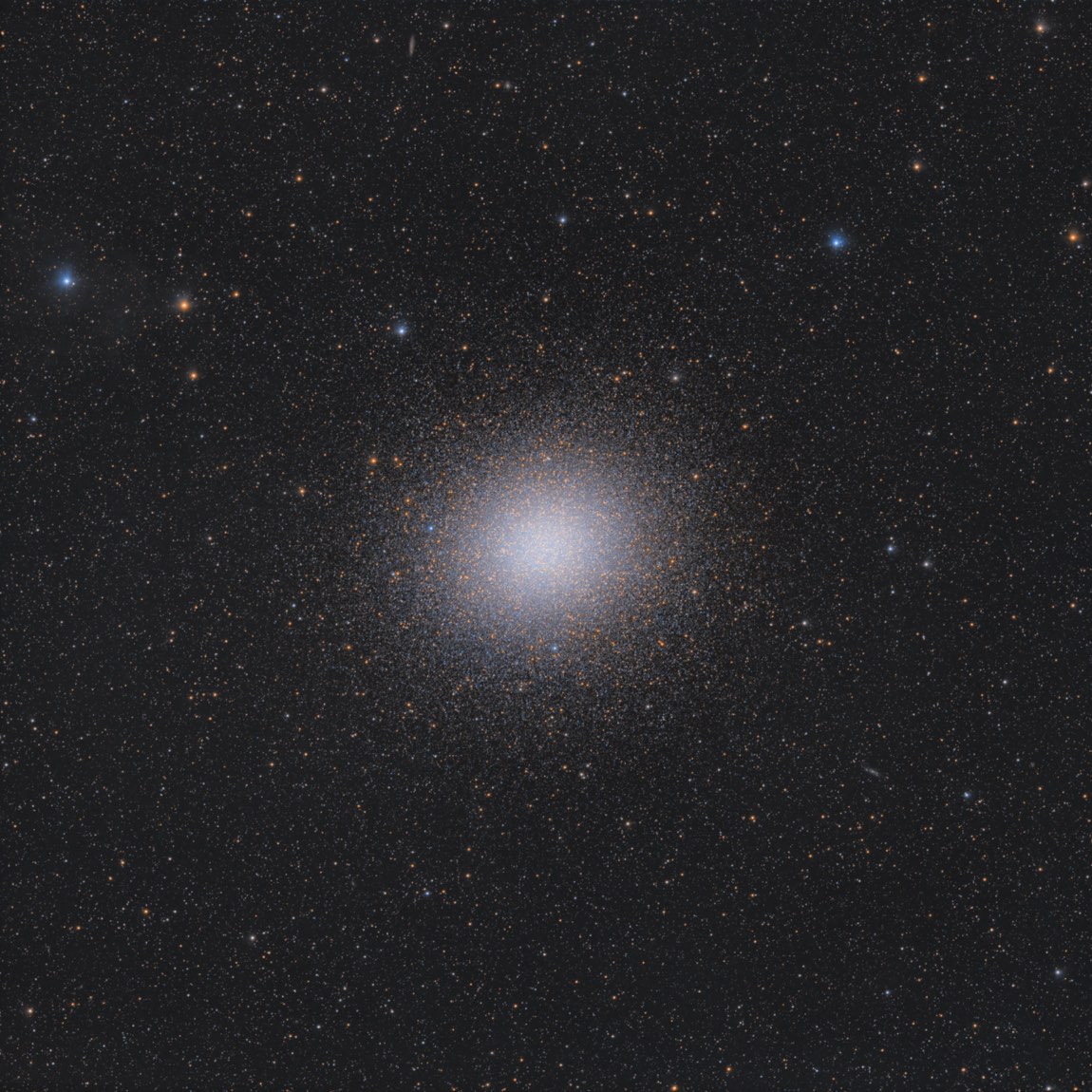
NGC 5286 is a globular cluster in Centaurus, lying just 4 arcminutes north of the naked-eye star M Centauri. James Dunlop listed it in his 1827 catalogue. It orbits in the Milky Way's halo and may be associated with the Monoceros Ring, a long stream of stars that could be the remains of a disrupted dwarf galaxy. At about 12.5 billion years old it may be among the galaxy's oldest globulars, and star motions in its core hint at a small central black hole.
The deep dive
Researched for the Atlas from Wikipedia — NGC 5286 (1,321 characters read) · updated Nov 15, 2026
01 A Scottish Astronomer Discovers It from Down Under
NGC 5286 was discovered by James Dunlop, a Scottish astronomer who carried out his observational work in Australia. He catalogued the cluster in 1827, making this one of the earlier systematic records of southern-hemisphere deep-sky objects. The southern sky holds a disproportionate share of the Milky Way's globular clusters because the galactic center lies in that direction, and observers in the northern hemisphere often miss them entirely. Dunlop's position in Australia put him in an ideal spot to sweep through Centaurus methodically. The cluster later received a second designation — Caldwell 84 — when amateur astronomer Patrick Moore compiled his own catalog of visually rewarding objects that Messier had overlooked. That dual naming is a small reminder of how astronomical history layers discoveries: a professional working in a colonial observatory in the 1820s and a popularizer in the late twentieth century both found the same object worth singling out.
02 Where Exactly It Sits in the Milky Way
NGC 5286 sits roughly 35,900 light-years from Earth and about 29,000 light-years — 8.9 kiloparsecs — from the Galactic Center. To put that second number in perspective, our solar system is about 26,000 light-years from the Galactic Center, so the cluster is not dramatically farther out than we are, yet it moves in an entirely different regime. Rather than orbiting in the flat, dusty galactic disk where stars and gas are constantly forming, NGC 5286 travels through the Milky Way's halo — the vast, sparsely populated spherical region that surrounds the disk. Halo objects follow orbits that can carry them far above and below the plane of the galaxy, largely insulated from the turbulent star-forming regions within the disk. The cluster is also conveniently close in projection to the naked-eye star M Centauri, lying just 4 arc-minutes to its north, which gives observers a helpful pointing landmark.
03 Reddening: How Dust Distorts Our View Deeper
Even at a halo distance, interstellar gas and dust between us and NGC 5286 scatter and absorb short-wavelength blue light more efficiently than long-wavelength red light — a process astronomers call interstellar reddening. For this cluster, the reddening is quantified as E(B – V) = 0.24 magnitude in the UBV photometric system. That value means the cluster appears noticeably redder and dimmer than it truly is, and any measurement of its intrinsic brightness or stellar temperatures must be corrected for this effect before it can be trusted. Getting that correction wrong would throw off distance estimates, age estimates derived from the color–magnitude diagram, and even the apparent metallicity of the stars. For NGC 5286, astronomers have to peel away almost a quarter of a magnitude of artificial reddening just to see the cluster's real colors — a routine but non-trivial step that illustrates how the interstellar medium constantly mediates our view of objects beyond it.
04 One of the Galaxy's Most Ancient Objects
The estimated age of NGC 5286 is 12.54 billion years, placing it among the oldest globular clusters known in the Milky Way. The universe itself is approximately 13.8 billion years old, which means this cluster began forming only a little more than a billion years after the Big Bang — when the cosmos was still in a comparatively early, chaotic state. At that epoch, the first generation of massive stars had already seeded space with heavier elements through supernova explosions, but the supply of those elements was still meager. Globular clusters born that early tend to have low metallicity, reflecting the chemical poverty of the gas clouds from which their stars condensed. The great age of NGC 5286 makes it scientifically valuable as a fossil record of conditions in the very young universe, and it means its stars have been orbiting their common center of gravity for essentially all of cosmic history.
05 Not Quite a Perfect Sphere
Globular clusters are often pictured as perfect, symmetrical balls of stars, but NGC 5286 departs subtly from that ideal. Its projected ellipticity is measured at 0.12, meaning the cluster's outline on the sky is slightly flattened rather than circular. Ellipticity values run from 0 for a perfect circle to 1 for a completely flat structure, so 0.12 is a modest but real deviation. Several physical mechanisms can produce this kind of flattening in a globular cluster: rotation of the cluster as a whole, tidal forces exerted by the Milky Way's gravity stretching it along its orbital path, or simply an asymmetric distribution of stars that has not yet been erased by the constant gravitational stirring between cluster members. Distinguishing between these causes requires detailed measurements of stellar velocities across the face of the cluster, and NGC 5286's slight ellipticity gives astronomers one more data point to work with when modeling how globular clusters evolve over billions of years.
06 The Hidden Black Hole at Its Core Deeper
One of the most intriguing possibilities raised by observations of NGC 5286 is that an intermediate-mass black hole lurks at its center. The evidence is indirect but physically coherent: by tracking how fast stars move at the core, astronomers measured a central velocity dispersion of (8.1 ± 1.0) km/s. When stellar velocities rise steeply toward a cluster's center, it can signal the gravitational pull of a compact massive object that is too dim to see directly. The analysis of NGC 5286 sets an upper limit of 6,000 solar masses for this hypothetical black hole — and it must represent less than 1% of the cluster's total mass. Intermediate-mass black holes, with masses between roughly a hundred and a million solar masses, occupy an important but poorly understood gap between the stellar-mass black holes formed by dying stars and the supermassive black holes at the centers of galaxies. If confirmed, the one in NGC 5286 would help bridge that gap, but it currently remains a possibility rather than a certainty.
07 A Relic of a Devoured Dwarf Galaxy Deeper
NGC 5286 may carry the genetic memory of a galaxy that no longer exists. It is identified as part of the Gaia Sausage — a structure named after the elongated, sausage-shaped distribution of stellar velocities first detected in data from the European Space Agency's Gaia satellite. The Gaia Sausage is interpreted as the debris of a dwarf galaxy that the Milky Way swallowed long ago, with the merger so violent and radial that the infalling galaxy's stars were scattered into highly elongated orbits. Globular clusters can be dragged along with their host galaxies during such mergers, essentially becoming orphans absorbed into the larger system. If NGC 5286 genuinely belongs to the Gaia Sausage, it did not form in the Milky Way's own protogalactic cloud but arrived as an immigrant, deepening its scientific interest as a probe of hierarchical galaxy assembly — the process by which large galaxies grow by consuming smaller ones.
08 The Monoceros Ring Connection Deeper
Beyond the Gaia Sausage, NGC 5286 may also be physically associated with a completely different structure: the Monoceros Ring, a vast and elongated stream of stars that wraps around the outer disk of the Milky Way. The Monoceros Ring is thought by some researchers to be the tidal debris left behind when a dwarf galaxy — possibly the Canis Major Dwarf — was gradually stripped apart by our galaxy's gravity over billions of years. If NGC 5286 is genuinely linked to the Monoceros Ring, it would suggest the cluster was once a satellite of that disrupted dwarf galaxy before the dwarf was torn to pieces. It is worth noting that the article flags this as a possibility rather than a confirmed association, and the relationship between the Monoceros Ring, the Gaia Sausage, and clusters like NGC 5286 is an active area of research where consensus has not yet fully settled.
09 How to Spot It in the Sky
For observers in the southern hemisphere or low northern latitudes, NGC 5286 is accessible through a moderate-aperture telescope. The easiest way to find it is to locate M Centauri, a star bright enough to see with the naked eye, and then nudge the view just 4 arc-minutes to the north. The cluster carries an apparent magnitude that makes it a rewarding but not trivial target — it rewards a dark sky. Interstellar reddening, as noted above, slightly dims and reddens its appearance relative to its intrinsic brightness, but through an eyepiece the cluster presents itself as a concentrated glow that larger apertures begin to resolve into individual stars at its edges. Its position in Centaurus means it culminates at a useful hour during southern autumn evenings, when the constellation rides high. Because it lies well south of the celestial equator, observers in northern Europe or Canada see it only briefly and low, if at all.
10 Stellar Velocities as a Scientific Instrument Deeper
The measured velocity dispersion at NGC 5286's center — (8.1 ± 1.0) km/s — is not just a curiosity; it is a primary tool for probing the cluster's gravitational structure. Velocity dispersion is a statistical measure of how widely individual stellar speeds vary around the mean motion of the cluster. A large dispersion near the core can indicate either an unusually dense concentration of mass there, such as a black hole, or simply a naturally dense, dynamically evolved stellar population. The ± 1.0 km/s uncertainty in the measurement is important: it reflects the limits of current observational precision and means the inferred black hole mass carries significant error bars. This kind of measurement requires spectroscopy of individual stars crowded into a small angular region of sky — technically demanding even with large modern telescopes. Improving the precision of such measurements is one pathway through which the intermediate-mass black hole hypothesis could move from plausible inference to confirmed detection or firm ruling-out.
11 What Its Great Age Tells Us About Star Formation
An age of 12.54 billion years places NGC 5286's birth deep in the epoch known as cosmic dawn, when the first structures in the universe were collapsing under gravity and igniting into stars. At that time, the chemical building blocks we associate with rocky planets — oxygen, silicon, iron, calcium — were far less abundant than they are today, because only a few generations of massive stars had lived and exploded to manufacture and distribute them. The stars inside NGC 5286 formed from whatever gas was available back then, gas that was dominated by the hydrogen and helium produced in the Big Bang, with only a thin sprinkling of heavier elements. This chemical poverty is a defining characteristic of old globular clusters. Studying the metallicity patterns of NGC 5286's stars — which elements are present and in what proportions — lets astronomers reconstruct the nucleosynthetic history of the early universe and understand how the first stars enriched their surroundings before the cluster ever fully assembled.