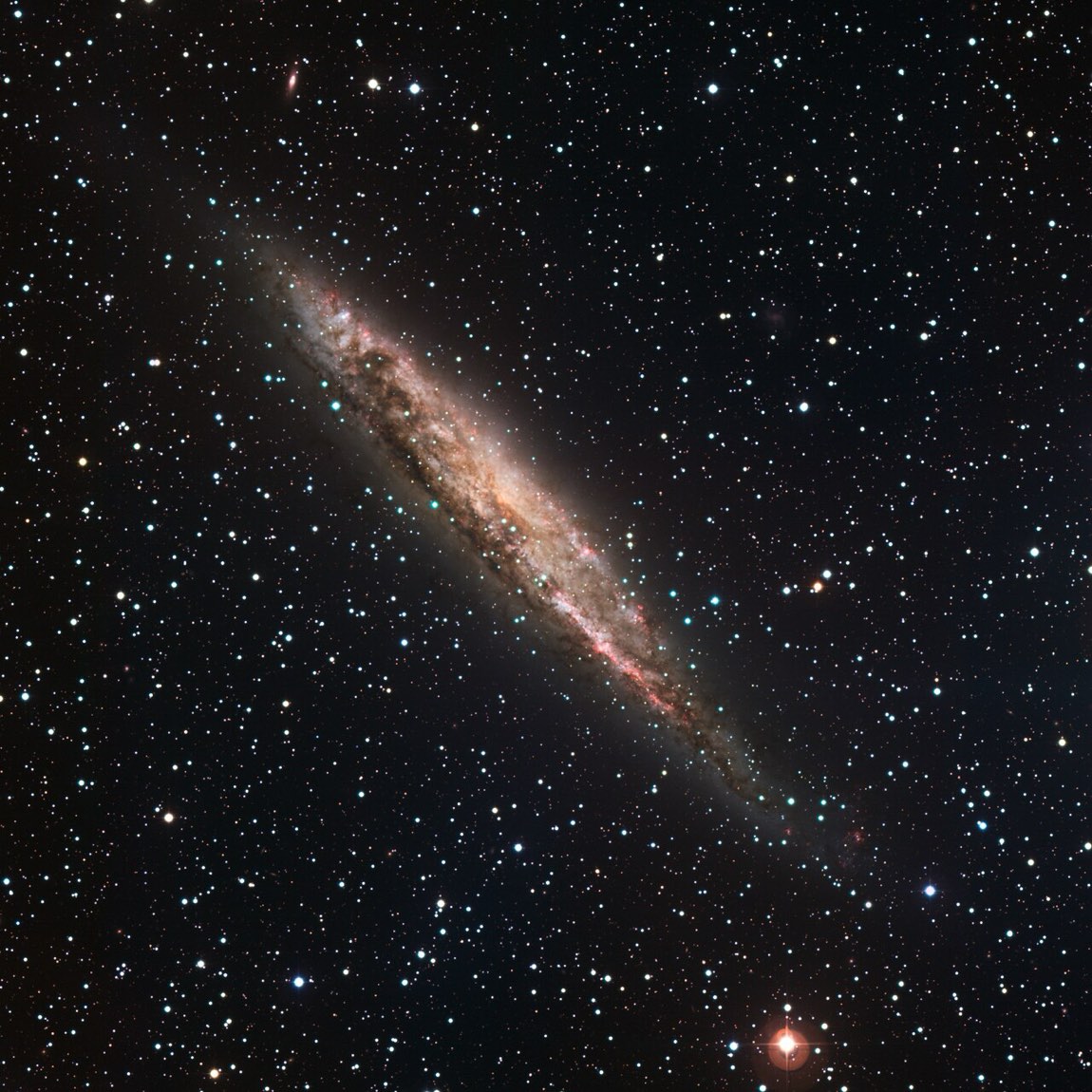
 Photograph · ESO · CC BY 4.0
Galaxy · Deep guide
NGC 4945
Also called: Caldwell 83 · NGC 4945
An edge-on spiral in Centaurus hiding one of the nearest active galactic nuclei.
What is it?
NGC 4945 is a barred spiral galaxy in Centaurus that we see exactly edge-on. James Dunlop discovered it in 1826. It belongs to the Centaurus A/M83 group and is the second-brightest galaxy in the subgroup around Centaurus A. Its core hosts one of the closest active galactic nuclei to Earth, classed as a Seyfert 2, and the galaxy is thought to be broadly similar to the Milky Way.
The deep dive
Researched for the Atlas from Wikipedia — NGC 4945 (4,444 characters read) · updated Nov 15, 2026
01 Two Names for One Striking Galaxy
NGC 4945 goes by several names, each reflecting a different chapter in how astronomers have catalogued the sky. It is listed as Caldwell 83 in Patrick Caldwell-Moore's popular observing catalogue, but its more evocative nicknames — the Gold Dollar Galaxy and the Tweezers Galaxy — hint at its distinctive appearance when seen through a telescope. Scottish astronomer James Dunlop first recorded it in 1826, working from the southern hemisphere where the galaxy rides high enough in the constellation Centaurus to be studied properly. It sits close in the sky to Xi Centauri, an optical double star that serves as a convenient signpost for observers hunting it down. The name Punctum — Latin for 'point' or 'dot' — was later given to a mysterious compact object discovered within it in 2023, adding yet another layer of nomenclature to this already richly labelled system.
02 A Galaxy Seen Perfectly Edge-On
NGC 4945 is tilted almost exactly towards us — its inclination to the plane of the sky is 90°, meaning we see its galactic disk edge-on, like looking at a dinner plate from across the table rather than from above. Its morphological classification is SB(s)cd?, which unpacks into a great deal of information: it is a barred spiral (SB), it lacks an inner ring structure (s), and its spiral arms are probably loosely wound (cd), though a question mark flags genuine uncertainty about that last detail. Most of the galaxy's disk follows a linear rotation curve, spinning at a maximum of roughly 180 km/s — somewhat slower than the Milky Way's own rotation. The southwest region, however, shows an infall pattern that researchers interpret as the gravitational signature of the bar structure pulling gas inward.
03 Mass, Stars, and a Milky Way Twin Deeper
Astronomers estimate the total combined mass of NGC 4945 at 1.4 — with an uncertainty range from 0.7 to 2.8 — times 10 to the power of 11 solar masses, making it comparable in heft to the Milky Way. The stellar component alone accounts for 3.8×10¹⁰ solar masses, or 38 billion times the mass of our Sun. That resemblance to the Milky Way extends beyond mass: NGC 4945 is thought to be a genuinely similar system, a barred spiral of roughly the same scale, though the somewhat lower maximum rotation rate suggests it may be modestly less massive overall. Its halo is metal-rich and relatively massive at approximately 3.5×10⁹ solar masses — both characteristics typical of Milky Way-class galaxies — reinforcing the comparison. Understanding NGC 4945 therefore gives astronomers a kind of external mirror in which to study processes that are difficult to observe from inside our own galaxy.
04 A Galactic Neighbourhood: The Centaurus A Group
NGC 4945 is not an isolated object. It belongs to the Centaurus A/M83 Group, described in the article as a large, nearby collection of galaxies. Within that group, NGC 4945 ranks as one of the brightest members overall and holds the position of second brightest galaxy in the subgroup gathered around Centaurus A. At a distance of approximately 11.0 million light-years — or 3.36 megaparsecs — from the Milky Way, it is close enough on the cosmic scale to be studied in considerable detail, which is one reason it has attracted so much scientific attention. Its proximity also made it historically significant: NGC 4945 was the first galaxy outside the Local Group in which individual stars in the galactic halo were resolved, a milestone that opened new possibilities for studying stellar populations in nearby but extra-Local-Group systems.
05 A Hidden Monster: The Obscured Active Nucleus
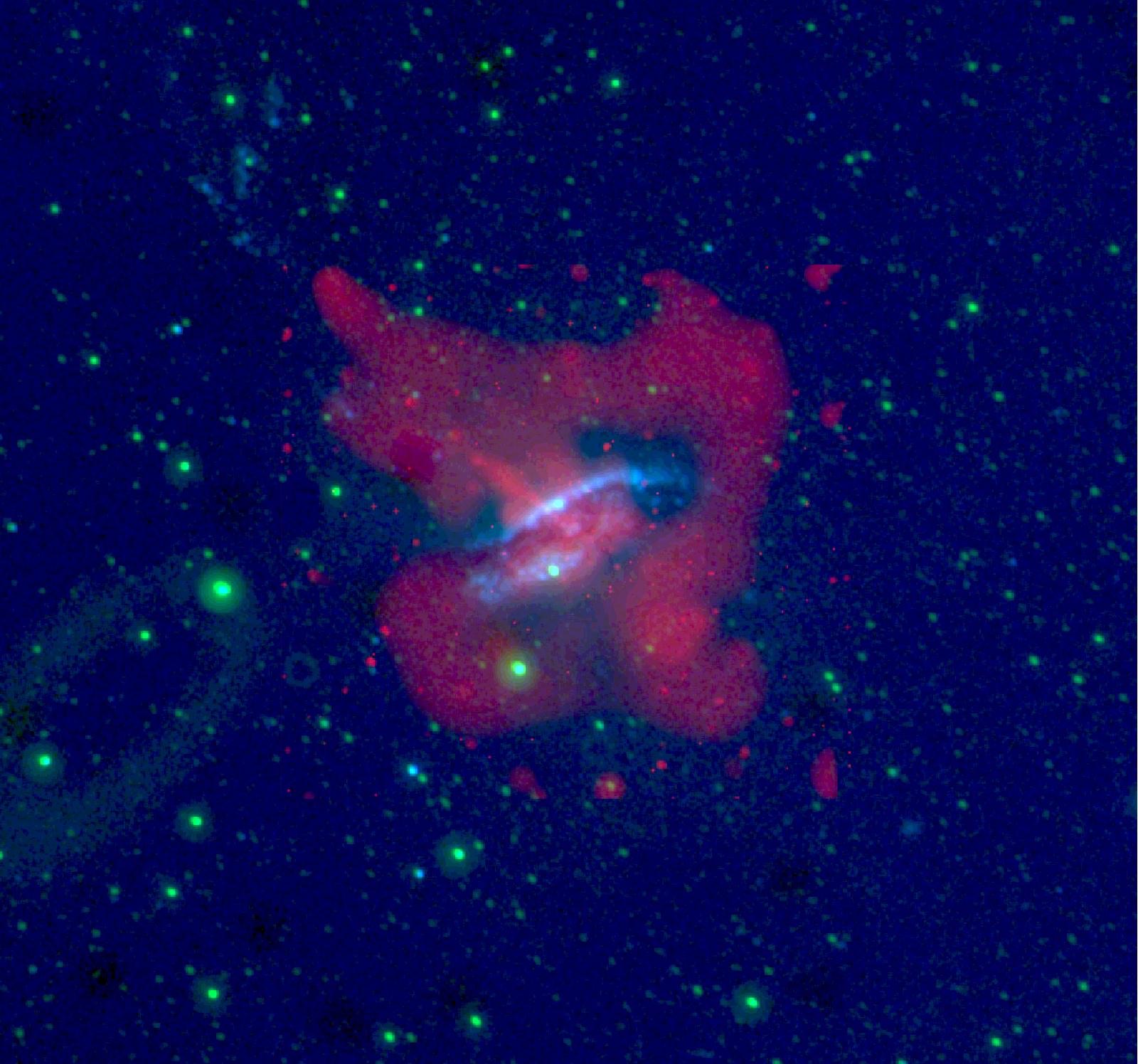
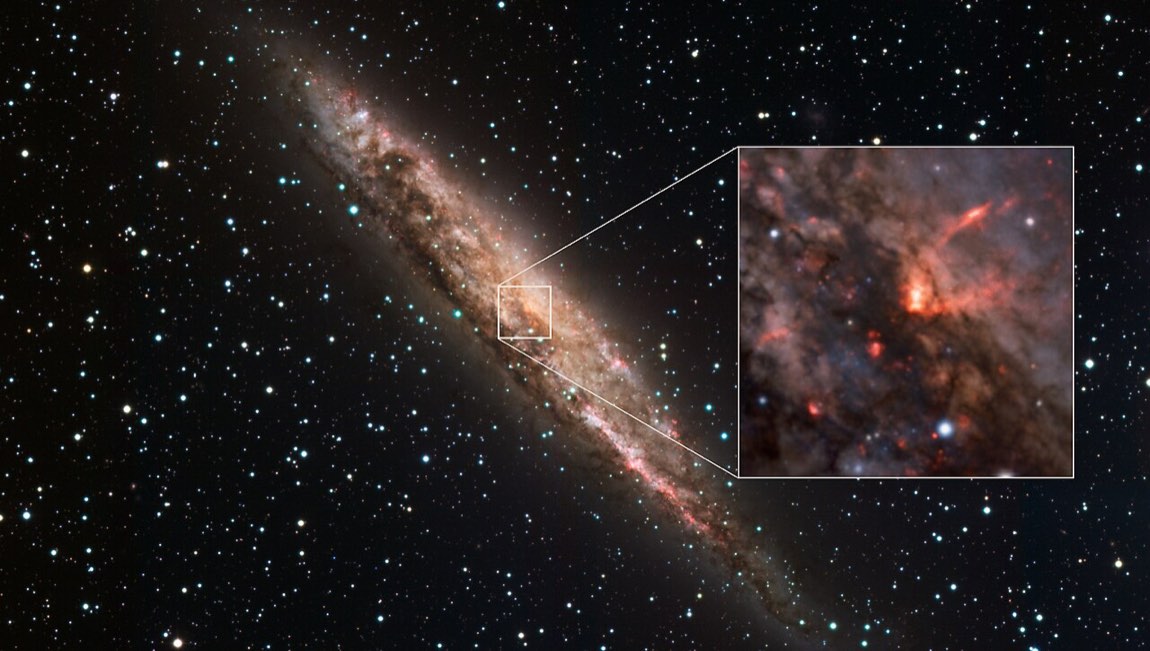
At the heart of NGC 4945 sits an active galactic nucleus classified as Seyfert type 2 — meaning the central engine is there, energetic, but hidden. The nucleus is heavily obscured by dust in visible light, yet it blazes in both infrared and hard X-rays. In fact, NGC 4945 is the second strongest emitter of hard X-rays among known galaxies, surpassed only by NGC 4151. X-ray emission from the nuclear region confirms the Seyfert 2 classification, and the galaxy is widely believed to harbour a supermassive black hole driving that activity. The dust lanes responsible for the obscuration don't just drift near the nucleus — they approach it and wind into a tightly bound structure within the inner 650 light-years (200 parsecs), creating a dense cocoon that hides the action from optical telescopes while remaining transparent to infrared and X-ray instruments.
06 Starburst Fires Burning at the Core Deeper
Alongside its active nucleus, NGC 4945 hosts an intense starburst region — an area of furious star formation that contributes at least half of the total luminosity coming from the core. This starburst is thought to be at least 5 million years old and is concentrated in a remarkably compact zone just 330 light-years (100 parsecs) across. Within that space lie dense molecular clouds, a disk of dust and gas, and many rich star clusters. The energy released by the resulting supernovae has carved out a conical cavity, essentially a bubble blown by the combined force of stellar explosions. Those same supernovae drive a hot wind of gas away from the nuclear region at a rate of 1.6 solar masses per year — material that the galaxy is steadily expelling into its surroundings. The galaxy was classified as a radio source as early as 1964 at Parkes Observatory, and its infrared brightness — it ranks third in the IRAS point source catalogue — reflects the heat generated by this star-forming engine.
 ⤢
07 Water Masers and What They Reveal Deeper
In 1979, astronomers detected strong water maser emission from the central region of NGC 4945. Masers — the microwave analogue of lasers — occur when clouds of molecules, in this case water (H₂O), are excited by intense radiation and emit highly concentrated beams of microwave energy. Their detection is significant because masers of this kind are typically found in regions of dense gas very close to active galactic nuclei or powerful star-forming zones, and they serve as precise probes of conditions and geometry that would otherwise be impossible to measure. The presence of strong H₂O maser emission in NGC 4945 is fully consistent with the dual nature of its core: a region that simultaneously shows properties of a Seyfert galaxy and an intense starburst, with a complex, layered structure at its heart.
08 An Accreted Halo Spinning the Wrong Way Deeper
The stellar halo of NGC 4945 tells a story of galactic cannibalism. It appears to be counter-rotating relative to the main disk — spinning in the opposite direction — which astronomers interpret as strong evidence that the halo was not formed alongside the disk but was instead accreted, meaning the galaxy absorbed a smaller companion over time. The mass of the dominant satellite that was swallowed is estimated at approximately 1.5×10⁹ solar masses, which is roughly comparable to the Large Magellanic Cloud, one of the Milky Way's own satellite galaxies. The halo itself has a total mass of around 3.5×10⁹ solar masses and is notably metal-rich. The historical significance of this halo is considerable: NGC 4945 was the first galaxy outside the Local Group where individual stars in the halo were resolved, a feat that allowed these structural and compositional properties to be measured directly.
09 Punctum: An Unexplained Object Within
In October 2023, astronomers using the ALMA radio telescope array discovered a puzzling compact object approximately 200 light-years from the centre of NGC 4945. Named Punctum — Latin for 'point' or 'dot' — it is a highly polarized source of millimeter-wavelength synchrotron radiation, the kind produced by electrons spiralling through magnetic fields at close to the speed of light. Its luminosity is striking: Chandra X-ray archive data record an X-ray luminosity of 1×10³⁷ erg per second in the 3–6 keV range, while ATCA radio data show a radio luminosity of 5×10³⁵ erg per second at 23 GHz. In a paper published in July 2025, the research team noted that Punctum most resembles a magnetar — an extraordinarily magnetized neutron star — because of its polarization fraction of 50% ± 14%. However, they also acknowledged that the millimeter luminosity of known magnetars is usually far lower, leaving Punctum's true nature an open question.
10 Two Supernovae and What They Left Behind
NGC 4945 has hosted two observed supernovae in recent decades, both of Type II-P — the most common variety, produced when a massive star exhausts its fuel and collapses. SN 2005af was discovered on 8 February 2005 by the CEAMIG/REA Supernovae Search and reached a peak brightness of magnitude 12.5 just four days later on 12 February, making it briefly visible to modest amateur telescopes. The second, SN 2011ja, was found by observer Berto Monard on 18 December 2011 and proved even more spectacular, peaking at magnitude 11.7 on 9 January 2012 — bright enough to be followed in considerable detail. Analysis of the progenitor star of SN 2011ja suggests it may have been a massive star of around 25 solar masses embedded in a massive stellar cluster, linking the explosion directly to the kind of dense, cluster-rich environment found in NGC 4945's active core region.
11 How to Find NGC 4945 in the Night Sky
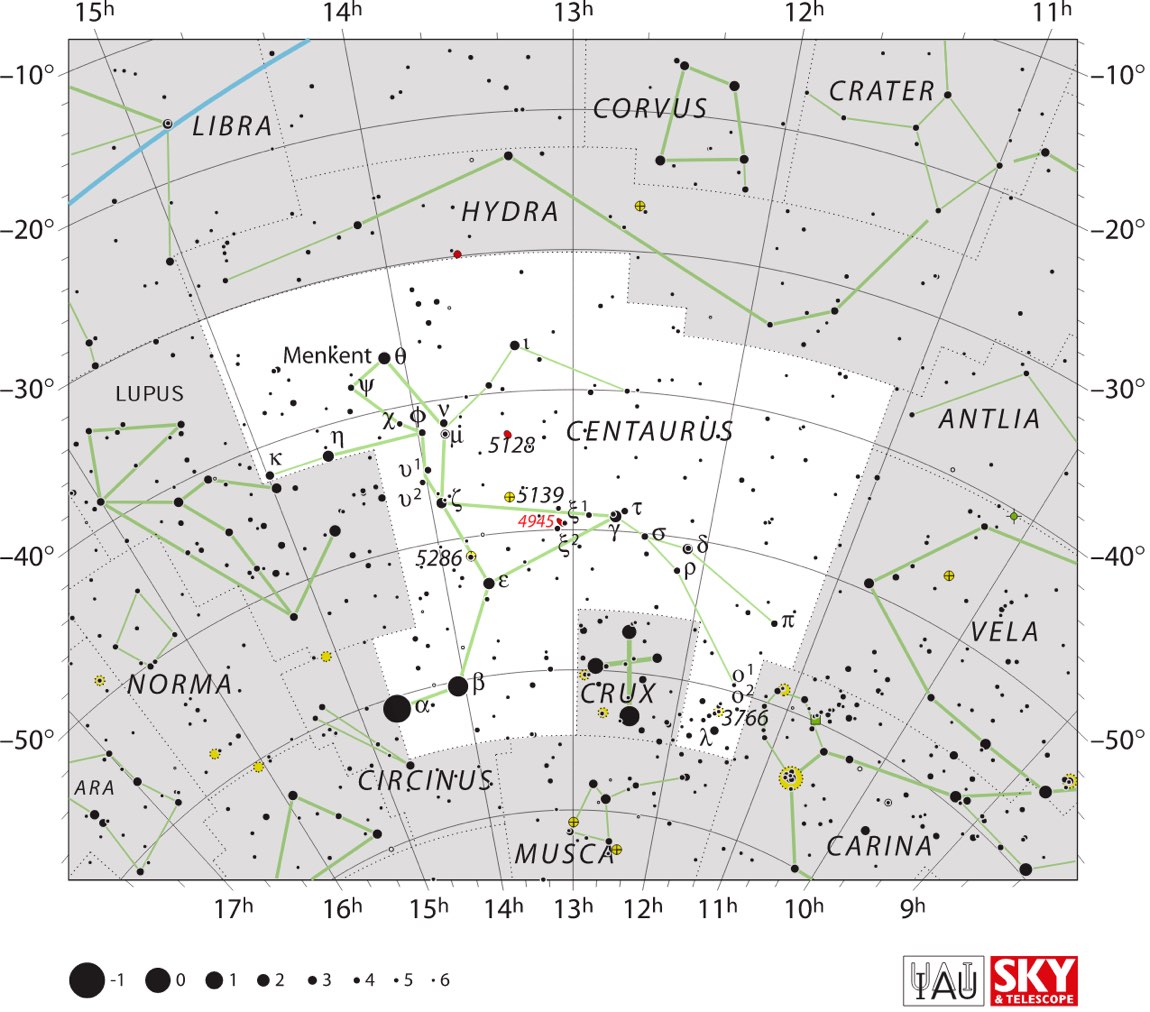
NGC 4945 sits in the constellation Centaurus, a southern-sky constellation that never rises above the horizon for observers at mid-northern latitudes, making it essentially a southern-hemisphere target. The nearby optical double star Xi Centauri serves as a useful finder's landmark, sitting close to the galaxy on the sky. With an apparent magnitude that places it among the brighter galaxies in the Centaurus A group, it is accessible through modest amateur telescopes under good conditions, though its edge-on orientation — the galactic disk tilted at 90° to our line of sight — means it appears as an elongated sliver of light rather than the face-on spiral shape many galaxy hunters expect. Infrared and radio telescopes reveal far more of its true character, since the most dramatic activity in its nucleus is invisible in ordinary light.
 ⤢