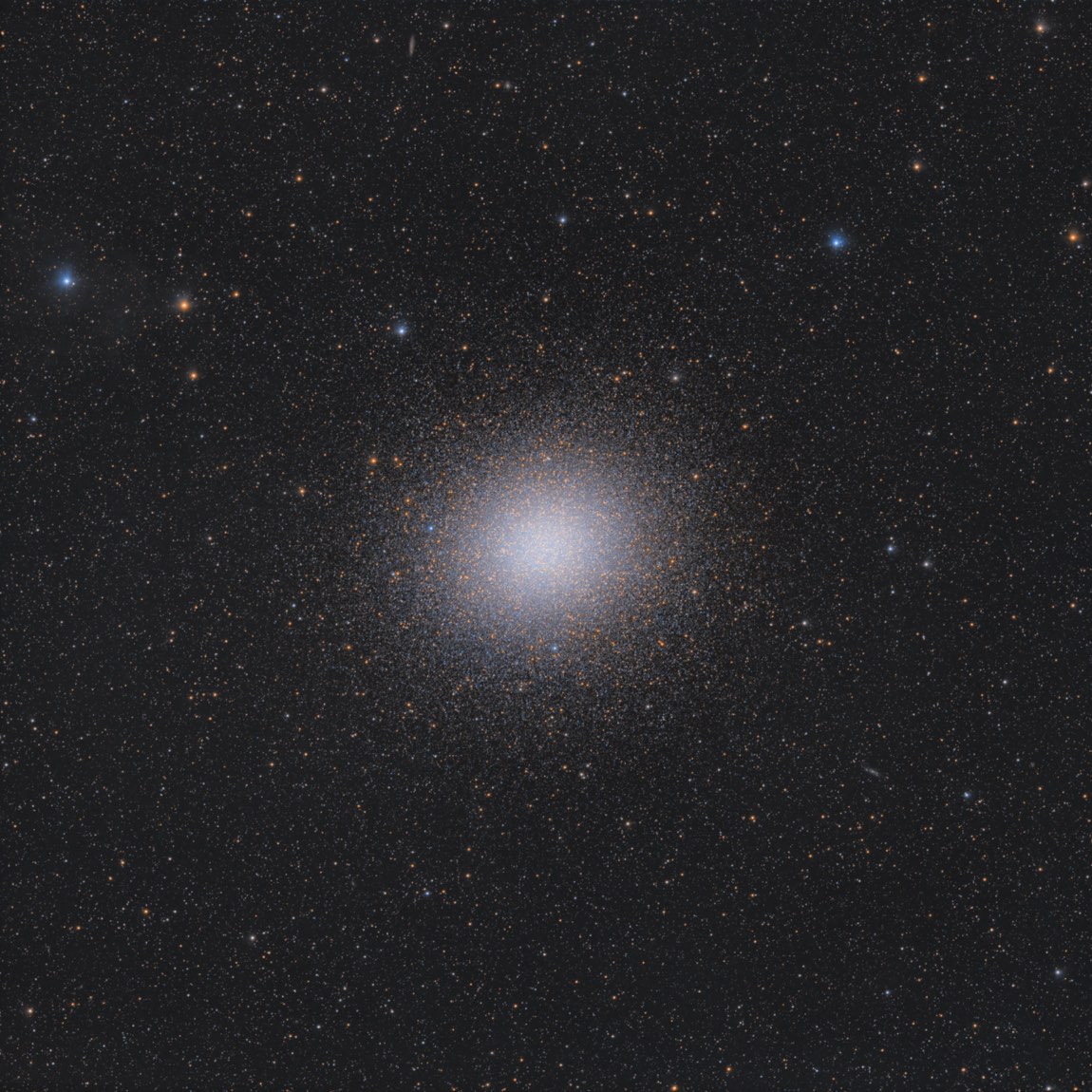
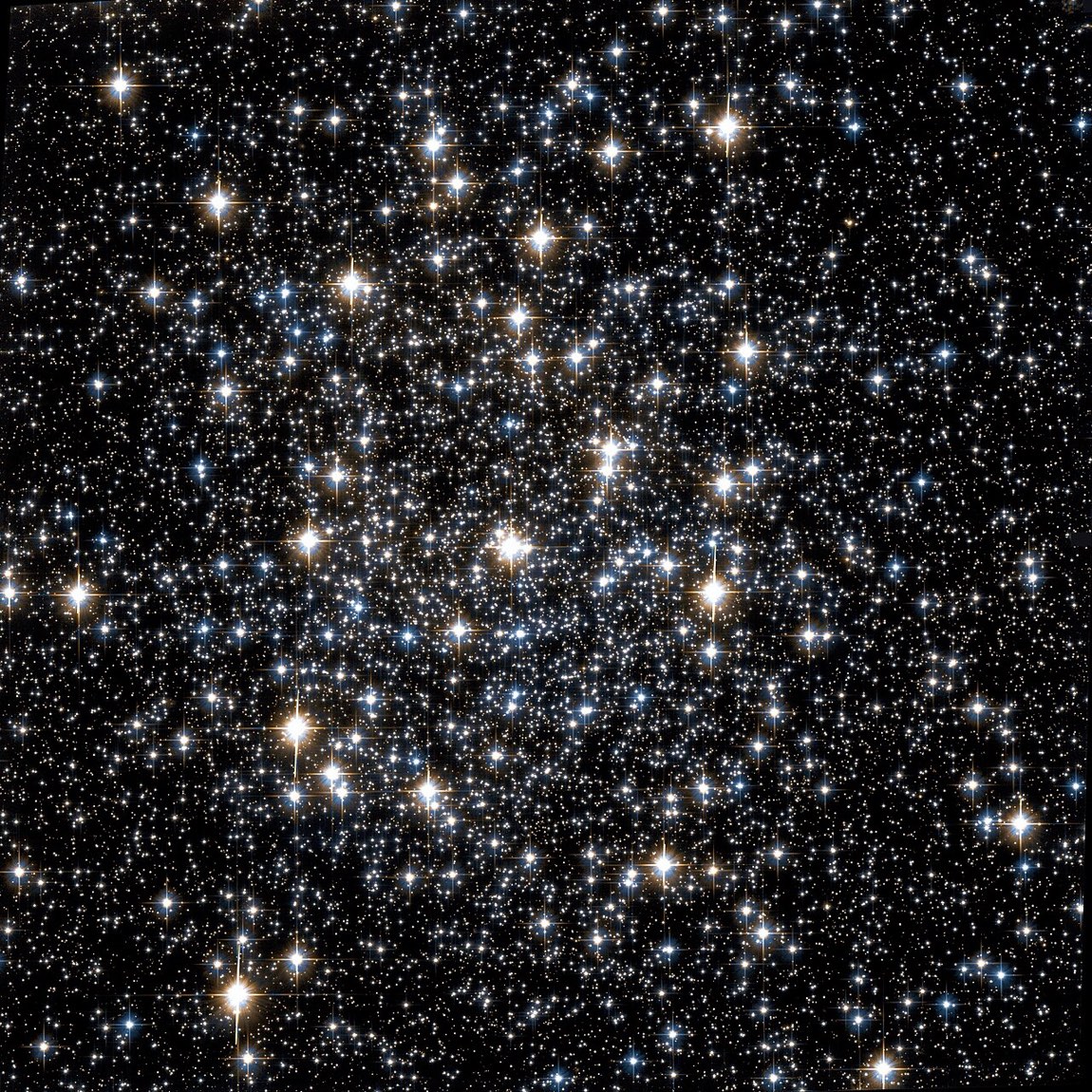
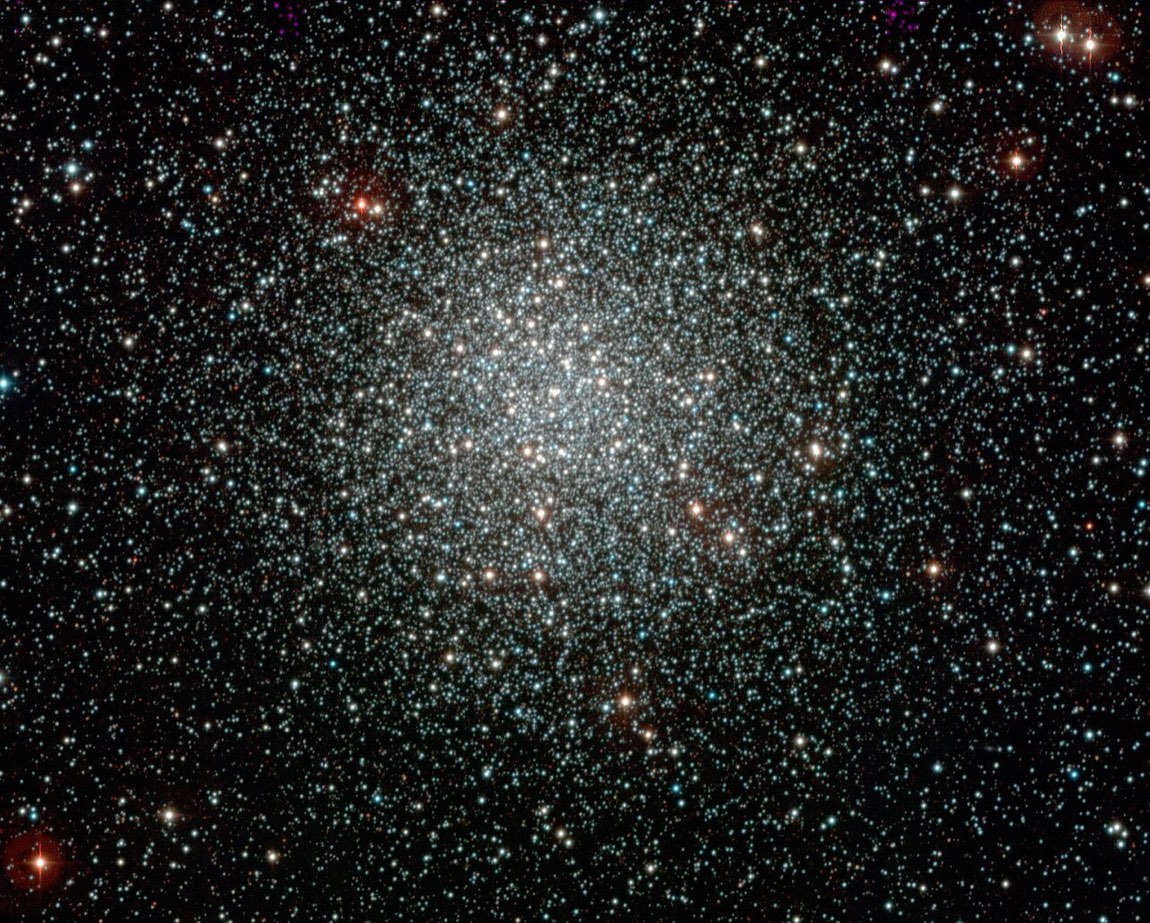
 Photograph · en:NASA , en:STScI , en:WikiSky · Public domain
Star Cluster · Deep guide
NGC 3201
Also called: Caldwell 79 · NGC 3201
A loose globular cluster racing through the galaxy faster than any other known.
What is it?
NGC 3201 is a globular cluster in Vela, discovered by James Dunlop in 1826. Unlike most globulars it has a very loose core. Its radial velocity of about 490 km/s is larger than that of any other known globular cluster, though it is still below the Milky Way's escape speed. It holds about 157,000 solar masses of stars, and its stellar population changes with distance from the centre.
The deep dive
Researched for the Atlas from Wikipedia — NGC 3201 (1,977 characters read) · updated Nov 15, 2026
01 James Dunlop and the 1826 Discovery
NGC 3201 was discovered by Scottish-Australian astronomer James Dunlop on May 28, 1826, and formally catalogued in his 1827 publication. His description is remarkably detailed for the era: he called it "a pretty large pretty bright round nebula, 4′ or 5′ diameter, very gradually condensed towards the centre, easily resolved into stars; the figure is rather irregular, and the stars are considerably scattered on the south." What is striking about Dunlop's account is how accurately it captures two features that modern astronomers would later measure precisely — the loose, low-concentration structure and the slight asymmetry in the star distribution. He made these observations from Parramatta, Australia, one of the few southern-hemisphere observing stations active at the time, which is why a cluster so prominent in the southern sky had to wait until the 19th century for its formal documentation. The cluster also carries the designation Caldwell 79, placing it in Patrick Caldwell-Moore's catalogue of non-Messier deep-sky objects.
02 A Cluster Racing Through the Galaxy
NGC 3201 moves through the Milky Way at a radial velocity of 490 km/s — faster than any other globular cluster known at the time this was recorded. To put that in perspective, 490 km/s is roughly 1.76 million kilometres per hour, fast enough to cross the diameter of Earth in under a second. This extreme speed translates into a peculiar velocity of 240 km/s, meaning the cluster is moving 240 km/s faster than would be expected from simple orbital motion around the galactic centre. Despite this, the cluster is not an escapee: its velocity remains below the escape velocity of the Milky Way galaxy, so it remains gravitationally bound to our galaxy. This unusual kinematic signature has led astronomers to speculate about NGC 3201's history — whether it was captured from a satellite galaxy or was flung into its current trajectory by some ancient gravitational interaction deep in the Milky Way's past.
03 Low Concentration: Stars with Room to Breathe
One of the most distinctive structural features of NGC 3201 is its very low central concentration of stars. Many globular clusters pack their stars so tightly toward the centre that the core appears almost stellar to the naked eye through a telescope. NGC 3201 is the opposite — its stars are spread loosely, the centre is only gradually brighter than the outskirts, and there is no sign that it is anywhere near undergoing core collapse, the process by which a cluster's centre contracts to extreme density. This openness is not just an aesthetic detail; it has profound physical consequences. A less dense core means stars interact with one another less frequently, gravitational encounters are gentler, and — critically for black hole research — massive dark objects can persist in the core without being quickly ejected by repeated stellar interactions. The low concentration is therefore a window into NGC 3201's dynamical history and a key reason scientists targeted it for black hole searches.
04 A Star Population That Changes With Depth Deeper
NGC 3201 has an inhomogeneous stellar population — the mix of stars changes depending on how far from the core you look. Specifically, the effective temperature of stars increases with distance from the centre, meaning the hotter, bluer stars tend to inhabit the cluster's outer zones while the cooler, redder stars are preferentially found closer to the core. This kind of spatial segregation by stellar temperature and colour is not trivially explained and points to processes — likely a combination of mass segregation through gravitational dynamics and possibly differences in the original stellar population across the cluster — that are still being worked out. As of 2010, NGC 3201 was one of only two globular clusters confirmed to show a definite inhomogeneous population in this way, sharing that distinction with Messier 4. The rarity of this confirmed inhomogeneity makes NGC 3201 a particularly valuable laboratory for understanding how globular clusters evolve internally over billions of years.
05 Ten Billion Years of Stellar History
NGC 3201 is estimated to be approximately 10.24 billion years old. For comparison, the Solar System is about 4.6 billion years old, meaning this cluster was already more than halfway through its current age when the Sun and Earth formed. At that antiquity, the cluster's stars are overwhelmingly old, low-mass objects — the massive stars that once burned brilliantly have long since ended their lives, many of them collapsing into the neutron stars and black holes that now populate the cluster's interior. The cluster sits at a distance of 16,300 light-years from the Sun, placing it within the Milky Way's halo but not at an extreme remove. It lies in the southern constellation of Vela and at a low galactic latitude, meaning it is seen against a relatively crowded backdrop of Milky Way stars, which complicates but does not prevent careful study of its individual members.
06 A Swarm of Black Holes in the Core
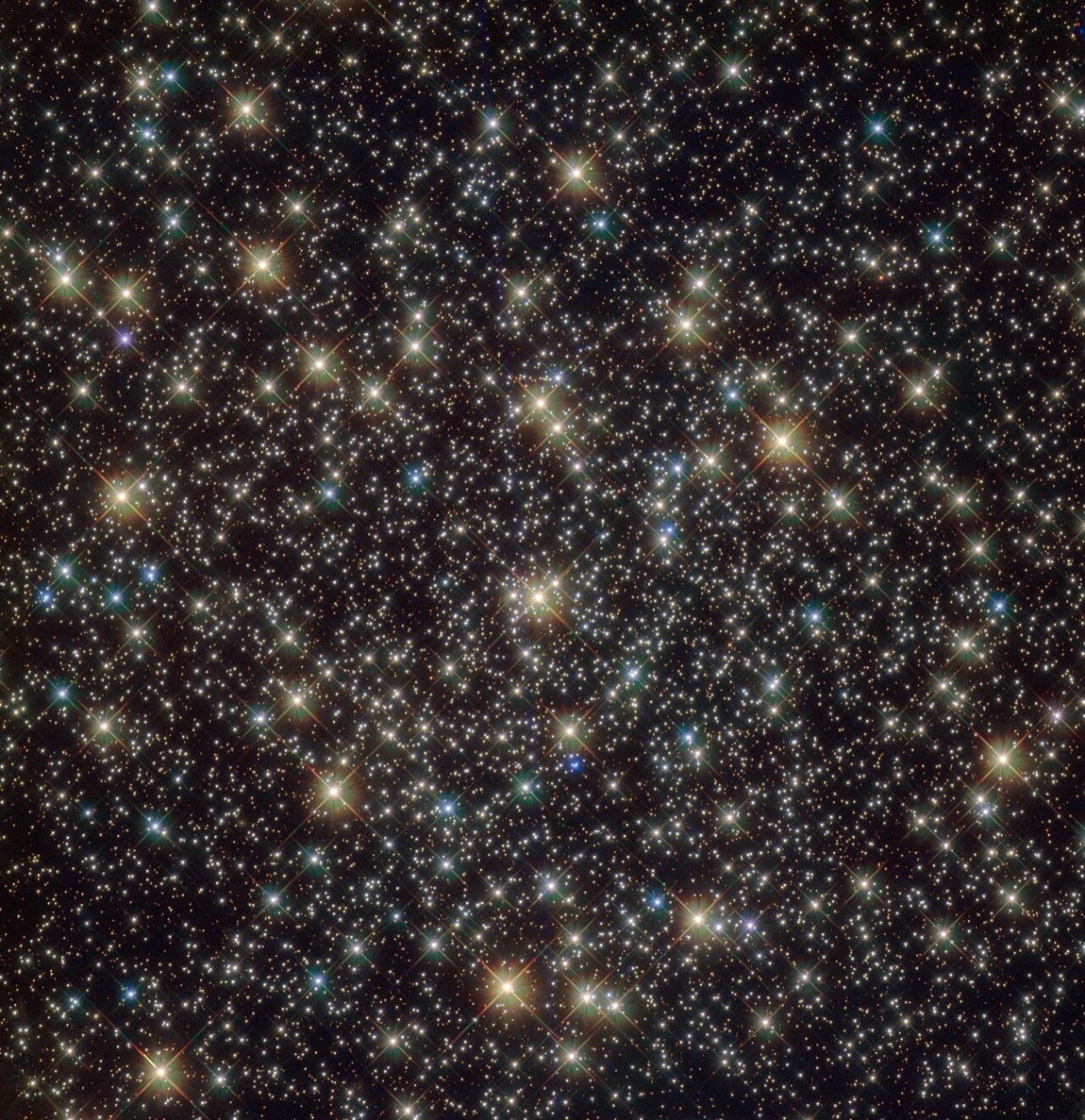
Because NGC 3201 is a low-density cluster not undergoing core collapse, astronomers have long theorised that its core could retain a substantial population of stellar-mass black holes rather than expelling them through repeated gravitational encounters. Direct evidence arrived through careful analysis of stellar motions. Data gathered by the Hubble Space Telescope and the European Space Agency's Gaia spacecraft revealed that stars near the cluster's core are moving in ways that imply a hidden concentration of mass — a sub-cluster of stellar-mass black holes with a combined mass of roughly a thousand solar masses. That is roughly a thousand times the mass of our Sun, all packed into a relatively small region of the cluster's heart. Dynamical simulations carried out in the same 2022 study extended this finding further, suggesting the sub-cluster could contain nearly a hundred individual black holes. The discovery turns NGC 3201 into one of the richest known reservoirs of black holes in a single star cluster.
 ⤢
07 How Hubble and Gaia Revealed Hidden Mass Deeper
The detection of NGC 3201's black hole sub-cluster relied on an elegant combination of two space observatories working in complementary ways. The Hubble Space Telescope provided high-resolution imaging that allowed astronomers to track the precise positions and motions of individual stars within the cluster's crowded core — a region where ground-based telescopes struggle to separate neighbouring stars. The European Space Agency's Gaia spacecraft contributed its own astrometric data, measuring stellar positions and proper motions across the whole cluster with extraordinary precision. By combining these two datasets, researchers were able to construct a detailed velocity map of stars near the cluster centre. Stars moving faster than their neighbours — or following paths that curve unexpectedly — betray the gravitational pull of unseen massive objects. The 2022 study used these signatures to infer both the total mass of the hidden population and, through dynamical simulations, to estimate that the sub-cluster likely consists of close to a hundred individual black holes rather than a single massive object.
08 Black Holes Caught Orbiting Living Stars
Beyond the statistical inference from stellar velocities, a few black holes in NGC 3201 have been detected more directly — identified because they orbit nearby visible stars, forming binary systems. In such a pairing, the black hole's gravity tugs on its stellar companion, causing the companion's light to shift back and forth in a telltale Doppler pattern as the two objects orbit each other. This technique, well established in the search for exoplanets and compact objects in the Milky Way's field population, becomes especially powerful in a globular cluster because the stars can be studied individually over time. Finding black holes still bound to stellar companions is itself significant: it implies the black holes were not kicked out of the cluster at birth by the explosive asymmetry of their forming supernovae, or at least not kicked hard enough to escape. This restraint is consistent with NGC 3201's low-density environment, where ejection through repeated gravitational scattering is also relatively slow.
09 An Estimated Mass of 157,000 Suns
NGC 3201 carries an estimated total mass of 157,000 times the mass of the Sun — a figure that encompasses all the visible stars, stellar remnants such as white dwarfs and neutron stars, and now the confirmed population of stellar-mass black holes. To put 157,000 solar masses into perspective, if you could somehow replace our Sun with this cluster, it would outweigh the Sun by a factor of over 150,000, yet the cluster's stars are spread across a region tens of light-years wide rather than concentrated in a single point. The mass figure matters for understanding the cluster's future. A globular cluster loses mass over time through stellar evolution and through dynamical evaporation — stars gaining enough speed from gravitational encounters to escape the cluster's gravity. At 157,000 solar masses and 10.24 billion years old, NGC 3201 is a survivor, but it is also slowly dissolving, its outer stars drifting away into the Milky Way's halo over cosmic timescales.
10 Observing NGC 3201 from Earth
NGC 3201 has an apparent magnitude that places it within reach of moderate amateur telescopes, and its position in the southern constellation of Vela means it is best observed from the Southern Hemisphere or from low northern latitudes. Its low galactic latitude — meaning it lies close to the plane of the Milky Way as seen from Earth — places it in a rich star field, which adds visual drama but also means background stars can be confused with cluster members in photographs. The cluster's very low central concentration is immediately visible through a telescope: even at modest magnification it begins to resolve into individual stars rather than presenting the compact, hazy nucleus seen in denser clusters. This looseness makes it a satisfying target for observers who want to pick out individual stars rather than simply detect a fuzzy glow. Its Caldwell catalogue number, C79, appears in many amateur observing lists alongside its NGC designation.
11 Open Questions Surrounding NGC 3201 Deeper
Despite the discoveries of recent years, NGC 3201 poses several open questions. The origin of its extraordinary radial velocity of 490 km/s — the highest known among globular clusters — remains debated. Was the cluster accreted from a dwarf galaxy that merged with the Milky Way long ago, arriving with that galaxy's orbital velocity? Or was it accelerated by some gravitational slingshot event within the Milky Way itself? Its inhomogeneous stellar population, shared as of 2010 only with Messier 4, also lacks a fully accepted explanation. Additionally, while the 2022 study estimates a sub-cluster mass of roughly a thousand solar masses and suggests nearly a hundred black holes, these figures are model-dependent — the actual number could differ if the dynamical simulations do not perfectly capture the cluster's history. Future observations with next-generation telescopes may sharpen these estimates and finally resolve how this ancient, fast-moving, black-hole-rich cluster came to be what it is.
 ⤢