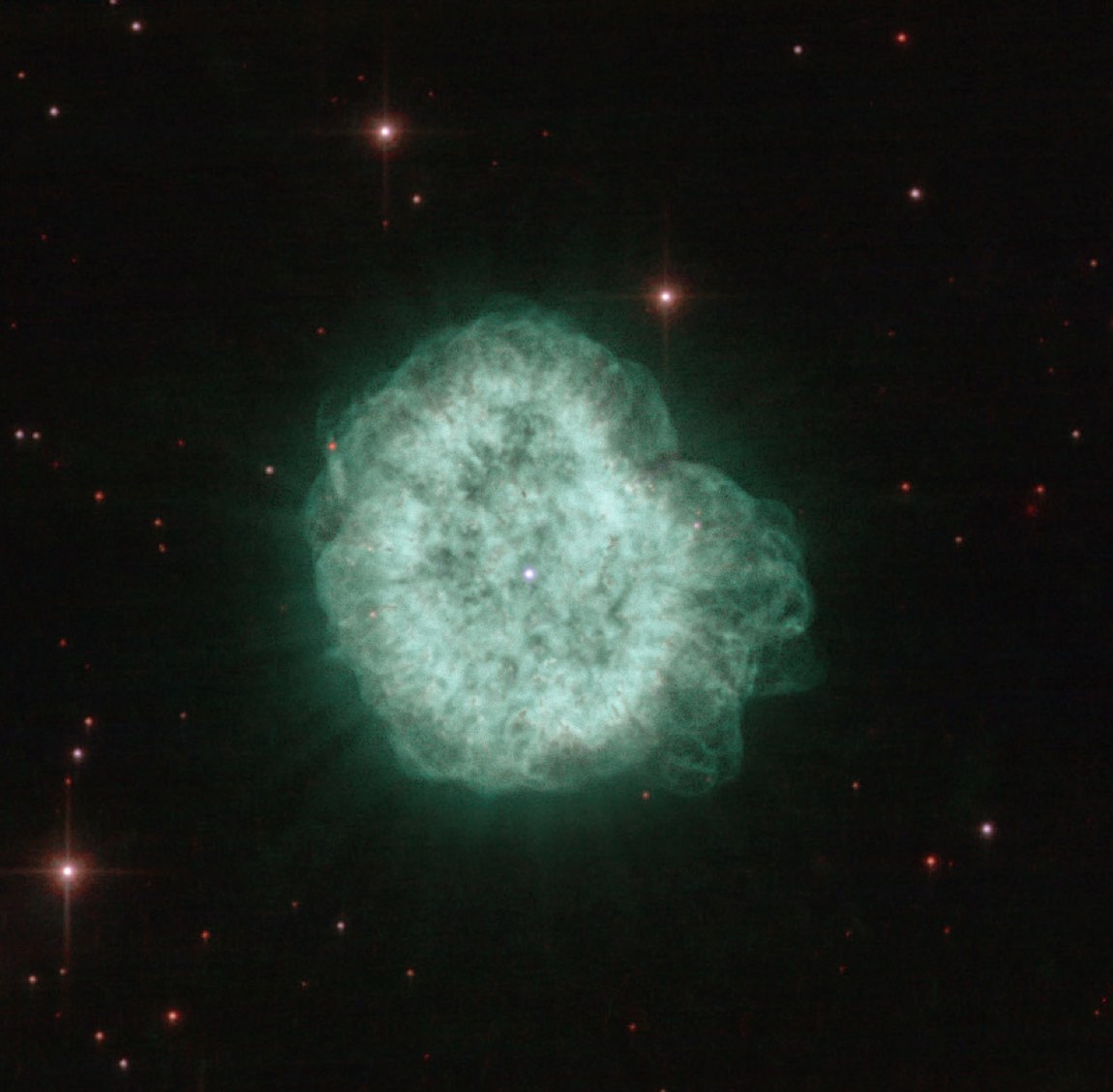
 Photograph · Judy Schmidt · CC BY 2.0
Nebula · Deep guide
NGC 2867
Also called: Caldwell 90 · NGC 2867
A planetary nebula John Herschel briefly mistook for a new planet.
What is it?
NGC 2867 is an elliptical planetary nebula in Carina, just over a degree from the star Iota Carinae. John Herschel found it on 1 April 1834 and wondered if it might be a new planet, but it had not moved the next night. Its central star is a hot, hydrogen-poor Wolf–Rayet-type star turning into a white dwarf; it pulsates slightly and shines about 1,400 times brighter than the Sun. Carbon in the nebula hints that the original star was not especially massive.
The deep dive
Researched for the Atlas from Wikipedia — NGC 2867 (1,392 characters read) · updated Nov 15, 2026
01 A Mistaken Planet That Stayed Put
When John Herschel swept his telescope across the southern skies on April 1, 1834, he spotted something that stopped him cold — a compact, disk-like glow that looked uncomfortably like a new planet in the solar system. The date alone might invite suspicion, but Herschel was methodical. He returned the following night and checked whether the object had drifted against the background stars the way a planet in our solar system must. It had not moved even a fraction. That single observation was enough to rule out a nearby world and confirm he was looking at something far more distant. The object was catalogued as NGC 2867 and later added to Patrick Caldwell-Moore's independently compiled list as Caldwell 90. It sits just over a degree to the north-northwest of the naked-eye star Iota Carinae, making it straightforward to locate once you know the region, though the nebula itself requires a telescope to resolve.
02 A Star Shedding Its Skin
The story of NGC 2867 is really the story of its central star caught at a dramatic crossroads. The star has already blown off the outer layers that once constituted its atmosphere, and those expelled gases now form the glowing shell we see as the nebula. What remains at the center is a spectral type WC3 object — a Wolf-Rayet-class star notable for having almost no hydrogen left in its observable spectrum. It is currently in the process of evolving into a white dwarf, a cooling stellar cinder that will eventually radiate no new light of its own. This transitional phase is relatively brief on cosmic timescales, which is part of what makes finding a star in exactly this state scientifically valuable. The central star's classification as WC3 places it among the hottest and most carbon-dominated of this rare stellar family.
03 Pulsations From a Hydrogen-Starved Star Deeper
The central star of NGC 2867 belongs to a specific and exotic class called GW Vir variables. These are hydrogen-deficient stars that oscillate — not in a simple in-and-out breathing motion, but in complex non-radial pulsations, meaning different parts of the stellar surface move in and out independently, creating a shifting, asymmetric pattern of motion. The amplitude of these pulsations is less than 0.3 in magnitude, which is subtle enough that detecting them requires careful photometric monitoring. GW Vir variables sit at the intersection of post-asymptotic-giant-branch stellar evolution and white dwarf precursors, and studying their oscillations allows astronomers to probe the internal structure of the star using the same general principle as seismology on Earth — the way the pulsation frequencies propagate reveals information about layers deep inside that no telescope can photograph directly.
04 An Extraordinarily Hot and Compact Stellar Core Deeper
The physical parameters of the central star push into extreme territory. Its estimated temperature is 165 kilokelvin — written out, that is 165,000 degrees on the Kelvin scale — with an uncertainty range of plus 18 or minus 20 kilokelvin. To put that in perspective, the surface of our own Sun sits at roughly 5.8 kilokelvin, making this star roughly 28 times hotter at its surface. Despite this ferocious heat output, the star has collapsed to just 5% of the Sun's radius, a diameter smaller than many planets. Yet it still manages to radiate energy at 1,400 times the Sun's total luminosity. That combination — tiny size, extreme temperature, enormous energy output — is exactly what physics predicts for a star transitioning toward the white dwarf graveyard, compressing its remaining nuclear fuel into an ever-shrinking core.
05 Carbon Enrichment and the Third Dredge-Up Deeper
One of the more scientifically informative characteristics of NGC 2867's nebula is its notable carbon enrichment. This chemical fingerprint traces back to events inside the progenitor star long before it died. During the asymptotic giant branch phase of stellar evolution, stars can experience convective mixing events known as dredge-ups, in which material from the carbon-rich interior gets churned upward into the outer envelope. The article notes specifically that the progenitor passed through the third dredge-up — the most effective of these mixing episodes — and that the progenitor was not a massive star. This combination tells astronomers something important: you do not need an exceptionally heavy star to produce a carbon-rich nebula. Intermediate-mass stars that undergo third dredge-up efficiently can enrich their surroundings just as dramatically, leaving a detectable chemical record encoded in the glowing gas long after the star itself has transformed.
06 Ionization Pushed to Extremes
The classification of the central star as a WC3 Wolf-Rayet type has a direct and dramatic consequence for the nebula surrounding it. The star pumps out an intense flood of ultraviolet radiation, and that radiation has ionized the gas of the nebula to a very high degree. Ionization strips electrons away from atoms; a very high degree of ionization means atoms have lost many electrons, not just one. This matters because highly ionized atoms emit light at specific wavelengths that act as reliable diagnostic tools, letting astronomers measure temperatures, densities, and chemical abundances in the nebula gas from afar. The extreme ionization state of NGC 2867's nebula is therefore not just a spectacle — it is a window into the physics of how a hot stellar remnant interacts with the material it shed. Few planetary nebulae achieve this degree of ionization, which makes NGC 2867 a useful benchmark case.
07 An Elongated Shape and What It Might Mean
NGC 2867 is classified as a Type II elliptical planetary nebula, and its shape appears somewhat elongated rather than perfectly circular. This is not merely an aesthetic observation — the elongation carries a physical interpretation. The article notes that the shape may indicate an interaction between the expanding nebula and the surrounding interstellar matter. As the nebula pushes outward, it does not always expand into a uniform vacuum; the density and structure of nearby interstellar gas can resist the expansion more in some directions than others, stretching or compressing the nebula's outline. Alternatively, the progenitor star's mass-loss geometry or any binary companion could introduce asymmetry earlier in the process. The elongation of NGC 2867 is flagged as a potential clue to one or more of these mechanisms, though the article does not settle definitively on a single explanation.
08 A Halo With a Complicated History Deeper
Beyond the main glowing shell, NGC 2867 possesses a halo — a fainter outer envelope of gas. What makes this halo particularly intriguing is the possibility that it is not a simple single structure. The article raises the idea that the halo may represent the recombination of two separate halos, meaning gas that had been ionized and then recombined as the radiation environment changed. If confirmed, this would point toward a peculiar mass-loss history for the progenitor star — one in which material was shed in at least two distinct episodes rather than in a smooth, continuous outflow. Variable or episodic mass loss is not fully understood, and finding physical evidence for it preserved in a nebula's halo structure gives theorists something concrete to test their models against. The halo of NGC 2867 is therefore a potentially important piece of evidence in the broader puzzle of how dying stars shed their mass over time.
09 Finding NGC 2867 in the Southern Sky
NGC 2867 is embedded in the constellation Carina, one of the richest regions of the southern Milky Way, and is accessible only to observers in the southern hemisphere or from low northern latitudes. Its reported apparent magnitude places it within reach of a moderately sized amateur telescope, though distinguishing it from a faint star requires higher magnification or a narrowband filter to bring out the nebular disk. A useful starting point for star-hopping is Iota Carinae, the bright star located just over a degree to the south-southeast of the nebula. Observers who successfully locate it will see a compact elliptical glow — the light from ionized gas at a distance of 7,270 light-years, arriving after a journey of more than seven millennia. The nebula is listed in both the NGC catalogue and Patrick Caldwell-Moore's Caldwell catalogue as number 90, giving it two independent handles in the observer's reference literature.
10 Where NGC 2867 Fits in Stellar Evolution
Planetary nebulae like NGC 2867 represent a stage that the Sun itself will eventually reach, billions of years from now. After a star of intermediate mass exhausts its nuclear fuel, it swells into a giant, sheds its outer layers, and the remaining hot core ionizes that escaping gas into a luminous shell — the planetary nebula. NGC 2867 is currently in the act of that transition, with its central star still hot and luminous enough to maintain the glow but moving inexorably toward the cooler, inert white dwarf phase. The fact that the central star is already classified as a GW Vir variable means it is pulsating during this crossing, something that does not happen to every post-giant-branch star. Catching a star in this precise sub-phase, surrounded by the chemical evidence of its evolutionary history in the form of carbon-enriched gas, makes NGC 2867 more than a pretty nebula — it is a snapshot of stellar death in progress.