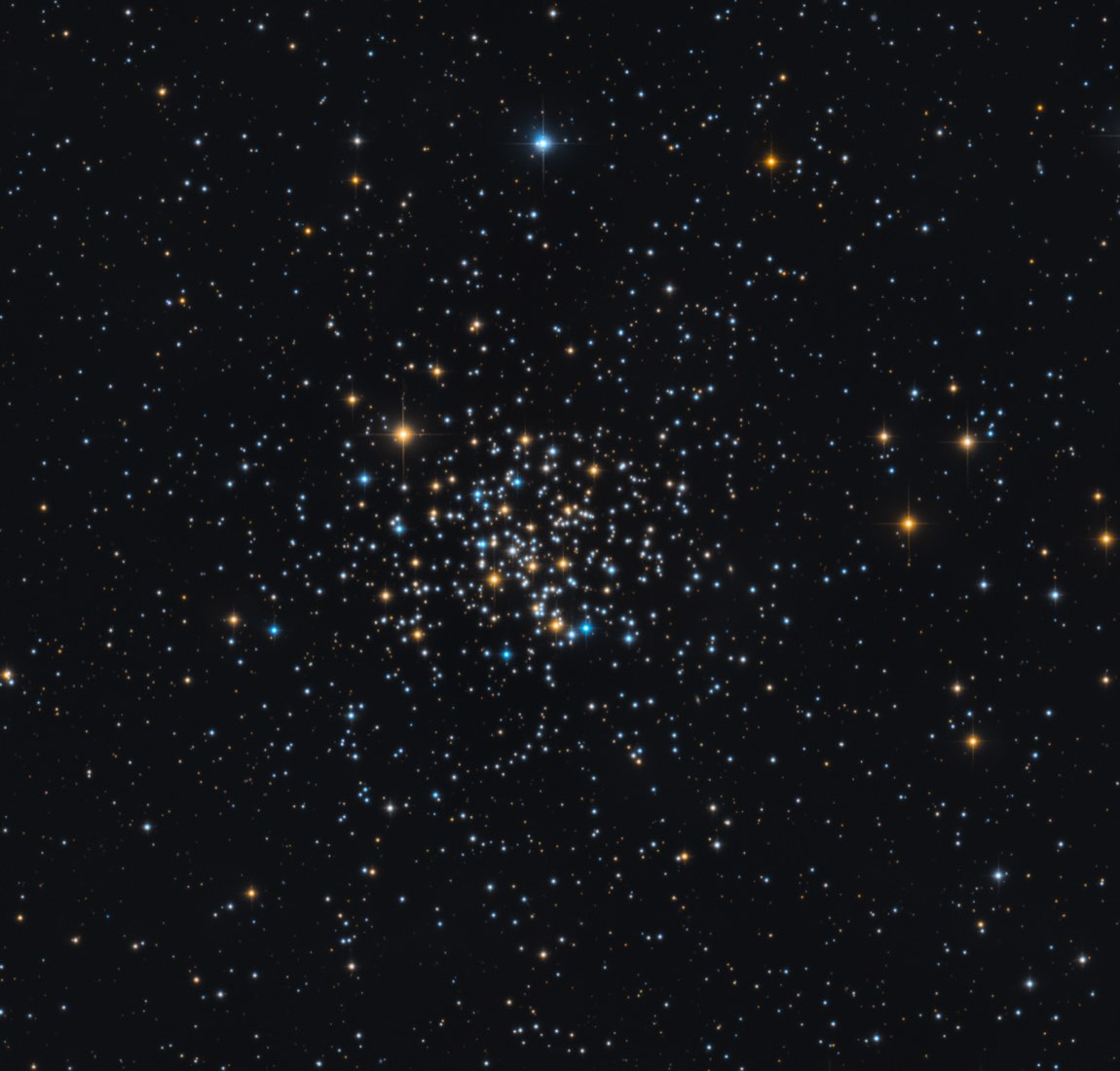
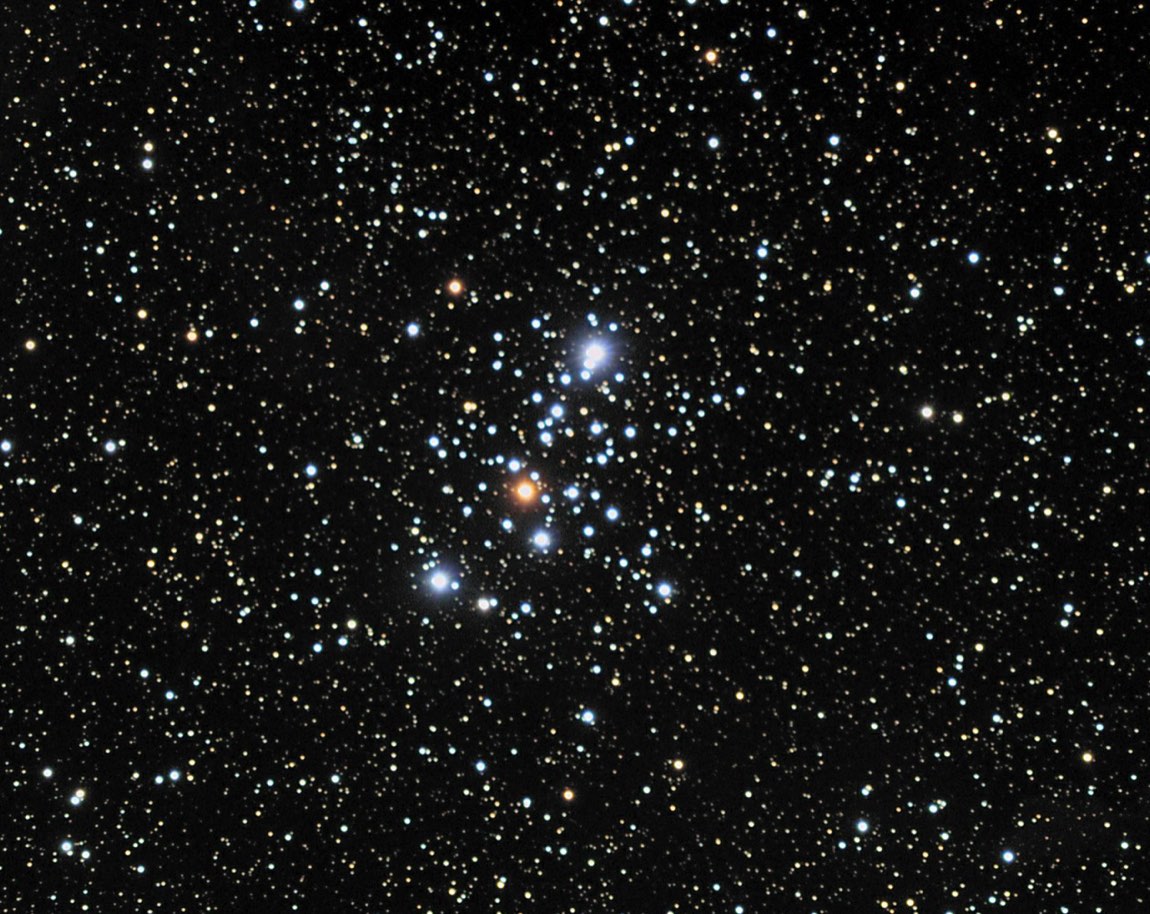
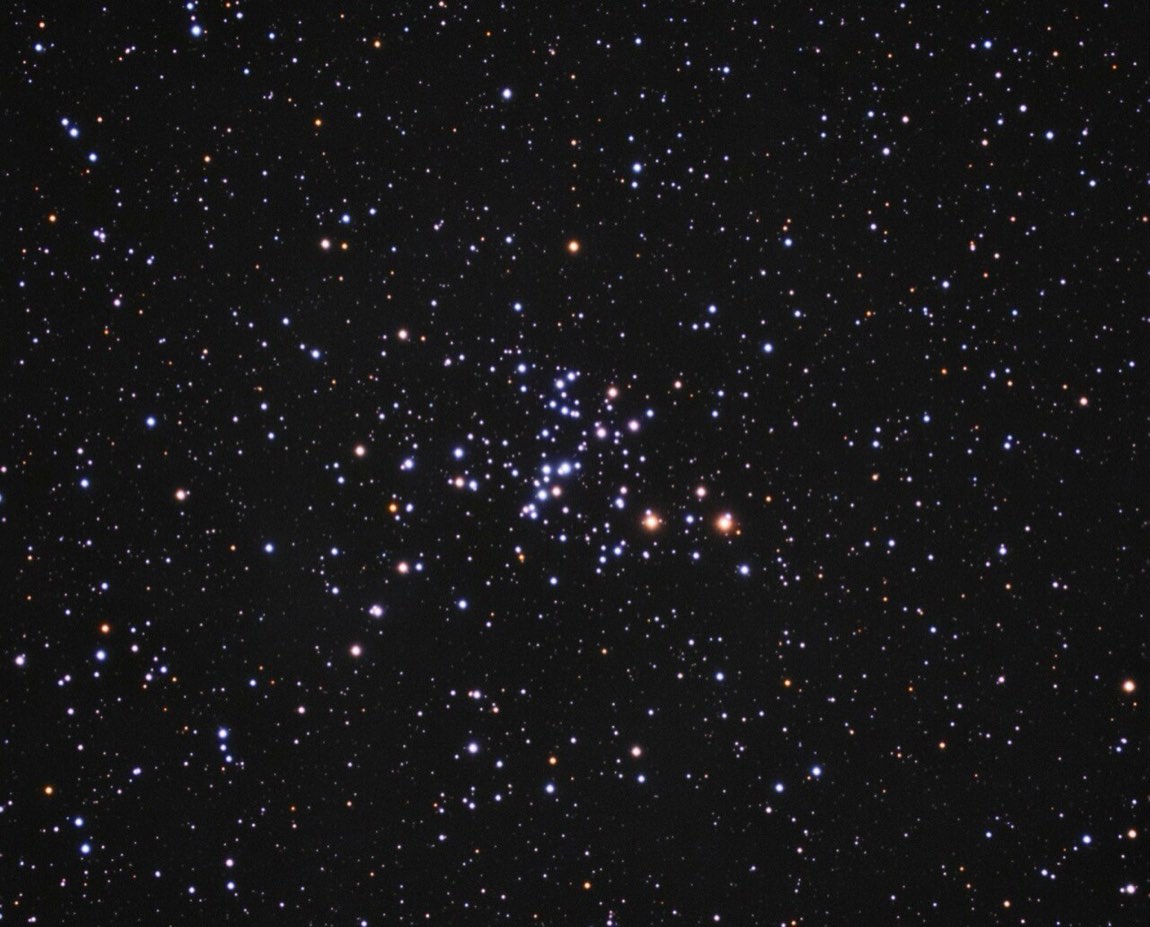
 Photograph · Sergio Eguivar · CC BY-SA 4.0
Star Cluster · Deep guide
Messier 93
Also called: M93 · NGC 2447 · Critter Cluster
A rich, wedge-shaped open cluster in Puppis that some see as a starfish.
What is it?
Messier 93 is an open cluster in Puppis, the poop deck of the old constellation Argo. Messier catalogued it in 1781, and Caroline Herschel independently found it in 1783. It is strongly concentrated, rich in stars and has a wide range of brightness. Some observers think it looks like a starfish. It lies about 3,400 light-years away, nearly in the plane of the Milky Way, and its stars are about 390 million years old, young compared with the Sun.
The deep dive
Researched for the Atlas from Wikipedia — Messier 93 (1,587 characters read) · updated Nov 15, 2026
01 How Charles Messier catalogued M93
Charles Messier added M93 to his famous catalogue in 1781, a list he built not to celebrate star clusters but to avoid mistaking them for comets — his true obsession. The irony is that this practical nuisance list became one of astronomy's most enduring reference documents. Just two years later, in 1783, Caroline Herschel independently swept it up during her own systematic sky surveys, genuinely believing she had found something Messier had missed. She had not, but the double discovery speaks to how active and competitive observational astronomy had become in the late eighteenth century. Caroline Herschel was no mere assistant to her more famous brother William; she was a rigorous observer in her own right, and her independent rediscovery of M93 is one small piece of evidence for that reputation. The cluster also carries the designation NGC 2447, assigned later when John Louis Emil Dreyer compiled his New General Catalogue, giving the object a second numerical identity still used by professional astronomers today alongside the Messier number.
02 The starfish shape that changes with aperture
The visual character of M93 shifts noticeably depending on the telescope you point at it. The late observer and writer Walter Scott Houston, who died in 1993, captured this beautifully: on a dull night through a fair-sized telescope, the cluster takes on the unmistakable shape of a starfish, with arms of stars radiating outward from a central concentration. But swap in a four-inch refractor and that romantic silhouette dissolves into what Houston called a typical star-studded galactic cluster — a dense, glittering swarm without obvious geometry. This aperture-dependent personality is not unusual among open clusters, where the eye's ability to connect stellar dots into patterns depends heavily on how many faint members the instrument can reveal. More stars fill in the gaps between the starfish arms and the pattern breaks apart into general richness. The cluster's popular nickname, the Critter Cluster, nods to this same zoomorphic quality, though exactly which critter observers see seems to shift from person to person and night to night.
03 What the Trumpler class tells us Deeper
Astronomers classify open clusters using a system devised by Robert Trumpler in the 1930s, and M93's designation of I 3 r is a compact summary of three independent qualities. The Roman numeral I means the cluster is strongly concentrated toward its center — stars bunch up noticeably rather than fading gradually into the surrounding field. The number 3 indicates a large range in brightness among its members, meaning the cluster contains both luminous, conspicuous stars and much fainter ones, hinting at a broad spread of stellar masses still present rather than a population stripped of its brightest members by evolution. The lowercase r stands for rich, confirming that M93 contains a genuinely large number of stars rather than being a sparse, scattered grouping. Together these three descriptors paint a picture of a cluster that is physically coherent, dynamically concentrated, and well-populated — in Trumpler's vocabulary, one of the more impressive examples of its class rather than a threadbare or poorly defined grouping.
04 Sizes within sizes: core, tidal, and spatial radii Deeper
M93 has three distinct size measurements, each capturing a different physical reality. The spatial radius of 10 light-years represents the visible stellar extent of the cluster as observers typically define it — the region containing the obvious members. The core radius of 4.2 light-years is smaller and marks the inner zone where stars are most densely packed, the gravitational heart of the system. The tidal radius, measured at 13.1 ± 2.3 light-years, is the most physically meaningful boundary: it marks how far out the cluster's own gravity can hold onto a star before the Milky Way's tidal forces pull it away and add it to the general stellar field. Stars beyond this limit are essentially lost to the cluster over time. The uncertainty of ± 2.3 light-years on the tidal radius is a reminder that these boundaries are not sharp lines but statistical estimates, dependent on assumptions about the cluster's mass distribution and the local galactic gravitational field. All three radii sit nested inside each other, describing a system that grows progressively looser moving outward from center to edge.
05 An orbit that barely wanders from the Sun's distance Deeper
M93 sits today about 3,380 light-years from the solar system in the constellation Puppis, but its position within the broader Milky Way is remarkably stable. The cluster follows a nearly circular orbit around the Galactic Center, swinging between just 28,000 and 29,000 light-years from the galactic core — a variation of only about 1,000 light-years, which is tiny compared with the Milky Way's roughly 100,000-light-year diameter. For comparison, some open clusters follow highly elliptical orbits that carry them far into the outer galaxy and then back close to the dense inner regions. M93 does no such thing. It completes one of these nearly circular galactic laps in 242.7 ± 7.9 million years. The cluster also lies nearly on the galactic plane, meaning it does not bob far above or below the flat disk of the Milky Way as it travels. This stable, in-disk, nearly circular orbit places M93 in a relatively calm gravitational environment for most of its long life.
06 An age measured in hundreds of millions of years
M93's estimated age of 387.3 million years puts it in an interesting middle ground among open clusters. It is old enough that its most massive, shortest-lived stars — the brilliant blue giants that would have dominated its early appearance — have already exhausted their nuclear fuel and disappeared. What remains are stars of more moderate mass, including the aging blue and white stars still visible today. Yet M93 is not so old that it has been completely disrupted by gravitational encounters with giant molecular clouds and by the slow evaporation of stars beyond its tidal radius. Many open clusters dissolve within a few hundred million years, so the fact that M93 remains a recognizable, richly populated cluster at nearly 400 million years old is itself a statement about its initial mass and the relatively benign orbital environment it has experienced. Its age estimate, like most cluster ages, comes from fitting the observed spread of stellar brightnesses and colors to theoretical models of stellar evolution.
07 Fifty-four variable stars hidden in the swarm Deeper
One of M93's most scientifically productive features is its collection of variable stars — 54 of them identified within its boundaries. This variety reads like a catalog of stellar physics. Seven Delta Scuti variables pulsate with periods typically of hours, driven by pressure waves rippling through their interiors in a zone where helium is partially ionized. Six Gamma Doradus variables pulsate differently, through gravity waves that disturb their outer layers over longer timescales of roughly one to three days. One object is a hybrid, simultaneously exhibiting both Delta Scuti and Gamma Doradus pulsations, which is scientifically valuable because the two mechanisms probe different depths inside the star and together give a richer picture of its interior. There is also one slowly pulsating B-type star, a class whose long, low-amplitude variations are driven by the kappa mechanism acting on iron opacity deep in the stellar interior. One rotating ellipsoidal variable rounds out the collection — a star distorted into an egg shape by a close companion, brightening and dimming as its elongated body rotates into and out of view.
08 Yellow stragglers and the mystery of old-looking stars Deeper
Among M93's four known spectroscopic binary systems lurks a particularly intriguing object: a yellow straggler component. Yellow stragglers are cousins to the more famous blue stragglers — stars that appear older and more evolved than the cluster's main stellar population should allow, yet have not yet reached the red giant stage. They occupy an unexpected position on the color-magnitude diagram, appearing yellower and more luminous than the cluster's standard turnoff stars. The leading explanation involves mass transfer or mergers in binary systems: a star gains material from a companion, altering its apparent age and position on the diagram. The fact that the yellow straggler in M93 sits within a spectroscopic binary system supports this mass-transfer picture directly, since spectroscopic binaries are identified by the Doppler shifts in their spectra caused by orbital motion around an unseen partner. These oddball stars are not mere curiosities; they are probes of binary evolution, stellar cannibalism, and the ways that stars in dense environments can break the simple rules that single-star models predict.
09 Puppis: the poop deck among the stars
M93 resides in the constellation Puppis, whose name refers to the stern — specifically the poop deck — of the mythological ship Argo, sailed by Jason and the Argonauts in their quest for the Golden Fleece. Puppis was not always its own constellation. It was once part of the enormous ancient constellation Argo Navis, a single vast star pattern representing the entire ship. In the eighteenth century the French astronomer Nicolas Louis de Lacaille divided Argo Navis into three smaller pieces: Puppis for the stern, Carina for the keel, and Vela for the sails. This dismemberment was partly practical — Argo Navis was simply too large to work with conveniently — and partly reflects the growing formalization of constellation boundaries. Because Puppis sits at a modestly southern declination, it is best observed from the Southern Hemisphere or from low northern latitudes, though it rises high enough for northern observers to view M93 under good conditions during late winter and spring evenings.
10 How to find and observe M93
M93 sits in Puppis at a modestly southern position, making it accessible from most populated parts of the world but best placed for observers south of the equator. Its apparent magnitude puts it within range of binoculars under dark skies, though a small telescope will begin to resolve individual stars and reveal the cluster's character. As Walter Scott Houston noted, aperture matters enormously for how M93 presents itself: a four-inch refractor transforms it into a typical but rewarding galactic cluster, while larger instruments under poor transparency can tease out the starfish shape that gives it visual personality. The cluster lies roughly 3,380 light-years away, far enough that individual stellar disks are of course impossible to see, but close enough that the brightest members stand out clearly against the background field. For observers chasing the full Messier list, M93 is one of a tight grouping of Messier objects in Puppis, making the region efficient to survey in a single session. The cluster's high stellar richness — encoded in its Trumpler r designation — means that even modest apertures reveal a satisfyingly populated field.
11 Open questions the article leaves unanswered Deeper
Even with 54 variable stars catalogued and orbital parameters calculated, M93 leaves genuine questions on the table. The yellow straggler's exact formation history — whether it grew fat through mass transfer from its binary companion or through an outright stellar merger — remains unresolved, as it does for most such objects in any cluster. The precise mechanisms driving the hybrid Delta Scuti and Gamma Doradus pulsator are still a subject of active asteroseismological research across all clusters where such hybrids appear; M93's example adds one more data point to that broader debate. The tidal radius estimate carries an uncertainty of ± 2.3 light-years, meaning the precise boundary at which the Milky Way wins the tug-of-war against cluster gravity is not sharply pinned down. And while the age of 387.3 million years comes from stellar evolution modeling, different isochrone grids and different assumed chemical abundances can shift such estimates, so the figure should be understood as a well-constrained best estimate rather than an exact measurement. These open edges are where future spectroscopic surveys, space-based photometry, and proper-motion studies will likely make the next advances.