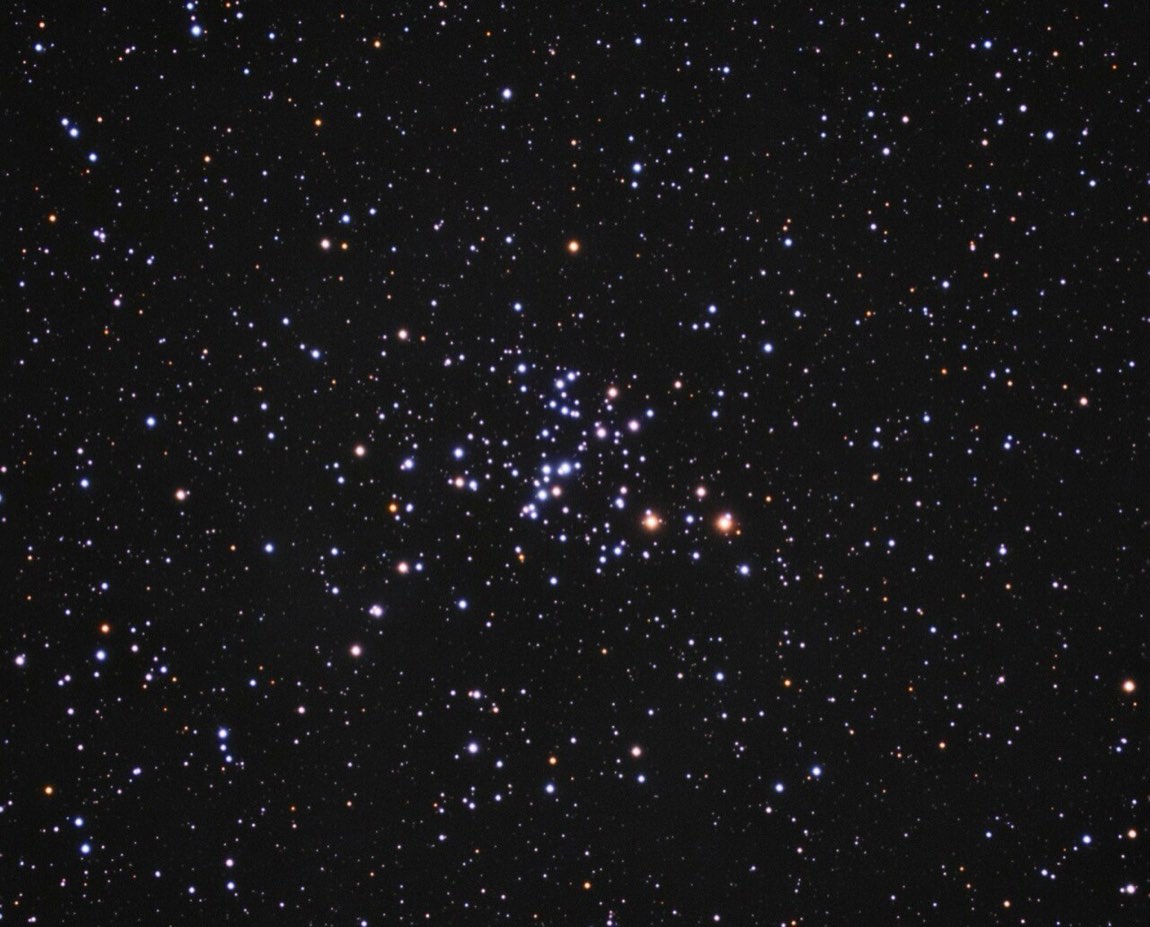
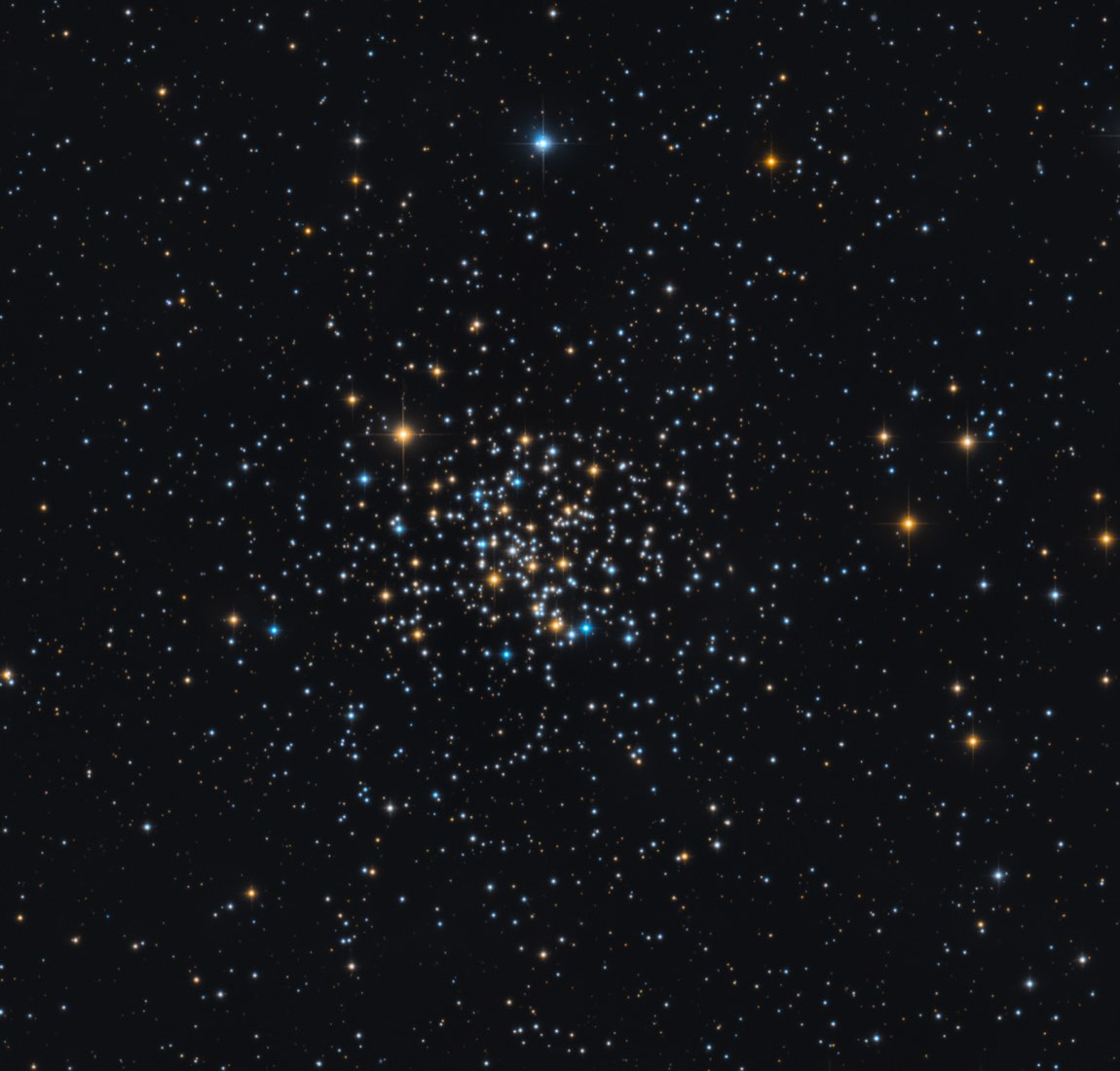
 Photograph · Chuck Ayoub · CC0
Star Cluster · Deep guide
Messier 67
Also called: M67 · NGC 2682 · King Cobra Cluster · Golden Eye Cluster
A billions-of-years-old open cluster packed with more than 100 Sun-like stars.
What is it?
Messier 67 is an open star cluster in Cancer, discovered by Johann Gottfried Koehler in 1779. It is estimated at 3.2 to 5 billion years old, comparable to the age of the Sun, which makes it one of the older open clusters known. It contains well over 500 stars, more than 100 of them similar to the Sun, plus many red giants. Because its stars share one age and distance and little dust blocks the view, astronomers use it as a test bed for how stars age.
The deep dive
Researched for the Atlas from Wikipedia — Messier 67 (3,565 characters read) · updated Nov 15, 2026
01 Discovered by a footnote in history
M67 was discovered in 1779 by Johann Gottfried Koehler, a German astronomer whose name rarely appears in popular astronomy texts despite this significant find. The cluster sits in the southern, equatorial half of the constellation Cancer, placing it in an accessible but often overlooked patch of sky. Over the centuries it accumulated two evocative nicknames — the King Cobra Cluster and the Golden Eye Cluster — though neither has the institutional weight of an official designation. Its formal labels, Messier 67 and NGC 2682, reflect two separate cataloguing traditions: Charles Messier's eighteenth-century comet-hunter's list and the later New General Catalogue. The fact that a cluster this scientifically important carries the work of a relatively obscure observer is a small reminder that the history of astronomy is full of careful watchers who never quite achieved household fame.
02 Why astronomers treat M67 as a laboratory
Open clusters are valuable precisely because all their stars share a birthday and an address — they formed from the same cloud of gas at roughly the same time and sit at essentially the same distance from us. M67 takes that advantage and amplifies it. It is well-populated, meaning there are enough stars to draw statistically meaningful conclusions. It suffers negligible dust obscuration, so astronomers see the stars' true colors and brightnesses without having to apply uncertain correction factors. And because all the stars sit at a common distance — typically estimated at 800 to 900 parsecs, roughly 2,600 to 2,900 light-years — apparent brightness translates cleanly into real luminosity. These qualities make M67 what researchers call a paradigm study object for stellar evolution, a cluster where theoretical predictions can be tested against an unusually clean dataset.
03 The turn-off point and what it reveals Deeper
Plot every star in M67 on a Hertzsprung-Russell diagram — brightness against color — and a striking pattern emerges. There are no main-sequence stars bluer or hotter than spectral type F, aside from a handful of anomalous objects. The reason is age: M67 is old enough that any star originally more massive and luminous than an F-type has already exhausted the hydrogen in its core and departed the main sequence, swelling into a red giant or beyond. The precise point where stars peel away from the main sequence is called the turn-off, and it acts like a clock. As a cluster ages, that turn-off migrates progressively downward toward cooler, dimmer stars. Reading M67's turn-off is therefore one of the primary tools astronomers use to pin down its age — though estimates still range between 3.2 and 5 billion years, reflecting genuine uncertainties in stellar physics models and the methods used to measure it.
04 Blue stragglers: stars that defied the schedule Deeper
Among M67's hundreds of members are roughly 30 objects that look far younger than they should — blue, luminous stars that by rights ought to have evolved off the main sequence long ago. These blue stragglers have puzzled astronomers since they were first identified in clusters. The leading explanations involve stellar interaction: a blue straggler may have stolen mass from a companion star, effectively being rejuvenated, or two stars may have merged outright, creating a single more massive object that resets its evolutionary clock. M67, with its dense, well-studied population, provides a large enough sample of blue stragglers that researchers can test these models statistically. Their very existence is a reminder that stellar evolution is not always a solitary journey — the crowded environment of a cluster introduces collisions, mass transfers, and mergers that isolated field stars rarely experience.
05 Mass estimates and what they disagree about Deeper
Pinning down M67's total mass has proven surprisingly contentious. Richer and colleagues place its current mass at 1,080 solar masses, while Hurley and colleagues estimate 1,400 solar masses for today's cluster — already a 30 percent difference. More dramatically, Hurley's team estimates the cluster's initial mass at roughly ten times its current value, implying that M67 was born with something like 14,000 solar masses of material and has shed the vast majority of it over billions of years. That mass loss is not a mystery: it reflects the ongoing escape of lighter stars through a process called mass segregation. During close gravitational encounters within the cluster, lower-mass stars gain speed at the expense of their heavier neighbors, eventually reaching escape velocity and drifting away into the galactic field. What remains is a cluster increasingly dominated by heavier stars — a bias that observers can actually detect in M67's present-day stellar population.
06 More than 100 solar twins in one place
One of M67's most remarkable features is sheer abundance of Sun-like stars: the cluster contains more than 100 members whose temperatures, luminosities, and spectral types closely resemble our own Sun. That concentration in a single cluster is extraordinary and has obvious scientific appeal. Studying these stars lets researchers ask what a Sun-like object looks like at a known age in a controlled environment. A March 2016 study by Barnes and colleagues, part of the extended K2 mission of the Kepler space telescope, measured the rotational periods of 20 such stars by tracking how moving starspots dimmed the light reaching Earth. The result: stars of roughly 4 billion years old in M67 spin in approximately 26 days. The Sun itself rotates at the equator in 25.38 days. The near-perfect agreement strongly supports what the authors call the solar-stellar connection — the principle that fundamental solar properties can be generalized to stars of the same size and age.
07 Could M67 be the Sun's lost birthplace?
The overlap in age and stellar composition between M67 and our own Solar System has led some astronomers to float a tantalizing hypothesis: that the Sun itself was born inside M67 and was later ejected into the galactic field. The cluster's age range of 3.2 to 5 billion years brackets the Solar System's own age, and its chemical makeup is consistent with what we might expect from the Sun's nursery. However, the idea runs into serious problems. Computer simulations disagree on whether the outer Solar System — the giant planets and distant Kuiper Belt — would have survived the gravitational upheaval of being flung out of a dense cluster. Equally troubling, the cluster itself would probably not have survived such an ejection event intact. The hypothesis remains neither confirmed nor firmly ruled out, sitting in the intriguing but unresolved category that makes astronomy perpetually interesting.
08 Exoplanets hiding in the cluster
Finding planets inside a dense open cluster is technically demanding, partly because the gravitational environment is chaotic and partly because many stars in a small patch of sky complicate the measurements. Despite this, a radial velocity survey of M67 successfully detected exoplanets around five cluster stars: YBP 1194, YBP 1514, YBP 401, Sand 978, and Sand 1429. A sixth candidate, Sand 364, initially appeared promising, but a follow-up study found no convincing evidence for a planet and concluded that the radial velocity variations were more likely caused by stellar variability — the star itself shifting in ways that mimic a planet's gravitational tug. Five confirmed planetary hosts in a single cluster is nonetheless a meaningful result, demonstrating that planet formation proceeds in crowded stellar environments and opening the possibility of studying how cluster dynamics affect planetary systems over billions of years.
09 White dwarfs: M67's stellar remnants Deeper
Because M67 is old enough that many of its more massive stars have completed their entire life cycles, the cluster is home to a substantial population of white dwarfs — the dense, Earth-sized remnants left behind after a star exhausts its nuclear fuel and sheds its outer layers. Richer and colleagues estimate that M67 contains approximately 150 white dwarfs. That number is scientifically significant: white dwarfs cool predictably over time, so measuring their temperatures and luminosities provides an independent age estimate for the cluster, one that does not rely on main-sequence turn-off models. The fact that two independent methods — turn-off analysis and white dwarf cooling sequences — both point to an age in the billions of years for M67 gives astronomers confidence that the broad picture of the cluster's history is correct, even if the precise age figure remains contested between roughly 3.2 and 5 billion years.
10 How to find and observe M67
M67 sits in Cancer, one of the zodiacal constellations that transits high in northern hemisphere skies during late winter and early spring evenings. The cluster has an apparent magnitude that places it at the edge of naked-eye visibility under exceptionally dark skies, but binoculars easily resolve it into a soft glow, and a small telescope begins to separate individual stars. Its position in the equatorial belt means it is accessible from most inhabited latitudes on Earth. Because Cancer contains few bright stars, M67 and the nearby Beehive Cluster (M44) are the constellation's main visual attractions. The cluster's well-populated core and its hundreds of member stars — total count estimated at well over 500 — give it a satisfying richness at moderate magnification, making it a rewarding target even for amateur observers who have no particular interest in its considerable scientific pedigree.
11 Open questions that keep researchers busy Deeper
Despite being one of the most-studied open clusters in the sky, M67 still resists easy characterization. Estimates of its age span from 3.2 to 5 billion years — a range wider than the entire age of complex animal life on Earth. Its mass estimates differ by hundreds of solar masses depending on the research team and method used. The number of white dwarfs, the precise count of Sun-like members, and even the total star count remain approximate. The Solar System birth hypothesis sits unresolved. The planet around Sand 364 was claimed and then retracted, underscoring how difficult it is to disentangle stellar variability from genuine planetary signals in a crowded cluster environment. Each of these open questions is an invitation: M67 is old, nearby by cluster standards, and observationally accessible, which means future instruments with better precision should be able to settle debates that have persisted for decades.
 ⤢