 Photograph · Jim Mazur · CC BY-SA 4.0
Star Cluster · Deep guide
Messier 103
Also called: M103 · NGC 581
A young open cluster in Cassiopeia and the last deep-sky object Messier himself added.
What is it?
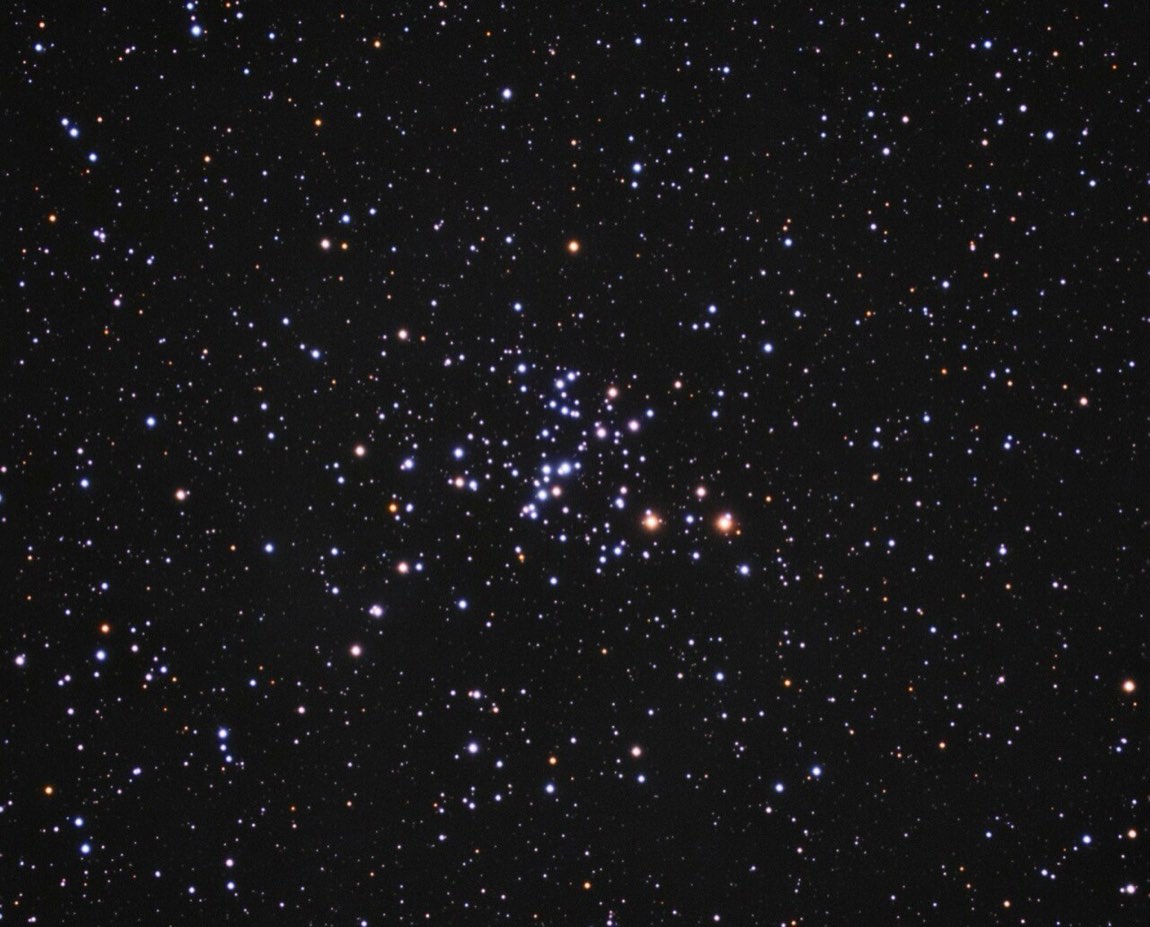
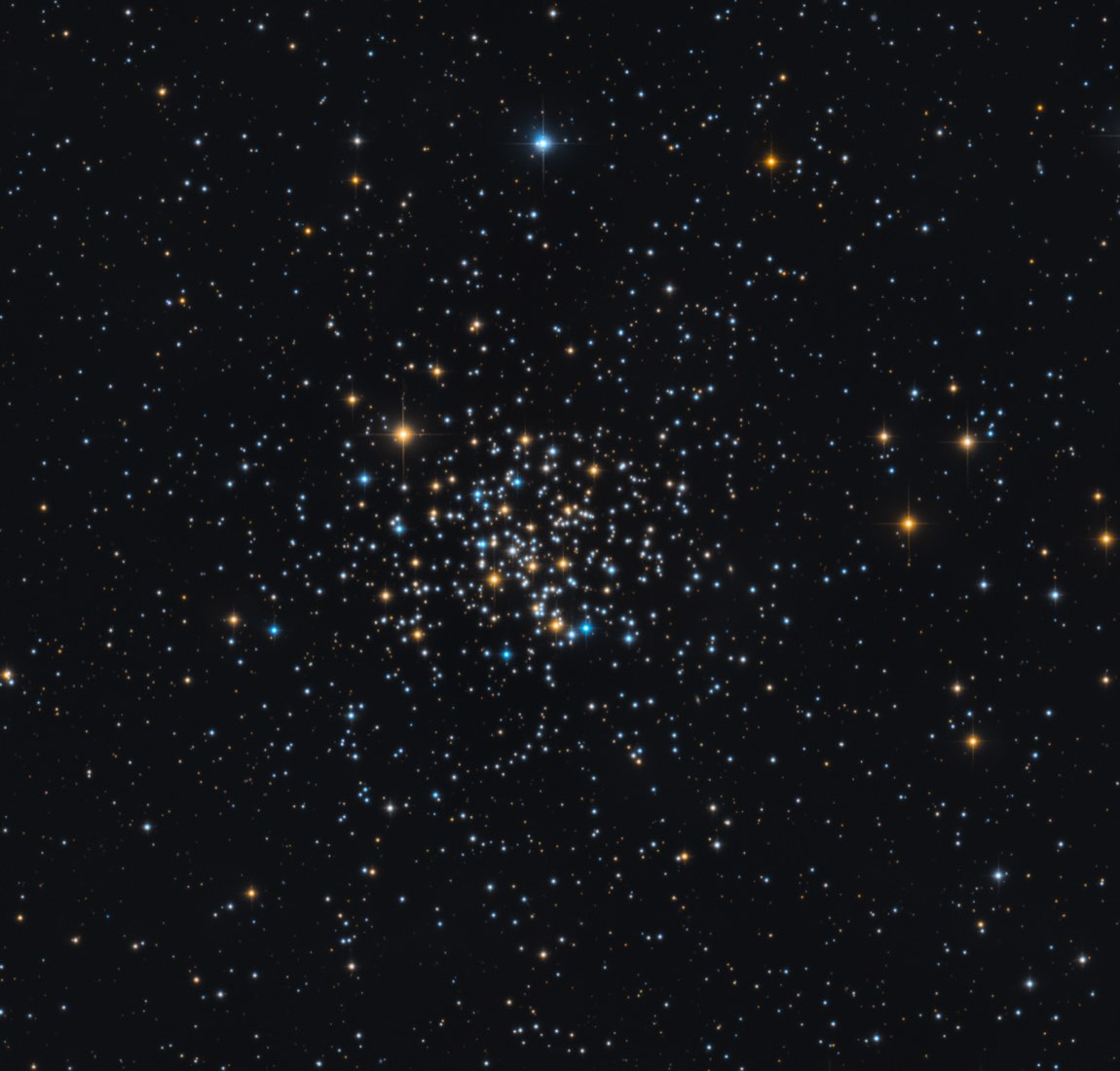
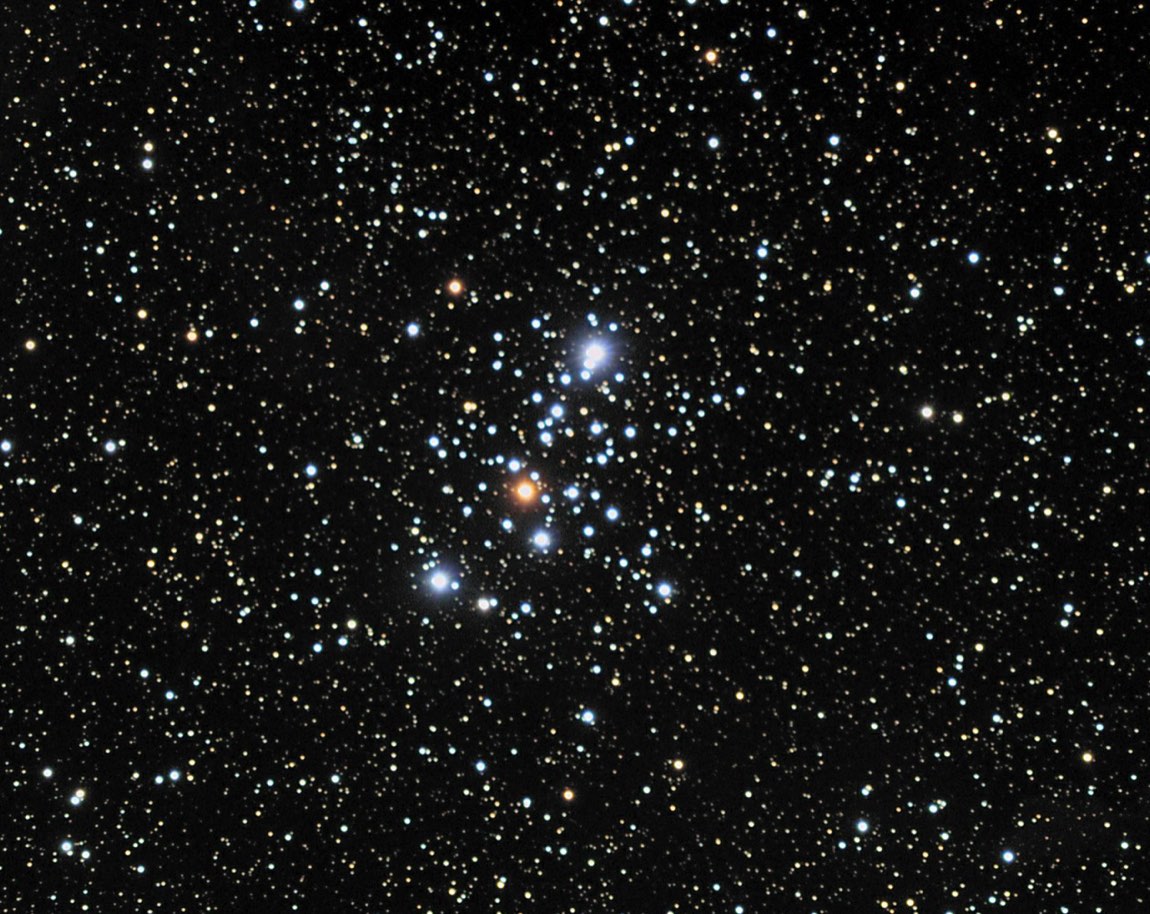
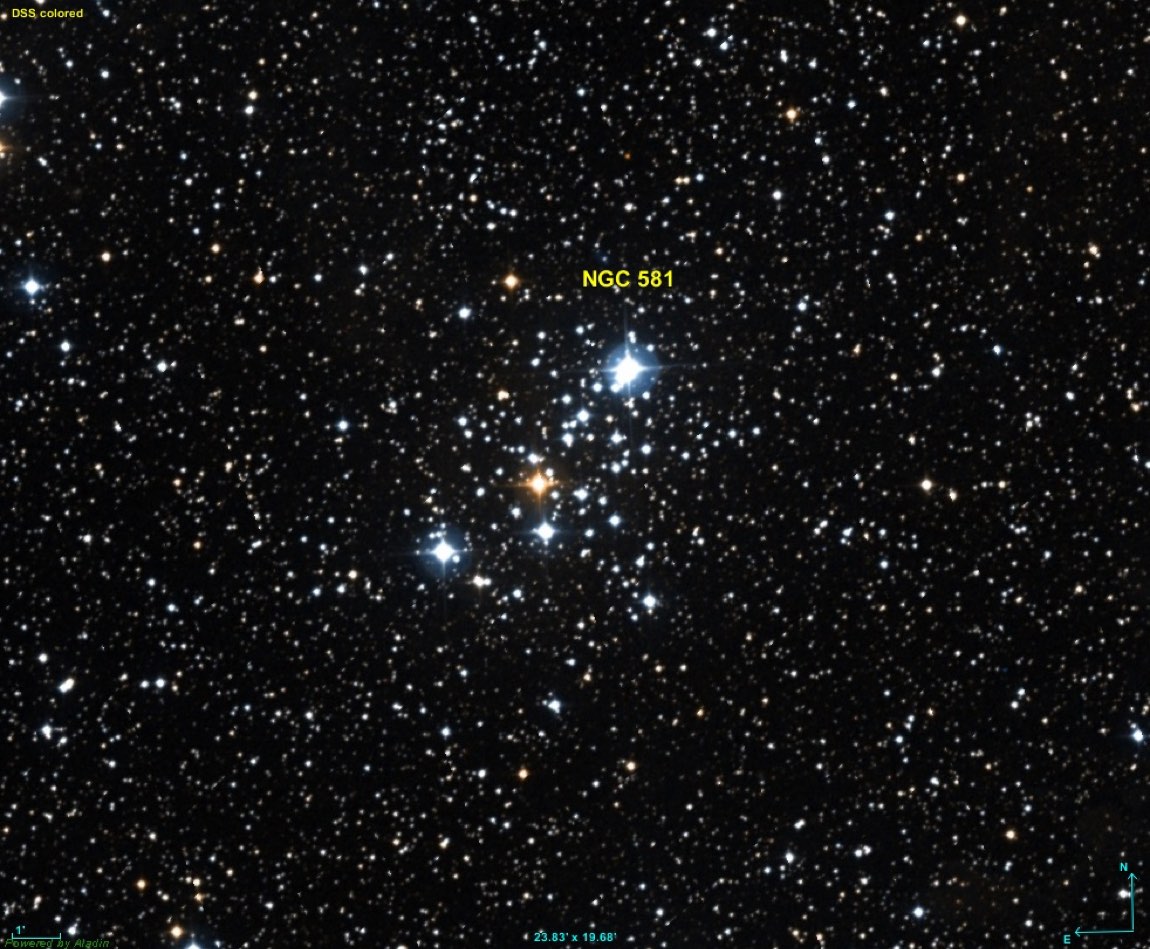
Messier 103 is a small open cluster in Cassiopeia, discovered by Pierre Méchain on 27 March 1781 and the last deep-sky object Charles Messier added to his own catalogue. It lies about 9,400 light-years away and is roughly 15 light-years across. Its brightest stars include a magnitude 10.5 star and a red giant near the centre. The bright double star Struve 131 appears in the same field but is not a member. About 172 stars likely belong to the cluster, which is only some 12.6 to 25 million years old.
The deep dive
Researched for the Atlas from Wikipedia — Messier 103 (1,990 characters read) · updated Nov 15, 2026
01 Discovered by Méchain, credited to Messier
The story of M103's discovery is a small drama of astronomical credit. Pierre Méchain spotted it on 27 March 1781, along with Messier 101 and 102, during a productive sweep of the northern sky. Charles Messier then added it to his famous catalogue, making M103 the last deep-sky object to carry his name. The timing matters: Messier's catalogue had already become the definitive reference for nebulae and clusters that comet hunters needed to avoid confusing with actual comets. By appending Méchain's find at the end, Messier essentially handed his colleague a permanent place in the history of observational astronomy, even though the cluster now bears Messier's initial rather than Méchain's. The object also carries the designation NGC 581, assigned later when John Dreyer compiled his New General Catalogue from the accumulated observations of nineteenth-century astronomers.
02 How astronomers counted its stars over time
Pinning down exactly how many stars belong to M103 has been a surprisingly long project. William Herschel visited the cluster in 1783 and described the region as containing 14 to 16 "pretty large" stars alongside a great many "extremely faint" ones — precise numbers were beyond the technology of his era. Decades of subsequent work slowly raised the count: Åke Wallenquist identified 40 member stars, and Antonín Bečvář pushed that figure up to 60. The modern tally, proposed by Archinal and Hynes, stands at 172 stars, but this number comes with an important statistical qualifier. Only stars with greater than a 50 percent probability of being gravitationally bound to the cluster are included. That threshold matters because open clusters sit in crowded star fields, and distinguishing true members from coincidental line-of-sight neighbors requires careful analysis of proper motion and distance data.
03 A young cluster still taking shape Deeper
M103 is strikingly young by cosmic standards, with an estimated age falling somewhere between 12.6 and 25 million years. That wide range reflects genuine uncertainty in the measurements rather than careless rounding. For comparison, the dinosaurs disappeared from Earth roughly 66 million years ago, so M103 formed well after that extinction event would have occurred, had Earth existed in its current form. At this tender age, the cluster has not had time for internal gravitational dynamics to eject many of its members into the surrounding galaxy — a process called evaporation that gradually dissolves open clusters over hundreds of millions of years. The presence of a red giant at the cluster's center is scientifically interesting given its youth: massive stars evolve quickly, and a star that has already swelled into a red giant tells astronomers something about the upper end of the cluster's initial mass distribution.
04 The red giant hiding at the heart of M103
Among the roughly 172 stars gravitationally tethered to M103, one stands out in color as much as in history. A red giant sits near the center of the cluster, shining at magnitude 10.8 — just a fraction fainter than the cluster's single brightest star at magnitude 10.5. Admiral William Henry Smyth drew particular attention to this red giant, describing it as a double star positioned on Cassiopeia's knee, located about 1 degree northeast of Delta Cassiopeiae, the star known as Ruchbah or Rukhbah. The ruddy color of a red giant comes from its cooler outer atmosphere, which makes it visually distinctive even in a field of white and blue-white young stars. At magnitude 10.8, it sits just beyond comfortable naked-eye detection but is well within reach of a small telescope, where its warm hue provides a satisfying contrast against the cluster's younger stellar population.
05 Struve 131: a beautiful impostor in the frame
When observers point a telescope at M103, one of the most visually appealing objects in the field is a double star catalogued as Struve 131. The pairing looks as though it belongs to the cluster, but the article is clear: Struve 131 is a foreground object, not a true member of M103. Its apparent proximity to the cluster is a line-of-sight coincidence — the double star simply happens to lie along the same direction as seen from Earth, at a different distance entirely. This kind of foreground contamination is a persistent challenge in open cluster science, because the Milky Way's disk is rich with stars at every distance. Without measurements of stellar motion or spectroscopic distance estimates, a star like Struve 131 could easily be misclassified as a cluster member, inflating the apparent population and skewing conclusions about the cluster's mass and age.
06 Seeing M103 for yourself
M103 is considered an easy observing target, visible in binoculars or even a small telescope. Through an eyepiece it appears as a nebulous, fan-shaped patch of light spanning about 6 arcminutes — roughly one fifth the apparent diameter of the full Moon. That compact apparent size means the cluster fits comfortably in a wide-field eyepiece without spilling beyond the frame. Finding it is straightforward for anyone already familiar with Cassiopeia's distinctive W shape in the northern sky. The recommended method is to center the view on Ruchbah, which is the lowest star of the W asterism, then scan approximately one third of the imaginary line toward Epsilon Cassiopeiae — the northern endpoint of the W — placing the cluster on the outer side of that famous zigzag pattern. Under dark skies, the fan shape becomes more pronounced and individual stars begin to resolve from the hazy glow.
07 Herschel's 1783 account and what it tells us Deeper
William Herschel's 1783 description of M103, sparse as it sounds, is a small window into the state of observational astronomy in the late eighteenth century. He characterized the region as containing 14 to 16 stars he called "pL" — pretty large, meaning relatively bright — alongside a great many he marked "eS," or extremely small, which in the notation of the era meant extremely faint rather than physically tiny. Herschel was not attempting a membership census; he was recording what his telescope revealed at the eyepiece. The fact that he noted a large number of faint stars beyond the dozen or so obvious ones suggests his instrument was already hinting at the cluster's true population, even without the photometric or proper-motion tools needed to confirm membership. His observation is an early data point in the long chain of increasingly precise star counts that eventually led to the modern estimate of 172 probable members.
08 M103's place in space: distance and true size Deeper
M103 lies 9,400 light-years from the Sun, placing it well into the outer reaches of the Perseus Arm of the Milky Way — a substantial fraction of the way across the galaxy's disk from our own position. At that distance, its apparent diameter of 6 arcminutes translates to a physical width of about 15 light-years. For context, the nearest star to our Sun, Proxima Centauri, is roughly 4.2 light-years away, so M103 spans a volume that could contain several such stellar neighborhoods side by side. That physical scale is modest compared to the largest open clusters but is consistent with a relatively young grouping that has not yet had time to expand significantly through internal dynamics. The combination of distance and angular size also explains why the cluster's brightest star reaches only magnitude 10.5 as seen from Earth — a star that might be dazzling at closer range is dimmed considerably across 9,400 light-years of intervening space.
 ⤢