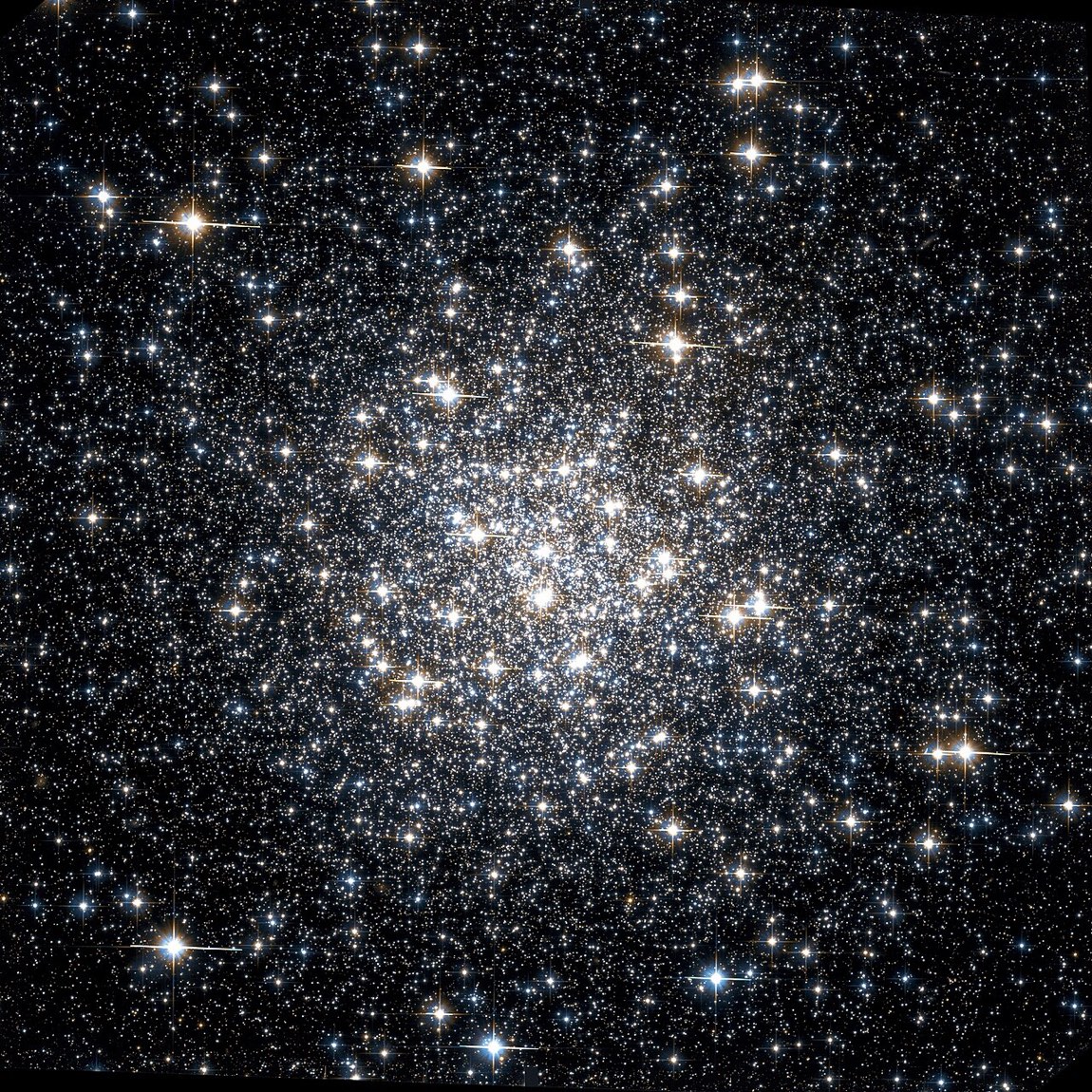
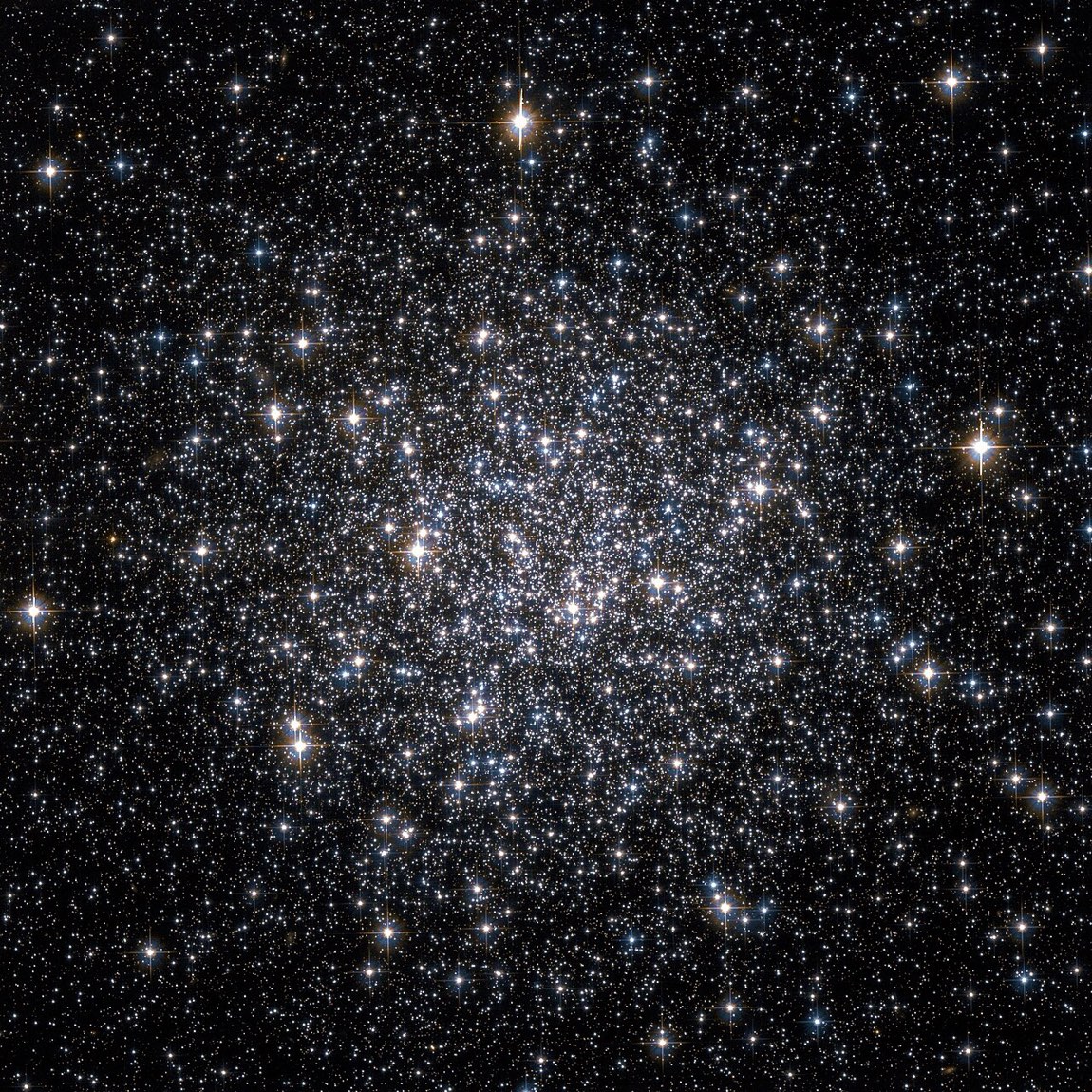
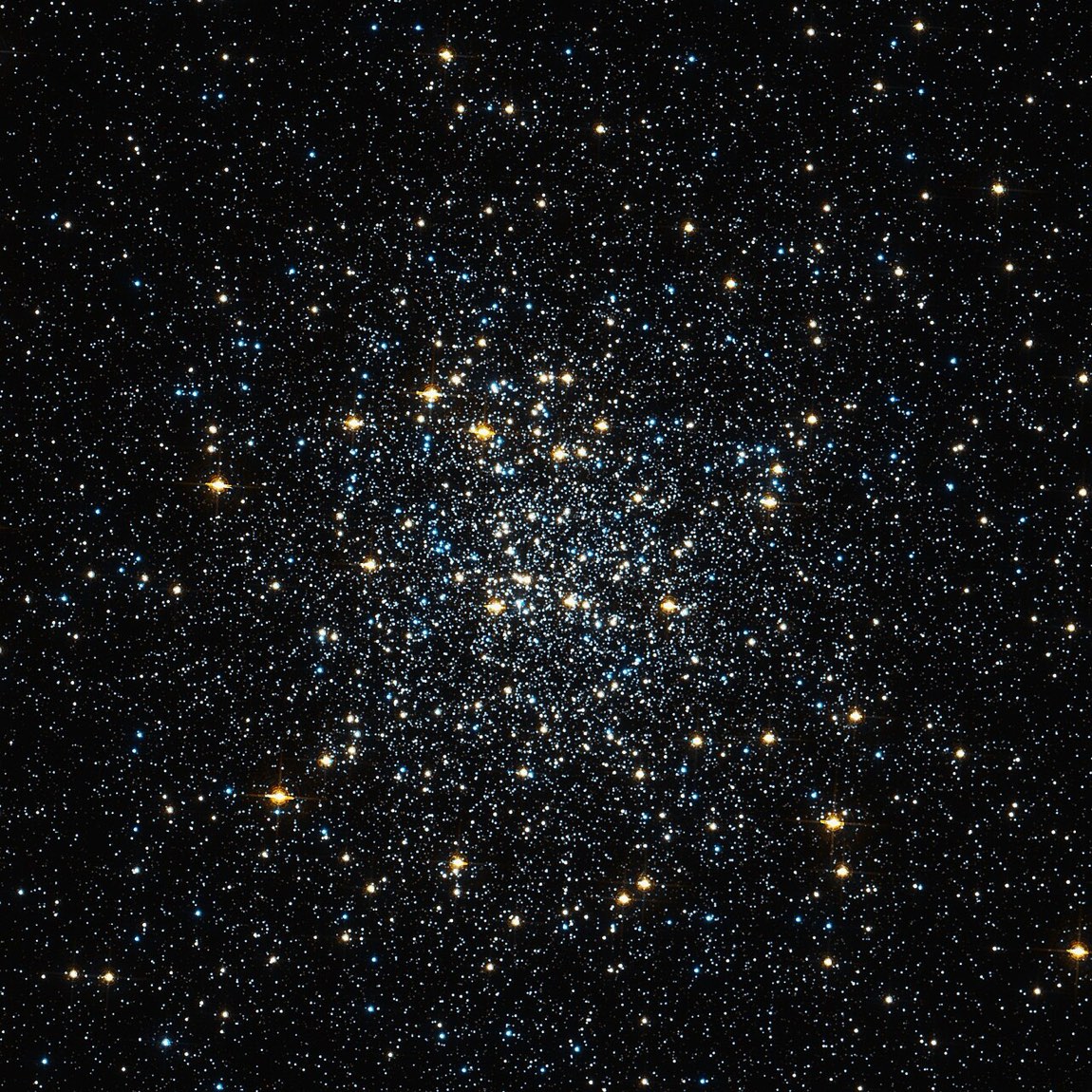
 Photograph · en:NASA , en:STScI , en:WikiSky · Public domain
Star Cluster · Deep guide
Messier 92
Also called: M92 · NGC 6341
A brilliant, very old globular in Hercules, overshadowed by its famous neighbour M13.
What is it?
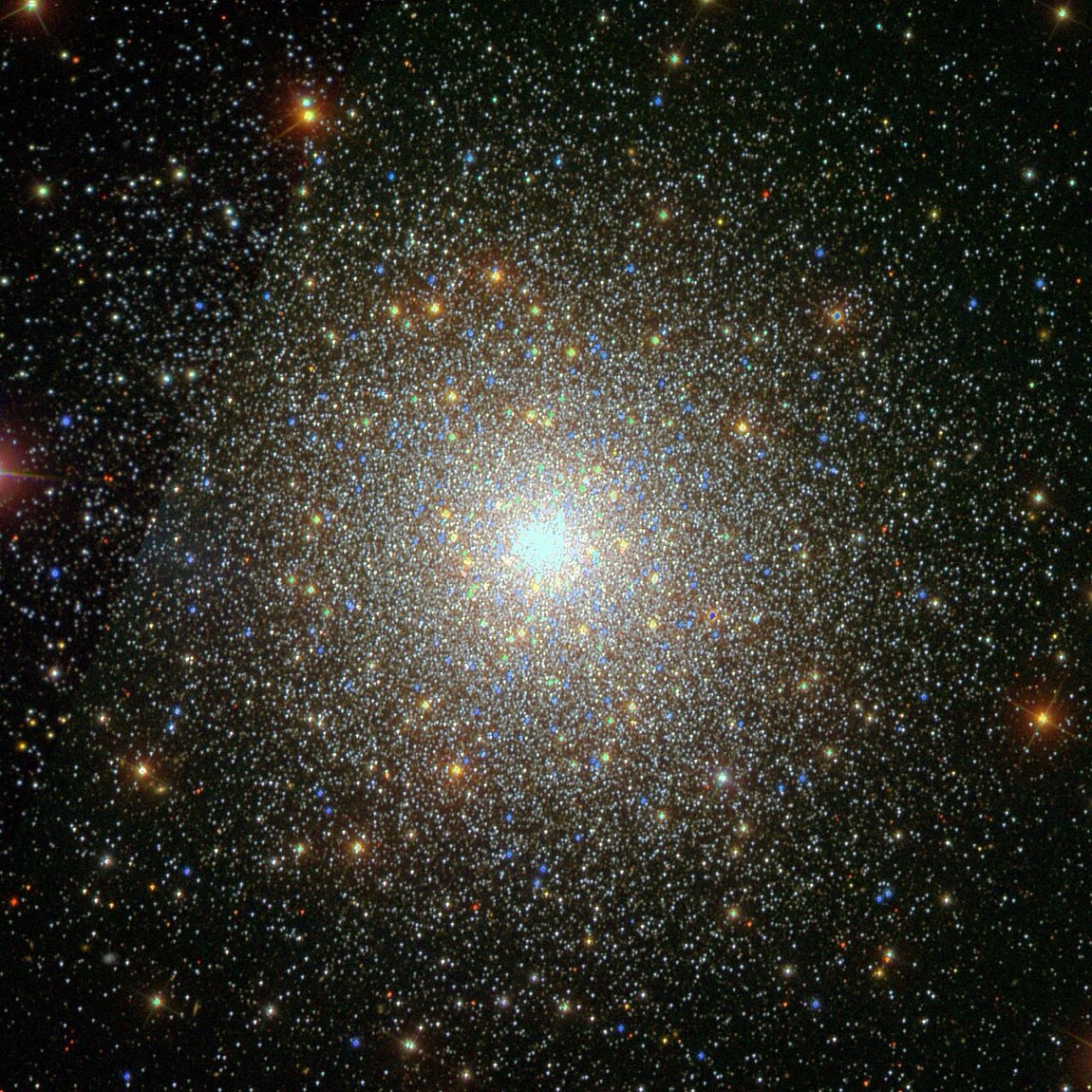
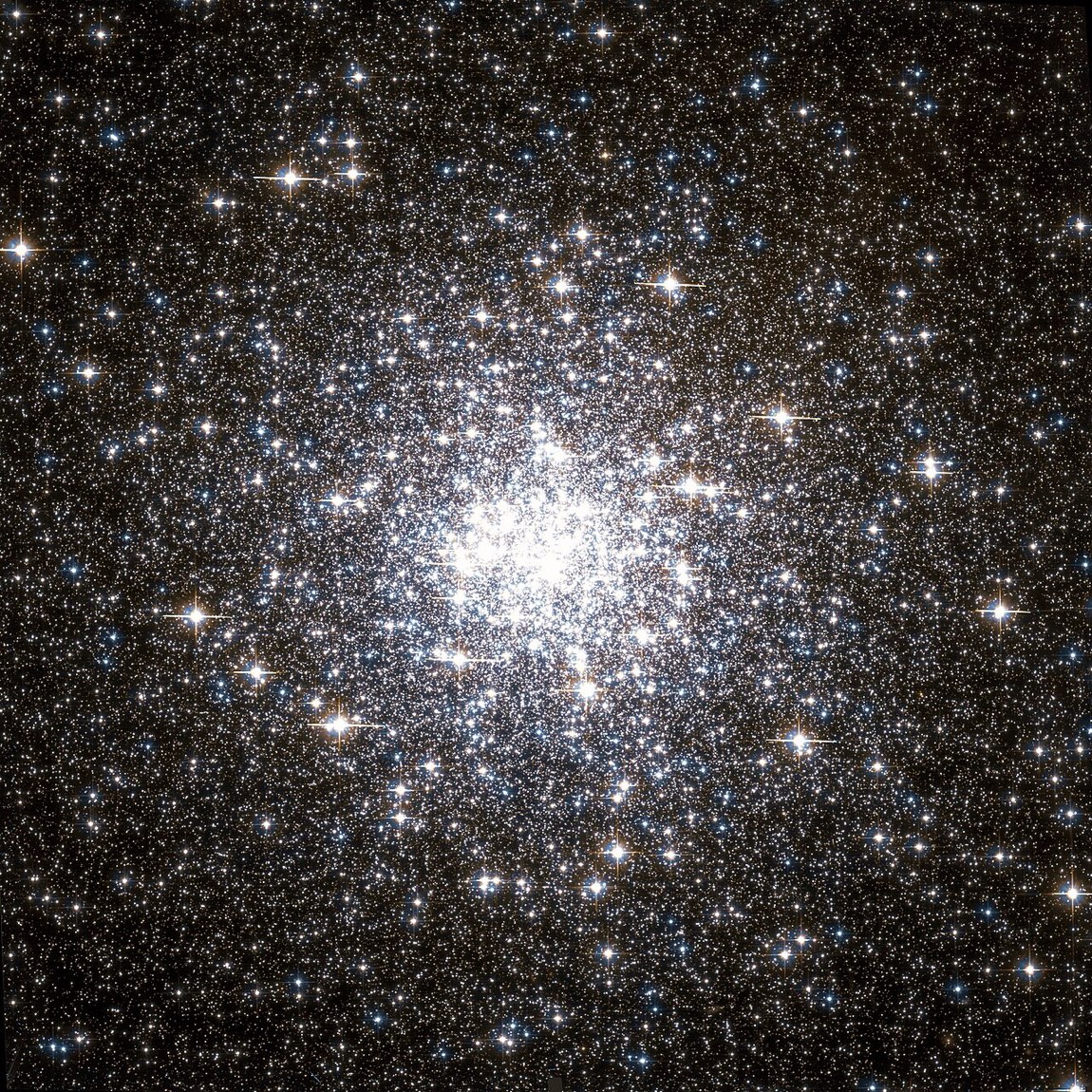
Messier 92 is a globular cluster in Hercules and one of the oldest in our galaxy. Johann Bode discovered it in December 1777; Messier found it again in 1781, and William Herschel first resolved its stars in 1783. It is only slightly fainter than the famous M13 nearby, so it is often overlooked, yet under very dark skies it can be seen with the naked eye. Its stars are extremely poor in metals. It lies about 26,700 light-years from the Solar System.
The deep dive
Researched for the Atlas from Wikipedia — Messier 92 (3,294 characters read) · updated Nov 15, 2026
01 A Cluster Discovered Twice by Accident
Messier 92 has an unusually tangled discovery history. Johann Elert Bode first spotted it on December 27, 1777, and published his finding in the Berliner Astronomisches Jahrbuch in 1779. Yet Charles Messier, the French comet hunter whose catalogue would eventually immortalize the object, independently stumbled upon it again on March 18, 1781 — completely unaware of Bode's earlier work. Messier logged it as the 92nd entry in his famous catalogue, and the name stuck. A few years later, in 1783, William Herschel turned his more powerful telescope on the fuzzy patch and became the first person to resolve it into individual stars. That moment was significant: it confirmed that what looked like a smear of light was actually a vast, gravitationally bound swarm of hundreds of thousands of suns. M92's double discovery is a reminder of how crowded the 18th-century sky was with overlooked wonders, and how independent observers working oceans apart could chase the same secrets without ever knowing it.
02 Living in M13's Shadow
M92 suffers from one of astronomy's crueler accidents of placement: it shares the constellation Hercules with Messier 13, one of the most celebrated globular clusters in the northern sky. Because M13 sits only about 20% closer in angular terms on the sky, most amateur astronomers who sweep through Hercules stop at M13 and never push on to M92. This is an understandable but unfortunate habit, because M92 is only slightly less bright in apparent magnitude and is comparable in absolute brightness across the whole galaxy. The main honest difference is size: M92 is roughly one-third less extended on the sky than its famous neighbor. Despite that, M92 is still visible to the naked eye under very good viewing conditions — a remarkable achievement for an object 26,700 light-years away. Even through a small telescope in a heavily light-polluted sky, it registers as a nebulous smudge. Under darker skies, finer detail begins to emerge. Its relative neglect has arguably made it one of the most underappreciated showpiece objects accessible to beginners.
03 Among the Oldest Things We Can See
M92 is one of the oldest globular clusters in the entire Milky Way. By studying its chemical makeup and comparing the brightness of its stars at different evolutionary stages, astronomers have estimated its age at 11 ± 1.5 billion years. To put that in perspective, the Solar System is only about 4.6 billion years old, meaning M92 was already ancient — packed with dying stars and stellar remnants — before our Sun had even formed. The cluster's extreme age is directly linked to its very low metallicity, the astronomers' term for the abundance of elements heavier than hydrogen and helium. Stars forge heavier elements through nuclear burning, and those elements are recycled into later generations of stars. Because M92 contains very little of this enrichment, its stars belong to some of the universe's earliest batches of star formation. The uncertainty of 1.5 billion years on either side of the age estimate reflects genuine ongoing debate about the precise distance to the cluster and the fine details of stellar evolution models.
04 Extraordinarily Low in Heavy Elements Deeper
The chemical poverty of M92 is striking even by globular cluster standards. Its iron abundance is measured as [Fe/H] = –2.32 dex, which on the logarithmic scale astronomers use means its iron content is just 0.5% of the Sun's. In practical terms, a cubic meter of M92's stellar material contains only a tiny fraction of the iron, calcium, oxygen, and other heavy elements that fill the same volume inside our own Sun. This extreme metal-poverty is why M92 is classified as an Oosterhoff type II (OoII) globular cluster — a designation that links its chemical composition directly to the behavior of its pulsating variable stars. OoII clusters are metal-poor, and their RR Lyrae stars pulse with longer periods than those found in more metal-rich OoI clusters. As of 2001, 17 confirmed RR Lyrae variables have been identified within M92, and they serve as precise distance indicators as well as clocks that probe the cluster's internal physics. The 1997 Catalogue of Variable Stars in Globular Clusters listed 28 candidate variables in total, though only 20 had been confirmed at the time of that catalogue.
 ⤢
05 Size, Shape, and Internal Structure Deeper
M92 spans a true diameter of 108 light-years and may contain a mass equivalent to 330,000 Suns — a staggering concentration of stars packed into a space that, while vast by human standards, is tiny compared to a galaxy. Its shape is very nearly spherical: measurements show the minor axis is about 89% ± 3% of the major axis, making it only slightly flattened. The half-light radius — the radius enclosing half of the cluster's total emitted light — is 1.09 arcminutes as seen from Earth. The tidal radius, the outermost boundary beyond which the Milky Way's gravity would strip stars away, extends to 15.17 arcminutes. One important internal feature is the core radius, which figures at about 2 arcseconds — an extremely compact central zone. Despite this dense core, M92 has not yet undergone core collapse, nor is core collapse guaranteed for it. Core collapse is a dramatic gravitational runaway process where the innermost stars sink ever closer together, and the fact that M92 has avoided it so far tells astronomers something important about the distribution of mass and energy within the cluster.
06 X-ray Sources and Exotic Stellar Remnants Deeper
Hidden within M92's dense heart are some of the most energetic and exotic objects in stellar physics. Ten X-ray sources have been detected within the cluster's half-mass radius of 1.02 arcminutes, and roughly half of them are candidate cataclysmic variable stars. Cataclysmic variables are binary systems in which a white dwarf — the collapsed remnant of a dead Sun-like star — pulls material from a companion, triggering violent outbursts that blaze in X-rays. Globular clusters are ideal breeding grounds for such systems because their dense stellar environments promote close gravitational encounters, which can pair up stars that would never have become binaries in the more spacious regions of a galaxy's disk. The discovery of ten X-ray sources in M92's compact core hints at a rich population of stellar remnants: white dwarfs, possibly neutron stars, and the binary systems they form through these chance gravitational encounters. Studying these sources helps astronomers understand how stellar evolution and dynamics interact in extreme stellar density environments.
07 Two Generations of Stars Inside One Cluster Deeper
For decades, globular clusters were treated as the textbook example of a "simple stellar population" — a single burst of star formation producing stars of identical age and composition. M92 is part of a growing body of evidence that overturns that picture entirely. Research has revealed that M92 hosts at least two distinct stellar generations, labeled 1G and 2G. Beyond that, the second generation itself splits into two chemically distinguishable groups, named 2GA and 2GB. The key difference between these populations lies in helium abundance. The 2GA stars carry a helium mass fraction higher than the first-generation stars by 0.01, while the 2GB stars exceed the first generation by 0.04. These differences are small in absolute terms but astronomically significant: they indicate that M92 experienced multiple episodes of star formation in its early history, with later generations of stars forming from gas that was enriched and re-processed by earlier stars. Exactly what sources — massive stars, asymptotic giant branch stars, or others — provided the enriched material remains an active area of research and debate.
08 M92's Unusual Position in the Galaxy
M92 does not orbit close to the crowded plane of the Milky Way. It currently sits about 16,000 light-years (4.9 kiloparsecs) above or below the galactic plane, well out in the galaxy's sparse halo, and roughly 33,000 light-years (10 kiloparsecs) from the Galactic Center. Its distance from our Solar System is about 26,700 light-years. That halo location is entirely consistent with its extreme age and metal poverty: the galactic halo is home to the oldest, most chemically primitive stellar systems in the Milky Way, relics of an era before the galaxy had built up thick layers of heavier elements through successive rounds of star formation and supernova enrichment. M92 is also approaching us at a velocity of 112 kilometers per second, meaning it is on an inbound leg of its long, looping orbit around the galactic center. At that speed it would cover the distance from Earth to the Moon in roughly 3.4 seconds — yet it will still take millions of years to draw appreciably closer, given the immense distances involved.
 ⤢
09 When M92 Was the North Star Cluster
Earth's axis does not point in a fixed direction. It wobbles slowly like a spinning top, completing one full cycle roughly every 26,000 years — a motion called axial precession. As a result, the celestial pole, the point directly above Earth's North Pole, traces a slow circle across the sky over millennia. Today that spot lands near Polaris, our familiar North Star. But the coordinates of M92 place it in a remarkable position relative to this wandering pole: Earth's North Celestial Pole periodically passes within less than one degree of the cluster. That means M92 itself served as a "Polarissima Borealis" — a north polar cluster — approximately 12,000 years ago, around 10,000 BC, when prehistoric humans were spreading across the globe at the end of the last Ice Age. And it will serve in that role again in about 14,000 years, around 16,000 AD. No other frequently observed globular cluster has quite this connection to the history and future of Earth's orientation in space.
10 How to Find and Observe M92
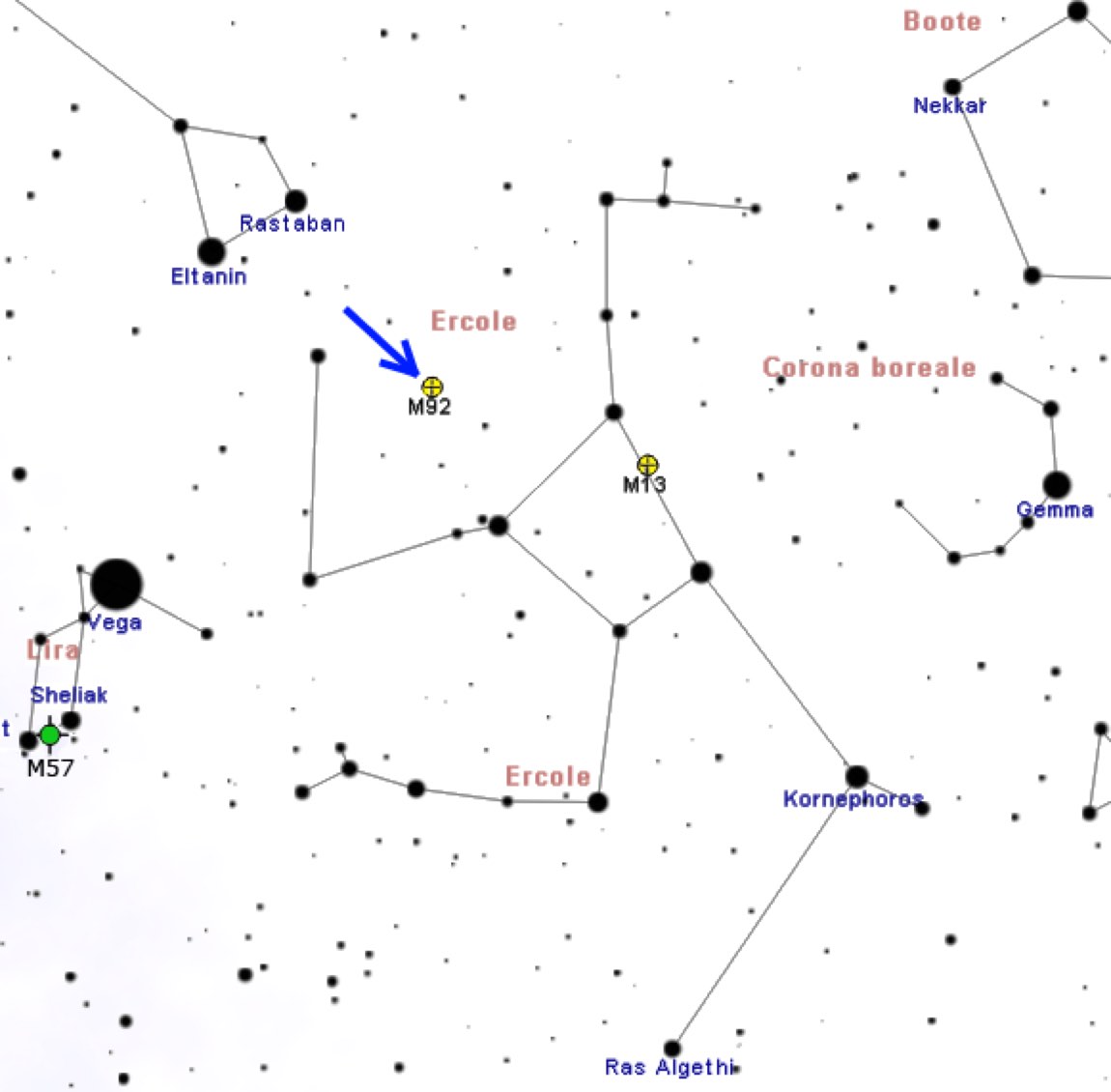
M92 rides high in northern summer skies inside the constellation Hercules, making it accessible to observers across the entire northern hemisphere and even from moderate southern latitudes. Its apparent magnitude places it among the brighter globulars visible from the northern hemisphere, and under genuinely dark skies it is accessible to the naked eye — a point of soft light in the northern part of Hercules. Even in heavily light-polluted conditions, a small telescope will reveal it as a nebulous smudge, and as sky quality improves, the outer stars begin to resolve. The main practical challenge is remembering to look for it at all when the magnificent M13 is so nearby. A useful strategy is to visit M13 first, then deliberately sweep northward to find M92 as a comparison object. Doing so reveals the subtle but real differences in apparent size and central concentration between the two clusters. M92 rewards patient observation, and its slightly more compact appearance and comparatively uncrowded field give it a distinctive aesthetic despite being perpetually eclipsed in reputation by its famous neighbor.
11 Variable Stars as Tools and Tracers Deeper
The pulsating stars within M92 are among its most scientifically productive features. RR Lyrae variables are old, low-mass stars that expand and contract in a regular rhythm, brightening and fading with a period that is tightly linked to their intrinsic luminosity. This makes them dependable standard candles — objects of known true brightness that astronomers can use to measure distances. M92's 17 known RR Lyrae variables, confirmed as of 2001, have been central to pinning down the cluster's distance. Because M92 is an Oosterhoff type II cluster, its RR Lyrae stars pulse with longer periods than those in OoI clusters, a systematic difference that reflects the stars' lower metal content. Tracking variables across different clusters and comparing their period distributions helps astronomers understand the chemical and dynamical history of the Milky Way's halo. The 1997 Catalogue of Variable Stars in Globular Clusters identified 28 candidate variables in M92, with 20 confirmed at that time, and ongoing monitoring programs continue to refine that census as measurement precision improves.
 ⤢