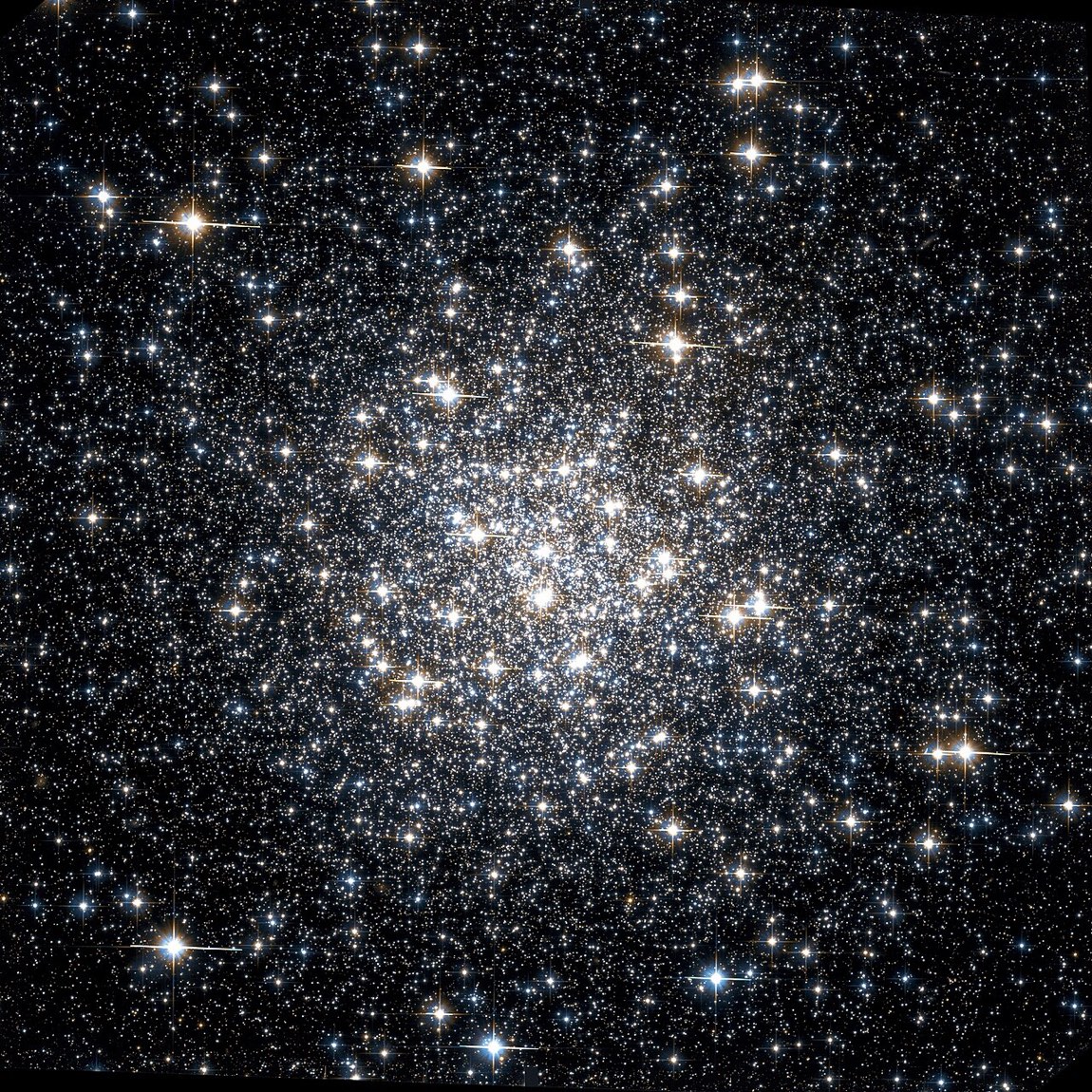
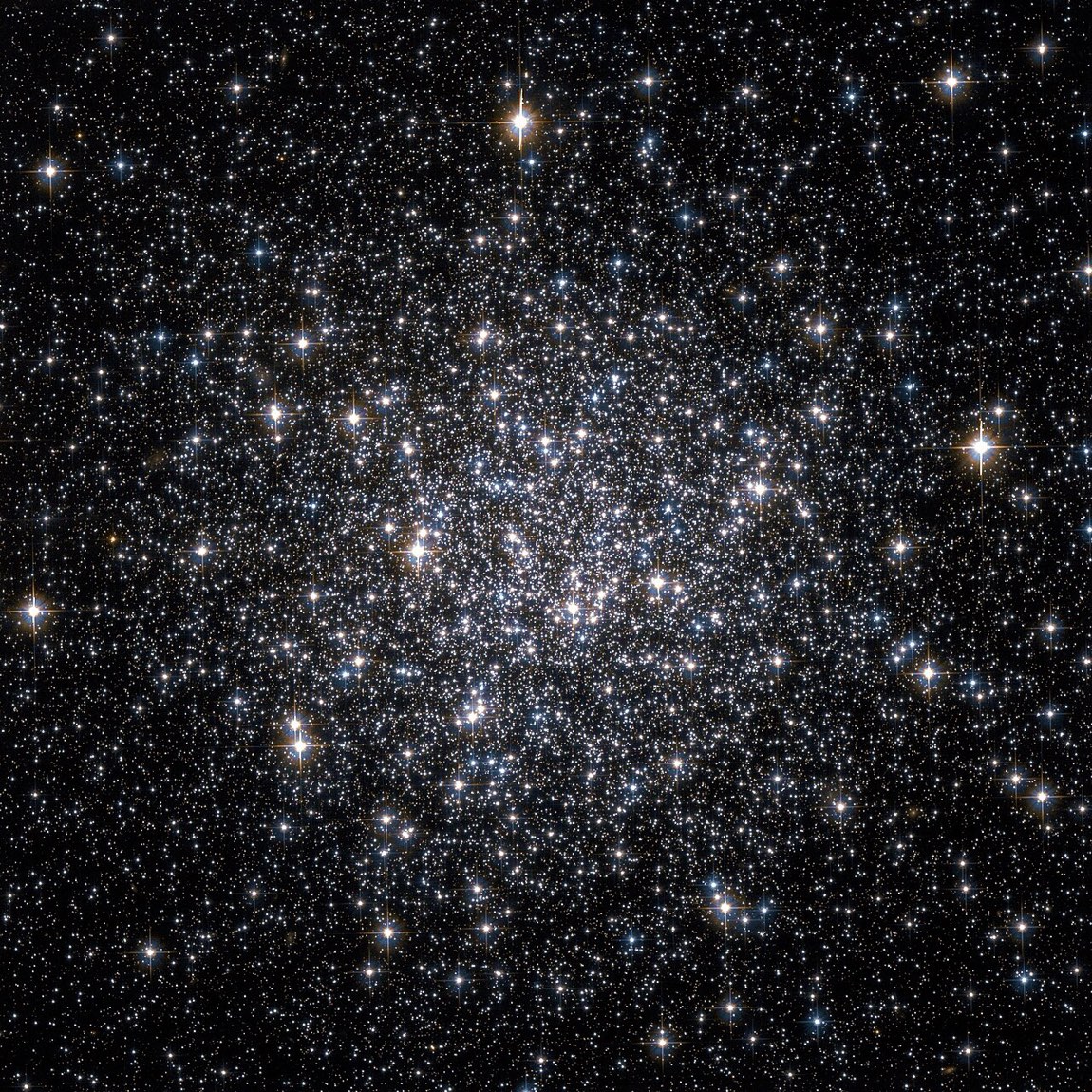
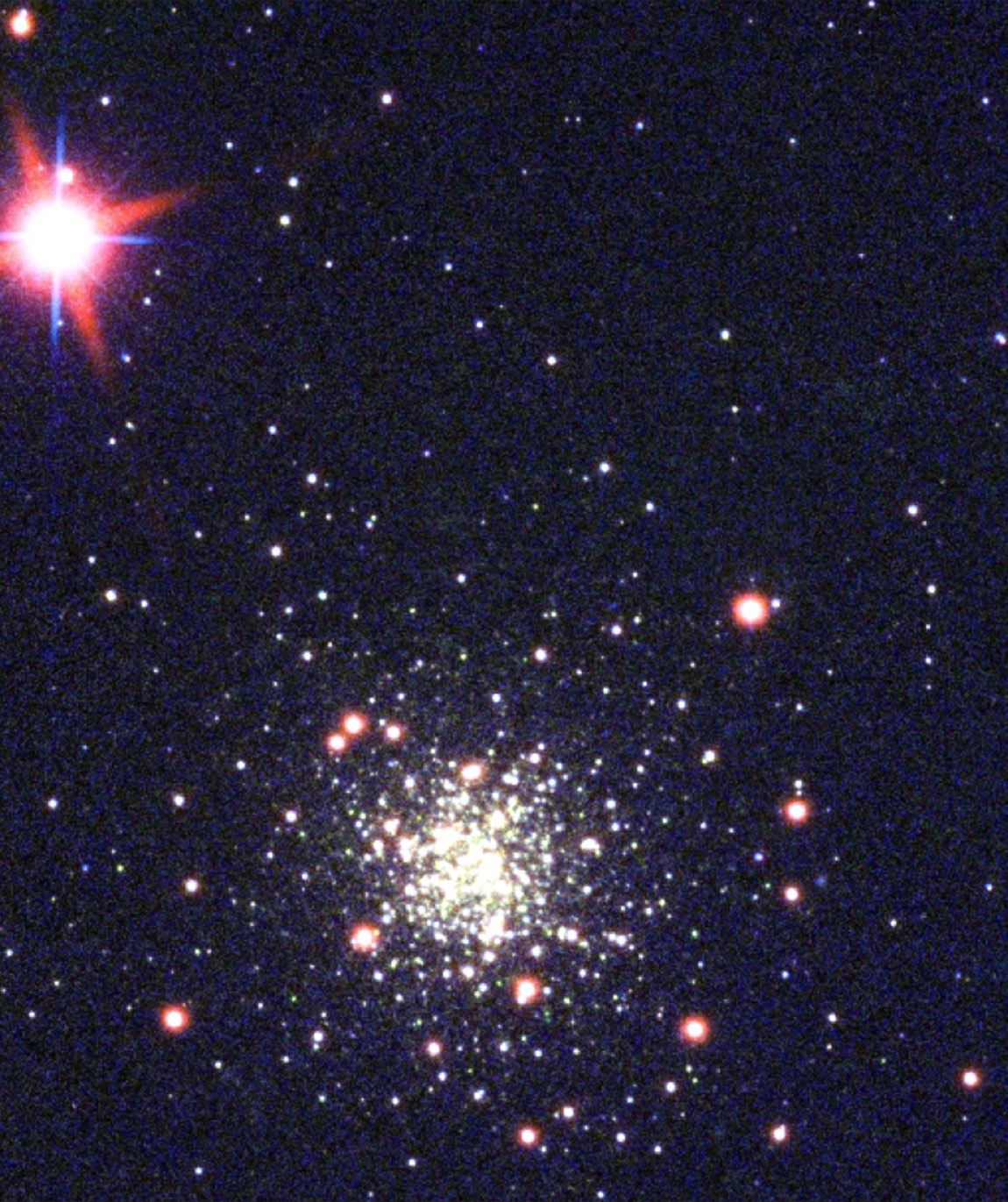
 Photograph · en:NASA , en:STScI , en:WikiSky · Public domain
Star Cluster · Deep guide
Messier 68
Also called: M68 · NGC 4590
A metal-poor globular in Hydra on a long, looping orbit around our galaxy.
What is it?
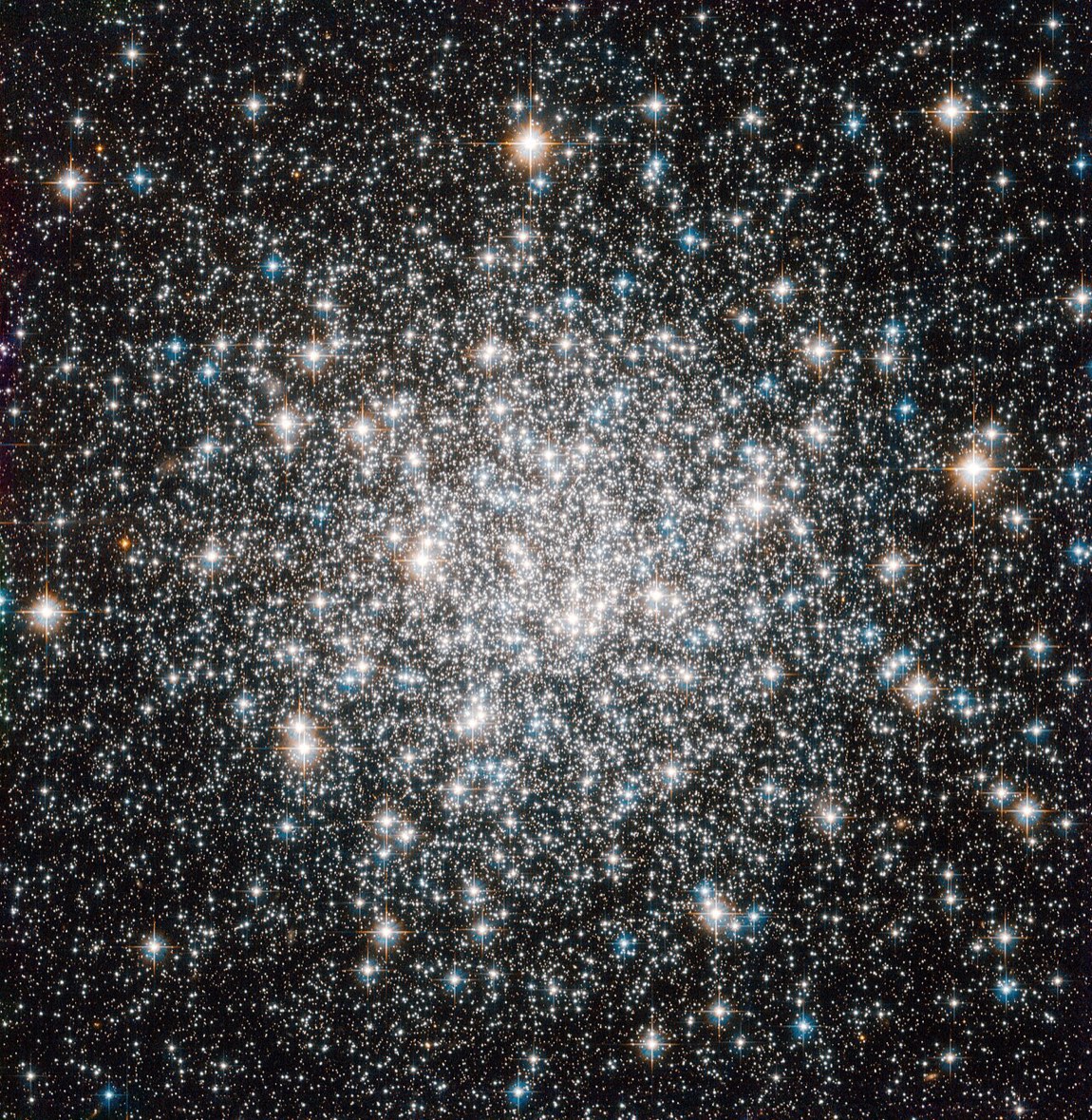
Messier 68 is a globular cluster in Hydra, discovered by Messier in 1780. William Herschel later described it as a very rich cluster whose stars blend together. It lies about 33,600 light-years away and follows a stretched orbit that carries it as far as 100,000 light-years from the galaxy's centre. It is one of the most metal-poor globulars known, meaning its stars contain very little besides hydrogen and helium. It may originally have come from a small satellite galaxy that the Milky Way absorbed.
The deep dive
Researched for the Atlas from Wikipedia — Messier 68 (1,314 characters read) · updated Nov 15, 2026
01 Discovered by Messier, Described by the Herschels
Charles Messier logged this globular cluster in 1780, adding it to the famous catalog he built to prevent comet hunters from being misled by fuzzy, stationary objects. Within years, the cluster attracted the attention of two of the greatest observers in history. William Herschel — the discoverer of Uranus — called it "a beautiful cluster of stars, extremely rich, and so compressed that most of the stars are blended together." That compression note is scientifically important: it hints at the dense stellar packing that still puzzles researchers today. His son John Herschel later turned his own telescope toward M68 and offered a strikingly different impression, describing it as "all clearly resolved into stars of 12th magnitude, very loose and ragged at the borders." The apparent contradiction reflects the genuine structural complexity of the cluster: a potentially collapsing core surrounded by a looser, more scattered outer halo of stars. Both Herschels were right about different parts of the same object.
02 Where to Find It in the Night Sky
M68 sits in the constellation Hydra, the water snake — the largest constellation in the sky by area. More precisely, it lies to the east-south-east of Hydra, away from the constellation's strictly equatorial portion. Hydra sprawls across a large swath of the southern sky, which means M68 is best viewed from the Southern Hemisphere or from low northern latitudes. The cluster also carries the designation NGC 4590, which places it in the New General Catalogue compiled in the nineteenth century. Despite the two catalog names, astronomers are always referring to the same object. Its apparent magnitude — how bright it looks from Earth — is not listed in this article's figures, but its distance of about 33,600 light-years means it cannot be seen with the naked eye; a small telescope will reveal a hazy patch, while a larger instrument begins to resolve individual stars at the edges, just as John Herschel described.
03 A Wild, Looping Orbit Through the Galaxy
Most objects we think of as simply "orbiting" the Milky Way trace relatively well-behaved paths, but M68 follows a dramatically elongated route. Its orbital eccentricity is 0.5 — meaning the orbit is significantly stretched rather than circular, comparable in shape to a fairly flattened ellipse. At one extreme of its journey the cluster swings to within the region of the galactic bulge, the dense central hub of the Milky Way, and at the other extreme it reaches as far as 100,000 light-years from the galactic center — a distance roughly equal to the full diameter of the Milky Way's visible disk. This enormous range means the cluster experiences wildly different gravitational environments depending on where it is in its orbit, which can affect the way its stars interact with one another and with the broader galactic environment over billions of years.
04 Stolen from a Satellite Galaxy? Deeper
One of the most intriguing questions about M68 is not what it is today but where it came from originally. The cluster may not have formed inside the Milky Way at all. Scientists have proposed that M68 was acquired by our galaxy through the gravitational accretion of a smaller satellite galaxy — one of the dwarf galaxies that orbits or once orbited the Milky Way. When the Milky Way's gravity tore apart such a companion, any globular clusters the satellite hosted could have been captured into new orbits around our galaxy. Its highly eccentric orbit and its extreme metal poverty are both consistent with an extragalactic origin, since objects that formed in smaller, chemically simpler environments tend to be very metal-poor. This hypothesis remains an open question, but it places M68 in an exciting broader story about how the Milky Way has grown by consuming its smaller neighbors over cosmic time.
05 One of the Most Metal-Poor Clusters Known Deeper
In astronomy, "metals" means every element heavier than hydrogen and helium — from carbon and oxygen all the way up to gold and uranium. Stars forge these elements through nuclear fusion and scatter them into space when they die, so later generations of stars are progressively richer in metals. M68 is described as one of the most metal-poor globular clusters known, meaning its stars contain a strikingly small proportion of these heavier elements. That scarcity is a direct fingerprint of extreme age and of a birth environment where few earlier stars had yet polluted the gas with their nuclear products. In practical terms, the planets that might form around such stars — if they formed at all — would be built from a far more limited palette of materials than the rocky worlds in our own solar system. Metal poverty is also one reason the extragalactic-origin hypothesis is attractive: dwarf satellite galaxies, being small and chemically primitive, tend to produce very metal-poor stellar populations.
06 Is the Core Collapsing Right Now? Deeper
Globular clusters are not static objects frozen in time. Gravitational interactions between stars cause energy to drain steadily from the cluster's center toward its outskirts, a process that can eventually cause the core to contract runaway-fast in an event called core-collapse. M68 displays signs that it may be undergoing this process. Core-collapse produces a sharply concentrated, highly dense stellar nucleus surrounded by a more diffuse envelope — a structure that matches what observers across centuries have noted in M68's appearance, from William Herschel's impression of stars "blended together" at the center to John Herschel's "ragged" outer borders. If core-collapse is confirmed, it would mean the innermost stars of M68 are locked in an increasingly intense gravitational environment, with stellar encounters happening at a far higher rate than in a relaxed cluster. The word "may" is deliberate here: the article is careful to say the cluster "may be undergoing" collapse, reflecting genuine scientific uncertainty.
 ⤢
07 A Cluster That Spins Deeper
For much of astronomy's history, globular clusters were assumed to be essentially non-rotating systems held together purely by the mutual gravity of their hundreds of thousands of stars. M68 challenges that assumption. The cluster displays signs of being in rotation — meaning the whole stellar system has a detectable net spin. Rotation in a globular cluster is not trivial to measure because the individual motions of stars must be carefully disentangled from the overall rotation signal, requiring precise spectroscopy or proper-motion studies. When rotation is real, it has consequences for the cluster's internal dynamics, its shape, and even the rate at which it might undergo core-collapse. A spinning cluster tends to be slightly flattened along its rotation axis rather than a perfect sphere. The detection of rotation in M68 adds to a growing recognition among astronomers that globular clusters are far more dynamically rich and varied than the simple, uniform balls of stars they were once thought to be.
08 Harlow Shapley and the First Variable Stars
The story of M68's variable stars begins with Harlow Shapley, the American astronomer famous for using globular clusters to work out the true size of the Milky Way and Earth's position within it. As early as 1919 to 1920, Shapley identified the first 28 variable stars in M68 — stars whose brightness rises and falls in a periodic pattern. This was painstaking work in the photographic era, requiring careful comparison of glass-plate images taken at different times to catch the subtle brightness changes. By 2015, the total count of known variables in the cluster had grown to 50, meaning that nearly a century of subsequent work added only 22 more to Shapley's original tally, a testament to how thorough his early survey was. Variable stars in globular clusters are not just curiosities; they serve as standard candles that allow astronomers to measure distances across the galaxy with remarkable precision.
09 RR Lyrae Stars: The Cluster's Distance Rulers
Most of the 50 known variable stars in M68 belong to a class called RR Lyrae variables — or, as the article puts it, periodic variables. RR Lyrae stars are pulsating giant stars that expand and contract rhythmically, brightening and dimming over periods typically ranging from about 0.2 to 1 day. Because all RR Lyrae stars have very similar intrinsic luminosities, measuring how bright they appear from Earth immediately reveals how far away they are. This is what makes them such powerful tools: they act as cosmic measuring rods embedded right inside the cluster. The 33,600 light-year distance figure given for M68 almost certainly relies in part on the RR Lyrae population within it. These stars are especially numerous in old, metal-poor systems like M68, which is why globular clusters became the proving grounds for the entire RR Lyrae distance-measurement technique in the first place.
10 SX Phoenicis Stars: Short, Sharp Pulses Deeper
Among M68's 50 variable stars, six belong to a more exotic category called SX Phoenicis variables. The article characterizes them as displaying "short pulsating behavior," which is an accurate but understated description. SX Phoenicis stars are low-mass, metal-poor pulsating stars that oscillate over periods far shorter than those of RR Lyrae variables — sometimes completing a full brightness cycle in under two hours. They are related to Delta Scuti variables found in younger stellar populations, but their low metallicity places them in a distinct class. Having six of these in a single cluster is scientifically interesting because SX Phoenicis stars in globular clusters are often thought to be "blue straggler" stars — objects that appear younger and hotter than they should be, possibly formed through stellar mergers or mass transfer between close binary companions. Their presence adds another layer of dynamical complexity to M68's already eventful internal life.
11 How Vast Is 33,600 Light-Years?
The article places M68 approximately 33,600 light-years from Earth. A light-year is the distance light travels in one year — about 9.46 trillion kilometers. Multiplying that by 33,600 gives a number so large it resists intuition, so consider this comparison: the fastest spacecraft ever launched by humanity, Voyager 1, travels at roughly 17 kilometers per second. At that speed, reaching M68 would take approximately 600 million years — longer than complex animal life has existed on Earth. Even light itself, the fastest thing in the universe, takes 33,600 years to make the journey. When astronomers study M68 tonight through their telescopes, they are seeing the cluster as it existed roughly 33,600 years ago, during the Upper Paleolithic period of human prehistory, when our ancestors were painting cave walls and mammoths still roamed across much of the northern continents.
12 M68's Place Among Globular Clusters
The Milky Way is home to roughly 150 known globular clusters, and M68 stands out in several ways simultaneously. Its exceptional metal poverty places it among the chemically most primitive clusters known, suggesting it formed very early in the universe's history when heavy elements were scarce. Its highly eccentric orbit, reaching 100,000 light-years from the galactic center, makes it one of the more far-ranging members of the galactic globular cluster system. Its possible extragalactic origin would put it in a special subset of clusters thought to have been captured from dwarf satellites. Its potential core-collapse state marks it as structurally dynamic rather than settled. And its mix of RR Lyrae and SX Phoenicis variable stars makes it a productive laboratory for stellar physics. Few single clusters tick so many scientifically interesting boxes at once, which is why M68 continues to draw attention despite being discovered more than two centuries ago.
 ⤢