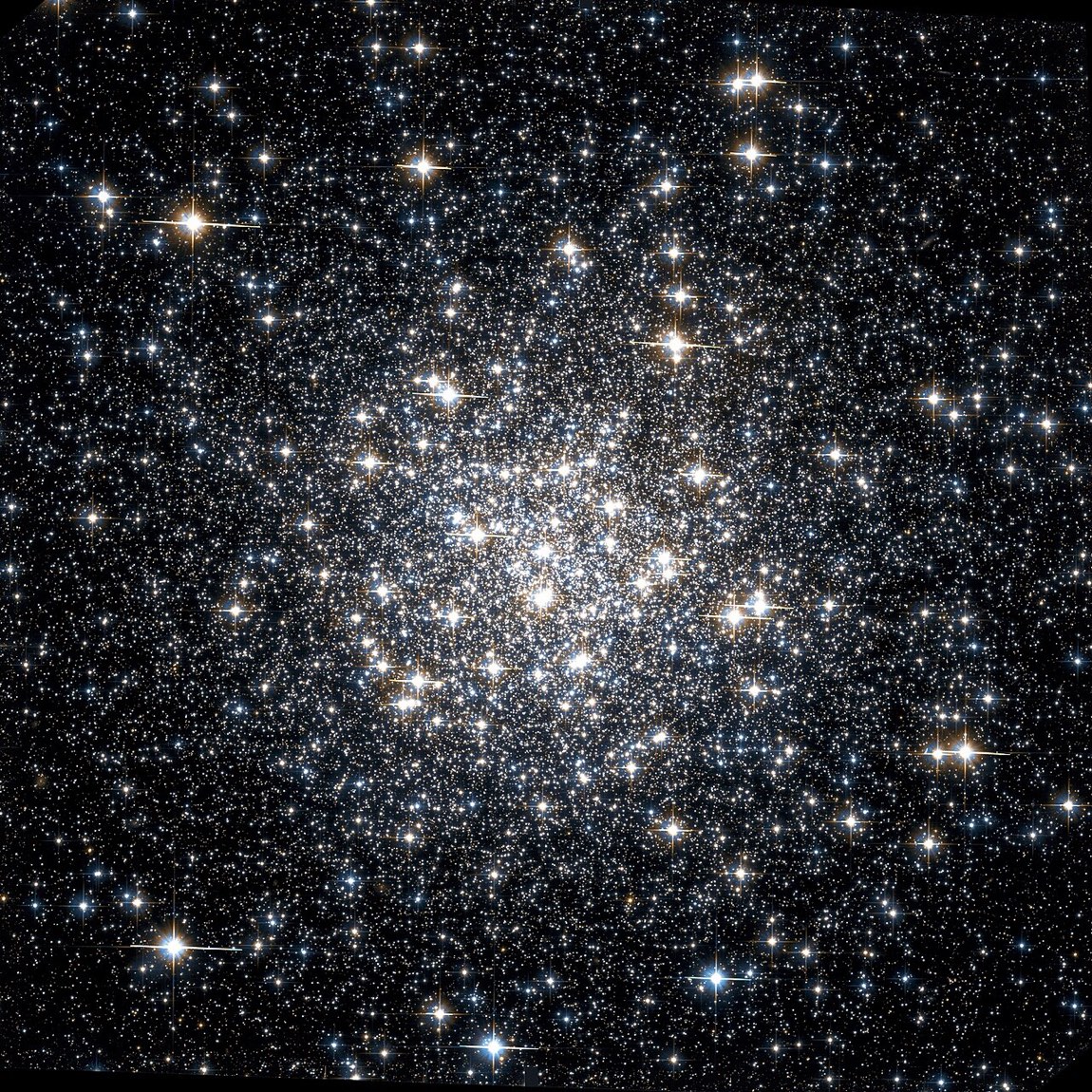
 Photograph · en:NASA , en:STScI , en:WikiSky · Public domain
Star Cluster · Deep guide
Messier 56
Also called: M56 · NGC 6779
An ancient ball of stars in Lyra that may once have belonged to another galaxy.
What is it?
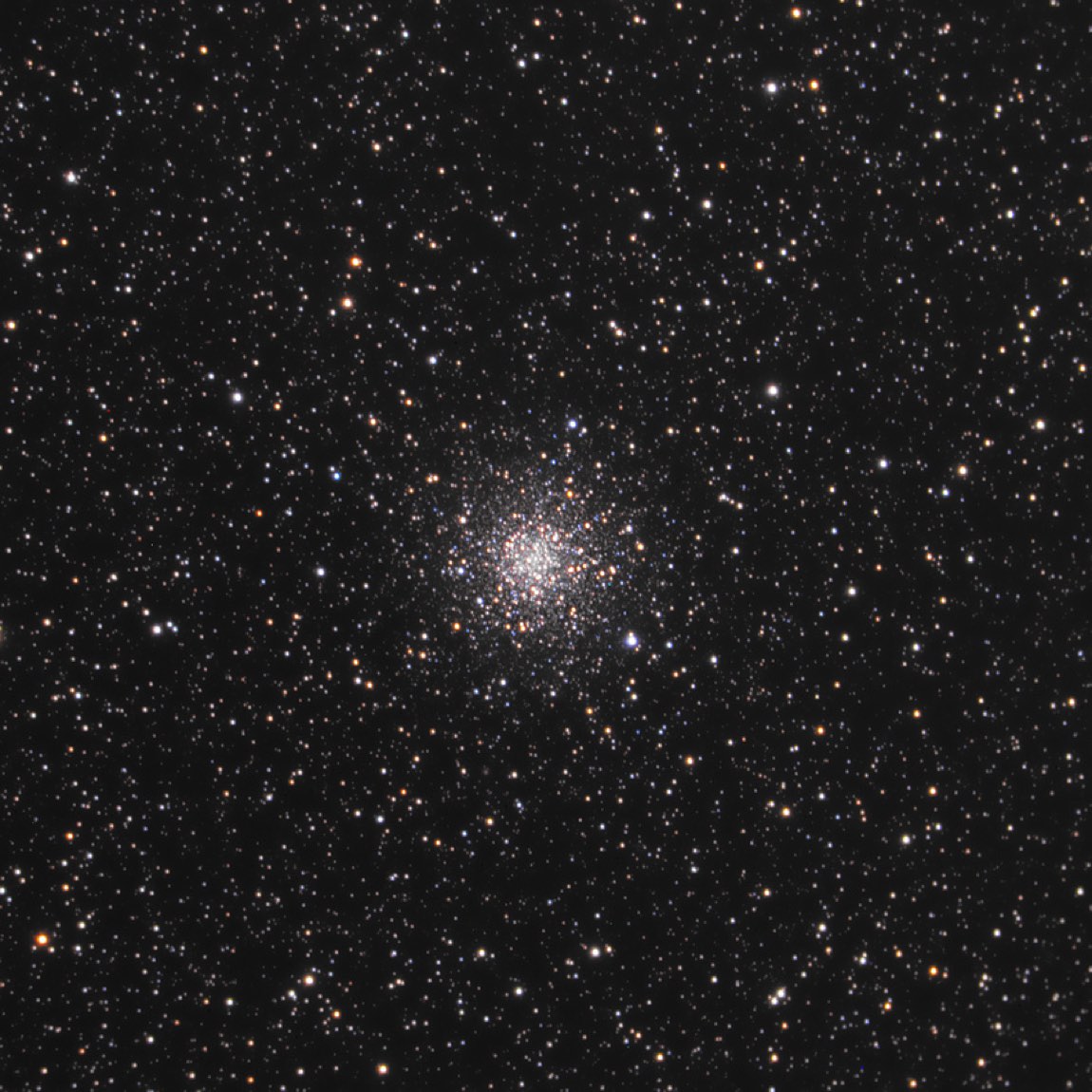
Messier 56 is a globular cluster in Lyra, roughly halfway between the stars Albireo and Sulafat. Charles Messier found it in 1779. Its stars are some of the oldest known, around 13.7 billion years old, and they contain very few elements heavier than helium. The cluster travels backwards (retrograde) around the Milky Way, a clue that it may have been captured when a small galaxy merged with ours. In binoculars it looks like a slightly fuzzy star; a telescope begins to split it into individual stars.
The deep dive
Researched for the Atlas from Wikipedia — Messier 56 (1,858 characters read) · updated Nov 15, 2026
01 Discovered in a single remarkable night
Charles Messier added M56 to his famous catalogue in 1779, making it one of the objects swept up during his systematic search for comets. The cluster sits roughly midway between two well-known stars — Albireo, the colourful double star at the head of Cygnus, and Sulafat, the foot of Lyra — which gives observers a useful star-hop route. Despite its respectable apparent magnitude, M56 is considered tricky to locate even with large binoculars in the 50–80 mm range, where it appears as little more than a slightly fuzzy star. Only a telescope with an aperture of 8 inches (20 cm) or larger begins to resolve individual suns within the cluster, revealing its true globular nature. That difficulty is partly a matter of angular size and partly the cluster's modest central concentration, which keeps it from jumping out of the star field the way a more compressed globular would.
02 A relic almost as old as the universe
M56 carries an estimated age of 13.70 billion years, placing its birth astonishingly close to the Big Bang itself, which occurred roughly 13.8 billion years ago. At that epoch, the universe was a very different place — there had been almost no time for successive generations of stars to forge and scatter heavy elements through supernova explosions. M56's chemistry reflects this antiquity with brutal clarity: its metallicity, the astronomers' shorthand for the abundance of all elements heavier than hydrogen and helium, registers at [Fe/H] = –2.00 dex. That figure means its iron abundance is just one one-hundredth of the Sun's. In practical terms, the stars in M56 formed from gas that was almost pristinely primordial, barely seasoned by earlier stellar generations, making the cluster a preserved sample of the universe's earliest stellar populations.
03 Stolen from another galaxy entirely Deeper
M56 is following a retrograde orbit through the Milky Way — that is, it travels in the opposite direction to the general rotation of the galactic disk. This backwards motion is a powerful clue that M56 did not form within our galaxy. Its properties instead suggest it was acquired when the Milky Way swallowed a dwarf galaxy long ago. Astronomers have linked this event to the Gaia Sausage, the hypothesised remnant of a merged dwarf galaxy whose debris was mapped in remarkable detail by the Gaia space mission. According to this picture, the surviving nucleus of that ancient dwarf galaxy is Omega Centauri — the largest and most massive globular cluster associated with our galaxy. M56 would then be one of the stripped-away satellites that accompanied the doomed dwarf on its final plunge into the Milky Way, a fossil of galactic cannibalism.
04 Size, mass, and place in the galaxy
Spanning roughly 84 light-years from edge to edge, M56 packs approximately 230,000 solar masses into that volume — a city of ancient stars so dense that the night sky viewed from deep inside it would blaze with far more brilliant neighbours than our own solar neighbourhood offers. The cluster sits about 32,900 light-years from Earth, which is well beyond the galactic centre. It is located 31 to 32 thousand light-years (9.5 to 9.8 kiloparsecs) from the Galactic Center and rides 4,800 light-years (1.5 kiloparsecs) above the galactic plane, well into the halo region where the Milky Way's oldest stars and clusters drift. That elevated position, combined with its retrograde trajectory, reinforces the picture of an object that has never truly belonged to the orderly disk of our galaxy.
05 Ploughing through the halo at speed Deeper
M56 is not drifting gently through space. It moves at a relative velocity of about 177 kilometres per second — fast enough to cover the distance from Earth to the Moon in roughly 36 minutes. At that pace the cluster ploughs through the tenuous interstellar medium that fills the galactic halo, and the collision between its gravitational wake and that gas has detectable consequences. In 2000, astronomers tentatively identified diffuse X-ray emission coming from the vicinity of the cluster. The most likely explanation is that the interstellar medium has been shock-heated by the cluster's passage, reaching a temperature of around 940,000 Kelvin — hotter than the outer atmosphere of the Sun. This phenomenon turns M56 into something like a slow-motion bullet moving through fog, leaving a trail of superheated gas behind it.
06 Variable stars hidden inside the cluster Deeper
Despite being an ancient, metal-poor system, M56 contains about a dozen known variable stars, each telling a different story about stellar evolution. The most exotic is V6, classified as an RV Tauri star — a highly luminous pulsating giant that brightens and dims on a period of 90 days. RV Tauri variables are thought to be stars in a late evolutionary phase, and they are rare enough that finding one in M56 makes it a valuable laboratory. V1 is catalogued as a Cepheid variable with a much shorter period of just 1.510 days, potentially useful for distance cross-checks. The cluster also harbours V2, which pulsates irregularly with no predictable rhythm, and V3, which falls into the semiregular category — varying but with only approximate periodicity. The brightest individual stars in the cluster reach only 13th magnitude, still far too faint for the naked eye.
07 How to find and observe M56 tonight
Finding M56 begins with the constellation Lyra, home to the brilliant blue-white star Vega, one of the easiest stars in the summer and autumn sky to identify. From Lyra, the observer tracks eastward toward Cygnus and its famous star Albireo. M56 lies roughly halfway along the line connecting Albireo to Sulafat (Gamma Lyrae), so sweeping that region in binoculars — ideally 50 mm aperture or larger — may reveal a slightly fuzzy, star-like glow. Under a truly dark sky the cluster is achievable with binoculars, but it rewards patience. Pointing an 8-inch (20 cm) telescope at the fuzzy spot begins to separate individual stars from the glow, and larger apertures make the resolution progressively more satisfying. The cluster offers a worthwhile target from northern temperate latitudes during summer evenings.
08 What the Gaia mission revealed Deeper
The European Space Agency's Gaia satellite transformed our understanding of M56's origins by providing the high-precision stellar motions needed to trace the history of objects in the galactic halo. Gaia data underpinned the identification of the so-called Gaia Sausage — named for the elongated, sausage-like shape the remnant galaxy's stars make in velocity space — as the debris field of a substantial dwarf galaxy that merged with the Milky Way billions of years ago. M56 fits within this structure, suggesting its retrograde orbit and extreme age are direct inheritances from its original host galaxy rather than quirks of formation within the Milky Way. The proposition that Omega Centauri represents the surviving nucleus of that merged dwarf places M56 in an extraordinary family of objects, all refugees from the same ancient collision.
09 Open questions astronomers still debate Deeper
Despite decades of study, several aspects of M56 remain uncertain or actively debated. The 2000 detection of diffuse X-ray emission near the cluster was described as only tentative, meaning it has not been conclusively confirmed or thoroughly characterised. If real, it would be a rare example of a globular cluster visibly interacting with the medium around it, but the precise mechanism and geometry of that heating are not fully worked out. The link between M56 and the Gaia Sausage merger event is a hypothesis supported by orbital and chemical evidence rather than a proven fact, and the exact timeline and mass of the original dwarf galaxy remain subjects of ongoing modelling. The classification of some variable stars in the cluster as a Cepheid (V1 with its 1.510-day period) in such a metal-poor environment also raises questions, since metal-poor Cepheids behave differently from their better-studied solar-metallicity counterparts.
 ⤢