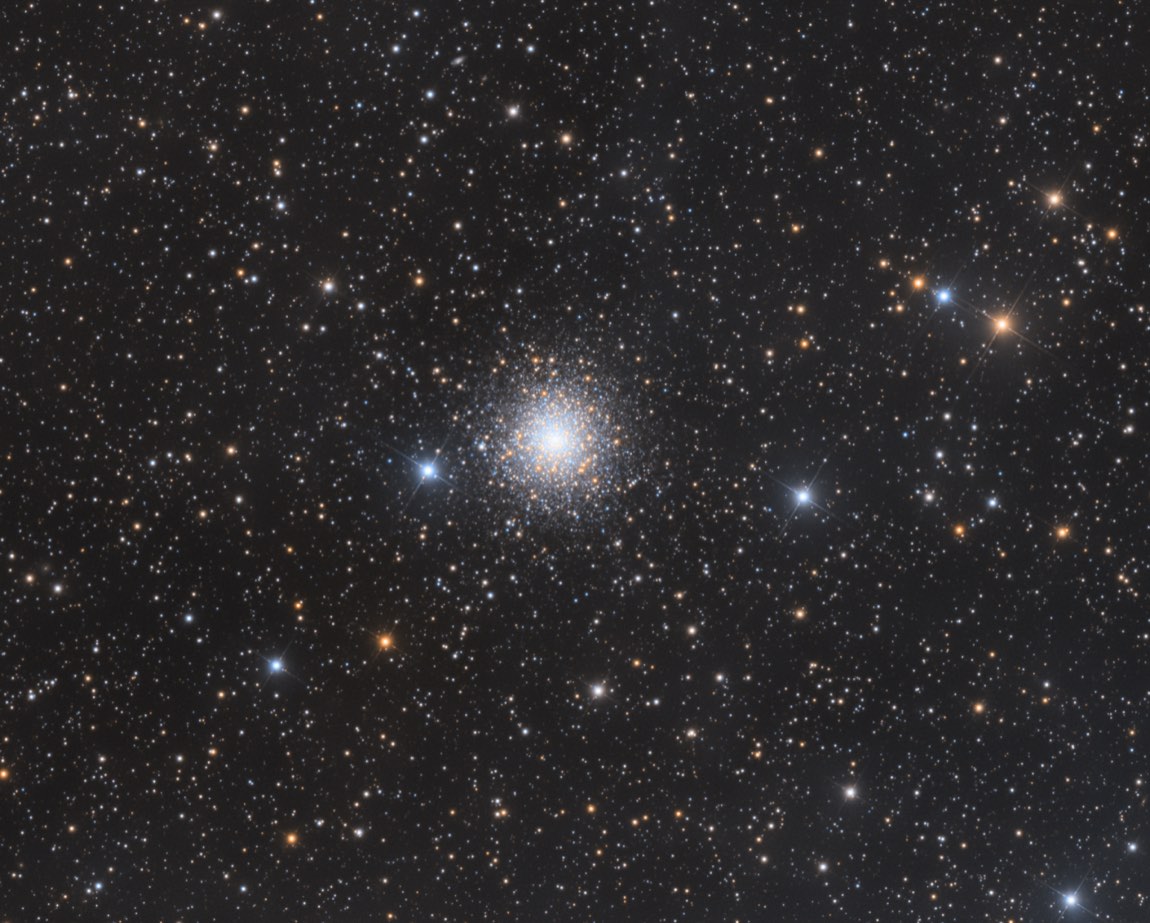
 Photograph · Chuck Ayoub · CC0
Star Cluster · Deep guide
Messier 80
Also called: M80 · NGC 6093
One of the densest globular clusters in the Milky Way, where a nova once outshone the whole cluster.
What is it?
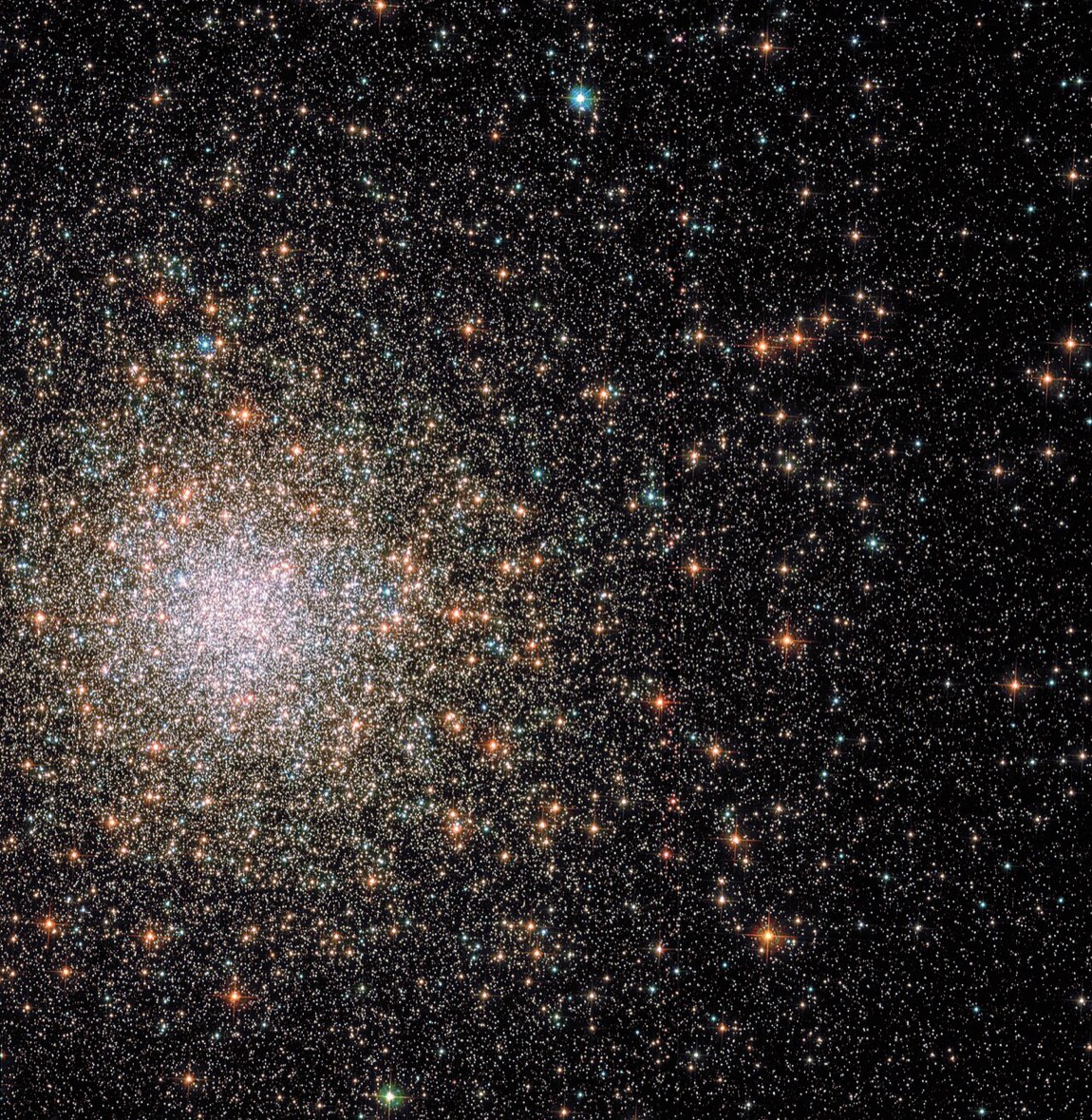
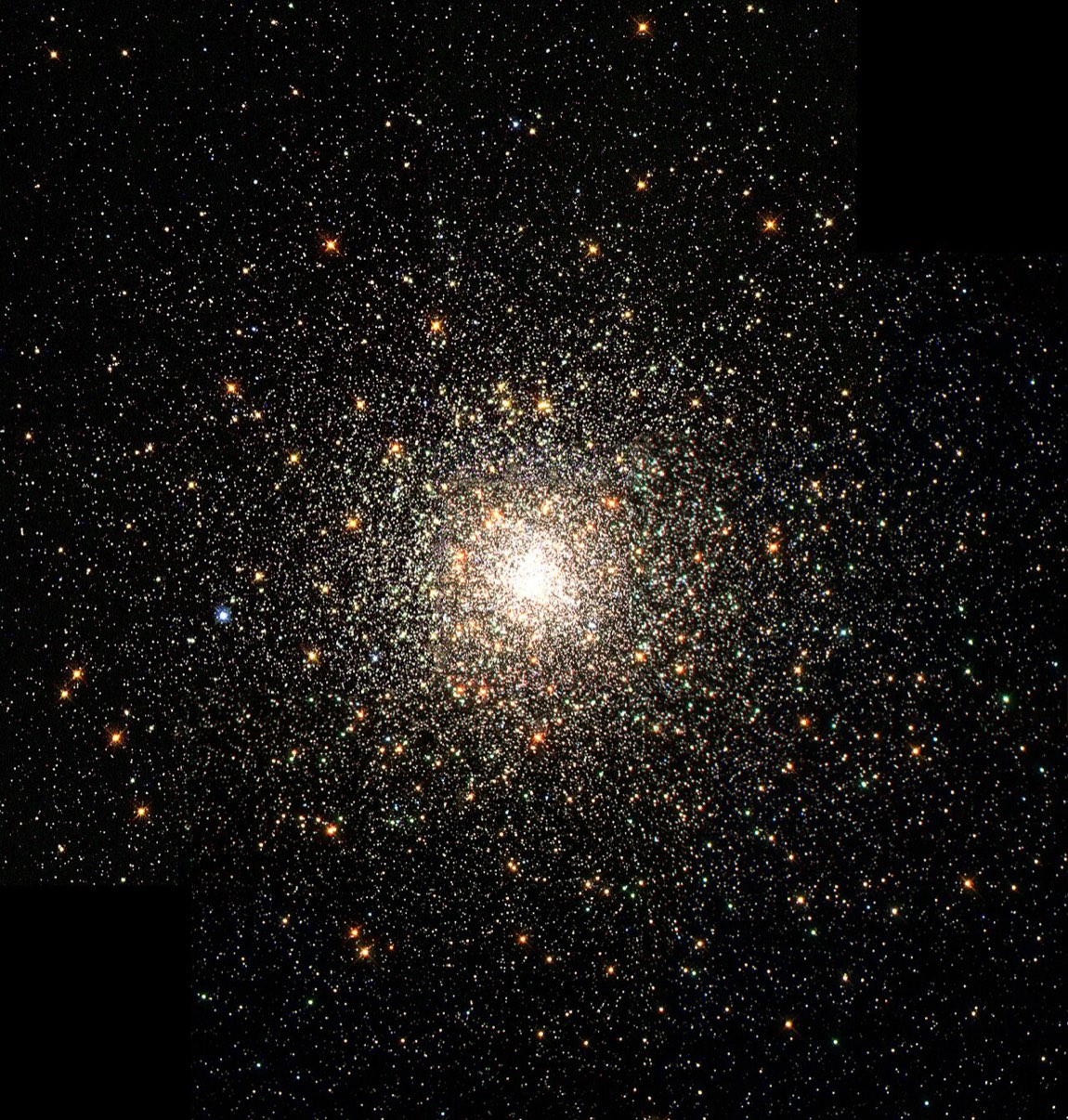
Messier 80 is a globular cluster in Scorpius, between the stars Antares and Beta Scorpii. Messier discovered it in 1781. It is one of the densest globulars in the galaxy, with several hundred thousand stars packed into a ball about 95 light-years wide. Hubble found many blue stragglers in it, stars that look younger than the cluster, probably made when crowded stars merge or collide. In May 1860 a nova, T Scorpii, flared up inside it and briefly outshone the entire cluster.
The deep dive
Researched for the Atlas from Wikipedia — Messier 80 (1,309 characters read) · updated Nov 15, 2026
01 One of the Milky Way's densest star cities
Messier 80 earns its reputation as one of the densest globular clusters in the entire Milky Way. Pack several hundred thousand stars into a sphere only about 95 light-years across and you get a stellar metropolis where stars are crammed together at densities almost impossible to picture from our quiet corner of the galaxy. For comparison, the nearest star to our Sun is about 4 light-years away; inside M80's core, that average separation shrinks dramatically, turning what would be a lonely cosmic neighborhood into something closer to a rush-hour crowd. This extreme crowding has profound consequences for the stars themselves — they jostle, gravitationally tug, and sometimes physically collide, producing exotic objects that a more relaxed cluster would never generate. The cluster sits in the Galactic halo, more than twice as far from Earth as the Galactic Center itself, meaning it orbits far above the busy disk of the Milky Way in a region of much thinner interstellar gas.
02 Where exactly M80 sits in the sky
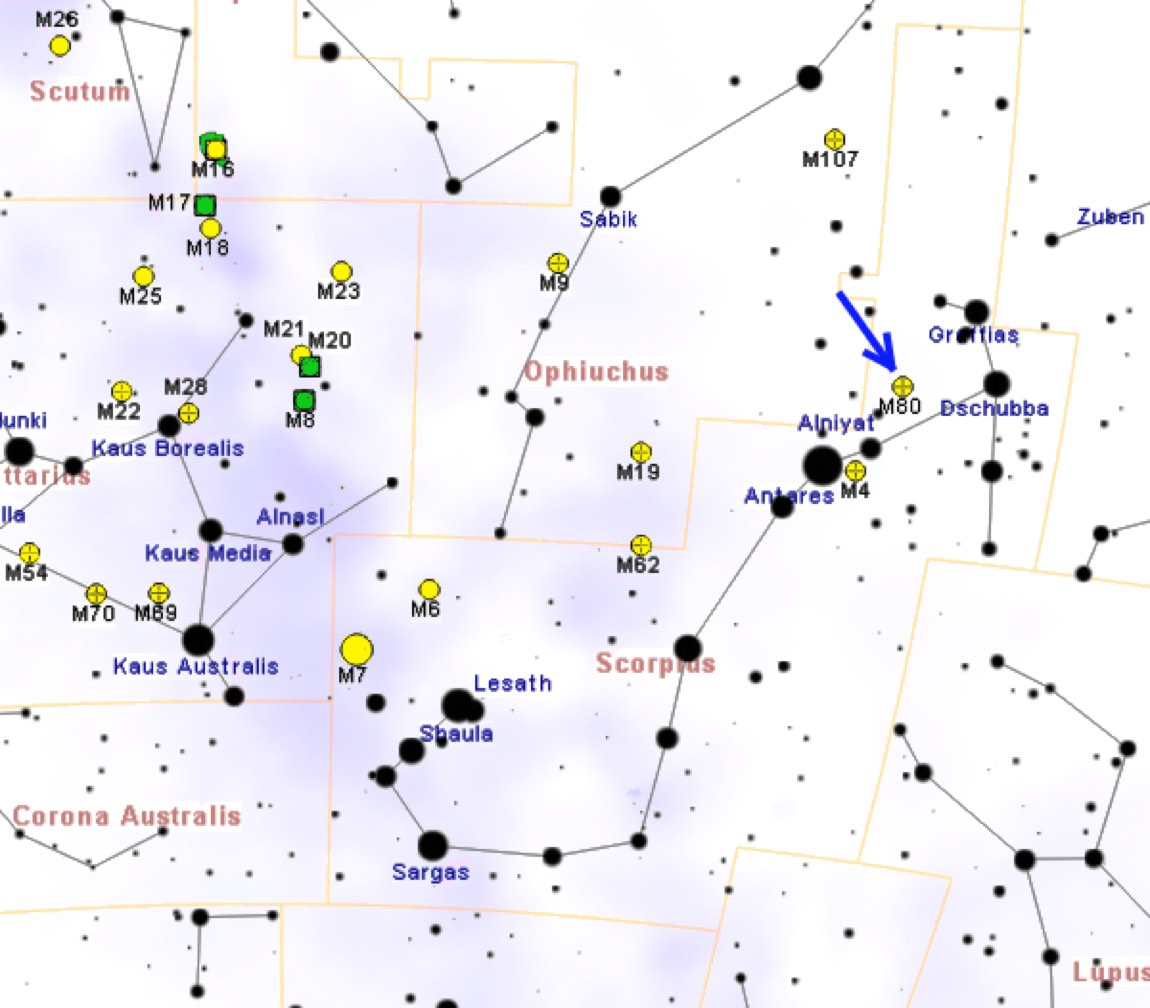
Finding Messier 80 on a star chart is surprisingly straightforward because it lies almost exactly midway between two of the most recognizable stars in the constellation Scorpius: brilliant red Antares, also known as Alpha Scorpii, and Beta Scorpii. That placement in a region the article describes as rich with nebulae makes the surrounding field rewarding to scan even at low magnification. The cluster sits roughly 32,600 light-years from Earth — about 10,000 parsecs — which places it well into the Galactic halo rather than among the star-forming lanes of the disk. Any observer south of the 67th parallel north can catch it with a modest amateur telescope, where it shows itself as a mottled ball of light under dark skies. Its apparent angular diameter spans 10 arcminutes on the sky, which is about one-third the width of a full Moon, large enough to show obvious texture and central brightening even in a small instrument under low light-pollution conditions.
03 Charles Messier's 1781 discovery
Charles Messier logged M80 into his famous catalog in 1781, adding it to a list he originally compiled to prevent comet-hunters — including himself — from wasting time on fuzzy objects that stubbornly refused to move. At the eyepiece of an 18th-century telescope, a dense globular cluster like M80 could easily be mistaken for an unresolved comet at first glance, since both appear as soft, glowing smudges. By cataloging these impostors, Messier inadvertently created one of astronomy's most enduring reference lists. M80 carries the dual designation NGC 6093 from the later New General Catalogue, which systematized thousands of deep-sky objects compiled by later observers. Messier himself had no way of knowing he was looking at several hundred thousand suns bound together by gravity, located more than 32,000 light-years away — the full nature of globular clusters as ancient, gravitationally bound stellar systems would not be understood until well into the twentieth century.
04 Blue stragglers: stars that refused to age Deeper
Among the most scientifically striking features of Messier 80 is its unusually high population of blue straggler stars — objects that appear far younger and hotter than the cluster's other members, seemingly defying the fact that all the stars in a globular cluster formed at essentially the same time. In a normal stellar population of M80's age, stars as massive and blue as these should have already exhausted their fuel and died long ago. Two leading explanations exist for why they persist: either they gained extra hydrogen by merging with a companion star through direct collision, or they siphoned mass from a binary partner over time, essentially getting a second wind. Hubble Space Telescope observations of M80 were key in showing that these blue stragglers are concentrated in distinct regions of the cluster rather than spread uniformly, a spatial signature that points strongly toward frequent stellar interactions or outright collisions driven by the cluster's extraordinarily dense core environment. M80's density makes it an almost ideal laboratory for studying these peculiar rejuvenated stars.
05 The nova that briefly stole the show
On May 21, 1860, something extraordinary happened inside Messier 80: a nova designated T Scorpii ignited, and for a brief period it outshone the entire rest of the cluster combined. The event reached an apparent magnitude of +7.0, bright enough to be detected through telescopes and binoculars despite the cluster lying more than 32,000 light-years away. Even more remarkable is the absolute magnitude the nova achieved: −8.5, an intrinsic luminosity that places it among genuinely powerful stellar outbursts. A nova occurs when a white dwarf in a binary system accretes enough hydrogen from its companion to trigger a runaway thermonuclear explosion on its surface — the white dwarf itself survives, but the blast briefly produces light that can rival or exceed an entire galaxy of stars. The fact that T Scorpii reached naked-eye-adjacent brightness from such an enormous distance underscores just how violent the event was. M80 remains one of a small number of Messier objects with a documented, historically observed nova embedded within it.
 ⤢
06 How the Hubble telescope changed our view Deeper
Ground-based telescopes can resolve the outer regions of Messier 80 into individual stars, but the cluster's dense core remains a nearly unresolvable blur when seen through Earth's turbulent atmosphere. The Hubble Space Telescope changed that by operating above the atmosphere, delivering sharp enough images to pick out individual stars even in M80's congested heart. Those observations were particularly productive for the study of blue straggler stars, revealing not just how many exist but precisely where they are concentrated within the cluster — information that is essential for distinguishing between the collision and mass-transfer formation scenarios. Hubble's ability to detect subtle differences in stellar color and brightness across a crowded field made it possible to build a census of unusual stellar types that simply could not be attempted from the ground. This kind of detailed stellar population mapping in a cluster as dense as M80 represents exactly the science case that motivated building a space-based optical telescope in the first place, and M80 continues to serve as a benchmark object for understanding the physics of densely packed stellar environments.
07 What the cluster's size tells us about its mass Deeper
Messier 80 spans a spatial diameter of about 95 light-years, a measurement that becomes meaningful when combined with its stellar count of several hundred thousand stars. That combination implies a remarkable average stellar density throughout the volume, but the density is far from uniform — globular clusters like M80 are strongly centrally concentrated, meaning the core packs stars far more tightly than the outer halo. This central concentration is a natural consequence of a process called core collapse, where energy exchange between stars causes the heaviest members to sink toward the center while lighter stars migrate outward. M80's reputation as one of the densest globular clusters in the Milky Way suggests its core has undergone substantial concentration over its lifetime. The cluster's location in the Galactic halo, more than twice as distant as the Galactic Center, also means it experiences relatively modest tidal forces from the Milky Way compared to clusters that orbit closer in — allowing it to retain more of its outer stars rather than having them stripped away by the galaxy's gravity.
08 Observing M80 with your own telescope
Messier 80 is accessible to amateur astronomers across most of the inhabited world, since it can be observed from any location south of the 67th parallel north. Its apparent angular diameter of 10 arcminutes gives it a substantial apparent size, and under dark skies it shows up as a bright, mottled ball of light — the mottling being the first hint that this glow is composed of countless unresolved individual suns rather than glowing gas. Even modest amateur telescopes reveal its notably bright and concentrated core, with brightness fading gradually toward the edges. Larger apertures begin to resolve individual stars in the outer regions, transforming the smooth glow into a sparkling, three-dimensional-looking sphere. The cluster benefits from its convenient sky position midway between Antares and Beta Scorpii, making star-hopping to it straightforward. Because Scorpius rides low on the horizon for observers at mid-northern latitudes, the best views come when the constellation is highest in the sky during summer evenings, minimizing the thickness of atmosphere through which light from M80 must travel.
09 M80's neighborhood: a region rich with nebulae
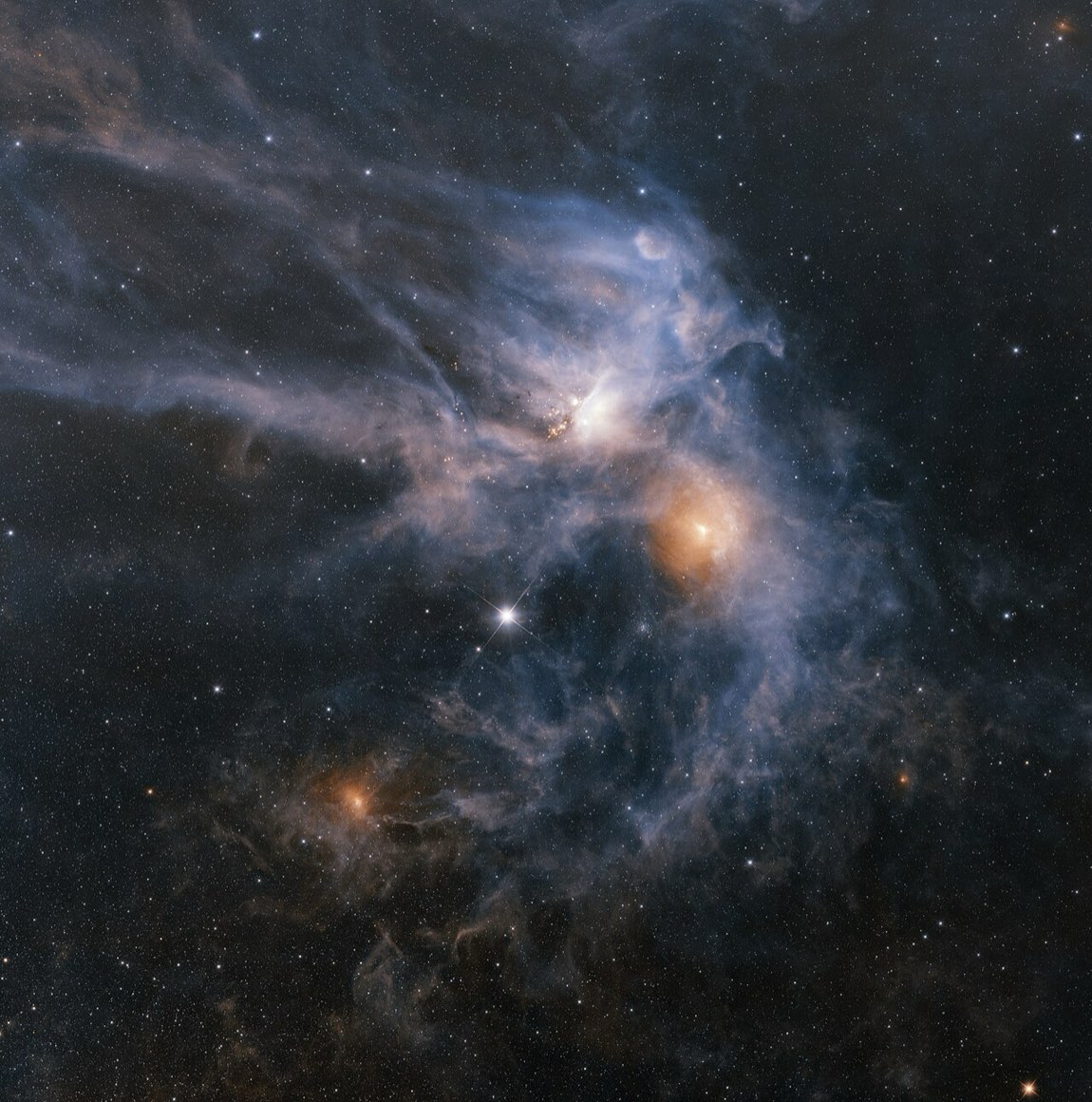
The patch of sky containing Messier 80 is not empty space between the guideposts of Antares and Beta Scorpii — the article describes it as a region rich with nebulae, making the surrounding field scientifically and visually interesting in its own right. Antares itself, Alpha Scorpii, is one of the largest and most luminous red supergiant stars visible to the naked eye and is embedded in its own associated reflection nebula. The broader Scorpius-Ophiuchus region is one of the nearest active star-forming complexes to Earth, filled with dust lanes, emission nebulae, and young stellar clusters that contrast sharply with ancient M80 behind them. While M80 is a background object far beyond these local structures — sitting at 32,600 light-years compared to the star-forming regions at a few hundred light-years — the visual coincidence places a snapshot of the very old and the very young side by side in the same field of view, offering observers an accidental but compelling illustration of the full stellar life cycle in a single sweep of the eyepiece.
 ⤢