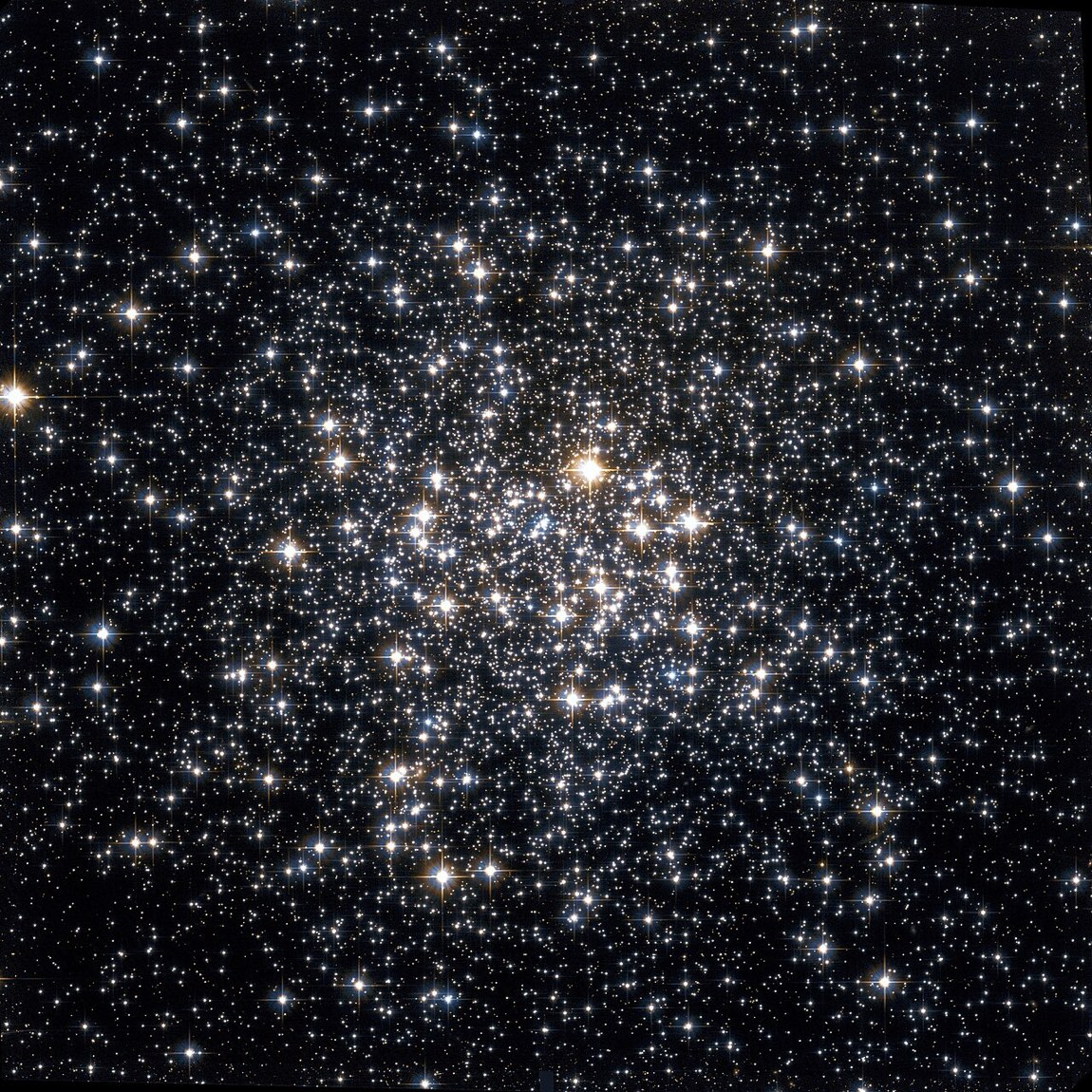
 Photograph · Credit: ESA/Hubble & NASA, S. Anderson et al. · CC BY 4.0
Star Cluster · Deep guide
Messier 62
Also called: M62 · NGC 6266 · Flickering Globular Cluster
The Flickering Globular: one of the heaviest, brightest star balls orbiting the Milky Way.
What is it?
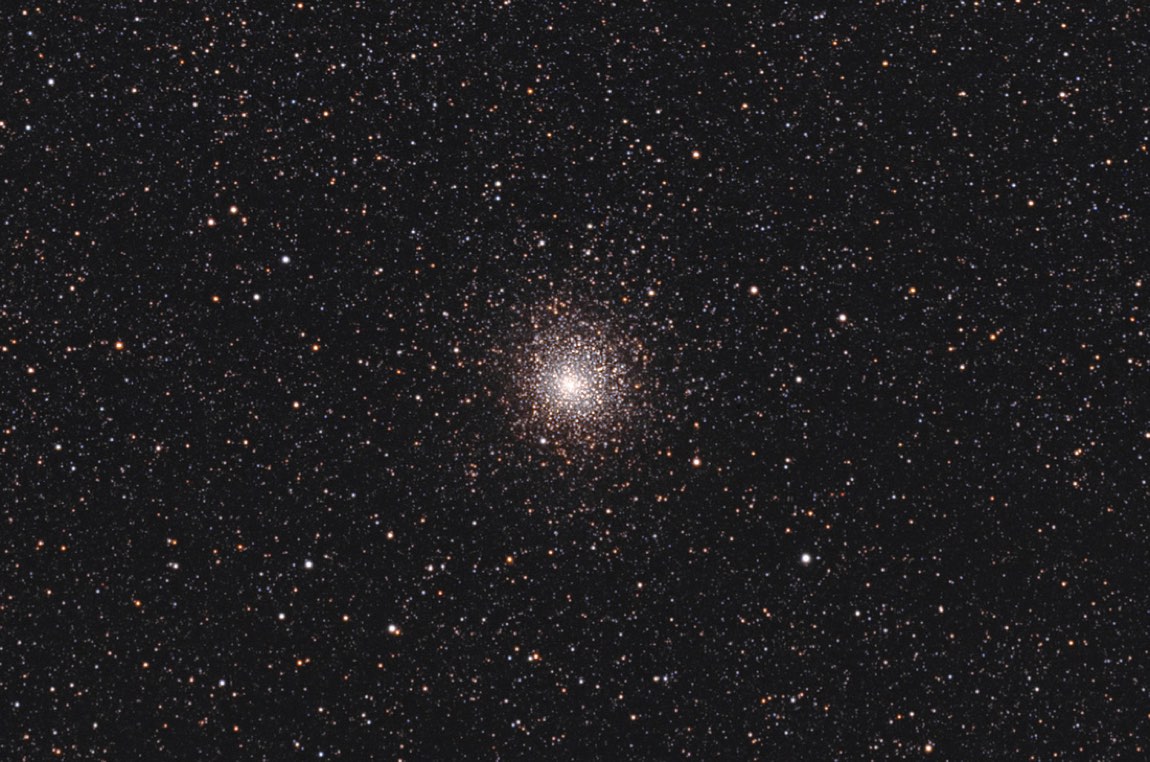
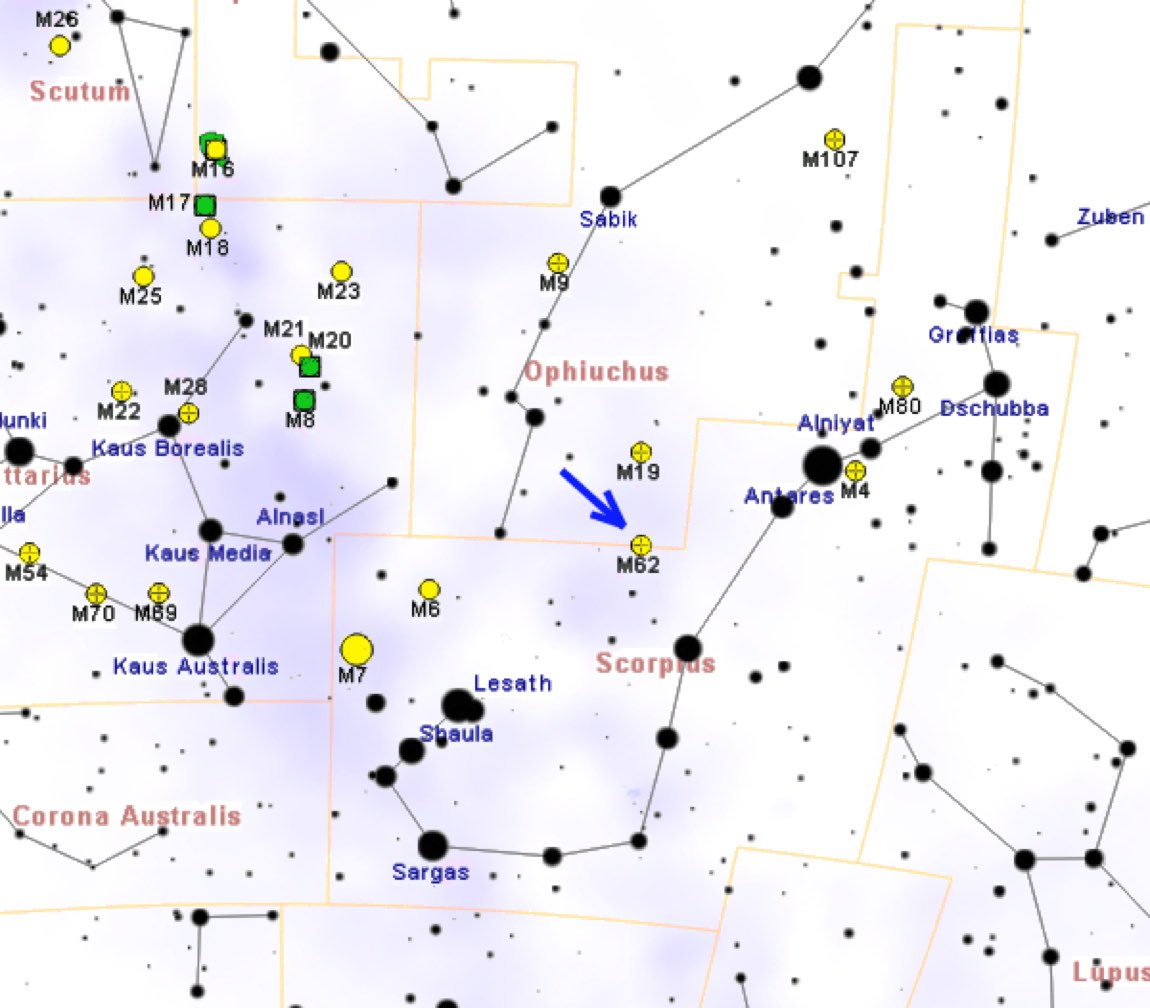
Messier 62 is a globular cluster in southern Ophiuchus, close to the centre of our galaxy. Messier discovered it on 7 June 1771. It is among the most massive and luminous globular clusters in the Milky Way, holding about 1.2 million Suns' worth of stars in a nearly perfect sphere. Its stars come in at least two generations: the second formed from gas enriched by the first. A 2010 study counted 245 variable stars in its field, most of them RR Lyrae stars that pulse with clockwork regularity.
The deep dive
Researched for the Atlas from Wikipedia — Messier 62 (2,763 characters read) · updated Nov 15, 2026
01 Discovery and a Name Born from Chaos
Charles Messier stumbled upon this cluster on 7 June 1771, adding it to the running list that would eventually bear his name. It became the 62nd entry when his catalogue was formally published eight years later in 1779. The nickname "Flickering Globular Cluster" is not purely poetic — it reflects something genuinely unusual about M62's stellar population: the cluster is extraordinarily rich in variable stars, objects whose brightness shifts measurably over time. A 2010 study catalogued 245 variable stars within the cluster's field, a count so high that researchers now suspect M62 may prove to be the richest globular cluster in the entire Milky Way in terms of RR Lyrae variables alone. With 209 confirmed RR Lyrae variables already on the books, alongside four Type II Cepheids, 25 long-period variables, and one eclipsing binary, that flickering reputation is well earned. Few clusters of any kind can match this density of pulsating and variable stellar light.
02 An Extreme Address in the Galaxy
M62 sits about 21,500 light-years from Earth, but its more striking address is its distance from the Galactic Center: only 5,500 light-years. For context, our entire solar system lies roughly 26,000 light-years from that same center, making M62 more than four times closer to the galaxy's heart than we are. That proximity to the dense, gravitationally intense core of the Milky Way almost certainly shapes the cluster's character — higher rates of stellar interactions, greater tidal stresses, and an environment rich in older, metal-processed material. The cluster resides in the southern part of the constellation Ophiuchus, low in the sky for many northern-hemisphere observers, which has historically made detailed study more challenging. Its integrated absolute magnitude in the V band is −9.18, placing it among the most luminous globular clusters the Milky Way harbors.
03 Size, Shape, and Internal Architecture Deeper
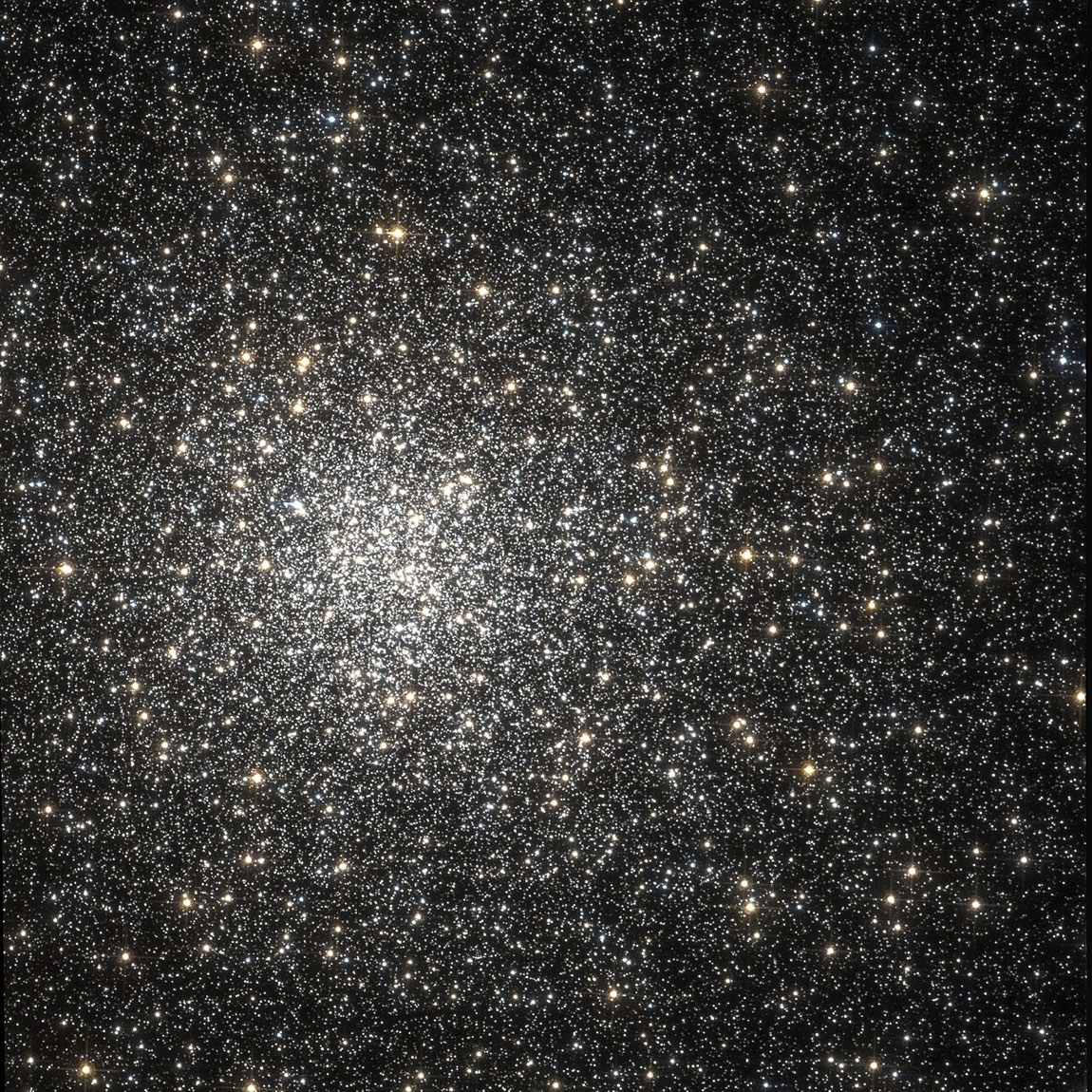
Despite being one of the Milky Way's most massive globular clusters, M62 is very nearly a perfect sphere — its projected ellipticity is just 0.01, essentially zero. Its internal structure can be described by a set of nested radii. The core radius, the region where stellar density begins to taper noticeably, is only 1.3 light-years (0.39 parsecs) across. The half-mass radius — the sphere containing half the cluster's total mass — extends to 9.6 light-years (2.95 parsecs), while the half-light radius, the sphere enclosing half the total emitted light, is 6.0 light-years (1.83 parsecs). At the outer boundary sits the tidal radius of 59 light-years (18.0 parsecs), the theoretical limit beyond which the galaxy's gravity would strip stars away. The stellar density in the core reaches 5.13 solar masses per cubic parsec — an intensely crowded environment where stellar collisions and close encounters are genuinely common occurrences.
04 Two Generations of Stars, One Cluster
M62 carries within it a layered chemical history. The cluster shows at least two distinct populations of stars, most likely the product of two separate episodes of star formation occurring at different times. Among the cluster's main-sequence stars, 79 percent (plus or minus 1 percent) belong to the first generation, while the remaining 21 percent (plus or minus 1 percent) make up the second. That second generation is chemically enriched by material shed by the first generation of stars as they aged and died. The chemical fingerprints of this enrichment show up clearly in the abundances of helium, carbon, magnesium, aluminium, and sodium, all of which differ measurably between the two populations. This two-generation structure, now documented in many globular clusters, is one of the central puzzles of cluster formation: how a single gravitationally bound system can produce two chemically distinct cohorts of stars, apparently from different reservoirs of gas.
 ⤢
05 Millisecond Pulsars: A Cosmic Timekeeping Record Deeper
M62 hosts ten binary millisecond pulsars, an impressive tally for any single globular cluster. Millisecond pulsars are neutron stars spun up to extraordinary rotation rates — hundreds of times per second — by accreting matter from a companion star. Because globular clusters encourage the kind of close stellar encounters and binary interactions that produce such systems, they tend to be disproportionately rich in millisecond pulsars. Among M62's ten, one designated M62B is particularly dramatic: it shows eclipsing behavior caused by gas streaming off its companion star and periodically blocking our line of sight to the pulsar. Another, M62H, has an even more remarkable distinction — it has a confirmed exoplanet orbiting it, with a mass roughly three times that of Jupiter. Finding a planet in such an ancient, densely packed, radiation-intense environment challenges assumptions about where planets can survive long-term.
06 Has the Core Already Collapsed? Deeper
Many old globular clusters have undergone what astronomers call core collapse — a process where the inner stars progressively lose energy through interactions and sink toward the center, creating an extremely dense, nearly point-like core. M62's density profile tells a different story: the distribution of its member stars suggests it has not yet undergone core collapse. Its core radius of 1.3 light-years, while small in absolute terms, is consistent with a cluster that still has a resolved, extended core rather than a collapsed singularity of stars. The cluster's mass-to-light ratio of 2.05 ± 0.04 also provides a tool for probing its internal dynamics. Whether M62 is on a trajectory toward eventual core collapse — and on what timescale — remains an open question tied closely to how its massive objects, including the binary millisecond pulsars and any central black hole, redistribute energy through the system.
07 The Hunt for a Hidden Black Hole
One of the most compelling open questions about M62 is whether its core hides an intermediate-mass black hole — a class of object with a mass in the thousands to tens of thousands of solar masses, sitting between ordinary stellar-mass black holes and the supermassive monsters at galactic centers. M62 is considered particularly well-suited for this search. A brief pre-2013 study of the proper motion of stars within 17 arcseconds of the core found no compelling requirement for an intermediate-mass black hole to explain the stellar dynamics. However, computer simulations cannot rule out the existence of one with a mass of a few thousand solar masses lurking in the cluster's heart. For comparison, Kiselev et al. in 2008 made a similar claim for the cluster M15, also citing an object with a mass in the range of 1,000 to 9,000 solar masses. The debate remains genuinely unresolved.
08 X-ray Sources and Exotic Stellar Remnants Deeper
Beyond its pulsars, M62 is a productive source of X-ray emission. The cluster contains multiple X-ray sources, with at least 50 detected within the half-mass radius alone — a sphere of only 9.6 light-years. X-ray sources in globular clusters typically include accreting neutron stars, cataclysmic variables where a white dwarf feeds on a companion, and in some cases, black hole binaries. The sheer density of these sources within M62's compact interior reflects the cluster's high rate of stellar interactions: when stars pass close enough to form new binary systems or disrupt existing ones, exotic end-products accumulate over billions of years. The concentration of X-ray sources within the half-mass radius rather than spread through the full tidal volume also suggests that the heaviest remnants have sunk toward the center through gravitational mass segregation, as expected for a cluster of M62's age and density.
 ⤢
09 Blue Stragglers: Stars That Refused to Age
Among M62's stellar population, 47 blue straggler candidates have been identified. Blue stragglers are stars that appear younger and bluer than the other stars at their position on the Hertzsprung-Russell diagram — in a cluster of similar-aged stars, they stand out like teenagers at a retirement community. The leading explanation for their existence, confirmed in many clusters, is that they form from the merger of two stars in a binary system: when the two partners spiral together and combine, the resulting object has more mass and therefore burns hotter and bluer, mimicking a younger star. Crucially, M62's blue stragglers are not randomly scattered through the cluster — they are preferentially concentrated near the core region. This spatial bias is exactly what gravitational mass segregation would predict: the heavier merged stars sink toward the gravitational center over time, leaving the outer regions depleted of these objects.
10 Metal-Rich Chemistry and Stellar Classification Deeper
M62 is classified as an Oosterhoff type I system, one of the two broad categories used to group globular clusters by the properties of their RR Lyrae variable stars. Oosterhoff type I clusters are characterized as "metal-rich" — meaning their stars contain relatively higher proportions of elements heavier than hydrogen and helium compared to Oosterhoff type II clusters. In stellar astronomy, the term "metals" encompasses every element heavier than helium, from carbon and oxygen all the way up to iron and beyond. A higher metal content is generally associated with a younger formation epoch, since heavy elements are built up progressively by successive generations of stars living and dying across cosmic time. The chemical enrichment already documented between M62's two stellar generations is consistent with this picture: the second generation is measurably richer in helium, carbon, magnesium, aluminium, and sodium than the first, a direct record of nucleosynthesis happening within the cluster's own history.
11 How to Observe M62 from Earth
M62 carries an apparent visual magnitude that places it within reach of binoculars under dark skies, though its southerly position in Ophiuchus makes it a low target for observers in mid-to-high northern latitudes — the cluster never climbs far above the horizon for much of Europe or northern North America. Southern-hemisphere observers have a considerably better view. The cluster is catalogued under both its Messier designation (M62) and its NGC number (NGC 6266), and either label will locate it in planetarium software or star atlases. Its essential spherical shape and compact angular size mean that modest amateur telescopes will show it as a soft, unresolved glow, while larger apertures begin to resolve individual stars at the outer edges. The concentration of variable stars within the cluster makes it a productive target for time-series photometry projects, and professional surveys have used it precisely for that purpose to build the extensive variable-star census that now defines its identity.
 ⤢