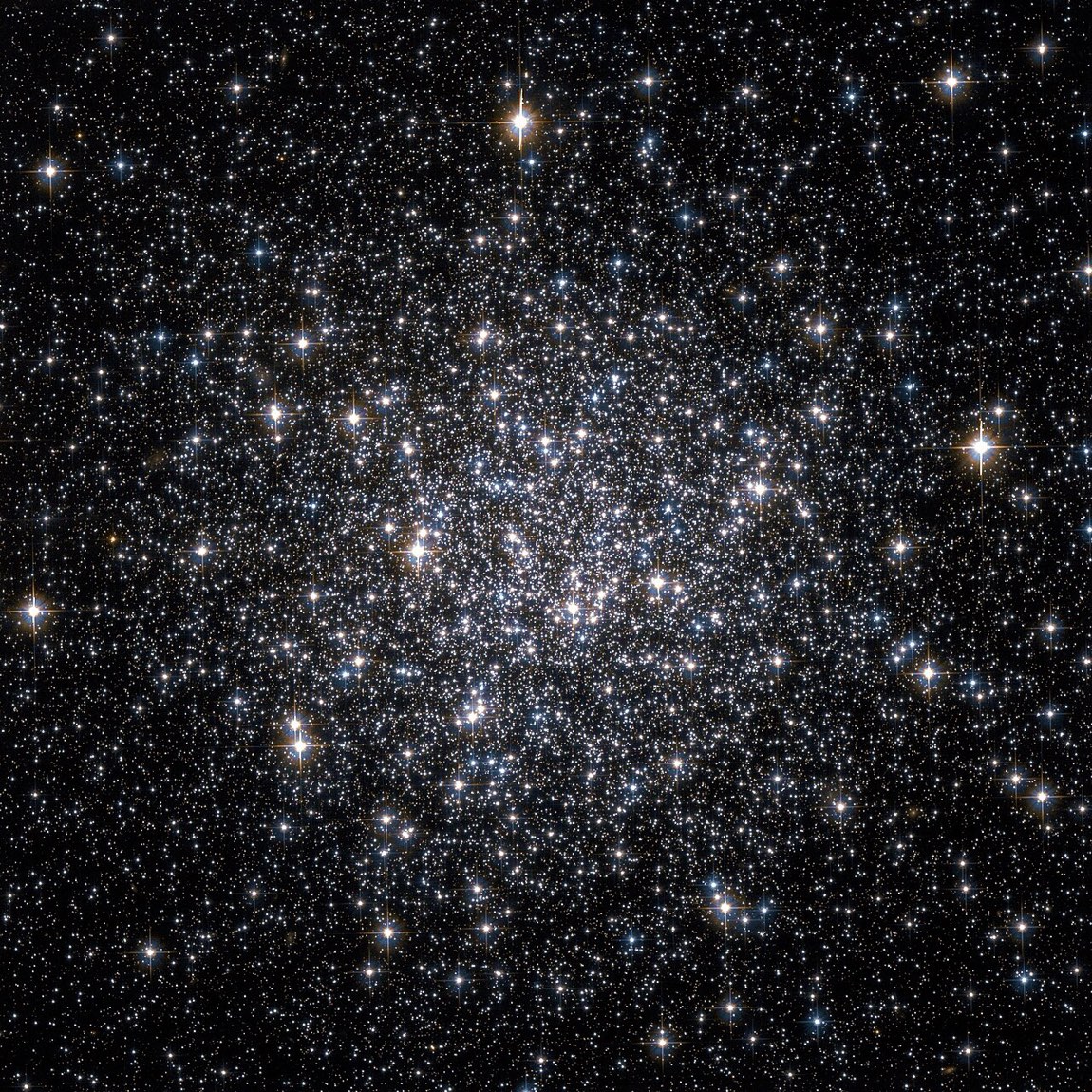
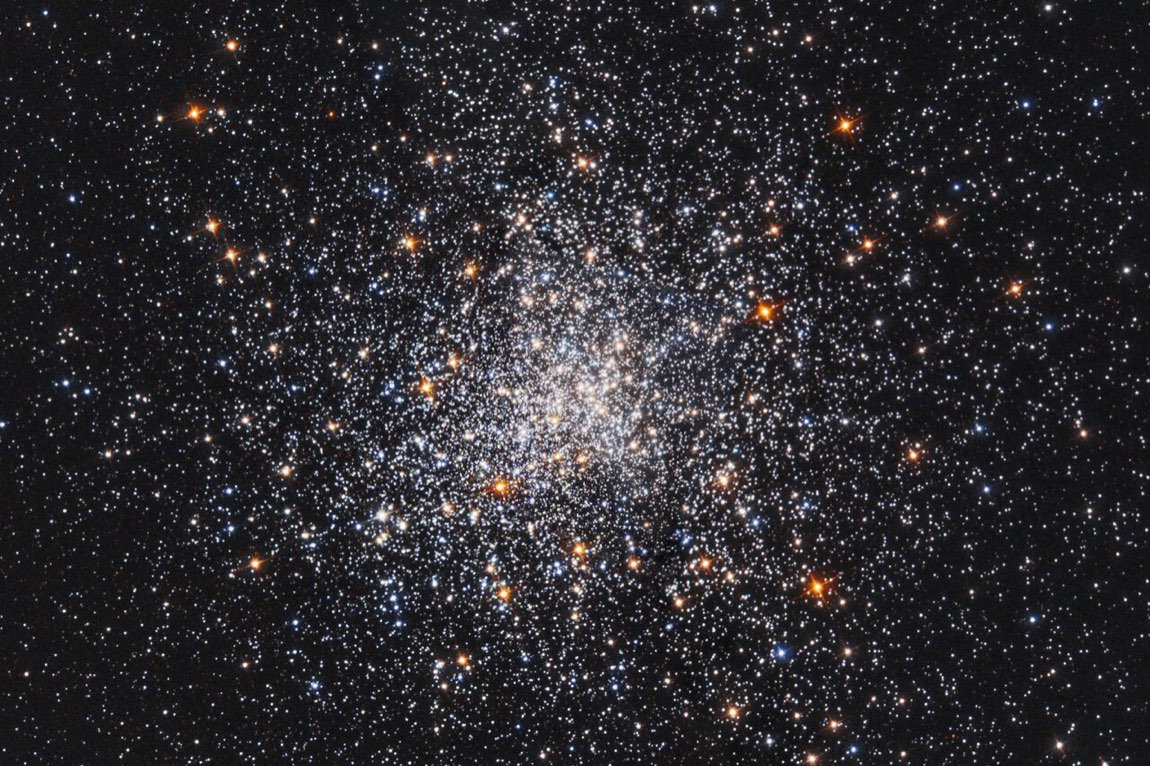
 Photograph · NASA and ESA Acknowledgement: S. Djorgovski (Caltech) and F. Ferraro (University · CC BY 4.0
Star Cluster · Deep guide
Messier 79
Also called: M79 · NGC 1904
A winter globular in Lepus that may be an immigrant from another galaxy.
What is it?
Messier 79 is a globular cluster in the southern constellation Lepus, found by Pierre Méchain in 1780. It lies about 42,000 light-years from Earth and about 60,000 light-years from the galaxy's centre. Some astronomers think it came from the disputed Canis Major Dwarf Galaxy or from the Gaia Sausage merger rather than forming in the Milky Way. Our galaxy's gravity is pulling it apart, drawing out a long tail of stars.
The deep dive
Researched for the Atlas from Wikipedia — Messier 79 (1,738 characters read) · updated Nov 15, 2026
01 A Cluster That Came from Somewhere Else
Most globular clusters orbiting the Milky Way are thought to have formed alongside our galaxy billions of years ago, but M79 is a suspected interloper. Astronomers believe it originated not in the Milky Way at all, but in the Canis Major Dwarf Galaxy — a small companion galaxy currently undergoing a very close encounter with our own. As the dwarf galaxy is gravitationally torn apart, its globular clusters, including M79, are being deposited into the Milky Way's halo. Messier 54 is the only other globular cluster on Messier's famous list suspected to share this extragalactic origin. If the hypothesis holds, M79 is essentially a refugee from a galaxy in the process of being cannibalized — a dramatic reminder that the Milky Way has grown partly by consuming smaller neighbors. This makes M79 scientifically extraordinary, offering a window into the stellar populations of an entirely different galactic system.
02 The Canis Major Debate Is Far from Settled Deeper
The claim that M79 came from the Canis Major Dwarf Galaxy carries a significant caveat: astronomers are still actively debating whether that dwarf galaxy even exists as a distinct object. The Canis Major structure was proposed as a galaxy, but some researchers argue that the overdensity of stars in that direction is better explained as a warped or flared part of the Milky Way's own disk, rather than a separate accreted galaxy. Because M79's extragalactic origin depends entirely on the reality of the Canis Major Dwarf Galaxy, its immigrant status remains genuinely uncertain. The article is careful to describe the Canis Major Dwarf as "putative" — meaning presumed but not confirmed. This is an honest reflection of where the science stands: the idea is compelling and widely discussed, but it has not achieved consensus. Future astrometric surveys and chemical abundance studies may eventually resolve whether M79 is a true outsider or simply an unusual native cluster.
03 Could M79 Be a Piece of the Gaia Sausage? Deeper
Beyond the Canis Major hypothesis, M79 may belong to yet another ancient accretion event: the Gaia Sausage. The Gaia Sausage — named for the sausage-shaped distribution its stars trace in velocity space — is the remnant of a large dwarf galaxy that merged violently with the early Milky Way. The collision was so energetic that it deposited stars and star clusters deep into the galactic halo in highly radial orbits. If M79 is associated with this event rather than with the Canis Major structure, its history would stretch back to one of the most dramatic episodes in the Milky Way's formation. These two hypotheses are not necessarily mutually exclusive, but they point to very different progenitor galaxies. Deciding between them requires precise measurements of the cluster's chemical fingerprint and three-dimensional motion, the kind of data that modern observatories are only beginning to provide in sufficient detail.
04 Its Position: Far from the Galactic Center
M79 sits roughly 42,000 light-years from Earth and approximately 60,000 light-years from the Galactic Center. That second number is especially telling. Most globular clusters crowd the inner halo and bulge region of the Milky Way, which is why the majority of them appear in the direction of the constellation Sagittarius. M79, by contrast, sits in the constellation Lepus — in almost exactly the opposite part of the sky from the galactic core. Its vast distance from the Galactic Center, 60,000 light-years compared to Earth's roughly 26,000 light-years from the center, places it in the outermost reaches of the halo. This unusual positioning was one of the early clues that M79 might not have formed in the same way as typical Milky Way globular clusters, since there is relatively little to anchor a cluster so far from the galactic core unless it arrived from outside.
05 Tidal Tails: The Galaxy Is Pulling It Apart
M79 is not simply drifting peacefully through the halo — it is being actively disrupted. The gravitational tidal force of the Milky Way stretches the cluster along its direction of motion, peeling stars away from the cluster's leading and trailing edges. This process has already produced a long tidal tail streaming behind M79. Tidal tails are essentially rivers of stars escaping their parent cluster, and over billions of years they can carry away a substantial fraction of a cluster's original mass. In M79's case, the disruption is a consequence of its orbit through the Milky Way's gravitational field. The same galactic tide that sculpts spiral arms and distorts satellite galaxies is slowly dismantling this ancient stellar system, star by star. Identifying and mapping the full extent of that tidal tail helps astronomers reconstruct the cluster's orbit and, ultimately, trace where in the sky it originally came from.
06 Pierre Méchain and the Discovery of M79
M79 was discovered by the French astronomer Pierre Méchain in 1780, the same productive era during which Charles Messier was compiling his famous catalog of nebulae and star clusters. Méchain was one of Messier's most trusted collaborators, and many of the catalog's later entries came directly from Méchain's observations. The eighteenth century offered no way to determine what M79 truly was — it would have appeared as a faint, slightly fuzzy patch of light through the telescopes of the time, indistinguishable in appearance from a comet in its early stages, which is exactly why Messier cataloged such objects: to help comet hunters avoid false positives. The underlying nature of M79 as a gravitationally bound sphere of hundreds of thousands of ancient stars, possibly stolen from another galaxy, was entirely beyond the reach of 1780 astronomy. It would take two centuries of increasingly powerful instruments to reveal that background.
07 Reading M79's Stars with Infrared Light Deeper
Astronomers have analyzed M79 using near-infrared imaging in the J and K wavelength bands, producing a color-magnitude diagram that reveals the cluster's stellar population in striking detail. In that diagram, brightness in the J band is plotted against the color difference between J and K, allowing stars of different temperatures and evolutionary stages to be separated cleanly. The analysis reveals three distinct regions of the Hertzsprung-Russell diagram present in the cluster: the low-mass end of the main sequence, the complete red giant branch, and the horizontal branch. Infrared light behaves differently from visible light when tracing these populations — the lower main sequence appears shallower, while the horizontal branch becomes steeper, with its blue end appearing fainter and its red end appearing brighter than they would in optical images. This wavelength dependence is not a quirk but a physically meaningful tool, since different stellar temperatures radiate most intensely at different wavelengths.
08 Red Giants Dominate the Bright Population
When you look at M79's color-magnitude diagram, the dominant feature among the cluster's brightest stars is an elongated stripe called the red giant branch. Red giants are evolved stars that have exhausted hydrogen in their cores and expanded dramatically — they can be tens to hundreds of times wider than the Sun and much more luminous, which is why they stand out so clearly even across tens of thousands of light-years. The fact that most of M79's bright stars are red giants is consistent with the cluster being very old: in an ancient stellar population, the more massive stars that were once the brightest main-sequence members have long since evolved off the main sequence, leaving the lower-mass stars and their evolved descendants — red giants and horizontal branch stars — to dominate the light budget. The cluster's age is therefore written directly into the shape and position of its color-magnitude diagram.
09 Sorting Cluster Stars from Foreground Imposters
Not every star that appears in M79's direction of the sky actually belongs to the cluster. Some stars plotted in the color-magnitude diagram, particularly those extending away from the red giant branch toward the upper left of the diagram, are foreground stars — objects lying between Earth and M79 that happen to fall in the same line of sight. These stars are physically unrelated to the cluster; they just appear in the same images by coincidence. Identifying and excluding them is an important step in analyzing the true stellar population of any globular cluster. Because foreground stars have different distances and are not bound by the cluster's shared chemistry and age, they scatter across the color-magnitude diagram in ways that betray their nature. Specialized software for crowded-field photometry, designed to handle the dense star fields typical of globular clusters, makes it possible to rapidly process these images and flag likely non-members.
10 How to Find M79 in the Night Sky
M79 resides in the constellation Lepus, the Hare, which crouches just below the more prominent constellation Orion. This placement makes it unusual among Messier globular clusters, the vast majority of which concentrate toward the summer sky in and around Sagittarius, near the galactic center. M79 is instead a winter object from the Northern Hemisphere, best observed in January and February when Lepus rides high enough above the horizon. Its apparent magnitude makes it detectable with binoculars as a faint, fuzzy point, but a small telescope will begin to show its globular nature. Larger amateur telescopes under dark skies can resolve individual stars around the cluster's edges. Its southern declination means it rewards observers at lower latitudes with higher, cleaner views, though northern hemisphere observers can still observe it successfully when it transits.